Paris > Marseille by train is 3:08, not 4:00.
Nice writup, thanks for sharing.
I don't typically check the byline before I start reading, but Gopnik always gives himself away. This one set a record.
I can't help but feel that many people who now work remote and therefore don't need to commute suddenly are all for moving to mass transportation...that other people will use to get to work.
By this logic, since planes can cover longer distances in shorter times than trains, should we quit trains in favor of planes?
People want good public transportation, and they recognize that they aren't going to get it in a car-centric society
My family live a 30 minute drive away, however there are no buses that go directly there. No trains, either.
I would appreciate more public transport, for sure, we absolutely need that as well. More, higher-quality public transport that is ideally available 24 hours.
But nobody is ever going to build that from my front door to my family's. The best I can hope for is to reduce the number of changes I have to make. Right now it would take a bus to the nearest town, another bus to another town in sort of the right direction, another bus to the town center nearest to my family, and then another bus to get me to a street 15 minutes walk away. Even if that drops to two buses, my car will still simply be faster & more convenient.
Quitting cars in cities is a fine goal -- when commuting into cities I tend to get a bus or a train rather than drive, but for everybody that doesn't live in a city, or travels outside of cities, it's simply not possible to get rid of cars. Sheltered personal transport, which largely comes in the form of cars, is not going to go anywhere.
The key change of the last few years has been very successful and very high profile car-free / car-light policies, most notably in Paris.
[1] https://www.theguardian.com/cities/2015/may/05/amsterdam-bic...
I feel fortunate to make enough money to easily afford the rent, but it's insane that in most places you need a high paying job to escape needing a car. Refugee and low-income housing here is clustered around major streets like six-lane one-way transport corridors. Unless they work downtown or close to a stop on one of the few bus lines that run frequently and reliably, they need cars. Usually the cheapest they can afford, which likely means they need to spend money they don't have to get them passing emissions tests at registration time, deal with breakdowns, high insurance premiums, etc.
It doesn't help that most of the planned transit improvements seemingly are focused on greenification of buses rather than just getting more buses on the road to expand routes, make lines frequent enough to use for commuting, etc.
My city did pass some new zoning codes which heavily cut back on parking requirements, I'm excited to see how that (slowly) pans out. I expect more high-capacity parking structures to go up, fewer surface lots. People might need to walk further or explore other last-mile options, I have hope that will turn people's eyes towards non-vehicle transportation improvements.
Additionally the cost to own a newly acquired new or used car has substantially increased over the past few years.
edits: infrastructure, private
Much of our housing shortage is directly due to parking minimums and its resulting tacit ban on high-density housing.
The problem is we don't live near Euston station, it would take about 1.5 hours to get to Waterloo then maybe 30 minutes to get across London on the underground. With two small children and the stuff they require for a week it would be excruciating. When we get to the other end we wouldn't have a car to visit the family members were traveling to see and realistically would have to rent a car.
I've done the journey by train more times than I can count, both when I was single and before we had kids. I would be happy to do it again but the cost is easily 5x what it would be to just drive and is far less flexible.
As for someone that's been "anti-car" for quite some time, I'm not sure why it's suddenly exploded. But I think lots of people enjoyed the cities more with less traffic during covid, and realized the streets can be made for the people, not metal boxes on wheels.
One other factor is global increase in house/rental prices. Seeing your local government prioritize parking instead of housing, or NIMBYs blocking new development, has angered lots of people and they're now taking action. Or cities spending billions on adding yet another lane to their 26 lane wide highway while the public transportation is famished.
Also, with people feeling the rising cost of living etc, it's easy for people to look for ways to remove what is a huge chunk of their spending: their car.
Additionally, lots of great contents the later years. Strongtowns, NotJustBikes etc is orange pilling lots of people that have already started to be curious about these issue. Driven by memes from fuckcars etc, it's become a movement.
Surprisingly good article, thank you for posting it.
I got the sense that Gopnik is aware there may be places in the country outside of New York and Los Angeles — that he has a vague awareness about a sort of middle area where people might not live in apartments or be within a fifteen minute walk of everything in their life. Now, he never actually mentions this liminal space between the coasts, but it seems like he's inferred its existence based on the persistent popularity of cars. I appreciate someone with that kind of perspective writing for the New Yorker.
However, people very often are taking the plane instead of the train, partially because it's cheaper, and partially because on paper it looks faster.
So... maybe?
Here’s a better theory: because American public transit is, when compared with the alternatives, not safe, not clean, and not convenient. Take LA, probably the most car-dependent big city in America. Riding the bus or subway in LA is not an enjoyable experience. Nor is it enjoyable to walk around the areas where the stops are. If I were trying to get more people to use public transit, I’d start by making the stations and buses/subways beautiful, clean, safe places that are just nice urban places to hang out in. There’s no need to make it a moral crusade; just offer a better product and more people will use it.
what you get is people parking on the sidewalk
what you get is people leaving garbage bins out all week to "protect" their spot
what you get is legit road-rage level violence over people blocking driveways or protecting spots or leaving cars parked too long
people have cars, they need a place to put them, even in fantasyland
Only by traveling to places that were developed before cars took a chokehold on the world can people realize how nice it is to live without them absolutely everywhere.
Many Americans get a taste of that when they vacation to Europe. They often choose to leave their suburb and spend their 2 weeks in urban environments like Barcelona, London, Munich, Paris, Rome, etc., that where built for people and not cars, because it's so pleasant to live like that, and because letting cities develop for people first leads to cities that people actually want to be in, with car-free streets, plazas, promenades, etc. (Yes, today those places are also full of cars. But, unlike American cities, their skeletons are people-first and cars are the invasive element.)
It could be argued that so many problems of American life - weight gain, loneliness, fracturing of the social fabric - stem from how we've isolated ourselves in unwalkable suburbs, where there's no spontaneous social interaction because everyone's always in a car, and where our only exercise is the walk from the parking lot to our desk.
What's depressing is visiting developing countries and seeing them start to ape the worst of American car life. Places like Colombia, which I visit often, are building shopping malls, big-box stores, parking lots, suburbs, and freeways, while after almost 100 years of that type of car-first development in America we're only just starting to realize that actually it might not be that great.
Then you need to factor the fact that airports are not often in easy to reach places. (exception: LCY and JFK). That applies to both ends. The times stack up very rapidly.
In theory it's 2hrs to Birmingham from Copenhagen, but that trip will take approx 5hrs when you factor in all the "early arrive" and last mile shenanigans.
Can't say why the movement picked up exactly, just like everything, there are cycles, and after decades of building highways all over our cities and realizing how bad the situation got and how it never really "solved" traffic, there's just a return to a different way of planning cities.
I'd imagine the spike in car prices over the past couple of years contributes as well. A car is an expensive investment that eats a huge part of your income just so you can participate in society, and I'm sure plenty of people feel the pain of this.
The solve for is one or more of these:
1. Make cars cheaper, but various market and regulatory forces seem to be conspiring against that
2. Make cities cheaper so you can move to good transit, but housing isn't in great supply there
3. Make public transit better and broader so more people can use it, but this faces opposition from people in the suburbs and exurbs who have car-centric assumptions baked into their lifestyle
1 is a multilayered problem with a lot of entrenched interests, so it's hard to solve. 2 and 3 are persuasion issues first and foremost, and the persuasion battle can be a lot more localized. So it doesn't surprise me that people are fighting those battles.
EDIT: Napkin math plus some searching said it's about $9,000 a year to own and operate a car on average. $750/month to participate in society. That's 8 annual fares for Pittsburgh's public transit, by way of comparison.
Another related topic: we should not change cars all 3 years. Why not drive them 20-30? Get replacement parts when needed, get the interior freshed up every 15 years and be happy. With the rising of electric cars, the only really critical part has become the batteries (and they seem to last longer than what we all thought).
Theories all mention urban population growth putting people closer to stuff and friends who are available to run errands since it’s not a one hour one way trip from ruralandia. Taxi/ride share, delivery services, increased investment in walkable neighborhoods… it’s all really happening?
Old numbers I read a while ago. I imagine wfh has made more people realize the same only occasional need for a car.
Similarly drop off in youth participation in contact sports like football was gaining steam before covid. A contraction in college and pro participation is probable in 10+ years.
Especially as AI generated content gets to be able to simulate unique sports with photorealistic visuals; most viewers are at home already.
Propping up the status quo culture of the last 50 years is not really an obligation of future generations.
I wonder if this would have been the case had cars stayed as diminutive as they were becoming in the mid 70's.
"If this harmful, expensive thing isn't free, a few people will steal it."
"Better make it free forever then, and force all of society to pay for it, whether they use it or not."
This is nice, but you absolutely must recognise that the amount you're paying for your car does not begin to match what it costs the country for you to have a car.
Road infrastructure is heavily subsidised by the tax payer.
If you had to pay 3x more to operate your car, would you be more or less likely to be in favour of bolstering public transport?
Population density is definitely a factor, and private vehicle ownership should always be possible. But the sheer size of our current personal vehicles and the tiny amount we pay vs their actual cost to society needs to be addressed.
You can probably lose one.
When the wife and I left the Bay Area for the midwest we kept only one car. It simplified moving and if we needed another we could get one in the midwest.
Soon we'll have been a single-car family for two years.
- Ability to get a vehicle on-demand (say within 5-10 minutes) 24/7/365, anywhere in Upstate NY, from cities to boonies.
- That vehicle would need to allow me to transport large goods, bulky goods (to an extent), lumber <6', flammable solvents
- also needs to accomodate 2 medium dogs
- I'd need dedicated bike lanes to the nearby shops and groceries before I could even attempt to use that as an option. There's stores only a few miles from me but the roads to get there are treacherous
There's more but those are the bare minimums, and I don't see that changing any time soon.
The TGV (high speed train) between Paris and Marseille takes 3 hours and ten minutes, not four hours. The distance is 780 km or 480 miles. The distance between Baltimore and Boston is ~410 miles (660 km).
I got into running after college and lived in a borough where things were walkable and some decent landmarks were no more than two miles away. Things felt close, and accessible. I went home for Thanksgiving once and realized that, while there were plenty of things that were kind of in range (grocery store ~2.5mi, shopping mall ~3mi, mini-golf ~1.5mi), the fact that it all ran through that highway made everything feel far, and it was never feasible to do anything but drive.
And I'm not even sure the solve needs "make my hometown area dense"! But if you had protected bike lanes on the highway and made everyone slow down a bit to let pedestrians through, that could be a massive improvement for everyone.
Now that people are working from home, it might not be necessary for suburban families to have two cars. I would know, I've been one-car for over four years now I think. Additions like walking paths and bike lanes and better bus access can make a huge difference and can save thousands of dollars a year on vehicle costs.
Seeing tons of videos online of interactions on the New York subway system, I can say that I have no interest in that form of transportation. The recent drama about Penny/Neely is just one of many such interactions you can find on the subway. I can link dozens of videos of insane, disturbing interactions that take place on the NY subway to which I would never subject my family.
If we somehow create subways that are as clean, safe, and convenient as those in Japan I would probably consider using it, but until then I will definitely be pro-car.
That isn’t the case in America, where riding the bus absolutely has a low social status. So I think making public transit more of a prestige product (safe, clean, well-designed, etc.) would help break that and make it more socially acceptable for middle and upper class people.
There’s tons of work todo and new potential colleagues in our neighborhoods. Nurses and teachers could quit and start local collectives.
But the grind and exploitation of hustle culture and bloated adminispheres seems so normal no one can see around it.
So, in your case, you only really need to make more to afford a walkable lifecycle if you still want to own a car and have the option to use it to drive to places outside of your walking distance. Of course, completely moving to a lifestyle where all travel is public trasit and airport-based is tough to achieve, but it could be a worthwhile price to pay depending on how often you travel and where (since the time investment is also high for cars in the U.S. with how far apart each city is from the next).
0: https://www.bankrate.com/loans/auto-loans/average-monthly-ca...
1: https://www.bankrate.com/insurance/car/average-cost-of-car-i...
My sister and I watched day-time game shows on days when we were stuck inside during the Summer months as kids in the mid 1970s. Even as kids we knew when watching The Price is Right that the first digit in the price of a new car was a "3".
(Oh, forgot to mention the price of a new car was also only four digits.)
I know, I know, that was nearly five decades ago....
The United States sat out the HSR revolution. China built 26,000 miles in the past 20 years. The US has essentially nothing.
Personally, I think the creation of China’s subway system is even more impressive.
https://en.wikipedia.org/wiki/List_of_metro_systems#:~:text=....
Trains (most of the time) are a bit better in that regard because stations are more plentiful and often closer to where people want to be.
Cars, bicycles, and feet (mostly in that order; depending on infrastructure, it may be faster to get into your car than to hop on pot your bicycle) are even better.
Speed wise, it’s reversed. If there are no obstructions, speeds are feet < bicycle < car < train < jet plane.
That means that, only looking at trip duration, the detour to an airport and from the destination airport only is worth it for fairly long trips. Similarly, walking can be faster than cycling if you don’t have to go far, cycling can be faster than taking the car, etc.
Unfortunately, people also take trip costs into account, and those often are cheaper for air planes, compared to trains.
So, to ‘quit’ cars, we have to make it easier for people to go to a train station or to hop onto their bicycle and/or have to make it more difficult to hop into their car.
Banning on-street parking, requiring car drivers to walk a few hundred meters to a parking garage cuts multiple ways there. Using less space for parking allows for higher density, which leads to shorter travel distances, and increases the time to hop into one’s car.
The VTA train smells of pot and the CalTrain often smells of sewage. Periodically there are crazy people yelling on the VTA and regularly there are people having could-have-been-an-email loud conferences calls on CalTrain.
I really like trains and dislike car dependent cities. But it’s hard for me to walk-the-talk when it’s so unpleasant so consistently.
I spent yesterday travelling around Greater London using only public transport, coupled with quite a lot of (fairly brisk) walking ... my phone said my day involved 20591 steps and 98 heart points.
When you don't have access to a car, you have to think quite differently about mundane things like going to a supermarket.
"Where is the closest supermarket to my current location" for the car user becomes "where is any supermarket which is close to a public transport stop I can readily reach from my current location" which I find isn't handled nearly as well by all our favourite mapping services. Things like fares and fare zones become of interest, not just raw distances and traffic on routes.
> There’s no need to make it a moral crusade [..]
Unfortunately there seems to be no broad agreement on exactly how you make places "beautiful, clean [and] safe" if they aren't.
I can't imagine what you mean here by individual transportation. Could you explain a bit more?
https://www.radroutenplaner-deutschland.de/veraDNetz_EN.asp
Should I choose public transport, it is ubiquitous and very cheap (even free for some people). Fast and slow trains, streetcars, some subways and buses, but most importantly frequent and with total coverage by law if I remember correctly, no one can be more than 500m from a public transport stop. Even in the countryside you can take public transport everywhere: I have visited rural areas entirely by train and even a farmhouse by bus with a short walk. This is typical European lifestyle at least for the wealthier northern continental countries.
https://www.german-way.com/travel-and-tourism/public-transpo...
There is a downside, however. Everyone - that is everyone except the very rich and those in the countryside - lives in an apartment. An apartment which, even by lower class American standards, is tiny, dark, grungy, often ridden with mold, and with non-existent amenities. For the price I pay in rent, including exorbitant utility costs, I could get a much nicer place anywhere outside the coastal elite urban cores. My fellow software developers, who are paid far above average for German engineers (or even doctors here) are in the same boat. Tiny and grimy is the norm:
https://www.immobilienscout24.de/Suche/de/berlin/berlin/wohn...
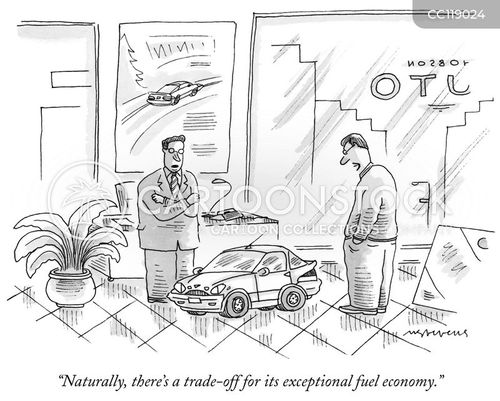
What I wish I saw less of in the car/transit debate was moralizing, and what I wish I saw more of was engineering tradeoffs. You can try to have cars and houses and transit and high salaries and (relatively) low taxes and what you get is NYC or SF - a playground for the rich and a dystopian hellscape for the average middle class worker. If you make transit ubiquitous and affordable with affordable housing and restrictions on cars you get everyone in tiny accommodations, the kind of mass single family home communities and even NYC townhomes and billionaire skyscrapers would never be approved by German town planners. Engineering tradeoffs, which can mean many tiny cars you never see sold in the USA:
https://lowres.cartooncollections.com/shopping-auto_dealer-c...
Let's have more discussion on the tradeoffs, and maybe we can find solutions of which Larry David would say:
"You're unhappy. I'm unhappy too. Have you heard of Henry Clay? He was the Great Compromiser. A good compromise is when both parties are dissatisfied, and I think that's what we have here."
Monthly parking in Manhattan is $1000/month. If you want a car, you gotta pay for the space it takes up. We could be using that space for better things.
People parking on the sidewalk? Great! Tow them and fine them, and now the city has another source of revenue.
Apart from Uber or hitching a ride from a friend, there's no good transportation option to our airport but I get your point. I think in most cases, given the option between a walkable (to work and restaurants) neighborhood and no car (and no good public transit), and suburbia with a car, most people would choose suburbia. Ease of getting groceries, ease of access to recreation, etc. What's really missing is the transit investment.
Old cars are a Prius for interstate trips, and an early 2000s Outback for camping/interstate trips where we need to bring more things with. Prius got severely damaged in our parking lot and I used the insurance payout to help with a down payment on a Crosstrek, which will eventually replace the Outback as well.
I feel bad for taking up the (free) parking space, but the cost of ownership of the Outback when infrequently used is something like a $40 insurance premium every six months. That's another benefit of not driving much -- low mileage and safe driver insurance discounts.
I think in the USA, pre-existing airports have reduced demand for HSR. The US has airports in almost every city with more than 500k people, while that is definitely not true in China (even still).
So all those cities/countries where public transport is not clean and safe have to just copy - for instance - Singapore or China?
Q: What's stopping them?
That's what I mean about lack of broad agreement.
Pittsburgh used to have a vibrant rail and trolley system. Most American cities that were established before cars did. It's absolutely workable, it's just a question of priorities.
> part immaturity
Explain please?
> degrowth mindset
Not inherently. For many it's just a question of where people want the growth to be, and which modes of transit get priority.
I live about 30 minutes from Pittsburgh in an area that could be called rural (or at least a rural-feeling part of a suburb), and 80% of where I need to travel more or less happens on a straight line of road that follows the Ohio River. There's no inherent reason why that must be a highway instead of a railway.
I have bus stops that are about a mile and three miles away; if one of those was also a train station it would vastly cut down on the amount of driving I'd have to do. I'd enjoy that greatly!
The former is fine, since it's an improvement to society. The latter is not fine, since it's a worsening of society.
Agree however that some of their subway systems are their most impressive engineering feat and prove that they could have done a better job with their HSR.
You don't have to. It's a recommendation. The only true "have to" is that you have to be at the gate before the scheduled end of boarding, which is usually 15 minutes before takeoff.
    Public transit is now the cause of the reforming classes,
    and the car their villain. The car is the consumer economy
    on wheels: atomizing, competitive, inhuman—and implicitly
    racist, hiving people off to segregated communities—while
    the subway and the train are communal zendos. Good people
    ride bicycles and buses; bad people ride in ever-bigger cars.
Another surprise:
    People always maintain, similarly, that the big auto
    manufacturers killed L.A.’s once efficient public-transit
    system, leaving the city at the mercy of polluting and
    gridlocked cars. That this is, at best, a very partial
    truth does not weaken its claim on our consciousness.
This was in Amsterdam Schipol.
And I also distinctly remember being unable to drop my bag at EWR for being "too late" to do so.
Always better to be early, so people will factor that in.
And to those who are in the small minority who don't use it, would you also ask childless couples to pay for schools? Or people never intent on flying to pay for airports?
That is indeed a universal thing when you have bags to check. I just don't consider that a "have to" since you don't have to check a bag to fly.
That’s an opinion, not a fact. IMO, the negative effects for society of it being easy to hop into their cars for so many are plentiful. Cities get worse, the environment is worse of and the population gets less healthy.
I live in a dense city. I have a grocery store next door. I have car sharing cars in my street I can rent. This is feasible, because we're so many people within a few minutes walk. In a suburb this is impossible. Would be far too few people per shop or car.
You're kinda part of the problem talked about in an other comment here: you can't even visualize how things could be different. Basically you could only give up your car if you could live exactly as before..
But why can't your lumber get delivered? Do you need a car with huge dimensions just for the off chance you one time the next five years need to carry something big? Why not then rent something for the occasion?
Why do you constantly need to drive your dogs? Again, the reason is probably rooted in a car centric society. The solution isn't to fix all your needs, just without owning a car. The solution would be to make you able to do your hobbies and live your life without the gigantic sprawl.
We do.
> people never intent on flying to pay for airports?
We also do.
I think the point I'm making (broadly) is that it appears cheap because a lot of that cost has been bundled into taxes, and spreading taxes over an entire population of people (even those not using roads directly) is going to dilute those costs.
The incidental point then; is that you are not actually paying the entire amount for your usage of the road system.
Heck even if you were to make the argument that "everyone uses the roads" or that everybody at least benefits indirectly: your use of them is adding to wear and tear that is disproportionate to your input to that system.
Please understand that this is not meant as an attack. It's a request to shift your perspective into truly internalising the cost, since you're already paying that cost but not directly; how much would you have to pay directly before you consider changing your mind? How much better do the transport options need to be?
Personally, and I don't require everyone to share my view of course, but living in reach of multiple transport options that are quick, cheap, clean and frequent has really changed my life.
I'm not a heavy drinker, but it's really freeing to not worry about my ability to drink. or to worry about parking, or worry about theft or damage, and also to not worry about getting into a collision (especially when it could just as easily be my fault). It feels extremely liberating. I also understand that cars give similar feelings of liberation in other areas (until you want to drink or park).
So it really is more about understanding convenience trade offs; and really I'm not happy to hear "it's cheap" because honestly; it's not. You're just heavily subsidised.
*I say "perceived safety," because vibes seem to matter more than actual safety. Like, the stats on car wrecks, drunk driving, distracted driving, and so on are alarming. But when I think of someone concerned about "safety," I imagine someone being uncomfortable around people they feel are sketchy.
That said, I currently find myself in a suburb, and bicycling is actually okay. I can bike out of my neighborhood to reach the main streets, and there are actually pretty decent bike commuting paths once I reach them. If you're wanting to haul things like pets and lumber, recent cargo e-bikes can haul a lot. They're expensive, but they exist if that's a priority for you. I think bicycles can be a pretty decent option for people in the suburbs, at least sometimes. Plus, bikes are just fun!
That said, using my car less is a big goal for me, so I sometimes take the less convenient option. My longterm goal is to find a way to leave the suburbs and live in a city, though, so I can be much less card-dependent.
What I don't like about this is that people (even urbanist bloggers) tend to form their opinions on their experience as tourists, while reality is much more nuanced and full of tradeoffs.
Case in point: I once visited my friend in Bilbao and the one thing I couldn't get over was that despite this being a beautiful, walkable, full of life city jobs were hard to come by and low-paid. Youth unemployment in particular in Spain stands at a whopping 46%.
Appealing to their moral side seems... perhaps necessary, because it seems a vocal minority simply do not want multi-family housing in their neighborhood at all. Look at the pushback by NIMBYs at city meetings across the US when anything like somewhat dense housing is proposed: right off the bat, I have literally never heard of any community collectively saying, "this sounds reasonable." I would be happy to be proven wrong.
Instead, it's pushback after pushback, claiming everything from character of the neighborhood to shadows from a tall building (even if the building is only 5 stories high, and most buildings in the neighborhood are 3 stories tall).
There's also conspicuously rare talk from those NIMBYs claiming what they do want. Instead, at the start of a project, it's always vague, "well not THAT many units!" or "well the traffic will get SO much worse!"
I've never seen specifics like, "We need 30 units or less in this proposal because of reason X and Y." Instead, it's just negotiation trying to get it as low as possible. Basically, trying to pull up the ladder as much as possible to minimize people moving to the area to folks who can afford a fairly expensive single family home.
Any single family home is fairly expensive now it seems these days, across the USA, relatively to the area it's in.
It's depressing, and I'm not sure how to get people to change those attitudes.
One thought: have people attend these meetings who are not yet residents of the neighborhoods, but would consider it if they could move into one of these developments. Of course, NIMBYs would likely be outraged that folks from outside of their neighborhood are levying their opinion... even though the NIMBYs themselves are not vocalizing considering the opinions of people who want to move to the area.
NYC is beautiful, walkable, full of life, and you sure can find a job there. Same with the Boston area.
I've lived in both walkable and car-dependent areas for years. I am one of the people who grew up in a car-dependent small city who couldn't imagine not owning a car 10 years ago.
Now that I've lived in both, sure, there might be tradeoffs living in a walkable neighborhood, but if you build a neighborhood with the amenities you need, walking for most things is simply amazing. Having a car is useful for getting out, but it now becomes a "once in awhile" thing, almost a luxury, if you have a nice market and some restaurants nearby. And then you can do things like ZipCar or other options for the rare times you need to drive.
To me this is a huge part of the problem.
I've wanted to take the train many times in the US, but it also is wildly expensive here. Much faster and cheaper to take a plane in most cases.
I'd think the way to solve this is to tax driving a car appropriately, whether through parking or other methods, to encourage and subsidize train travel. If the cost comes down, I'm guessing many more people would do it.
I had to go to the doctor. Punch in address and drive there, park the car and walk in. No need to check at what time public transport shows up, or if it does at all.
While I live at the foothills with direct access to hiking trails, I don't need to drive through 45 minutes of urban unplanned jungle before I can jump on a congested freeway in the case I want to visit another place. No, the freeway is right there.
I want to go do my weekly Costco run. Couldn't do that before. Took too long, so I was stuck paying the inflated prices at Pavilions around the corner.
All of this, plus the fact that I don't need to worry to have a to step over a homeless guy to walk to work, or dodge shit, or being awoken by police 3 times per night make me REALLY happy to be where I am.
Far away from civilization.
Yes they do. US public transit is terrible and various groups like Strong Towns describe this and explain why. Things like the way buses wind-up the first thing cut in budget crises etc are important parts of the barrier to ending a car-based urbanism.
See a multitude of article here: https://www.strongtowns.org/journal/category/Public+Transit
I think an interesting thing to remember about perceived safety, statistical safety, and actual safety, is that they are all different things -- you can't just look at stats to determine actual safety.
E.g., I was involved in a couple of incidents involving attacks in SF that I am sure were not reflected in the stats. (As well as numerous thefts, though that's not a safety issue per se.)
And though insurance is officially "tied to the car" it's really tied to the driver; you can't drive more than one car at a time anyway so the third, fourth, tenth vehicle adds less and less.
Not necessarily. It's entirely possible that changing those incentives will improve things, overall.
Convenience is a big part of it, sure, but even Americans will use transit when it works for them, even if it is not faster (it is almost NEVER faster than driving a car unless you do strange restrictions or include a very-high-speed segment).
But you only need a few bad experiences on transit to put you off it when you have other options.
I've never heard a discussion on quitting cars anywhere offline, to be completely honest.
The amount of people who currently drive cars who think to themselves, "You know what would be better? If I were sitting on some form of public transit right now..." is a very small portion of the real world population I assume (In North America)
Sometimes, the internet is not real life...
And part of the problem is that the only real way to get competitive fair box recovery (which shouldn't really be a goal, imo) is to pack the vehicles to standing-room only, which makes it hard to read a book or do something else.
Yeah, you don't need a conspiracy to end up where we are. You just need cars to be very-beneficial to owners when most things aren't built up with car infrastructure and most people don't own cars (and they are! That's true!); and for us to start catering to that in our infrastructure-planning since, you know, it's better; and for there to be a hard-to-see-in-the-moment tipping point where suddenly everyone needs a car because everything's built with cars in mind and everything's very far apart now, but also everyone's worse-off, in precisely the ways that cars were suppose to improve things (time savings, especially), plus some others, than if we'd never had widespread private car ownership in the first place (which, there was such a tipping point, and we blew past it many decades ago). Self-interest takes care of the rest.
A short walk from the hotel and a quick ride and I was there for the day; and when I mentioned it to the manager he was flabbergasted because the tram is for poor people he must give me a ride back in his Audi.
Which took twice as long hahahaha.
Recently there's been a surge of 5-over-1 apartment complexes replacing old businesses and houses along my suburb's main road. Great, more dense housing, that's good. The main road has painted bike lanes in the middle of town, and dedicated multi-use paths further out in each direction. For some of these complexes, they had to tear up the road and sidewalk to add safe entrances. Not only did they NOT add more multi-use paths, but they actually approved the buildings to be closer to the road than ordinances typically allow, making a multi-use path unlikely to ever be put in.
The thing is, the entire society (at least in Copenhagen) is built around car-lite life (for example small corner grocery everywhere instead of large supermarkets). Additionally there is such low abject poverty that there is little tension with crime, homelessness etc.
My point is, lack of interest in public transit is merely symptomatic of larger issues we as Americans face, such as sprawl, existing infrastructure, crime, inequality etc.
A subway could be dug under everything, but the $$$ are too high. A gondola system could potentially go between houses and so serve a few cul-de-sacs before coming out at a suburban station - this looks like the lowest cost answer, but it still isn't cheap.
And many suburbs in the USA are actually technically their own towns, some older, some younger, and you can walk around just fine if you plan a bit and want to.
After all, if you live in a town of 10k people almost by definition you can walk everywhere that is available.
This can be a working strategy if you don't have a dollar to your name (whomever you hit won't be able to squeeze blood out of a stone), and never intend to have a dollar to your name, but is generally ill-advised for someone in the middle-class, who has money and assets to lose.
Cities are becoming increasingly unaffordable and increasingly violent. I think that we are past “peak metro” and that the absolute refusal of many people to return to office work is going to result in an acceleration of out-migration from cities. This in turn will exacerbate other urban problems as the revenue base dries up and low wage employees become ever more difficult to find in urban areas.
Suburbs are awash with parking. Maybe we should require parking to be "behind" stores instead of in front.
This is a great way to put it. Quite often these arguments against cars feel completely blind to reality. We've built our cities and culture around having cars, we can't easily change that. Starting with some small regulations, like having bike lanes everywhere, would go a long ways. I would love to not pay for a second car, and gas, and insurance, but where I leave, it's just not reasonable.
This is talked about if you follow urbanism communities. In addition to the reasons you mentioned, it just doesn't go to where people want to be. The last century of urban planning in the US has left transit and alternative modes of transportation as an afterthought or not thought of at all.
Land use is a major problem. In my particular city, half of the stations are surrounded by parking lots instead of actual destinations. Transit in the US has been treated as a band aid to car traffic, pollution, and costs. If it were funded and prioritized appropriately, we would see more transit oriented development and ridership.
Lack of ridership is seen as a reason to decrease funding. But when ridership increases, you get improved safety because there are more eyes to witness and report a crime.
I don't think most people make it moralistic crusade, but those kinds of comments and attitudes get the most attention. If you delve into the communities and read the relevant books, you may find that nuance is actually appreciated and discussed quite a bit.
Building such places is not easy where they don't already exist. It isn't impossible, but you need to start there.
If you can get a beater for $1k and some insurance, you're basically down to gas (when the beater dies, you get another one or fix it).
IIRC now they end up with some sort of restricted license that can't do much beyond go to school and insurance is through the roof.
Pretty much illegal everywhere in the US except for a few weird outliers. I think there’s one southern state that lets you have a bond instead of insurance?
Cities are increasingly unaffordable largely because of anti-urban, car-centric policies (zoning, infrastructure plans).
> If people want to live in cities and want to have a car-free lifestyle, then more power to you.
It's really not about what people want, it never has been. It is illegal to build walkable areas in almost all of the US. Laws need to be changed, immediately, for our well-being and the survival of our civilization. And then you can still go live in the country if you want to; it's awesome out there and you can be even further from the sprawl.
Does it require choices and perhaps sacrifices? Sure! But you can do it now and the more that choose it the better that choice will become. Work-from-home has made it even more possible.
You'll never have the same utility without a car that you will have with one; but you can still have a quite satisfactory, perhaps even enjoyable life.
Amusingly enough on the r/fuckcars subreddit awhile back, they asked about "what cars do you have" and most everyone .... had cars.
But if anything, Europe is too car centric as well. The consumer upper middle class and child bearing families still seek out suburbs unfortunately.
I always talk about this but live in a utopian dystopian socialist modernist neighborhood complex from the 1960’s. There is a health clinic downstairs, schools, library, market-shops, park areas all 5 minute elevator ride down. Most residents still have cars unfortunately - the parking area is packed with them.
In general, a city is more walkable and dense the earlier it developed. NYC and Boston are walkable cos they're old. Parts of Chicago are, but it did most of it's growing post-car so most of it isn't. LA did practically almost all it's growing post-car and so is awful for walkers.
It's the same in Europe - most of London is walkable because it hit a multi-million population pre-car. Milton Keynes is a concrete car-jungle because it only developed post-war.
Take something as far back as New York in the 60s depicted in _Mad Men_: Don Draper commutes by train. He lives a little away from the station, but that’s hardly something a well-timed local bus couldn’t easily bridge.
Many people still do today. It’s the same thing in most capitals where I’ve lived, and those big enough to be featured in movies. Suburbanites commute to London, Paris, Copenhagen, Stockholm, Chicago, Tokyo, Moscow, Delhi, Peking, Shanghai, and every large China city by local train. I know places where people don’t, but I can’t think of a single place where that’s not a nightmare.
Those are caused mainly by cars. Take away the cars and there’s a lot more space and fresh air for everyone.
When you're poor and you live in an area completely unserved by public transit and you lose your license because you can't afford to pay parking tickets, are you really going to stop driving and lose your job and become homeless?
We have statistics to show what unlicensed and uninsured driver crash and fatality rates are like and they're a lot higher than the rest of the cohort, but there's still a sizable part of the US population that does all of these things and still uses the same public road infrastructure as everyone else, often out of lack of alternatives.
NYC crime increased 22% last year. [2]
Chicago crime increased 41% last year. [3]
[1] https://missionlocal.org/2023/01/explore-how-crime-changed-i...
[2] https://www.nyc.gov/site/nypd/news/p00071/nypd-citywide-crim...
[3] https://www.illinoispolicy.org/chicago-crime-spikes-in-2022-...
**
That said, the OP said "violent" and technically the increase was almost entirely non-violent crimes (e.g. theft).
Probably the only unsubsidized form of transportation is walking across a field, wearing down your own path.
In fact, some transit should be sold as enhancing the drivers; those people will never use it but everyone likes fewer cars on the road.
Every time I go there, I make a point of using public transport, and it’s maddening how a 20-minute journey by bus becomes hellish because the station was moved, but no one knows why or where or cares.
It doesn’t need more than someone in charge who cares.
The default assumption should be that people who benefit from auto sales are actively trying to block public transportation. It's foolish to think otherwise.
If you never get pulled over, or you know some tricks, you slide by.
If you want to decrease your crime rates, just make crimes more legal tips forehead.
The reforms and improvements have consistently made things worse.
Now the city is completely changing bus routes.
Maybe you’ll have a ride to work. Maybe not. Maybe it will be quick. Maybe not.
People’s entire lives are being rearranged.
The folks at the lowest level of importantance are folks who send their kids to private schools.
The municipality is like “not our problem - public schools offer free transit. You’re chosing to send your kid to a private school, you drive them yourself.”
Note how the city is telling people to use cars, not public transit, because the city doesnt endorse what they’re using it for.
And if you want to take a bus to church Sunday morning? Hahahahahah! There would probably be a lawsuit from church/state people.
Etc.
I simply don’t have confidence public transit will be there when I need it.
Even when cars are prioritized, traffic makes even the smallest errands a problem eventually; roads simply don't scale.
And cars are by far the loudest thing about cities at almost all times. They make the very air hostile with pollution and heat. And, worst of all:
> I simply hop in my vehicle and can be anywhere I want in 3-15 minutes
You do this at the direct expense of everyone else in your city. You make the streets unwalkable and the city unlivable. You are insulated from the sounds and dangers that you are creating around you. (I'm just using you as an example, I don't actually blame you for taking the only option you've been given.)
Cars are by now a hard to reverse environmental and urban planning disaster across the world. We are stuck with them. As a mode of transport it has grown uncontrollably at the expense of all others (except the airplane) and practically everything has been shaped to accomodate it.
Reversing that development, limiting car traffic to where its really needed is like trying to perform a complete heart and arteries transplant on a living person. Even if there was a will (which there is not) it is not clear if there is a way.
In the best scenario it will be an excruciatingly long transformation (~50 yr) as car oriented cities (or city sections) get slowly deprecated and the car-free or car-lite segments become more desirable, more livable.
lets knock that down to $250/month
https://www.nerdwallet.com/article/loans/auto-loans/average-...
Italy isn't perfect and I could talk about that country's problems a lot, but in terms of transportation, it was more a "right tool for the job" place than here, where we'd walk to many things, ride bikes to others, take the train occasionally, city busses some, and yes, use the car too for some stuff.
All smelled of fresh paint and wet concrete. All were built with the intent to be walkable, and all are wonderful places to live. I never felt the need for a car once. What matters is not the age but the intent of the designers.
Saying something like "New York" immediately invalidates the rest of your comment as New York (City) is one of the few areas with meaningful public transit.
We worship cars here. Cars are like Freedom Jesus. If you do anything to mess with cars you are a filthy communist who should die according to the general public.
Important note here: US public transit use is way down from pre-pandemic levels and might never recover [1]. I've spoken to several city transit representatives about this and they're looking for ways to green and downsize their buses as a result of low demand. Adding more buses not only doesn't help if there aren't enough passengers, it makes things worse because buses are massively expensive (think quarter million dollars each), need expensive drivers and maintenance, etc. That's money that cities could be spending on things like improving housing instead.
Part of this is a structural issue. The Federal government has a robust system of funding road network expansion but has no equivalent system of funding transit. Even after the passage of the recent infrastructure bill, look at the apportionment to maintaining Federal roadway compared to Federal transit funding. You can't compare a budget Android phone for a developing market with a flagship Android or a new iPhone.
I see this in seattle. When I am commuting in the morning or in the evening my bus is full of yuppies and working class people getting to their job. But if I take the bus on the weekend or during the off hours when well-adjusted people are not on it, the bus is a much less inviting place.
I don't know how to solve the problem other than to believe in the system and hope that other people do as well.
I've noted that public transit is unpleasant 'cause it's underfunded and poorly planned. There's not much money for security, the routes are bad and irregular and so only those with no other choice ride it and so it's the very poor and that can result in bad behavior - plus those aiming to victimize step in as well.
We can both recognize that cars can be necessary in certain conditions AND ideally not a big part of our lives. I think that's reasonable and possible.
Saying driving is better is like saying littering is more convenient than picking up your trash.
Whether people in crisis are on the side of the road (and easier to ignore with a lifted car hood) or in your train car, they aren’t getting the help they need.
Perception certainly matters -- perceptions of SF BART and MUNI probably are not helping ridership -- but the narrative that San Francisco has become an urban hellscape is not borne out by the data nor by my personal anecdotal experience.
You're looking at it backward. I think almost everyone who sits in traffic or nearly gets in a crash by someone doing something stupid thinks, "Driving is awful." They've just been conditioned to think there's no alternative.
After a while, certain high usage routes will be noticed in the rideshare data. It will become obvious which streets and destinations could be optimally served with high capacity buses. Now is the time to bring in bus routes. Setup these bus routes and offer a discount for using them.
The current system isn't working, we need to try something different.
Saying something like "New York" immediately invalidates the rest of your
comment as New York (City)
If I worked in Boston/Cambridge, I could (and sometimes do) take the train in a similar manner though it takes me 90-120 minutes each way depending upon destination.
And to get your car registered in most states, you usually only have to pass an emissions test, have a valid license, and have proof of insurance at the time that you register the car.
This means that 11 out of 12 months, you get to drive around without insurance.
We don't need to be punitive, but we should make drivers pay their fair share of the costs they impose on the rest of us.
As far as I can tell many people are using public transport, including buses, so it seems to work to some extend.
Having the option to drive when there's copious amounts of transit is empowering. It lets you go hiking into the mountains where it wouldn't be economical to run even a bus at greater than 1 hr headways or haul your ski and snowboarding equipment to the slopes. It lets you ferry around your aging parents who are starting to have cognitive issues. It means when your children are still very young you can keep them from being a nuisance on the bus. Being forced to drive because there's no transit and you know your brake pads are shot and scraping against your rotors but you don't have the money or time to fix your car is dreadful.
A lot of bad decisions were made in Europe stemming from American city planners after the second world war. Like David Jokinen's influence on Amsterdam and The Hague: https://viewpointvancouver.ca/2019/10/27/the-1960s-when-the-...
It's strange that people are so eager to export (and import) urbanism ideas around the world without much understanding of the cultural differences and needs.
but there are a lot more cases, generally in the same direction, depending on the time frame, whether it’s city vs. country, race-related, drug-related, enforcement-related, from strangers, etc.
Overall, far fewer cases are being given a lot more cover while deaths preventable with standard healthcare increase, and deaths and life-altering injuries from car accidents remain so frequent you’d need a metronome to count them.
Density of people brings those three annoyances, cars or no cars.
The most I've ever paid for a vehicle is $19K for an almost fully loaded compact SUV with about 50K miles on it. The only reason I bought it is because the used $14K SUV I bought in 2014 was totaled in a car wreck. I was 4 payments left from fully paying the car off and had absolutely intended on continuing to drive it for another 8 years or so. Same with this one.
You could take from the hotel tax to pay for trains, or build bike paths that go alongside or orthogonal to roads.
If you go to people and say "cars or trains, pick one" of course cars will win every single time. You want to say "here's a solution to a problem that doesn't make your life worse". Which is why many of the newest suburbs and developments have the best bike/walking options - they're being considered from the start.
Living in such places is eye-opening!
I've lived most of my life in former streetcar suburbs -- neighborhoods of single-family homes, duplexes, and small apartment buildings that were served by a streetcar line every few blocks. Today, some of those places require cars to get anywhere interesting and back, while some of them have a few well-used bus lines and a ton of local restaurants, groceries, and hardware stores in easy walking distance.
The density tipping point is really low; a few four-plexes on each block, which didn't diminish any of the "neighborhood character" or lead to epic struggles to find parking. (I did still have a car, I just used it a lot less, and was much happier not having to bother.) And it felt a lot nicer than the all-or-nothing neighborhoods that are either single-family homes or large corporate apartment complexes.
Like Disneyland? Of course nobody could live there. But actual walkable neighborhoods tend to be prohibitively expensive because they're extremely desirable.
Every suburb I have lived in has been walkable for the main items (grocery, bar, getting to public transit). If you want to live in the suburbs and walk you have to make that your priority but it is very doable.
https://www.nerdwallet.com/article/banking/data-2023-savings...
(Used) car prices continue to climb.
https://www.usatoday.com/story/money/cars/2023/05/15/new-use...
Subprime auto loans continue to be fairly popular, Investopedia is claiming about 40% of used car loans are subprime.
https://www.investopedia.com/terms/s/subprime_auto_loans.asp https://www.consumerreports.org/car-financing/many-americans...
So, no, rich people aren't driving these ballooning loans they're going to the working poor. The excruciatingly poor don't own cars. Defaults were ticking up leading into the pandemic, people are simply living beyond their means at this point. Cars are expensive and have been getting more and more expensive.
But almost everyone would say "it would be better if there was less traffic to deal with."
Recommended reading:
https://www.goodreads.com/book/show/125313.The_Geography_of_...
https://nces.ed.gov/fastfacts/display.asp?id=55
And private school attendance is mostly higher income families:
https://www.educationnext.org/who-goes-private-school-long-t...
Unfortunately public transportation resources are limited, but prioritizing the vast majority of lower income public school routes over the vast minority of higher income private school routes makes sense
The goal of driving is to get from point A to point B. But when point A and point B are a 5 minute walk, why drive at all? Well, in America we designed our cities and suburbs to make the distance between A and B as large as possible. But we didn't have to do that!
I think you can do this in most states; I know you can in my state (MA).
Sure, once the town is already built for cars. If it wasn't, having a car would be a pain with no parking and no space in the streets.
The question is why cities choose/chose to rebuild themselves for cars in the first place, and continuously in the third world as suggested by the OP and the book "Urbanism Imported or Exported: Native Aspirations and Foreign Plans" by Joe Nasr and Mercedes Volait.
Driving somewhere for 30 minutes means you waste 30 minutes of your life in transport.
Taking a train somewhere for 50 minutes means you can do something else for 50 minutes. Read a book, browse the internet, write a poem, whatever.
You can't force a top-down solution for public transit with the road system in the US. The great strength of the US road system is point-to-point transportation. Let everyone benefit from that instead of running buses that only the poorest use. Publicly funded rideshare is the way to do this. After a while, the bus routes will naturally appear in the data. This is the bottom-up way to build a bus system.
I'm not against public transit. I just understand the reality of the United States. If it helps the poors or minorities with tax dollars we don't do it here.
In Boston there's both a will and a way. I haven't owned a car for as long as I've lived here, and the bike lanes are so, so much better now than when I first arrived. Neighboring Cambridge now has laws on the books requiring bike lanes to be added any time that a road is rebuilt. The new light-rail extension through Somerville added a bike path alongside most of its length, connecting the paths along the downtown riverside to the Minuteman bikeway that runs 15 miles out to Bedford.
It can be done. But people have to organize and give a fuck.
Taking the subway is a pain in the butt. If you try to come home when it's after 11pm, you get to wait 30+ min for a train.
When you want to get the groceries, you have to somehow shuffle all that stuff home, either with a cart or just have your hands suffer in the cold, and then have a four-story walk-up.
Sure, it's charming, but living there takes some real grit. By the way, those places are all expensive comparatively.
The little success I keep thinking of is downtown Mountain View during/after covid19 lockdowns. They shut down the roads, so people walk around and interact. Some still drive to there and park on the perimeter of that big walking area. If they keep this kind of thing up, making these areas desirable to live in and growing them, things will become more consolidated. Eventually with those fewer "point masses," public transit can go between them. Doesn't make sense currently because there are just too many destinations.
Meanwhile those who really want to live in suburbs and drive around can still do it. They could even drive to the dense areas and park. They'd just be missing out.
The most common is "farm implement operated incidentally over a highway".
The accuracy of significant elements of Snell's 1974 testimony was challenged in an article published in Transportation Quarterly in 1997 by Cliff Slater.[48]
Recent journalistic revisitings question the idea that GM had a significant impact on the decline of streetcars, suggesting rather that they were setting themselves up to take advantage of the decline as it occurred. Guy Span suggested that Snell and others fell into simplistic conspiracy theory thinking, bordering on paranoid delusions[61] stating,
Clearly, GM waged a war on electric traction. It was indeed an all out assault, but by no means the single reason for the failure of rapid transit. Also, it is just as clear that actions and inactions by government contributed significantly to the elimination of electric traction."[62]"What a patronizing take. Cars are freedom - you can go where you like, when you like, with whom you like, and you can do it without dealing with crowded, noisy, sometimes dangerous buses/trams/subways. It's as true in the developing world as it is here.
As for such things happening in Colombia, it turns out that Colombians like the same things as Americans - they just previously didn't have the money to afford them.
Like, what's the alternative? Developing economies go from grinding poverty to bicycle-centric urban planning utopia by... top-down fiat? How do you propose to stop Colombians from voting with their wallets when they choose to eat at chain restaurants, shop at big box stores and then take the freeway back to their air-conditioned 2000 sq ft houses in the suburbs? "Sorry Mr. Middle Class Colombian, I know you really like McDonalds... but trust us, we're saving you from your own bad choices."
Jarett Walker writes well about this coverage vs. ridership tradeoff: https://humantransit.org/2018/02/basics-the-ridership-covera...
New Yorkers know that working class people have to commute into Manhattan and often save hours driving instead of taking the train. The pro bike keyboard warriors should go to Manhattan during the work day and ask a worker at any downtown Manhattan restaurant how they get there.
> Every suburb I have lived in has been walkable for the main items (grocery, bar, getting to public transit).
Every suburb I have ever lived in or been to has not been walkable for any items. No bar, no restaurant, no store, no public transit. There were also no bike lanes nor any sidewalks. I live where I can afford to be within reasonable distance to employment. I don't have control beyond that to decide to live elsewhere.
You still need vans and trucks delivering stuff to people and businesses. Bus is far more flexible form of transport than tram. Just... if you need to wait ages for one and there is no stop nearby nobody will want to wait.
Betteridge's law of headlines says no.
Even extremely well-planned and progressive cities like Portland (which has been expanding light rail for 30 years straight) haven't budged above 15% commuting by public transportation. No city outside SF and NYC have meaningfully addressed this. https://www.census.gov/library/visualizations/interactive/pu...
This is why electrification is so important. North American civilization is dependent on cars and trucking and will always be so when our countries are continental at scale.
It's not even just cultural differences and needs. It's the lack of questioning in decisions and groupthink.
Tax per acre used to be a metric that was used in urban planning decisions. That was mostly thrown away when people started to want cars. A primary metric then became level of service. LOS was a way to measure traffic volume but didn't necessarily mean increased net economic output, although it was nearly used as one. It doesn't paint the picture correctly for municipal urban planning in a financial sense.
For sustained economic vitality in a very simplistic form, the infrastructure and municipal services costs should be subtracted from the amount of tax revenue gained from the land. Basically, is this land making the city money or is it costing the city money. This info can be used to adjust taxes, plan better built environments, amongst other things.
If that was regularly being measured throughout the last 100 years and acted upon, I imagine much of the car dependent areas of the world would look a lot different. If you talk to urban planners today about this (which I have), many still don't use it at all.
After looking at the excellent public transportation in the Santa Fe area, I decided to make the whole vacation car-free.
I’m from Kansas City, and public transportation is pretty much a joke. They have buses and a street car, but you just can’t get around town that way. It would take me an entire day to do things that would take a 1/2 hour in a car.
In Santa Fe, as long as I have a few bus schedules on hand, there is not much to worry about. I’m even couchsurfing with someone that lives 15 miles out of town, and there’s a bus that will get me within a mile.
What’s the worst is where I live now, the ‘burbs. Not quite the freedom and nature of the country, not quite the dazzle and immediacy of the city. At least it’s bike-able.
Anyway, I’m really excited about my trip and getting around in a different way.
Chinese HSR stations can be as inconveniently located as airports, so that isn't much of a benefit. Security is a bit better, they mostly make you put your bag through some sort of X-ray machine that I doubt they are looking at.
Actually, making cars efficient doesn’t work as soon as you reach a certain scale, and I suspect that scale is less than 40k people.
The person wasn't the difference
The infrastructure is all here already. They pollute less (ICE) and the no pollution electric ones are far more affordable than EVs. Like 4 of them fit in one parking space. They have storage space for some small groceries too.
Sadly winter and rain sucks.. i guess at least for rain those scooters with roofs could cover that.
This is, of course, the inability to visualize a different life that I referred to in my original post. There are many alternatives to car-oriented life, as cities that grew before cars plainly evidence. Those are the cities that people want to spend their vacations in.
Instead of building shopping malls with parking lots, Colombia could relax zoning to allow chain restaurants and McDonalds near housing, and build dedicated bike lanes to get to them. Instead of building suburbs and freeways, it could build more public space like open pedestrian plazas to give people a feeling of space, and metros/bus rapid transit to make it easy to get around. Colombians who want to live a quiet suburban-style life can still do that in a rural home, which could be connected by rail when traveling to a city is required - but their choice to live a suburban life should not require those of us in cities to give up our space for wide roads to fit their cars and endless free car storage, at the expense of our way of life.
These options aren't the only alternatives Colombians could have, nor are they a fantasy - they exist today in places like Europe and parts of Asia.
Cars are not a requirement for human flourishing. We only designed our lives to make them that way.
The infrastructure should support that sort of trip out of the city. It’s intra-city car use that’s a disaster, and our infrastructure should not support that.
Lately on youtube videos from Strongtowns and notjustbikes are going more viral but there are a lot of different videos out there that are anti car. This all leads to more interest in the topic.
Remote work may have been a factor as well I am not sure. I still get the weird look amongst friends for using the bus but it is becoming a little less (I do own and love cars too).
Edit: "Are teens really not driving anymore?
Not as much, certainly. The trend has been developing for a while now. In 2013, National Geographic noted a Michigan study showing that the percentage of 19-year-olds with a license had fallen from 87 percent in 1983 to 70 percent in 2010 — and that the percentage of 17-year-old drivers fell from 69 to 43 percent during the same time period. And The Wall Street Journal in 2019 reported that while nearly half of 16-year-olds were driving in the 1980s, just a quarter were by 2017. The Washington Post, drawing on data from the Federal Highway Administration, suggests the number remained at about 25 percent in 2020. "
Virtually no one is taking the train from Chicago to Seattle, even when the train is full, its to get on the train, go 4-5 stops and exit.
* Insurance: $640
* Registration: $51
* Repairs: $200
* Depreciation: $300
* Opportunity cost (assuming a 6% ROI on the $10k): $600
All in cost (excluding gas): $1790
At the time, I was comparing the cost of owning a car vs using car2go, uber, etc for a few trips a month. In the end, it basically just showed that owning a car wasn't all that expensive, and the convenience was WELL worth it.
My current car is worth ~$5k, and these numbers are actually a fairly good representation of my costs over the past few years. I take it in once a year to get the oil changed, and do other small repairs, but otherwise it just kinda.. works. Parking and other costs from living in a city might swing this calculus a bit more, but at the end of the day, you don't need a brand new car, and a modest 10 year old car can drive well, without costing you very much.
If a homeless guy punches you in SF, would you really bother to walk to a police station and wait in line and waste a ton of time for literally nothing to happen?
Cars are rapidly going electric, silent, and intelligent. The first two improvements will remove the problems with pollution and noise. The idea that the production of an electric car produces a vast amount of waste and pollution is nonsense, big oil propaganda.
The added intelligence will provide benefits further down the road, some of which we don't even know yet. Once cars are smart it promises to radically improve safety, with smart cars able to avoid most accidents, drive drunk people home in the back seat, able to drop the owner at their office door and then find somewhere to park on their own, either in a more spaced-out area or an automated dense public garage.
So it’s not like the anybody at the city transit office is saying “let’s divert resources from public schools to private schools.”
They’re saying “we don’t do schools at all, because the only schools we would be providing services for are private, and we don’t want to encourage people to go to private school.”
Wealthy private schools often have their own buses. Less well off ones, don’t.
So it isn’t even about benefiting the poor over the wealthy.
Catholic schools generally have their own buses, while schools affiliated with historically black churches don’t.
Regarding why I take it personally, the condescending and hostile attitude of city officials make it clear it is personal.
This is specific to where I live now. I’ve lived in places like the Bay Area and New York, and this attitude doesn’t seem to exist.
There are certainly some places with dumb laws, but I’d want to see evidence that “It’s illegal to build walkable areas in most of the US”. THAT sounds like fear mongering. Every house I have ever bought has had local ordinances requiring sidewalks.
You aren’t allowed to build sidewalks and trails on land you don’t own; I guess that is illegal in the sense that trespass is illegal. Also many areas don’t have the revenue to keep up sidewalks so they don’t build them. That sounds fiscally responsible to me even if a little sad, but is also a far cry from “illegal”.
I've witnessed things I just don't see on tv like people going to the post office and actually delivering mail with a giant vacuum.
Even more striking was just how an absurdly huge amount of ghettization and poverty lack of public transport leads to. Columbus was full of jobs and yet people living in suburbs had like no ways to get there unless they had a car.
And I know rideshare has a bad reputation because of Uber/Lyft. But government can create rules they must follow to accept these funds. They can either accept those rules or some other company will. Or maybe a government rideshare service is a better option. This is a classic free market vs government service question and there's many options here. But the important point is allowing everyone to use rideshare as a transportation option.
What’s the percentage of cars on the road you see moving big stuff that could not be moved by other means? (Aka not people).
Removing some roads and replacing with more shared/human-centric transport will make a huge difference to the utility of cities. We can do this independently of electrifying vehicles - see superblocks [1]
I think you are right that cars are reaching a certain tipping point of efficiency but they still beat the public transit in most categories.
Mass transit has the issue in that it tries to serve too many masters. Should it be faster (more expensive, serving few people)? Should it be serving the less wealthy (more stops, less money)? By trying to appease too many groups of people it tends to miss both marks.
Point is, you're right, it doesn't take that much density to make getting around without a car viable for many trips.
Nonsense.
Ljubljana went from full of cars downtown to a 1 square mile pedestrian area with zero cars. It’s fantastic. And all the major arteries into the city went from 2 lanes to 1 lane + bus.
Amsterdam famously reversed its car centric design in the 1980’s.
Even San Francisco was able to close its main city artery to car traffic and transform many of the big roads with dedicated bus and bike lanes.
And those are just the cities I know about. There’s bound to be more. The feat is completely possible, but takes a while as any large refactoring does.
(I'll extend it to a ¼—15 minute walk. I happen to live above a kiosk, it is nearer than the car in the basement.)
Surely you're not suffering from an inability to visualize vacationing outside of a city?
Trains already exist. They are proven technology. Smart cars have proven to be difficult to make safely. Smart cars will still be less efficient for moving lots of people than trains.
It's not just the cars. It's also the land use. All that extra pavement and other infrastructure for all the low-density land patterns cars necessitate is resource intensive to build and maintain.
This is just like lab grown meat. People think technology that will hit the market at a competitive price point in some indeterminate amount of time will save us from existential problems that are already manifesting. And that technological optimism is interfering with the development of the needed level of urgency.
Most of the people in the US under the age of 100 grew up in cars.
This addiction is wholly alien to me. Cars are luxuries to me. I live in a city 1.5M people and the city is not a walking city imo, and takes 2h+ to get across the city.
I do not travel the entire city unless necessary, and instead I spend most of my time in 1/4 of the city. I bike, scooter, walk, skateboard and generally I don't miss the vehicle.
there are two exceptions. Moving into a new house, and going camping or hiking. Cars are unnecessary for the rest of my lifestyle.
it would only be a negative in many ways - with the costs, the insurance, the parking, the maintenance, the oil changes, the collisions etc. again...going out of the city ...and moving.
Violent crime is more prevalent in urban areas of the US than in rural areas [2].
[1] https://crsreports.congress.gov/product/pdf/IF/IF12281
[2] https://www.city-journal.org/article/criminal-neglect#:~:tex....
> without dealing with crowded, noisy, sometimes dangerous buses
Yes because cars are neither noisy or dangerous nor do the occupy any space in cities.
> Like, what's the alternative?
There are alternatives to building very car centric infrastructure.
> How do you propose to stop Colombians
He didn't.
It can be argued but would be false as other societies have more of those but have less car users.
[1] https://www.boston.gov/news/new-steps-reduce-vehicle-emissio...
I don't have time to do a comprehensive survey of how other cities operate online crime reporting, but I'm assuming in good faith that the implication here is that San Francisco's violent crime statistics are under reported if you can't report online. It seems to me that many other cities don't allow you to report online either.
Open to having a good faith discussion on if crime stats in SF are deflated due to underreporting. My guess would be that the base rate of actual people getting assaulted by a homeless guy is pretty low - curious if you have any anecdotal evidence or data to the contrary.
Are you affluent and lucky enough to live near their school?
https://www.greencarcongress.com/2019/07/20190730-school.htm...
That's mostly a chicken-egg problem, if more people rode the bus there would be way more frequent stops and more nearby ones.
For one, large arterials were placed where the most marginalized in society lived so that they couldn't protest. Historically black neighborhoods and poor white neighborhoods were flattened to accommodate large arterials.
The other is sprawl. Newer arterials, built after the problematic era, started out as state highways designed for transport. Once interstates were built, due to height and FAR limits in residential and commercial zones, new development sprawled out, sometimes onto these state highways which now had interstate alternatives. Naturally it was mostly low cost housing or commercial real estate as those are the most likely uses that would work adjacent to a large arterial.
That was abandoned. While I was a long-term advocate of public transportation, no longer can recommend it. Certainly not for my family in this city.
Not like a “law and order” candidate is ever getting elected again in this state. Even a more compassionate version I’d support.
Unexpectedly Rio de Janeiro does this a lot better than California.
Depends where and when you're going, and some is just plain luck, or lack of it.
The convenience is hard to beat even with good public transportation.
That’s bonkers to me. That’s a completely walkable distance if road/sidewalk design allows it. That it frequently doesn’t is a failure on the part of our governments and urban planners.
What utility do cars provide?
Do zealots even consider these basic questions?
I live in Amsterdam which is arguably a few decades ahead in this process. It is both true that something can be done but also that we are nowhere close to actually closing this issue.
I don't mean to discourage people from switching where and when they can (or give anybody an excuse not to). There are tangible quality of life benefits that can be obtained each step along the way. So if car usage drops, say, from 90% to 60% thats hugely important.
But structural changes in the layout of urban environments are a wicked problem that will keep people busy (and procrastinating) for a long time.
They are free on only 3 lines (plus SL1 leaving the airport) https://www.boston.gov/news/mayor-wu-takes-steps-expand-fare...
The Roman empire, which existed from 27 BC to AD 395, had Rome as its capital, and while numbers are subject to discussion given the age, the floor for the density of the city of Rome back then, which had a large number of insulae, or apartment buildings, is 30,000 people/sq km. A more recent estimate put it at 72,150 people per square kilometer *. For reference, Manhattans' population density as of the 2020 census is 72,918 people per square kilometer.
This was 1,600 years ago! That is to say, there is precedent for humans living in the kinds of densities we have today, without anywhere near the kinds of technology we have. There was no electricity, no cars, no Internet back in '400. They most modern revolutionary thing was running water, and even then they used lead pipes for it and had no electrical pumps to pump it up to the 9th floor. One thing that will be familiar to modern readers is that the government came in and imposed regulations, making some buildings illegal due to height restrictions.
* https://go.gale.com/ps/i.do?id=GALE%7CA20586744&sid=googleSc....
There are literally several plot points in mad men where he drives drunk back from the city.
Many folks like to read these pieces from an extreme viewpoint, that they want to eliminate all cars everywhere.
A few moments thinking and you realize it would only be practical in downtowns, and alleys would still exist. Visit Wash.DC or London if still unsure. Street maps a cheap substitute.
https://www.youtube.com/watch?v=kYHTzqHIngk
(In response to now flagged comment below about grocery shopping 'requiring' moving big stuff)
Speaking of protest...
After the events of the past few years, I think about protest when I think about public transportation infrastructure.
Seeing people chain themselves together across roadways, railways, and entrances to other infrastructure - it honestly made me more supportive of automobiles.
Less susceptible to be corralled by government or interest groups if we all have personal transportation.
- remove 90% of street parking
- make the remaining 10% incredibly expensive and time limited to short durations which makes it so that spots are always available for someone that actually needs it for something like moving
- cut down every other road to be impassable by cars or extremely limited
- add wide, safe, protected biking/scooter lanes + bike parking in all the freed up space
- lower speed limits everywhere to cut down on noise and increase safety
The problem is that these are crippled by regulations that only apply to the new transportation modes.
In Los Angeles we put GPS speed limiters and parking enforcement on scooters while letting cars park practically anywhere. You can drive 80mph through a school zone and nobody will do anything unless a cop happens to be there when you do it.
It feels like an antitrust lawsuit waiting to happen.
https://transfersmagazine.org/2018/08/15/monopolizing-scoote...
Horses
> What utility do cars provide?
They don't shit on the street.
We try to minimize our car usage - we have one car for our family of 6; I ride an electric scooter to work etc. Not having a car at all though would be basically impossible unless we decided to cut out the kids sport and traveling to visit family.
I can visualize it just fine... High Density, people stacked onto of each other vertically, small dwellings where you need to shop for food every day or every few days, extreme cold or extreme heat is a problem, as is rain...
Instead i look out to my 3/4 acre homestead, lined with mature tree's and limited density... and say... yes I prefer this. I prefer going to to store every 1 or 2 weeks, I prefer not having an upstairs neighbor stomping around, I prefer not having to deal with stairs or neighbors only separated by a wall...
Too noisy, cramped, expensive, more dangerous, etc.
I want space, a yard, isolation, privacy, etc. Living more out in the countryside is much more ideal to me.
Many major and minor cities all across North America were not designed for the car, as much as they may seem so today. They were designed for the streetcar, with commercial blocks strung out along those streetcar corridors.
In older bigger cities these streetcar corridors densified and became commercial districts, while in younger ones they were on the precipice before the car and rigid zoning stopped the transition.
These corridors remain as valuable arteries awaiting a return to their original designs. Simple and affordable upgrades like bus rapid transit, small apartment buildings and bike lanes could once again transition them into being powerful parts of a transportation network that does not rely on car ownership.
The closest thing to 'eliminating streets' you see people advocating for is streets in urban cores that are pedestrian / bicycle first and car second.
Deliveries can be still go down those streets at off hours and slowly. If necessary emergency vehicles can still access those streets and turn on their sirens to clear people out.
London and Europe have tons of streets like that and most US cities have none.
Public transit is not a social program. Whether the poor can afford public transit on their own is mostly irrelevant. If you want social programs, start separate social programs. Don't ruin other programs with unrelated goals.
Or closer to NA have a look at Vancouver. From a high level looking at the whole region, it's about as devoted to cars as everywhere else in North America, though if you peek down to the neighbourhood level you can see some incredible successes in moving people away from car use. In the near downtown West End area for example, some 45% of the population walks to work.
Car-people can't imagine a town instead of a suburb and can't imagine that you can get from a town to a city by train or bus. Or that you don't need to travel to some far-off place with a huge car to get a ton of groceries because you can walk a few blocks and pick up the ingredients for dinner.
Only for the wealthy, and the car is the most expensive form of transportation that only the relatively wealthy have access to. For everyone else not wealthy enough to own a car the over investment in car infrastructure has made life worse and made them less free, as the under investment in transportation alternatives limits their access and ability to travel.
BBC's new season of race around the world featured Canada this year, and contestants were staggered at the lack of public transportation options, forced into illegally hitchhiking rides to finish the race. Such is the dearth of transportation options for people who do not own a car.
https://pedestrianobservations.com/2021/07/23/the-leakage-pr...
That's an implementation detail of a very old and underinvested system.
In contrast with Vancouver's automated skytrain, waits for trains are typically 2-4 minutes.
Better things are possible
On the other hand I lived more than a decade in sites in East Asia, including a long stint in Seoul, and never drove once. The public transportation there largely suffices to meet the needs of the majority of the population, although personal automobiles became increasingly popular in Korea from the 1990s. Within the confines of Taiwan, South Korea, Japan, Hong Kong or Singapore cars are absolutely less necessary, and I would be content not driving.
Different environments require varied means of transportation, and among them the personal automobile has its own valued place.
We aren't going to eliminate cars in my lifetime (hopefully I've got a good 40 years or so left) but if we can get more households going car-light that's still significant progress.
The heaviest users of highways are large shipping trucks and through our taxes we're all subsidizing business models that rely on that infrastructure.
Think about how local businesses, like local farms, are disappearing left and right because they can't compete on pricing and convenience. How much more competitive could they be if we weren't all charitably subsidizing infrastructure largely used by their competitors?
So it's not as simple as take the bus. (Which doesn't exist.) But that's fine. I mostly just don't go in.
It's a gradual process, and part of the problem is actually embedded on your analogy, it's not like perform a heart and artery transplant, because there's no single action that can solve the problem, but years, and years of multiple, small and large initiatives, to make car dependency goes down.
I've lived in Chile the past twelve years. I often say I feel like a time traveller. I feel like I'm from the not too distant future. Chile feels like what California felt like growing up in the 70s and 80s, only with smart phones. People here throw trash wherever ... just like we did in California in the 70s and 80s. People here love their cars, and think of them as a status symbol and an extension of their identity ... just like we did in California in the 70s and 80s. Before I came to Chile I lived in Los Angeles and had to commute each day for over an hour each way. I also lived in Amsterdam and had to commute by bike each day for 20 minutes. I never owned a car the entire time I lived there. I was much better off mentally, physically, and economically in Amsterdam for this reason alone. I was freer too. A lot has changed in Chile since I arrived, especially in car ownership, and car-centric growth. I would not say that it's natural or the obviously best choice to prefer a car-centric future. The future Chile is creating for itself is not the one I would choose. There are alternatives.
> Like, what's the alternative?
Building the infrastructure for cars is a choice. Prioritizing cars over other modes of transportation is a choice. So make different choices.
I live in a small town. It's just six square blocks, but is densely populated with multi-story condos, and lots of shops and restaurants. But the streets are filled with cars. Cars are double parked on the sidewalks, and traffic moves at a snail's pace. It's loud, dirty, and unsafe. We could easily close the streets to cars, encourage people to take mass transit (we have collectivos and busetas) by making it expensive to park outside of the town center, require the numerous gated communities nearby to incorporate more amenities, like markets and pharmacies, to discourage trips by car, make it safer to bike by building ciclovias, and so on. But we don't, because we choose not to, sadly.
Then when that happens, it’s easy to refactor architecture to be more in line with what people are doing already.
Discouraging driving is a reasonable public health measure for a safer society.
I also like how most of Paris has sidewalks lined with bollards so you can’t park there even if you wanted to. Although I always end up running into them as a pedestrian … they hit right at crotch level lol
Also, the population of Rome collapsed less than a century later.
Step 0: Start watching Not Just Bikes - https://www.youtube.com/@NotJustBikes/videos
Step 0.5: Browse through r/FuckCars - https://www.reddit.com/r/fuckcars/
I see you studied the work of Donald Shoup, the author of "The High Cost of Free Parking".
As for parking, well, it's market price. It's expensive because parking has been subsidized as the default in vast majority of the world.
Without at least bollards the road isn't actually thinner, so people don't actually drive slower. And without at least bollards, I wouldn't let my kids ride in a bike lane— which means many other people won't feel safe either. It's unfortunate that politicians get away with this willful disregard.
The bike lanes mentioned above all, by physical necessity, come at the expense of cars, either by reducing parking lanes or reducing driving lanes. Even if there were the same amount of traffic, fewer cars would be on the road because there is less road to be on.
Boudin's recall in SF also shows that there's certainly support for a tougher on crime stance, whether or not you agree with it.
Getting your first car is/was essentially a rite of passage into adulthood, not just a way to get around. All the movies and ads told you that. Pick a girl up to take her somewhere? Nope, can’t do that. Are you even dateable if you can’t drive? Watching all your friends get their license and feeling like you missed out on graduating to adulthood? It’s painful. Want to use buses and trains? That’s cool but be careful of all those ‘bad people’ that want to rob you and don’t travel too late at night or too early in the morning, it’s unsafe!
A car is a symbol of freedom, independence and safety for many people. Freedom to roam about wherever you want, whenever you want as you please, without having to rely on your parents. I don’t blame anyone for thinking this way, it’s what we’ve been fed by culture for as long as I can remember.
Not that these perceptions are accurate when I look back on it, they’re as much to do with my own insecurity as a disabled person as they are to do with general society. It’s nice to know that this isn’t a thing everywhere in the world.
FWIW I don’t hate cars (I think I’m as much of a fan as anyone that grew up with gear-head mates) and over the years I’ve come to terms with never driving and quite like the financial convenience of not owning a car, but still. As others here have alluded to, giving up cars is a huge societal zeitgeist change, not just a change to do with infrastructure.
Cars are a straight jacket, a two-ton $10k deadweight, you have to drag them everywhere with you, you can't go anywhere without them, you always have to return to where you left them, you have to baby them with concentration - they can't even go in a straight line without your constant guidance and if they could you legally can't let them; you get in one and you are trapped to the roads (no shortcuts down small walkable alleys or through parks), trapped in the flow of traffic (no pausing by a shop window and popping inside for a look), you're charged by the minute by the cost of gasoline, seatbelted into a fixed position for the duration, with an explosive airbag charge constantly pointed at your face because of the high chance you or other people can't safely control them, they're your responsibility when you aren't near them (they stop you from drinking alcohol with friends for example, or for parking irresponsibly), they're amazingly complex and costly systems to maintain, costly to insure. And you pay enormous amounts of tax to maintain the road network which needs to sprawl everywhere at enormous expense.
What's "freedom" about that?
American cities weren't designed for cars, they were bulldozed for cars. Car companies illegally bought up streetcar companies and sent the streetcars for scrap. Cars were killing so many pedestrians that car companies came up with the term "Jaywalker" to mean "country bumpkin walker" and propagandised it into blaming pedestrians for car drivers hitting them. Car companies are pushing SUVs in advertising because SUVs have a legal loophole about being 'light trucks' where they don't have to meet as strict safety and efficiency regulations so they are more profitable; it isn't that "Americans like SUVs", it's that "Americans are being told to want SUVs" so they do.
They stop you dealing with crowded, noisy buses and trams by being crowded, noisy traffic offloading that problem to everyone outside your soundproofed cage.
Walking is freedom - you can go where you like, when you like, with whom you like, and you can do it without dealing with crowded, noisy, sometimes dangerous buses/trams/subways, or rush hour or full car parks or car park fees or tailbacks. And without spending money or needing to be rich, without being confined to a car, without having responsibility of the safety of your passengers and all others around you, without having your attention constantly on controlling a car, without having to divert to a car park, look for a car park, or return to the same car park before you can go anywhere else, without being stuck in traffic, without being stuck to roadways. Walking with metros and trams and trains is freedom with a boost - optional, convenient, power assisted walking. (Bikes can be fun, but designing a city around requiring a bike sucks in the same way that designing a city around requiring a car sucks; design the city around not needing My Personal Metal Transport Vehicle(tm) and then add a little bit of that back in as necessary/helpful/fun).
> "How do you propose to stop Colombians from voting with their wallets when they choose to eat at chain restaurants, shop at big box stores and then take the freeway back to their air-conditioned 2000 sq ft houses in the suburbs?"
What happened in Amsterdam in the 1960s is the Jokinen Plan[1] proposed to demolish some working class neighbourhoods and run a six-lane highway into the city center, assuming that Dutch people would want to live in the suburbs and drive to the city like Americans do. Instead the people voted against it, and it turns out that making safe and convenient pedestrian and bike routes separate from car roads makes walking and biking safer and more pleasant, and so more people walk and bike for journeys instead of driving, which reduces car traffic and fumes and the need for big wide roads, which makes walking and biking even more pleasant. They didn't ban cars by fiat - surprise, lots of people don't want to drive for every single journey. (Possibly because driving is inconvenient, effortful, boring, and it's uncomfortable to be trapped in a fixed position for an hour looking at concrete and car-butts and road signs).
[0] https://i.imgur.com/hzDCcSg.jpeg - this is a "freeway" because you don't pay a toll to drive on it. And because of all the freedom these people are enjoying.
Most rebuilt postwar European cities were built for cars. Then the people realized that sucked, often quicker cuz their legs y built environments accommodated cars poorly, and instead we got effective metro systems instead.
Probably what would happen is the busses would get shut down, the Ubers would be underfunded, then no new busses would be started.
And buying cars can be a stressful process, it's not like you can just walk down the street and pick up another $1k beater whenever you want. Car buying often involves arranging rides and childcare for car shopping, and being forced to settle with whatever's out there when you need it.
Yes, you can undercut $9k if you find a cheap car and some luck, or if you know how to work on it yourself, or if you live in an area where salt doesn't destroy your car, if you don't have kids so you can go subcompact, etc. But in my experience, when you buy a cheaper, more high-mileage car, you're not saving a ton vs buying a similarly equipped lower-mileage car. It's more a matter of when you're spending the money.
In terms of the pure pleasure of driving a difficult-to-drive, classic that I saved and restored from the scrapyard, with a hair trigger clutch, listening to every sound from the engine, I feel like I'm probably one of the only people I know who enjoys doing it every day. But it's driving as an art, just like fixing cars is an art. I think that's the true value of the car culture, not the commercial patina of "freedom" sold with every lease.
This is what the car lobby wants you to think. The transformation to a better and more livable city free from overwhelming car traffic is closer and faster than you imagine. The primary challenge is the power of the car-industrial complex both inside and outside government and the continued work to destroy and hobble other forms of transit.
Also, wonder what 'other' is in that chart.
The real problem is both cities that are not growing at all, and cities that are still digging into the car hole.
You might be able to rezone 50 year old suburbs, if just because the houses themselves keep losing value (as the real price increases are just land). But when the house was just built 10 years ago, it's a very tough sell. And if you expect a couple of million people, who are living in very low density suburb, to come downtown for any reason, you either make their transit story hell, or you are stuck wasting a lot of space just to manage their cars: Bad either way.
The cities that aren't growing just are going to have a lot of trouble becoming denser, and the political problem will be even bigger, as every effort to make the area near the city center denser in a city that doesn't grow is just making the outer suburbs less valuable. I am really worried about those cities. As having the infrastructure to support four times the number of people that you have is just a road to fiscal ruin.
Although here is an attempt from a Saturn commercial: https://www.youtube.com/watch?v=e_oWmY_mkCA
If your goal is to simply eat, great, public transit enables this easily with many choices.
If your goal is to eat at a very specific restaurant, 4 miles away, this would take you less than 10 minutes by car, but could easily be 30 to 40 no car, with at least one transfer.
And I don't know, I'm not old by any means, but I've definitely noticed the value of time now. Saving an hour round trip is very valuable (and one of the reasons remote work is so popular).
The city I live in is modest in size, 250k-300k depending on who you ask. It will never be a walkable city. Throughout much of the year, that's asking to die of heatstroke or something. It will never have a subway. Hell, there's only one or two buildings that are more than 5 stories tall. It is hundreds of miles away from any city of comparable size. My in-laws live in a township of about 6000 an hour away.
Are we supposed to give up cars? I have a 6 minute ride to work in the morning if I hit the stop lights wrong. Why would I ride the piss-stinking bus, when it'd add 20 minutes of irritation to my day?
It's not a car-industrial complex that is an obstacle to your imagined utopia. It's that there are people like myself who don't want to make our lives more difficult so that yours gets better. I'd be shocked if there's a non-coastal city or town anywhere in North America that supports your vision.
Old world streets are narrow and sometimes cobblestone. Usually enough.
Compare that with the 50 foot wide boulevards of suburbia, USA. One job I had you couldn’t even cross the street for half a mile because it was built like a freeway.
It is true that some people use suburban malls as urban replacements. Teenagers use it for hanging out with friends, seniors use it for walking, and some sit and daydream. But the mall is not a real replacement for urbanism.
https://www.latimes.com/california/story/2023-03-14/horror-t...
https://www.latimes.com/california/story/2023-03-14/horror-t...
In the past he railed against car usage: https://www.mrmoneymustache.com/2011/04/18/get-rich-with-bik... , https://www.mrmoneymustache.com/2015/07/27/rent-vs-buy/ , https://www.mrmoneymustache.com/2017/10/24/get-rich-with-con...
Last year we moved to the US, and we couldn't last 6 months without a car. I mean, technically we could, but it made life so extremely inconvenient as to not be worth it. Also, the alternative was to use tons of Ubers, which I'm not entirely convinced counts as ditching the car.
Having paved roads means salting them in the winter. This has detrimental effects on rivers and wildlife.
I don't believe all these posts against cars are from humans, especially on this website. Surely, technologically savvy folks like us would have learned to appreciate why decentralized systems (like cars) are better than centralized systems (like mass transit) for their flexibility.
It's enough that they don't make things worse for me specifically and spitefully. I do wonder why that wouldn't be good enough for you.
Not even the best transit cities have transit every 5 minutes all over the city. There is a lot of room to improve in them all
geff82's observation that individual transportation is the norm forever is in fact true.
But they fail to notice that making a city more walkable and bikeable - with appropriate paths and distances - also promotes individual transport.
One could say the same about Singapore yet they find ways to make it work.
> It will never have a subway.
250k-300k is about the right size for a small tram network - compare e.g. Ghent.
> Hell, there's only one or two buildings that are more than 5 stories tall.
That's fine if there's no need for them.
> It is hundreds of miles away from any city of comparable size.
Sounds like banning cars from the centres of bigger cities won't really inconvenience you then.
> Are we supposed to give up cars? I have a 6 minute ride to work in the morning if I hit the stop lights wrong.
If traffic isn't a problem then there's no reason to give up cars. But generally as cities grow they reach a point where space is at a premium and cars take up too much of it. Again if we look at Ghent as a good example for a city that size, they have a car-free zone but it's only a few blocks around the very centre (there's a larger zone around it where cars are permitted but subject to emission requirements). It works well, makes for a really nice city centre that you can actually live in.
> Why would I ride the piss-stinking bus
What if I told you it was possible to have busses that don't stink of piss?
> It's not a car-industrial complex that is an obstacle to your imagined utopia. It's that there are people like myself who don't want to make our lives more difficult so that yours gets better.
Why do you think any change must be about making your life more difficult? Your whole post seems to be about looking for every possible problem and not making the slightest effort to look for solutions to them.
The above applies to most counties where someone is likely to read this.
You don't live in isolation as is, your car and roads and the rest of your context didn't come to be through others leaving you alone.
Uber is not the answer really as is, but some form of fewer cars used more often with much less parking needed — that would be an improvement.
If we can then get rid of half the parking lots and fill them in with a mix of medium-density mixed-use development and green space, that could set us up for enough walking/biking/transit contexts that we can take the next step away from car dependency.
My city can't time-travel back 100 years and get a do-over. This point of yours is purely asinine.
>> Hell, there's only one or two buildings that are more than 5 stories tall.
>That's fine if there's no need for them.
So you're just incapable of comprehending simple things, or is it a refusal to understand them when doing so would be inconvenient for your argument?
This is a rough description of density. For any half-assed New Yorker scheme to be even marginally viable, I would have had to have described a far different density. Something like Some Sim City 2000 arcology.
> Sounds like banning cars from the centres of bigger cities won't really inconvenience you then.
So go for it. Literally none of the rest of us care. Build a gigantic wall around those big cities too. 500ft tall, topped with razor wire. Tell all the inhabitants that it's to keep us rednecks out.
We'll thank you for it.
> If traffic isn't a problem then there's no reason to give up cars.
Every third comment here is about how they want to get rid of cars far beyond whatever traffic problems it might cause you. I doubt the intention of your movement, such as it is, to only ban them in city centers. Just a year ago, we saw this movement pop up out of nowhere, and I have my doubts that it arose organically.
> What if I told you it was possible to have busses that don't stink of piss?
How do you propose that? Any anti-piss-stink policy would subvert your other social policies.
> Why do you think any change must be about making your life more difficult?
Because this is all so transparent.
> Your whole post seems to be about looking for every possible problem a
I wish I lived in a reality where purposely ignoring every possible problem was not only expected but celebrated.
> and not making the slightest effort to look for solutions to them.
I have zero interest in trying to solve the intractable problems your wishful thinking has dreamed up. I have even less interest than that in doing so for free. Offer me salary of $250,000/year with well-defined bonuses, and I can grind through at least a few of them.
The total cost of owning a car sets you back enough to impact all other aspects of your life. Cars are inconvenient to store, maintain, and keep from getting damaged or stolen, which seems to be a constant source of anxiety. Keep driving for long enough and they’re likely to maim or kill you eventually. And in the end, they’re not even that convenient - people behind wheel seem to always be pissed. No wonder, I’d be pissed too if I had to spend 20 minutes looking for a spot to park my stinky mobile death trap. You can keep your freedom.
Manhattan, famous for its congestion-free streets :-)
Calling cars "decentralized" is funny, and more than a little ridiculous: American car culture is a result of centralized planning, both of highways and cities. It'd be more accurate to call them "individualized," with the misaligned incentives and commons failures that that implies.
Americans own cars because most of them live in single-family houses on large plots of land, and that doesn't make public transit for daily commuting a realistic possibility. In Paris car ownership is very low, maybe 1/3 of adults, but in rural France the car ownership rate is easily 95%+. I haven't seen a single developed area in the world that has violated the rule that low density = high car ownership and vice versa.
The other rule that I have never seen violated is that the large majority of middle and upper income people do not want to live near low income people, due to crime or other reasons. In Europe, poor people live in the suburbs, so the middle income live in the city with high density housing. In the US and some other places (south asia), low income people live near the business center, so the middle income live in low density housing in the suburbs. These are for historical reasons and cannot be easily changed.
> These corridors remain as valuable arteries awaiting a return to their original designs. Simple and affordable upgrades like bus rapid transit, small apartment buildings and bike lanes could once again transition them into being powerful parts of a transportation network that does not rely on car ownership.
Throwing money at public transport doesn't have a good track record in modern North American (US + Canada).
Instead (or in addition) you can try things that are free or even earn money:
- charge for street parking (see https://en.wikipedia.org/wiki/The_High_Cost_of_Free_Parking)
- improve zoning to legalise building (see eg http://urbankchoze.blogspot.com/2014/04/japanese-zoning.html) and legalise density
- remove mandatory minimum parking requirements
- remove other subsidies for car ownership, both explicit and implicit
- consider congestion charges and tolls
Once you enact things like the above, bus rapid transit might even become profitable to run privately. After all streetcars were famously profitable back in the day.
What is your point even? Population? Sprawl?
It id curious you seem entirely convinced that a car free "them" is necessarily taking from you. When your home town grows to be double the size and experiences gridlock, following the example of other cities, there are other ways to do it (and perhaps those ways aren't negative for you at all)
The real reason Americans own cars is because we’re rich enough to afford a more expensive and more convenient system. Public Transit at scale is surprisingly cheap when compared to all the costs associated with car ownership * 10’s of thousands of people in even a fairly small community.
The examples from those other towns and general strategies employed could easily translate to a smaller town. Alternatively, that smaller town could use towns in the Netherlands as a template for growth rather than say LA
The ultimate misery, when trains fell behind and youd spend an hour or more on a completely packed, sweltering platform watching train after train fully stuffed shoulder to shoulder pass through not stopping since each train is full, until one comes where you yourself have to shove yourself and your bags into the doorway and hope the doors can close so you can just get home. Never again. I suspect anti car people just don't see these things as that big of a deal. They're young. It's all exciting to them, I guess. I didn't have a car at all back then either, the city / commuter life seemed perfect to me for many years until I began to realize I hated these things.
Forget about the crime, mental illness, and homeless issues, just being shoved among "regular" people every day, all averting gazes and attempting to cope with dense crowding among people you don't know, by the time I was older I had become a strict remote worker, and when I had a kid we were out of there at last.
I have an EV now and getting to drive is like the best part of my day. I live very far from dense cities. A lot of people genuinely like to live this way and the posts here talking about the "car industrial complex" somehow coercing us all into some way we wouldn't otherwise prefer should consider that a lot of people really don't like crowds.
Throwing the kid in the car 2 minutes before the bell works.
The sidewalks are often there to be used, but the car is faster and easier.
I normally walk to school but it was raining today so I drove for pickup.
Nonsense. Like every healthy city, it's been continuously rebuilt.
> This is a rough description of density.
Right. Bigger cities need more tall buildings (or rather, find more tall buildings worthwhile). Smaller cities don't. I don't know what it is you think I don't get.
> So go for it. Literally none of the rest of us care.
Then why are you posting about how much you don't care, and how all these schemes must be stopped?
> Every third comment here is about how they want to get rid of cars far beyond whatever traffic problems it might cause you. I doubt the intention of your movement, such as it is, to only ban them in city centers.
There are lots of people with their own intentions, but as far as I'm concerned as long as you're remediating your pollution (properly remediating it, not just buying some certificates that say you promise to not cut down some trees or something) and not killing/injuring people I don't care about you driving where there's space for it. Car drivers demanding a bunch of space in the city is what I take issue with.
> Just a year ago, we saw this movement pop up out of nowhere, and I have my doubts that it arose organically.
Now you're getting into conspiracy theory - maybe try making some friends under 45. The younger generation aren't into cars just as they aren't into guitar rock. It's been going on far longer than a year (I've been saying this stuff at least 6 years), the pandemic just made it a bit more visible.
> How do you propose that? Any anti-piss-stink policy would subvert your other social policies.
I don't know, my city doesn't have the problem, because voters wouldn't stand for it if they did. Maybe start holding your government to higher standards.
> I have zero interest in trying to solve the intractable problems your wishful thinking has dreamed up.
The only intractable problem here is in your head, and it's only intractable because you want it to be. We know these policies work. We have cities where they're working already.
Paint doesn't make people drive slower--it's at best encouragement, and a lot of people don't. And that's when the bike lane is even clear: often it just gets used as a temporary parking area for Ubers and delivery vehicles, making it fairly useless for bikes during busy times.
It would be some bit of legal/liability wrangling and maybe some accounting to do it, but imagine if you had 50 families in a building, and ten vehicles available ranging from a small car to a pickup truck to a van to a moving truck. Tune it a bit and there you go!
Are we? When you zoom in on things like road maintenance backlogs and auto loan delinquencies, it kind of seems like we are not rich enough but have been pretending to be.
The easiest way to do that is reduce commuting trips, as those are very common, but you can reduce trips in other ways, such as allowing more gas stations/convenience stores. If it's a five minute drive to the grocery store but a two minute walk to a 7-11, some of those trips to the grocery store will be replaced with walks to the 7-11.
At some point I realized that I was spending my time at home doing what I was paid to do at work and I bought a Mac and moved on with my life.
The car as personal private time is also huge, it's one of the last private defended areas we have.
34% of kids ride a school bus to school, and that's basically transit designed for the middle class.
Rotterdam is the polar opposite to Amsterdam in terms of mobility and freedom from car dependency.
even more so if you price in eco externalities
A vacation is not the same as living somewhere.
Growing up in Toronto, I always assumed that public transit just provides transportation and nothing more. Their income comes from tickets and from government subsidies.
In areas of the world where profitable private mass transit exists, the transit company also deals in real estate. They own land near stations before construction and either rent it out or sell it. They build and own malls on popular stations. This is a large reason why financially sustainable private transit companies exist. This is also known as value capture.
The upside to private transit companies is that it is not a political debate about how much to subsidize them - they are self-funding.
And that's in a quite a few areas from pretty dense single-family urban to apartments to what some might call rural.
You can do it but people don't. Hell, walmart is only 30 minute walk away, but I drive most the time. Probably should get my bike fixed and easily accessible ...
likewise for industrialized humanity
Ok a lot less biking in winter, but always lots of walking.
Frankly the heat is mostly why I stopped walking. I figured at first I might just be out of shape as hell, but I decided to take one today while the rain had cooled down the temperature and it was mostly pleasant. Comparatively I tried to walk the same route a few days back and gave up early because I was drenching in sweat, slunched over, could hardly see in front of me and my head was throbbing.
Infrastructure is a big thing too. When I’ve had to walk in less urban areas with little or no sidewalk, walking on grass next to the road with massive cars zipping past you is unnerving.
This setup may or may not be replicated in the next town ten miles away.
And until you've lived your poor life you don't realize what an absolute ass it is to have transit schedules continually changing on you; and the bus may change when it comes but when you have to be at school or work won't, and so the moment you save enough for a car ...
Literally so hot the elderly and otherwise vulnerable are frequently told not to go outside at all in summer. Heat emergencies are a thing.
But the car adds to that.
The rest of us will keep our cars, all of our other property, and stay the hell away from and fight against that emerging authoritarian socialist dystopia as much as possible.
Clearly, the rabidly anti-car fanatics have never experienced the pleasures of driving a comfortable and powerful car on a long highway trip.
Or look how packed with cars Europe is, even in the tiny streets of Sienna they wedge little cars in everywhere.
Because on average they don't value personal freedom as much as Americans: There's something innately offputting about the thought of getting on a vehicle that is mostly out of one's own control, along with many others, and being taken somewhere instead of controlling one's own vehicle to a destination.
Obviously, this causes public transit to evolve to a bare minimum service.
Then the busses can stay on the straight main roads while all the cars go get lost in the culled sacs, while people walking or on bike have direct paths.
Some studies show people will walk 3/4 of a mile, which is about 15 minutes. That's a "circle" that is 1.5 miles across, which is a an area of about 1132 acres (Ignore that straight roads don't have circles; pretend the "extra" area is support stuff, shops, whatever). 1132 acres of single family housing is 13,000 houses if "close", upwards of 20,000 units if we go to townhomes/rowhouses.
13k dwelling units all within a 3/4 mile walk from the edge; that should support at least one bus.
Most sidewalks you see are set back from the road already, leaving a grass median for snow collection, etc. You can put a bike path in that area, if anyone cares.
And every time I've touristed in Europe it's been great wandering around without a car (the times I've driven the backcountry with a car have been fun, too).
But all the people I've worked with when in Europe have a car (sure, it might be small) and drive when it makes sense, which is often.
[1] https://www.bloomberg.com/news/articles/2015-04-17/a-pew-sur...
Odense has a total area of 30 square miles.
Carson City Nevada has a total area of 150 square miles and has a population of 50k.
Demark has an area of 16k square miles. Nevada has an area of 110k square miles.
So yes. The United States and other large countries do in fact operate off of different rules than small European countries.
Want to say that again when you want to go somewhere farther than you can walk in a reasonable time?
> ~1 million people
Here I am in a town of 8k thinking it'd be nice if they finally connect these two bike paths.
I certainly believe they are from humans.
Surely, technologically savvy folks like us would have learned to appreciate why decentralized systems (like cars) are better than centralized systems (like mass transit) for their flexibility.
But many humans are easily persuaded by FUD ("climate crisis" and all that other hogwash.)
Pacific Surfliner is one, and it boards millions per year.
Heck, the ridership on some extended bus lines is so bad and so expensive the city would have been much better off buying each person a small car and focusing the rest on more used lines.
Rail does much better because it's usually only built where it can be filled, and is electrified.
I now live in the Seattle suburbs, Redmond — very close to the same distance from the work site as in Copenhagen — and there is no way I could realistically rely on public transit to hit appointments unless I left an hour or two early—and, in bad weather, many hours early. I can’t imagine doing what I do without a car.
what is this? around here if the rust can accelerate to 88 mph it's fully considered fine and nobody cares
and I agree the spend is probably worth it (or I wouldn't be waiting for Toyota to start making the damn Sienna again) but the reality is millions of poor people drive clunkers and make it work somehow.
Because what everyone needs is a SUV that weighs 9000 pounds and can accelerate to 60 MPH in 3.5 seconds.
There are more and I don't know them because I don't live near them. Acela isn't the only one.
Surfliner is about 3.5 hrs from LA to San Diego; ain't nobody gonna fly that, but lots of people drive it.
Yeah, there are big areas of country Australia and the US where you need a car to get to anything. This is a good reason to have access to a car for some of the population. It's not a reason for the towns themselves to be built with carparks everywhere, no footpaths, massive outlets distributed far apart, bad public transport that doubles as crisis housing for the local homeless population, no pedestrian safety and comfort features like roadside trees, lawns instead of gardens, and everything else that makes up sterile urban sprawl.
It's property crimes that are below the insurance threshold that will just not be reported; why bother? I had cars broken into and I never reported any of them because it would be pointless; the only time I did report was when the car was stolen - and that only because I didn't want it to turn up burning somewhere and blamed on me.
The best we can realistically hope for is it staying relatively steady in nominal dollars whilst inflation burns up the purchasing power associated.
However, once an area builds real transit, like lightrail, or a subway or something, there's pressure to integrate the systems, and suddenly bus routes will optimize to connect people with those systems.
This is completely anecdotal, but I've noticed massive bus route redesigns in a couple places where transit comes on-line. A 45 minute meandering bus "loop" turning into a 15 minute direct route to the local transit station, which also works well for commuting as offices tend to be in high-density commercial zones near transit so the total commute time is within spitting distance of just driving.
I'm surprised we haven't had "ice mode" for EVs, you'd think they'd have enough computers where they could handle bad roads better.
It’s really hard for someone who hasn’t lived it to really understand what it means to be able to walk to the shop. Then compare to when that’s not physically possible.
I’ve only ever taken the Gold line, and it’s been uneventful. But, as I say, not often.
Around the world governments "nationalize" what they allow themselves to, and at each level they nationalize the most salient and notable industry that's not too small to be small potatoes. In the U.S. the federal government doesn't allow itself to nationalize anything, the States do allow themselves but they can't bring themselves to hurt their industry as they compete with other States, but cities don't see themselves as competing with other cities, and cities allow themselves (and the States allow them to) to nationalize public transportation.
Take Argentina where a strong national government has at times nationalized steel production, oil production, etc., but they wouldn't deign to bother with nationalizing bus service -- it's like it's beneath them -- and so Buenos Aires has one of the most fantastic privately operated public bus systems in the world. You never have to wait more than a few minutes for a bus during business hours. But in the U.S. you're lucky if buses run more often than every 30 minutes at rush hour.
Do you want Americans to not drive their cars so much? Fine, it's easy: allow private companies to operate all public bus services, and also to operate small buses without set routes (a sort of Uber of buses). If you insist on the cities running public transportation then you can be sure that the public transportation system will never ever be good enough that Americans will be happy to relinquish their cars.
It's that simple.
And no, trains won't cut it. Laying tracks down is unbelievably expensive, will never pay for itself, and you can't ever change them afterwards, and you won't be able to place them where people can use them because that would be way too disruptive unless you make it subways, and that's even more unbelievably expensive.
A lot of useful work that could be done is building better stuff, physically improving the local infrastructure and environment. That requires tradesmen doing hands-on labor. Giant portions of our labor pool wouldn't be caught dead doing that kind of work. That's why we have a flood of bullshit jobs where people shuffle paper in air-conditioned offices, float around to conferences, stay at business hotels, etc...
In the Netherlands we treat public transport as a basic necessity that should be available to everyone. Not everyone can own or drive a car (too old, too young, too poor, physically or mentally not able, hazard on the road for others), and you don’t want to force everyone to move to large cities where public transport is available: cities are more expensive. In addition, public transport usually has less impact on the environment.
Bussed are sized to need though: areas with lower demand are served by smaller, less frequent busses, or busses on demand. You need to call to reserve a ride. Which is almost like ride sharing, but not at the cost of ride sharing car owners.
Public transport has a large positive impact on a society, and as such doesn’t really need to make a profit. E.g., we all benefit if teachers that can’t afford to live in cites, can still travels into cities to teach children there. The entire society, including the economy, benefits from having the population educated well.
Here in backwaters of eastern europe, cars are freedom for everybody. If you're poor and live in backcountry... Get a car for €500 and go wherever you want. If you're poor in the city, you can do the same. Just find a makeshift parking spot. E.g. convert an unused lawn into a parking lot with your neighbours.
But also, compare average car sizes to the EU. The average car in the US is a fuel-guzzling battle tank, side by side. The options for anything else are pretty sparse, but they do exist.
I am personally not a fan of NFC becoming the standard in the US, since it requires strategically placing credit cards in your wallet instead of using a card specifically made for transit fare, but it does make it so large swathes of the population never even have to think about going to a fare machine.
The same way it is unreasonable to think that less car centric cities would solve all our issues, it's just silly to equate "non car-centric environment" to "dystopian cities where people die on the street whenever there is a bit of cold".
This cuts down on access time, infrastructure cost, fare collection cost, and minimizes marginal cost per trip for users (i.e. zero).
In Germany, they just introduced a monthly 49€ ticket that covers transit (and regional trains) for the whole country.
We are not talking about perfection being the enemy of the good. The congestion of the daily car commute is as real as anywhere.
Ultimately its a question of finding accelerating solutions (the way). The article I commended on focuses too much on a certain value set (the will).
There are good things being invented. Tiny electric cars for example, that in principle could halve the car density. But remember the paradox that more space will simply lead to more traffic.
Ultimately the entire distribution of work, residential and utility/shopping areas must change. This is not shapped so much by individual preferrences around mobility as it is about real eastate and transport economics, incentives for developers, manufacturers and financiers, interplay with local government tax strategies etc.
Its a wicked problem. Being clear about the challenges can only be good. Blind faith doesnt always carry the day.
Last time I was down in Seattle though, I noticed they were building a massive elevated (40 mile?) train thing quite far north, which looks somewhat impressive if it wraps up in the near future.
Even in the US, monthly swipe passes have been a thing in even the systems that used tokens.
However, I do take exception to your "everything is subsidised" argument; without even digging into it I can tell you for sure that trains have at least an order of magnitude less investment per km than roads do; and that's for existing infrastructure not to mention how much that lack of investment in new infrastructure has taken. -- Put another way: you can give me $1 and another person $1billion and claim that we both received money; the amount is important to acknowledge.
That means there is a ton of pent up demand. Why can't NY meet this demand? The tracks are already there!
I don't know how many people are begging to have their urban landscapes and culture bulldozed so people can park their cars on it, and I don't know how many people would be excited by the prospect of watching the infrastructure of their cities slowly crumble because the tax base is spread extremely thin and serviced in the most expensive way possible. Maybe that's just me though idk
Everyone seems to like American style fast-food chains though. No matter where you are in EU at least, it doesn't have anything to do how you get there, there's plenty of Dunkin Doughnuts, McDonald's, KFC, etc..
It's been almost-illegal to build any other kind of housing for decades.
But, the only alternative considered is private individual/family transport.
Why is private mass transport not more widely available given that it can solve a lot of these problems?
Having an Uber for buses which does smart scheduling based on current demand, possibly involving transfers so that frequent local routes connect with each other without long delays, should be possible.
Of course, prices will fall when things scale. So, the government can be involved as a facilitator but operations are mostly run by companies which can pay a fee to the government rent necessary infrastructure.
You still have the problem of higher prices for odd hours/locations but sharing costs ahould make it cheaper than uber.
Well, one could make an on-demand share taxi/microbus service that serves between those cul-de-sacs and the closest avenue that is served by full size fixed-route scheduled buses.
Just tried this out in my city, 6km away to a random point in a dense-ish environment (ie. not out in the suburbs):
* 19 minutes by bike
* 22 minutes by train
* 22 minutes by car
Note that this is a completely unfair comparison. The bike can likely be parked right outside, with the train walking is factored in. For the car this assumes there's parking near where I am, near the destination and that it takes no time at all to find a spot.
The only way to achieve the comparison you've made is to build exactly the kind of car-centric environment being criticized here. Bulldoze the neighboring stores to build car parks. Bulldoze entire neighborhoods to build urban freeways. Rip up tram and train tracks. Defund public transportation. The end result is that maybe your very specific restaurant only takes 10 minutes to get to, but the nearest 30 restauraunts are in a 4 mile radius rather than within walkable distance.
Exactly. So what's the issue with people who don't drive also contributing to road infrastructure?
Yes, a lot of the cost is bundled into taxes. But that isn't unique to roads & cars, that happens everywhere. Again, are you going to ask couples with children to truly internalise the cost of public schooling? Are you going to ask non-travellers to truly internalise the cost of airports? It's just an irrelevant point.
When I visit Seattle I only use public transit or walk to get around. I use the light rail as much as possible, but it only gets you kind of the way to anywhere. Plan on an up to quarter mile walk to a bus stop and then probably an additional bus to actual get to where you want to go. The previous poster is right in that you need to add at least an hour to your transit time to account for waiting for connections.
Also, a large portion of 1 Line's southern section is at-grade with auto traffic.
My (European) city is walkable by any American definition. Tourists enjoy its XIX century architecture, restaurants, boulevards and such. What they don't see is that the 1,6% unemployment rate is there thanks to huge swaths of barely walkable and frankly ugly industrial complexes providing jobs to which people generally drive or commute a significant amount of time in public transport, because with their credit score it made more sense to get something on the outskirts or suburbs. You won't see them in places visited by tourists because that's far from where they live and they generally can't afford going out that often.
I've spent vast amounts of time commuting on public transport and by car.
You can't pay me to ever get on a bus again.
And not just in the US/Canada either. Even in the dense cities of Europe, public transportation << car transport. No bus can ever beat the comfort and convenience of putting a large amount of shopping / luggage in the back, getting in your private bubble, and going directly to your destination.
Then there's the people you meet on public transport. 99 / 100 of them are just people who want to go from A to B. But then there are the trouble-makers and weirdos. Do you really want to be stuck on a bus or train, straining under shopping bags or holiday luggage, with some unpredictable idiot eyeing you?
Some people, like newyorker.com, have a platonic ideal of public transport where we are all happily whisked from A to B on hyper-efficient and advanced vehicles, perhaps humming kumbaya to ourselves. But the reality is that it will always be inconvenient and slow - at best - and dangerous and super unpleasant in reality.
The one instance where public transport works well is when you want to travel 5-10 blocks, there's a lot of traffic, and you are carrying nothing, and there just so happens to be a subway going the right way.
The real way forward is to have electric cars, nuclear power plants, remote work, and maybe this new Musk tunnel thing.
I will ask travellers who use airports to understand the cost of an airport and air travel. Yes. Absolutely. Hiding the cost does not help
Tiny remote communities rarely make enough for transport entities to care. For instance, without vehicles, in the village I live in, we’d probably be connected via bus to the nearby town, where you can do some shopping from a dollar store and get something to eat at restaurants, but to be connected to the various cities? They may have daily shuttles, but the population (<300) may not make this worth it. And as established in the thread public transport sucks and would make running errands impossible.
This doesn’t even compare to the truly remote individuals who live in the country miles out.
Honestly I feel like people who live in cities really lose their sense of scale for how large the US really is and how small a large percentage of communities are. I mean almost 1/3rd of the US population is crammed into less than 1% of the total surface of the USA. Using the 333 most populace cities in the USA gives an average population density of ~3,150/square mile. Out in the country where I live, we’re maybe 50/sqm, and further out that can drop to .25/sqm or lower.
Not to mention the fact that the reason public school buses work is because for the better part of the year the destinations are ironed out and rarely change. Little Æ is going from home to school and back 90% of the time. That simply doesn’t reflect an adult’s lifestyle, because while every child in a given area goes to a single school, jobs are much less localized. Not to mention errands, hobbies, visiting friends.
A bus schedule simply cannot replace the flexibility of a car to a large percentage of America.
...and then talks about buses. Buses? Ever heard of trains?
Commuting by car sucks. You have to actively participate in traffic, as opposed to just sitting on the train and reading a book, for example. In most EU large cities trains are faster and more convenient than cars. You also forget the fact that even in the 2x8 lanes of LA motorway systems you still get traffic jams, you cannot imagine what would happen if in an EU city all people would follow your advice.
And if you live closer to your work, you can hop on a bike (an ebike, even!), and enjoy some fresh air. Luckily on this side of the world people are not forced to live in those prison-like residential areas where the only way to get to anywhere is by car.
> maybe this new Musk tunnel thing.
It is inconcievable to me how people can take anything that man says seriously, even as a passing thought. But if you do, just look at the Vegas tunnel, how well that turned out!
> The one instance where public transport works well is when you want to travel 5-10 blocks, there's a lot of traffic, and you are carrying nothing, and there just so happens to be a subway going the right way.
This really depends on each region/city. Cities like Paris or Munich have a very dense network of public transportation - Even getting from point A in city center to point B in a 30km away suburb can be easier using public transportation.
If everyone has a monthly pass, fare evasion is less of an issue even in an open system. Fares are checked on a sampling basis with fines for not having a ticket.
>But then there are the trouble-makers and weirdos. Do you really want to be stuck on a bus or train, straining under shopping bags or holiday luggage, with some unpredictable idiot eyeing you?
I feel this is just as true as with driving a car or walking a street. My friend was hit by a drunkard running red lights (hey received no permanent injury, but did fly in quite an arc). I'm constantly weary of people not using turn signals and not looking to their sides, multiple times I've almost gotten hit. Lots of situations where one driver will stop in front of a zebra crossing, and someone on another lane speeds through like a guillotine. Tons of users signal they're turning in an intersection, then take that signal off and drive straight, leading you to almost T-bone them. Road-ragers like to drive in front of you and hit the brakes, people try to take over constantly when you try to keep a safe distance to the car in front of you.
In general I feel non-professional drivers are unsuited for cars.
Here's an example: https://arpeco.fi/wp-content/uploads/2020/01/20191231_143830... Can you see those big hatches? They're almost the depth of the bus
As for bulky things, shopping, and taking the kids to school, I use this and would recommend it to anyone.
I don't agree with you that public transport sucks. But it does suck in some situations.
But when I need to buy some furniture or transport luggage? I'm privileged enough to be able to ask parents and siblings to borrow theirs.
And just to use your own phrasing: Nothing beats getting on the bus in the morning, zooming past the traffic in the dedicated bus lane, reading a book, and having to walk a shorter distance than the people who drive to work have to walk from the parking lot.
But I understand that I'm lucky. I had the opportunity to buy an apartment so that I have a great bus route to work. I have the opportunity to borrow a car when I need one. The weather is warm enough most of the year that I can bike everywhere I want to go. I live five minutes walking distance from a grocery store.
And although electric cars are great; (If I did buy a car I'd probably buy something like the Renault Twizy) they are still cars. They still get stuck in traffic, they still need parking lots. They tear more on the road system due to the increased weight of the battery. The real way forward is to put people in a positition where they don't need a car for most errands. Walkable cities, bike infrastructure.
So just being someone that got tired of the commute and moved to a dense European city that's a 2000 years old, there are several assumptions you make I can't agree with.
1. I've absolutely been menaced on the road several times in the USA, you have to share the road with that 1 of 100 idiot too, (in a fast multiton hunk of metal). You've discounted this in your head but treat that same risk on a bus or whatever as impossible to cope with. I get it, everyone has their preference but you're not being equitable in the comparison. 2. Tiny dense European cities suck to drive and park in, but tend to be rather pleasurable on foot as all the services are accessible there, not wallkign through a giant parking lot 3. Driving a car is crazy dangerous by the numbers. Again everyone has their preference and your entitled to yours but again not actually an equitable comparison. 4. You seem to have a high minded view of driving I did not really encounter in 24 years of driving in US cities.
In the end, you're entitled to your preferences and I encourage you to continue driving but please be fair in your comparisons and leave the rest of us to ours.
I usually get around either by bike or public transit, but I had to move some inconveniently shaped items (studio lights for photography), so I decided to rent a shared car. It took me almost 40 minutes for a trip that takes 10 minutes by bike and 15 minutes by public transit. It was also highly unpleasant, because the "weirdos" you mention also exist in car traffic. Only in this case, the "unpredictable idiots" are texting while driving and drifting out of lanes.
I'll need to transport the same things again next week and I'll either find a way to pack things more compactly so that I can take public transit, or I'll take a taxi (still takes longer, but at least I'm not the one dealing with traffic).
For context, this is in Munich, Germany.
But I stand by my point that driving or being driven directly from A to B will always be better, and most people seem to agree with me.
I also have been on a bus, whooshing by traffic, and had great commuting experiences that way. But that’s a small minority of times in my experience.
1. More common driving scooter
+ in Thailand / Vietnam / Indonesia driving scooter is very common even for teenagers
+ easy to find (free) parking place and doesn't require so much space
+ they don't consume much fuel
+ still can have 2nd passenger
+ cheap, mass produced and easy available
+ easy to lock and more heavy so less likely to get stolen than bikes
+ have some (small) trunk space for storage (helmet, groceries, etc.)
+ in taiwan you have electric scooters that easy to swap batteries
+ you can still move forward in traffic jam
E-bicycles on the other hand:
- feel less safe when driving >20km/h (small wheels)
- doesn't have indicators, mirrors, lights out of the box
- feel like too fast for sidewalks and too slow for roads (unless have dedicated bicycle lanes)
- much more expensive, most cannot swap battery or replace it
- much less places to park
- easier to steal (and because they are more expensive they are better target)
- no space for groceries or storing helmet/gears
2. Shared taxi. Thailand has kind of public transport called Songthaew [0] (pickup car with 2 benches of seats) that you stop, pay small fee and it distribute people that go along the same direction. Similarly angkot in indonesia. With some modern app this could be probably even better optimized
3. Motorbike taxi - e.g. gojek in Indonesia, grab bike in Thailand
Obviously doesn't work everywhere and for everyone, but I'm confident that it could work in more places than most people (especially outside the Netherlands) think, and where it does, it really is fantastic. Not just for the cyclists themselves, but everyone who isn't in the process of getting from A to B as well.
You're comment also shows a disdain and low opinion of some fictional archetype of people who think public transport is the solution to all of our problems.
The things you list in your "real way forward" are all things that reduce getting in contact with people in public spaces. If this is your personal priority, it explains why you hate public transport so much. Not everyone is like this.
I dislike working from home and only do it twice a week (if I can bring myself to it) to save on gas money. If I weren't dependent on my car for various reasons, I'd happily get rid of it for financial considerations alone.
The excuse that postwar development is the reason for car dependency in north america doesn't hold water.
If people stopped buying cars, and stopped voting for people promoting zoning and a car shaped country, shared transports (bus, be they public or private) would take over. The thing is as long as people keep buying and using cars, there is no market for the shared transport. And US people tend to have difficulty to grasp the concept of a non profitability focused public service.
South East Asia is warm. I simply cannot feel safe driving a scooter with a few centimeters of winter ice on the roads. And I'd have to buy even more winter clothes: Wind chills are a thing. (I live in Norway. It snows, more so when you get inland)
And as far as e-bikes: They can have storage, quite a bit of it - just like a regular bike. You just have to get the right model or accessories. People use them with a trailer for their children, too, and there are at least a few around here that are used for goods. People locally use them all the time for groceries and stuff - you just go to the store more often. You can take the batteries inside to charge them: Of course you can swap them out most of the time. If you don't have places to park, that means your city doesn't have bike racks and other such things. A few places here have bike lockers that allow you to keep your bike out of the weather, too.
That quite a straw man, my friend!
A bus that runs twice per day, with a fixed number of passengers, all of which go to the same destination... that's not really the kind of service that can get you free of private cars!
I've never owned a car, and never struggled with carrying shopping/luggage. I guess my lifestyle is kind of different to the typical North American style, where I am not buying large amounts of stuff in bulk, such that I cannot carry it. Instead I wear a backpack and take a few tote bags and buy the amount of groceries etc that I can carry. If I did buy something large like a sofa, I'd get it delivered. I'd probably do so even if I had a car, because the delivery people would be able to help with moving it into the house, too.
> The real way forward is to have electric cars, nuclear power plants, remote work, and maybe this new Musk tunnel thing.
It seems you're looking at this very one-dimensionally, only thinking of exhaust emissions. Cars still produce pollution through tyre and brake dust, noise pollution from tyre hum, and of course the source of power for the engine has zero impact on the safety of a vehicle.
That is because social housing is everywhere.
Also fast trains means no need to live in London to work there.
E.g. to my office I commute by bicycle because it's much faster than stand in jam. But on winter I must not take bicycle, or I'll get fully sick and lose 10-14 days. Then I take tram which is second in terms of time.
However when I get my kids to music school, tram is so slow and rare, I have to take car, or I would need to leave 20mins earlier. That's this simple.
So govt, please stop planning how to prevent me from driving my car. Just do your duties, better as you did, and make pub transport better
In that case, what's your take on the cost of infrastructure required per capita in relation to property taxes as it pertains to suburban development?
As it stands today, property taxes in suburban areas generally do not cover the cost of infrastructure required for the areas, and hence they get subsidized by high-density areas which have a more sustainable amount of infrastructure per capita.
Why not? Busses exist.
Last time I took an U-Bahn in Berlin, a guy was urinating in front of me. I have not seen such sociopathic behaviour in public transport in Tokyo, Singapore, Taipei, Shanghai, Hong Kong, Beijing. All are turnstile based. I feel that they are strictly better in almost all dimensions than e.g. Berlin's public transport. In all you pay with some variant of NFC tech, e.g. your phone. Zero effort.
Fine-grained access control also allows for better understanding of train usage, and capacity planning.
Cost of transport is orthogonal to access.
Until 1976 the law was still extant that they had to keep a bale of hay in the vehicle.
The prices were even regulated
http://www.londonancestor.com/stow/stow-hack.htm
Indeed the Romans even had regulations about road width to ensure drawn carts could pass each other
Best of both worlds. No need to own a car but the convenience is there when you need it.
It was acceptable when I was riding alone but now I have a kid and there's no way I will bring him to this environment.
Unfortunately, our cities are not dealing with these issues adequately.
https://www.alexanderrea.com/project/mcdonalds-happy-world/
It's difficult to summarize the impact of commercial and social collusion while understanding the impact on daily decision making as easily as that.
Of course, all the beautiful people ride around in electric cars with their brains being told indirectly to consume the diet of Mr. Creosote by a conspiracy of corporations that have neither their best interests nor well-being at heart.
Two things provide hope. Young people who, when given the choice, choose not to get a driver's license, and old people who've become accustomed to cars but choose to abstain from car transport moving forward and have the freedom, health, and wisdom to choose other alternatives such as 2 feet, 2 wheels, or mass transit instead.
These choices arise from the fact that time (as in slow-* culture) and health are the new wealth for those who have the privilege to recognize and realize such beliefs as differentiators in the life they seek, not yesteryear's symbols of innovation.
I won't pretend that there are no exceptions to the pros for public transport. Cars are there for a reason too. Sometimes combo is the best [0].
From stereotypes - I'd agree that LA's public transport is orders of magnitude worse than travelling by car. Though it sounds like OC actually never been in a moderately dense European city. You often _cannot_ go directly to your destination with a car [1] and your travel will often take longer [2]. I probably won't be wrong by saying that it will be an order of magnitude more expensive too [3].
If it's a big city - driving will cost you greatly and you will lose time. If it's a moderate city - driving will cost you a lot and maybe it will take similar amount of time. I don't see where it is a win for cars here?
> convenience of putting a large amount of shopping / luggage in the back
How often do you go shopping/carry luggage to the amounts you can't carry? Personally once every week or two.
P.S. I know that there could be exceptions to the rule, but I had in mind travelling inside the cities for common scenarios as going to work to the city centre.
EDIT: Forgot to add. While going with public transport it's great time to catch up on latest podcasts, scroll news, even do minimal work if that's necessary (emails, chats, etc.) or you can just chill in general. Driving will need my 100% attention on the road and probably 80% of the time will make me super stressed and angry.
Also "this new Musk tunnel thing." - I think I wasted a comment against a troll. :) Musk tunnel is a "metro" with significantly less throughput and traffic jams: https://www.youtube.com/watch?v=p8NiM_p8n5A
[0] Often businesses are based in big cities, but a lot of people live in the surrounding area. You drive to the city limit, leave car there (often rather cheap/free if you use public transport) and hop onto the express train that takes you to the city center very fast.
[1] Good luck to park your car in the centre of London, Paris, Berlin, Amsterdam, Copenhagen, Stockholm, etc. and if you could (e.g. office building has parking) - it will cost you dearly;
[2] Traffic is prioritised for public transport. Separate bus lanes, some streets don't even allow cars, priority for trams. Leaving your car is a nightmare too.
[3] Fuel, insurance, road tolls and/or car taxes, maintenance and car price itself, parking.
I live in a large European metropolitan region with excellent public transport and bicycle infrastructure - at least comparatively. While both leave massive room for improvement a car is not needed, especially as alternatives like car sharing exist for moving heavy stuff once every few months.
There is quite the large support to completely prohibit car use in the inner city aside from transportation, taxis and deliveries. There are hundreds of streets and places where cars have NO value, take a lot of room, blockade other participants in public life and actively worsen the urban environment for everyone. Getting rid of personal cars in these areas would free up massive amounts of space as parking slots can be reutilized and 3-lane roads become single lane.
I love cars and love driving but I hate hate hate them in inner cities. Dense, well-connected urban centers are very suitable to completely outlaw cars whereas suburban or rural areas are absolutely unsuitable to do so.
An improvement doesn't have to be 100% on day 1.
Ever heard of umbrellas? :)
> Throwing the kid in the car 2 minutes before the bell works.
It the school is a mile away, unless you live right next to a large road with 60 mph limit and no stops or traffic lights, I doubt you can make it 1 mile in 2 minutes without driving recklessly fast (and in proximity of a school).
You are basically saying, "Why don't you just radically change your lifestyle?" E.g. I need to drive my dogs and partner to my parent's place (which is only across town) once a week for dinner. This is an activity all of us really enjoy. Despite being only a few miles away, the route is not safely walkable/bikeable. Which means: car, either mine or a rideshare. Rideshare service sucks here (because almost everyone drives). Huge chicken and egg problem.
Some of my hobbies involve building stuff. I can and have had wood delivered. It's an $80 charge (or more) for each delivery. That's a huge dent, and means I have to plan every material I need.
I go camping a few times a year. That would be outright impossible without a dedicated vehicle. I could rent, but again, huge cost.
But my most vital hobby revolves around spinning fire props, which involves numerous bulky large objects, heavy fuel dunks, and flammable fuel.
So yeah, pretty much all my hobbies and things I need to do for mental health revolve around car access. But that's kind of what happens when you spend your whole life in an ultra car centric suburb. I can't imagine anything else because I'd have to terraform all of suburban upstate NY to be more like Europe, and that's not happening (not that I don't want to). This is why the car debate is obnoxious: city folks with limited experience are telling folks with totally different lifestyles "have you considered... not?" and it's incredibly patronizing. I know that's not your intent, but that's how it's usually interpreted.
My one hope is for affordable FSD on-demand ride share with a variety of vehicles. Otherwise having a car (two actually) is a mandatory sunk cost for me.
The delinquencies are the ones you hear about. What doesn't get reported, statistically, is when people are balancing absolutely everything in their life on a knife's edge to fit the car in with all their other expenses when they are living on a meager salary (or unemployed).
And that is only on the private individual's side. Costing out car-dependent development in terms of building and maintaining roads, bridges, power lines, water pipes, trash collection, wastewater treatment, fire, police is all monstrously expensive, and it is one reason why when the roads get damaged from use and need repair, they get chronically backlogged and problems keep mounting for years and years.
One thing people notice about Japan and the Netherlands is how immaculately maintained the roads are. They are significantly more pleasant places to drive, specifically because they did not overbuild road infrastructure.
Walking with the dogs the approx 400' to the nearest cul-de-sac is a harrowing affair. Bike riding is so intimidating that my bike hasn't even gone outside in months. Yeah people ride on it but it's way outside my comfort zone.
Pretty much all of suburbia needs to be magically terraformed, for any of these things to be feasible.
> If you're wanting to haul things like pets and lumber, recent cargo e-bikes can haul a lot.
I don't think you realize how big a 3/4 x 48 x 96 is. I can't even fit it in my Forester without ripping it lengthwise and driving with the hatch propped.
Of course there's maintenance and insurance. But, for example, my yearly insurance is €80. With minimum wage of ~ €700-800. It's not exactly a deal breaker if that allows you to live in countryside and avoid obscene rents in big cities.
The main commercial thoroughfare which runs north-south and would be the ideal place for one since it has Walmart, Aldi, Depot, pizza places, etc, doesn't even have a sidewalk. That's how ass-backward this area is designed.
I need to import this whole place into SimCity, bulldoze and redo huge swaths of it.
I dont shop at the closest store to my home because I prefer the layout and selection of one that is further away, i know people that take their kids to schools across town because they are better than the one closest to me. (in my area schools are not assigned geographically, we have open enrollment at all public schools)
Cars give you that option, with out it you have THE store, and THE school... sorry but count me out of that
I don't even think if the entire town got together and said "we want a sidewalk on the main drag with Walmart so carless folks don't have to contend with walking on the shoulder with cars doing 55 in a 45" it would go anywhere, cause there's nowhere to even put that without some huge eminent domain grab.
It's not just a political or environmental problem, it's purely a "where does this infra even go" situation.
I wasn't able to find anything like "average car payment for low-income Americans", but this link shows that average car payments are pretty evenly spread across the credit score spectrum, with rates inching up as you go down, probably because of higher interest rates. No idea if credit score is a proxy for wealth though.
https://www.cnn.com/2023/04/15/cars/car-loan-interest-rates-...
A ton of concerning stuff here, most notably that two-thirds of these loans have 5.5-7 year terms now, compared to 30% in 2004. The article it links to shows that for 2023 Q1, the average term is 70 months, down payment is $4k, APR is 11.1% (!!!!), so that the monthly payment is $551 even as down payment increases and amount borrowed decreases.
Again, I don't want to say you're wrong: you can find cheap cars, people survive with clunkers. And the most frustrating part about searching this is that I haven't been able to separate the rich people buying Escalades from the poor people buying entry-level vans, so I don't have a sense of demographic makeup here.
But all of the trendlines are pointing towards car payments being bigger than ever and terms longer than ever. Mash that up with higher interest rates and some lingering supply constraints and it's not a healthy market right now, which is why it doesn't surprise me that people are yearning for a different solution that doesn't involve a heavy reliance on cars.
Also these busses generally go by homes 4x times per day twice for middle school and twice for high school. They don’t go by every home every time if no kid lives on a street, but in suburbs there’s a lot of school bus traffic.
Expanding that to adults would require more trips and a backbone network between collection points. But, the point still stands that sending busses to most homes in America say 40x or more times a day is hardly impossible when we are already sending them 8x a day on the cheap. Being inconvenient compared to a more expensive car option is the core reason why this doesn’t happen.
I lived within walking distance of my job and shopping for years near DC. To the point where I would go weeks without driving. But I didn’t sell my car and quickly went back to driving when it was even moderately less convenient.
I grew up next to farms and a school bus showed up 4x a day to take kids to k-6, or 7-12. It was a long and inconvenient trip, but that’s because we were living in the middle of nowhere.
Whiles there are downsides to a car, they are small compared to the masssivr upside of being about to go where you feel like it. If you live in one of the few places where there is great transit you may not realize how bad it is for most of us who have to wait for a bus that comes every half and hour, and then drives a slow winding route that is barely faster than walking.
I’ve done long commutes and I’ve lived close enough to walk to work. If I and millions of other people had prioritized car free lives 20 years ago we would already had noticeably different infrastructure. Instead I’m back to “needing” a car to get around based on these kinds of choices.
> Malls can kick you out for loitering or if they don't like how you look.
That is probably a huge advantage in most people's eyes.
Spending time around degenerates degrades your life. It changes how you see people around you. It makes you see other people as threats first and people second.
Trauma is real too. Seeing someone nod out from being on drugs, or fights, or whatever else, puts you on edge.
The kids are bussed. So, they walk the length of the neighborhood and wait 10-15 minutes for the bus. They could quite literally walk to the school in the same amount of time.
Even worse, many of the parents drive the kids to the end of the neighborhood (all of 2 city blocks, though we're in the 'burbs). And then wait in their cars, engines often idling, watching the kids stand around.
The parents could walk the kids to school and most of the way home again in that time. Assuing they leave from work the second the kids get on the bus, they might save 5 minutes.
It's ridiculous.
Meanwhile, I walk a mile the other direction to the office. I have to cross a 6 lane highway (signaled intersection, but still a mess). One side is housing and golf course, the other side is offices and retail. There is no sane way to get from one to the other without a car. It's some of the laziest urban planning I've seen. And this area (Reston VA) is better than average by orders of magnitude.
I got you, friend. I grew up in the USSR, where private cars were luxury and public transit was so abundant that people referred to locations by the subway stations. The cities were designed for the citizens without cars (no parking anywhere, "microdistricts" in the newly built areas). It objectively sucks. I now live in the USA and can compare, if you have any questions I will be glad to explain what the life without a car is really like.
But, in the US and EU, new scooters are (almost?) all 4-stroke today due to emissions regulations. Many are fuel injected for the same reason. I'm not sure if they're required to have catalysts - but that's a fairly simple fix (for new models).
This doesn't even require everybody to live in a city... I'm outside DC and just moment from my front door, I see plenty of opportunities to make transit better and reduce car usage... I'm 1.5 miles from a subway station, but it's impossible to walk to without crossing 1 or more 6 lane roads. There are bike lanes that lead nowhere (literally end a few blocks before the local school then start a few blocks after, then stop before the local shopping center, then start again after). They just built an expensive bike path/running trail as part of an interstate project but they put it right beside the highway - who wants to walk/run/bike 4' from trucks belching diesel fumes and with dangerous sound levels? They could have built the bike path on the other side of the sound wall, but didn't.
Even now, owning a car, I typically walk or ride. If I tried to do this in the USA, I'd be getting scraped off a stroad.
Both public transport and cars can both serve low density suburban commuters as demonstration by many cities around the world. America doesn’t lack public transportation because of it’s size, population density, layout etc, it’s simply people choosing driving consistently in how they vote, where they move, and what they do when given the option.
NYC doesn’t have good public transportation because New Yorkers are different, they have it because it’s the only option that scales.
Efficient public transportation + shared cars services/rental cars can help a lot with that for people who can't leverage using a bicycle or prefer not to during bad weather.
Or simply live 10 minutes walking from the nearest subway station? The issue is you need to have both sides of the trip essentially on top of a public transit station. Even the cities with great public transit systems will have plenty of areas where the closest station is half a mile away.
Or my holiday which involved a ferry and the freedom-car was too expensive to justify bringing on the ferry and too inconvenient to park this side of the ferry, but the train/bus replacement went right to the ferry port?
Or my trip from home to train station which is walkable (if a little boringly far) and I have the freedom to go through town or through the park or through the suburbs, into shops along the way, and straight into the station whereas by car it's 10-20 minutes of stop/start traffic, no meaningful choice of route, no way to stop in anywhere along the way, the train station has almost no on-site parking and the nearby parking isn't gratis? How does car win for 'freedom' there?
Or how about that I have rarely ever driven more than two hours in a day, but if I want to go somewhere far in my car (such as London and back) I would have to commit to driving eight hours - and if I got there and felt unable (tired, ill) to drive back I would be stuck having to drive unsafely because of the freedom-car ball and chain, or arrange a hotel for the night - whereas a train or coach you don't even have to be awake the whole way, let alone concentrating on moving a two-ton vehicle at motorway speeds? Where's the 'freedom' advantage there?
By the time you are doing regular long car journeys it's eating large amounts of your time and money to the point where you are likely only doing that because you are economically trapped by house prices and job locations, rather than because you are free. Cars are good for the medium-short journey of 5-15 miles which is mostly crummy design of putting big box stores and industrial estates with no options except driving, assuming people will drive to them, and thus self-fulfilling prophecy meaning people have to drive to them. Cars are good at this, but an unthinkably expensive way to be good. Next time you see a road, count the cars in terms of $20,000-$60,000 purchase price each. Five cars to a hundred k, fifty cars to a million dollars. Economic boom or burden on the drivers?
From Malcolm Gladwell's 10,000 hours idea, I am well on the way to being a world expert at my old commute, and trundling back and forth over the same bit of motorway for over a decade, ploughing thousands of hours of my life into pushing a pedal and turning a steering wheel, is not a skill worth developing and not any kind of 'freedom' the likes of which the Founding Fathers or the Ancient Philosophers were discussing.
There have been about 110 billion humans on Earth in all history, and over a hundred billion of them lived their entire lives without ever driving twenty minutes to Walmart, driving an hour to the next town for a coffee and a look around, driving eight hours to see Aunt Margaret once every couple of years, driving twenty hours to go skiiing, or driving a week coast to coast to burn some fossil fuels and feel important. And even today, the majority of car journeys are not people free to visit Aunt Margaret, they are people stuck in commutes or driving to stores who would generally prefer not to do that. If everyone who wanted to, could live a high quality of life close to work, how many car commuters would say "I don't want to live close to work and have more free time and less stress, I want my car commute because that's freedom"? Mostly they will say either "I can't afford to live closer to work" or "that's a horrible place to live" not "I love stop-start driving in traffic on a four lane concrete expressway".
[1] Let's it not pass unnoticed that driving is more than just distance and time; driving safely and concentrating and paying proper attention to the signs and conditions and other drivers is effortful and tiring, navigating in unfamiliar areas can be stressful, driving safely is a responsibility. How many drivers are honestly too tired, too distracted, too ill, too medicated, to be safely and responsibly making their journeys on any given day - but have no other reasonable choice but to cross fingers, pray, hope, and push through it?
[2] Edit: Using this soapbox to call out car adverts showing drivers on almost empty roads, such as this Ford Focus ad: https://www.youtube.com/watch?v=h-gGFaDZc3k whereas most people's experience of driving is more honestly like this https://evinfo.info/wp-content/uploads/2017/03/london-traffi...
One thing people don't realize is many US lanes are twelve feet wide, which is much wider than needed for slower traffic (in fact, one of the best ways to slow traffic down is to narrow the lane). An 18-wheeler is 8.5 feet wide, so even a 10 foot lane offers excess room.
If a stroad is three lanes each way, and they're 12 feet each, that's 12 feet that can be recovered simply by reducing lane width, and that doesn't even involve any sidewalk rearrangements.
But bike infra doesn't have to even follow the car infra, you can put a nice bike lane setup one block over from the stroad (more properly the arterial or collector). Nobody really wants to bike next to a bunch of cars anyway.
It does take a bit of will and time, but it's a great thing to grumble about at the council meetings; around here all new developments have to have a sidewalk plan (it's not required to be "both sides" but most do that anyway) and connect to the bike paths. They even had a fundraiser a few years ago to raise money to make a connector path, which is quite nice; every business had a little "bike path" jar and it got done.
2 minutes, 5 minutes, the concept is the same. People are bad at planning and fall back on crutches.
(Part of it is stupid media-fueled disaster porn about how if a kid walks to school without an entire armed battalion of bodyguards they're going to get raped and murdered because something that happened once back in 1989.)
That makes perfect sense in a constrained system. You sound like you are looking to be the victim no matter what. Without doxxing yourself, care to provide some specific info so we can better understand?
These are very odd things to say. A domestic refrigerator and cupboard holds a week's worth of food easily, you don't need 3/4 acres for that. Temperature management is easier not harder in a larger building. As is good roofing. The idea that when someone else says "the store is nearby" they mean "there is literally only 1 store that I can possibly reach" is also a creative worst-case reading.
IDK, this feels more like a dump of ignorant projected fears than a serious criticism.
It seems like many people would opt for this form of social isolation, an illusion that they are removed from the society that is what actually makes our civilization function. But perhaps this "freedom" of fully isolated mobility for the individual is damaging, both to this individual as well as to the fabric of society as a whole.
Maybe "freedom" to be isolated isn't actually good for us, despite how much many of us seem to want it? Maybe like junk food, or social media, or gatcha games, or many other technological marvels of the last century or so, we have a predisposition for addiction to it, but can fail to notice the damage it is doing to us as we embrace it.
If we focused on building a world where personal vehicles at least weren't required, perhaps we would see what we've been doing to ourselves.
For what it's worth, walkability demands a massive housing price premium in the US, so it is obvious that many people do desire it - just as some people clearly desire the freedom to be apart from their fellow humans.
Your argument is anti-scientific in a way. We see in nature that decentralized systems are more robust yet you are arguing the opposite.
This is what I meant in the second half of my previous comment.
Yes, cars are a horrible implementation of socialism. Everyone pays for extensive roads networks and maintenance because cars are impossible to use without them. And then everyone pays for cars and maintenance because traveling is impossible without them. And car dealerships get rich scamming your mother.
You can go anywhere at anytime on foot, as long as somebody doesn't build a wall. Public transit isn't supposed to be door-to-door. It's about enabling true freedom of movement by connecting you across longer distances. Cars are about making all distances long.
You said violence is increasing, which is fear-mongering and needs citation.
> Never before in human history have humans lived in densities that they live in modern cities
Citation badly needed. We're in a crisis of low density in almost every urban area on the planet thanks to the auto industry and zoning laws, which I'll explain below.
> I’d want to see evidence that “It’s illegal to build walkable areas in most of the US”.
Ah, so the problem here is that you're interpreting the existence of sidewalks as walkability. That's not what it means: https://en.wikipedia.org/wiki/Walkability.
Walkability is a complex concept dictated largely by zoning, the practice legally defining the type and qualities of structures that can be built. And zoning, almost everywhere in the US, prohibits walkable urban design: https://duckduckgo.com/?q=walkable+neighborhoods+illegal+due...
My fiancé’s mother can’t drive and managed to raise 3 children by herself without a car, too. In the right environment, yes it is possible. No, she’s not rich by any stretch.
Decentralization is not a virtue (or end) in itself when it comes to public infrastructure. Robustness is also not intrinsically tied to it, and there are a variety of senses in which the American road network is not particularly robust: congestion and unsustainable funding schemes are just the first two that come to mind.
That's true, but most people forget to take into account the cost of the car itself. If you spend 10$ in gas and vehicle depreciation to save 8$ on average on your bill, are you really winning?
When I really need to do a big grocery or to find a specific product which my local store does not have, I rent a car from one of the 5-6 carsharing stations near my place (think ZipCar), it cost me 20$ and I can go where I want. Only, I do not have to pay for a car all the time.
Schools are another topic, of course if you live in a bad neighborhood, it might be problematic, but again with a nice public transportation system, it is not an issue (in my home town, _public_ buses have specific routes for students of a given school, dropping them directly next to the school).
We can always devise a situation where you are "limited" by public/active transport ("I am an ER doctor, what should I do if I get called at 2AM on a winter night to an hospital on the other side of the town to save multiple children lives?"). Sure, in these cases, you should take the car. That doesn't mean that for the overwhelming majority of people, car _would_ not be mandatory (assuming a decent public transportation system and walkable/bikable cities).
https://web.archive.org/web/20230519170640/https://www.newyo...
But, that investment is generally decided on by that same wealthier class that is currently choosing their personal vehicle.
It's impossible to start the economic ball rolling without some evangelizing to capture hearts and minds of those that aren't currently using or interested in investing in the mass transit system.
I meant the bigger ones driving on roads (small motorcycles), not the small e-scooters. No mixing up passenger and scooter traffic.
My language have separate word for those types but english for some reason don't...
I was driving bicycle for ~10 years and most weather. Scooter would be upgrade.
> How do you deal with being stuck in the 5pm traffic under 90F sun?
You wouldn't if you removed 3/4 of cars and replace them with scooters
> How do you ride it when you're a bit unwell (flu, cold)?
You take a bus. Do you also drive car if you feel terrible ? It's not very safe....
>What do you do with your helmet, boots and protective gear when you go to a restaurant?
I'd imagine if that much traffic moved to scooters the city businesses would accommodate. At least for helmet they often just fit under scooter's seat.
And a whole lot of people managed to raise even more children before cars were invented or even horses were domesticated. Eg my gran-gran raised 3 children without running water and electricity (and obviously no horse or car), that does not mean she enjoyed it.
There's also the social design component: making driving uncomfortable increases the relative comfort of public transit, meaning people would be more likely to choose the latter over the former, improving the chances of a critical mass of public transit utilization.
I don't understand how you inferred that unless you chose to.
> And a whole lot of people managed to raise even more children before cars were invented or even horses were domesticated.
What on earth are you talking about? Either you've never been to London, or any major European city, or you're making spurious comparisons in bad faith.
Who cares about being interesting, I can go around outages in the network with a car where trains can't.
You should be arguing for smaller cars not less of them.
In virtually all dimensions, Berlin transit is better than every US system, Except NYC. Which is ironically the only place Ive ever seen anybody pee in the subway, and that one is supposedly “protected” by turnstiles.
The US has a homelessness epidemic, Berlin has some problems in this area as well. This is a problem thats orthogonal to the transit system, and has to be solved by society at large. Turnstiles don’t solve homelessness.
You, ostensibly[1]!
> You should be arguing for smaller cars not less of them.
I'd be more than happy to take both :-)
> Turnstiles don’t solve homelessness.
Nobody claims they do. My anecdote illustrated the opposite direction: barriers remove one related cluster of reasons, related to personal safety, why some avoid public transport and prefer to drive by car, namely the fear to be accosted by vagrants, pickpockets, and other forms of sociopathy.
But if you're the one poor schmuck whose quality of life goes down. Then it sucks to be you.
I can already see that I am in that group. No thanks.
In the US, public transit will always be an awful, reeking experience unless the cost of that transit rules out those who vandalize, defecate, and litter. It may be different in Japan or Belgium or some place like that... but engineering solutions don't fix sociological problems.
"We're not coming for your X!" is the lead-in. They need to be entrenched first, before they let anyone know the real play (if indeed they ever do). Plenty of useful idiots who truly believe in the PR spin too... so when they repeat it to you, in their own heads they're not lying. Just telling you a beautiful truth. And if you ever do catch one of the cynical ones who will tell you like it is...
They can be denounced. Or even dismissed as an obvious false flag. "We're the good guys, we'd never say that!"
I did speak for myself. I explained why this doesn't work for me, why I have no interest in it, and how there are millions of other people who will agree with me unless you find a way to deceive them.
Your condescending comment though doesn't make me feel bad for what I've said, it's expected. I'm actually a little amazed about how a group of semi-unorganized humans can do these things without coordination and succeed so often. You're all like some slime mold... no gigantic brain yanking on the marionette strings. And yet the puppet still dances.
> It id curious you seem entirely convinced that a car free "them" is necessarily taking from you.
It's pretty transparent. This won't be pursued in NYC council, this won't be pursued in the NY state legislature. It's a car free "everyone" masquerading as a car free "just them".
And with the onslaught underway, the only possibly opposition strategy with a snowball's chance in hell of succeeding is to throw up every roadblock, aggravate every irritation, stall every effort. Chances are we're not going to be friends, I think.
Concrete jungles where there is a giant parking lot and you drive to get from one end to the other is what is at discussion. Perhaps those could be built differently. Towns that are built along a highway and become a giant strip mall, and the good parts are the "old town" where you don't have to walk a mile to simply cross the street. I mean, car culture has won, and it's not at all - all good. The fact you see "conspiracy" and that this is a "grift" I feel says more about your entrenched views than much else.
I did not mean to be condescending. Though, your comments DO violate this communities code of conduct for discussions.
I'm a bit curious what actual "X" people have actually come for and taken from you. Clean water, the right to not breathe in toxic fumes, seafood free of contaminant, your guns?
Last mention, you say onslaught. From many perspectives that onslaught has been the guarantee of 1/3 of city land dedicated to freeparking, road subsidies payed by federal money and property taxes. Building codes that require space for cars, etc. Perhaps this mode of living does not scale, is unsustainable and does not entirely work for everyone. That is not to say the desire is to change things for everyone, but perhaps allow a grocery store to be built on the bottom floor of an apartment building for those that do want it (currently illegal in many places due to zoning laws). Your arguments at some point seem selfish, that car culture that you have no problem with must be imposed on others in every context.
The alternative is to build denser, sure. But as someone living in Germany and seeing all the Neubau here… is it really so appealing living on 500m2 surrounded by 50 houses like that where neighbours look into your house? Where in the summer you hear everything what other people do? One has 4 children, another one has a dog barking all day, another one likes playing music loud, the odd one does parties every second night, the couple two houses down fights every evening, every weekend there are a couple of bbqs into a late evening, every day some dude mows his lawn so there’s only the Sunday when nobody mows the lawn… there’s nothing appealing in that kind of neighbourhood. You buy a house, you gonna live in it for years, why getting pissed off with your neighbours every second day?
I don’t know, I guess it’s a matter of perspective. The point of view depends on where you sit. I’d choose the suburbs if given an opportunity. Every time I visit the US, I’m jealous of all that space. I don’t even want a big house, no need for 300m2, 160m2 is good enough. I just wish for space around so I don’t have to listen to others all day every day.
"I suspect anti car people just don't see these things as that big of a deal."
I do see it, and it is a huge deal. Those problems seem like issues of underfunding (a d more).. the amount spent on roads is just astronomical. If there were any kind of equity of personal vs public transport, the subway would be gold plated! (Perhaps not, but funding easily could be tripled and still not be at an equitable share of subsidy funding [yes, I do want those property tax dollars back and to stop paying for endless tarmac!])
Bottom line, the issues I do think are seen. It's that they are symptoms of neglect and a culture that does not value public transit (despite personal transit does not scale to what is needed!). I'm emphasizing that personal transit is a non-solution. Hence without a first rate public system, traffic, gridlock - nobody wins.
No offense to bus drivers they're amazing.
> "We're not coming for your X!" is the lead-in
What exactly are you afraid would be that X? We are talking about restricting a quarter mile, a single downtown square block from vehicle traffic and letting people walk in the streets. Is that X possible "your car", and do you plausibly think that allowing a few sections of downtown road become pedestrian zones would then lead to your car being seized from you somehow? Serious question. Can you walk through how that would happen step by step?
> I did speak for myself. I explained why this doesn't work for me, why I have no interest in it, and how there are millions of other people who will agree with me unless you find a way to deceive them.
(A) this is a contradictory statement as you are already assuming there are millions that agree with you. (B) You stated that "literally the rest of us", which also is speaking for a lot people other than yourself.
Where my issue is really with this statement is the complete 'othering' aspect. Are you sure that everyone that disagrees with you is either stupid or has been deceived? Every single one of them? And in no case does that describe any of your points of view? (As an aside, I do often wonder what things I think about others actually do also apply to myself. I think it's a healthy exercise). As far as the hacker new commentary guidelines, we are to explore the reasons for disagreement. So far you've called anyone that has disagreed with you as simply stupid. This strikes me as both arrogant and narrow minded. Perhaps you are simply unaware of things that make other people think otherwise.
I'll end with mentioning that admins have banned this thread. I'm not the only one that thinks you're not in the spirit of hacker news. I regret a bit that I don't actually understand how you've explained the way you feel, and it is a perspective I would like to learn more about.
Every time you reply you only further prove this point.
> I pointed out that somebody doing something in the past is not a proof of that being somehow superior or even acceptable now.
Either you’re unable to understand my point because your English comprehension is terrible or you’re arguing in bad faith. Either way, talking to you is a waste of time.
Farmers are a perfect example of why some globalized public transport is impossible and why private transport is required for society to function.
Question for you: can you quantify, what fraction of crime and other forms of sociopathy in the NY public transport system you estimate to be committed by passengers who paid their fare? (My estimation: less than 1 percent.)
I don't think it's reasonable to assume that a simple metal gate alone can completely solve complex social dysfunction, a simple metal gate can however help, and, when we refer to turnstile access being desirable, we implicitly assume that we can reasonably expect turnstile use being adhered to, and violations punished with at least moderately high probability.
For one, the mere existence of horses and their relatives were mostly in Africa and Asia, meaning that for a lot of unrecorded and a decent chunk of recorded history whether you had one or not was location dependent. And while yes, horses were expensive, renting them when needed was comparatively cheap.
Additionally, especially in feudalist societies, land was especially difficult to own, and an entire village would work on the land surrounding them. Meaning you rarely had need for any sort of transport that wasn’t your legs, as everything you needed was located in your village.
Contrast all of that to modern farmers, who regularly live on hundreds of acres, miles away from the nearest pocket of civilization. Without private transport they’d be stranded.
In my area, the lot is full, but the buses are fairly empty, as there is not enough parking to support the bus station.
I agree about zoning for density. That’s not the problem in this case.
There’s nothing wrong with individually owned vehicles in rural areas. Work with that, instead of fighting it.
It’s again wealth that allows for the modern system of roads and private vehicles rather than inherent necessity. Remember the post office is sending vehicles to every single one of these properties 6 days a week on the cheap. A bus doing the same would be really inconvenient, but also quite cheap.
> he could have ridden the Tube.
But he took a carriage more often than not.
You are plainly, objectively, and hilariously wrong
I think most people's - even a lot of Dutch people's - experience is getting off at Centraal and walking to some bar in the centre, or going through the shopping areas, and then extrapolating that to everywhere else in the city so all they imagine is that busyness.