The key change of the last few years has been very successful and very high profile car-free / car-light policies, most notably in Paris.
[1] https://www.theguardian.com/cities/2015/may/05/amsterdam-bic...
So, in your case, you only really need to make more to afford a walkable lifecycle if you still want to own a car and have the option to use it to drive to places outside of your walking distance. Of course, completely moving to a lifestyle where all travel is public trasit and airport-based is tough to achieve, but it could be a worthwhile price to pay depending on how often you travel and where (since the time investment is also high for cars in the U.S. with how far apart each city is from the next).
0: https://www.bankrate.com/loans/auto-loans/average-monthly-ca...
1: https://www.bankrate.com/insurance/car/average-cost-of-car-i...
The United States sat out the HSR revolution. China built 26,000 miles in the past 20 years. The US has essentially nothing.
Personally, I think the creation of China’s subway system is even more impressive.
https://en.wikipedia.org/wiki/List_of_metro_systems#:~:text=....
https://www.radroutenplaner-deutschland.de/veraDNetz_EN.asp
Should I choose public transport, it is ubiquitous and very cheap (even free for some people). Fast and slow trains, streetcars, some subways and buses, but most importantly frequent and with total coverage by law if I remember correctly, no one can be more than 500m from a public transport stop. Even in the countryside you can take public transport everywhere: I have visited rural areas entirely by train and even a farmhouse by bus with a short walk. This is typical European lifestyle at least for the wealthier northern continental countries.
https://www.german-way.com/travel-and-tourism/public-transpo...
There is a downside, however. Everyone - that is everyone except the very rich and those in the countryside - lives in an apartment. An apartment which, even by lower class American standards, is tiny, dark, grungy, often ridden with mold, and with non-existent amenities. For the price I pay in rent, including exorbitant utility costs, I could get a much nicer place anywhere outside the coastal elite urban cores. My fellow software developers, who are paid far above average for German engineers (or even doctors here) are in the same boat. Tiny and grimy is the norm:
https://www.immobilienscout24.de/Suche/de/berlin/berlin/wohn...
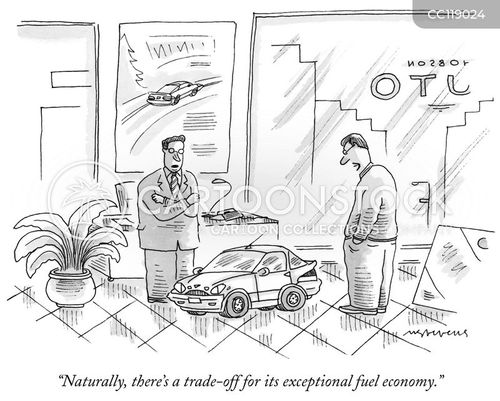
What I wish I saw less of in the car/transit debate was moralizing, and what I wish I saw more of was engineering tradeoffs. You can try to have cars and houses and transit and high salaries and (relatively) low taxes and what you get is NYC or SF - a playground for the rich and a dystopian hellscape for the average middle class worker. If you make transit ubiquitous and affordable with affordable housing and restrictions on cars you get everyone in tiny accommodations, the kind of mass single family home communities and even NYC townhomes and billionaire skyscrapers would never be approved by German town planners. Engineering tradeoffs, which can mean many tiny cars you never see sold in the USA:
https://lowres.cartooncollections.com/shopping-auto_dealer-c...
Let's have more discussion on the tradeoffs, and maybe we can find solutions of which Larry David would say:
"You're unhappy. I'm unhappy too. Have you heard of Henry Clay? He was the Great Compromiser. A good compromise is when both parties are dissatisfied, and I think that's what we have here."
Yes they do. US public transit is terrible and various groups like Strong Towns describe this and explain why. Things like the way buses wind-up the first thing cut in budget crises etc are important parts of the barrier to ending a car-based urbanism.
See a multitude of article here: https://www.strongtowns.org/journal/category/Public+Transit
NYC crime increased 22% last year. [2]
Chicago crime increased 41% last year. [3]
[1] https://missionlocal.org/2023/01/explore-how-crime-changed-i...
[2] https://www.nyc.gov/site/nypd/news/p00071/nypd-citywide-crim...
[3] https://www.illinoispolicy.org/chicago-crime-spikes-in-2022-...
**
That said, the OP said "violent" and technically the increase was almost entirely non-violent crimes (e.g. theft).
The default assumption should be that people who benefit from auto sales are actively trying to block public transportation. It's foolish to think otherwise.
If you never get pulled over, or you know some tricks, you slide by.
lets knock that down to $250/month
https://www.nerdwallet.com/article/loans/auto-loans/average-...
Important note here: US public transit use is way down from pre-pandemic levels and might never recover [1]. I've spoken to several city transit representatives about this and they're looking for ways to green and downsize their buses as a result of low demand. Adding more buses not only doesn't help if there aren't enough passengers, it makes things worse because buses are massively expensive (think quarter million dollars each), need expensive drivers and maintenance, etc. That's money that cities could be spending on things like improving housing instead.
A lot of bad decisions were made in Europe stemming from American city planners after the second world war. Like David Jokinen's influence on Amsterdam and The Hague: https://viewpointvancouver.ca/2019/10/27/the-1960s-when-the-...
It's strange that people are so eager to export (and import) urbanism ideas around the world without much understanding of the cultural differences and needs.
but there are a lot more cases, generally in the same direction, depending on the time frame, whether it’s city vs. country, race-related, drug-related, enforcement-related, from strangers, etc.
Overall, far fewer cases are being given a lot more cover while deaths preventable with standard healthcare increase, and deaths and life-altering injuries from car accidents remain so frequent you’d need a metronome to count them.
https://www.nerdwallet.com/article/banking/data-2023-savings...
(Used) car prices continue to climb.
https://www.usatoday.com/story/money/cars/2023/05/15/new-use...
Subprime auto loans continue to be fairly popular, Investopedia is claiming about 40% of used car loans are subprime.
https://www.investopedia.com/terms/s/subprime_auto_loans.asp https://www.consumerreports.org/car-financing/many-americans...
So, no, rich people aren't driving these ballooning loans they're going to the working poor. The excruciatingly poor don't own cars. Defaults were ticking up leading into the pandemic, people are simply living beyond their means at this point. Cars are expensive and have been getting more and more expensive.
Recommended reading:
https://www.goodreads.com/book/show/125313.The_Geography_of_...
https://nces.ed.gov/fastfacts/display.asp?id=55
And private school attendance is mostly higher income families:
https://www.educationnext.org/who-goes-private-school-long-t...
Unfortunately public transportation resources are limited, but prioritizing the vast majority of lower income public school routes over the vast minority of higher income private school routes makes sense
Jarett Walker writes well about this coverage vs. ridership tradeoff: https://humantransit.org/2018/02/basics-the-ridership-covera...
Betteridge's law of headlines says no.
Even extremely well-planned and progressive cities like Portland (which has been expanding light rail for 30 years straight) haven't budged above 15% commuting by public transportation. No city outside SF and NYC have meaningfully addressed this. https://www.census.gov/library/visualizations/interactive/pu...
This is why electrification is so important. North American civilization is dependent on cars and trucking and will always be so when our countries are continental at scale.
Removing some roads and replacing with more shared/human-centric transport will make a huge difference to the utility of cities. We can do this independently of electrifying vehicles - see superblocks [1]
Violent crime is more prevalent in urban areas of the US than in rural areas [2].
[1] https://crsreports.congress.gov/product/pdf/IF/IF12281
[2] https://www.city-journal.org/article/criminal-neglect#:~:tex....
[1] https://www.boston.gov/news/new-steps-reduce-vehicle-emissio...
I don't have time to do a comprehensive survey of how other cities operate online crime reporting, but I'm assuming in good faith that the implication here is that San Francisco's violent crime statistics are under reported if you can't report online. It seems to me that many other cities don't allow you to report online either.
Open to having a good faith discussion on if crime stats in SF are deflated due to underreporting. My guess would be that the base rate of actual people getting assaulted by a homeless guy is pretty low - curious if you have any anecdotal evidence or data to the contrary.
Are you affluent and lucky enough to live near their school?
https://www.greencarcongress.com/2019/07/20190730-school.htm...
They are free on only 3 lines (plus SL1 leaving the airport) https://www.boston.gov/news/mayor-wu-takes-steps-expand-fare...
The Roman empire, which existed from 27 BC to AD 395, had Rome as its capital, and while numbers are subject to discussion given the age, the floor for the density of the city of Rome back then, which had a large number of insulae, or apartment buildings, is 30,000 people/sq km. A more recent estimate put it at 72,150 people per square kilometer *. For reference, Manhattans' population density as of the 2020 census is 72,918 people per square kilometer.
This was 1,600 years ago! That is to say, there is precedent for humans living in the kinds of densities we have today, without anywhere near the kinds of technology we have. There was no electricity, no cars, no Internet back in '400. They most modern revolutionary thing was running water, and even then they used lead pipes for it and had no electrical pumps to pump it up to the 9th floor. One thing that will be familiar to modern readers is that the government came in and imposed regulations, making some buildings illegal due to height restrictions.
* https://go.gale.com/ps/i.do?id=GALE%7CA20586744&sid=googleSc....
https://www.youtube.com/watch?v=kYHTzqHIngk
(In response to now flagged comment below about grocery shopping 'requiring' moving big stuff)
The problem is that these are crippled by regulations that only apply to the new transportation modes.
In Los Angeles we put GPS speed limiters and parking enforcement on scooters while letting cars park practically anywhere. You can drive 80mph through a school zone and nobody will do anything unless a cop happens to be there when you do it.
It feels like an antitrust lawsuit waiting to happen.
https://transfersmagazine.org/2018/08/15/monopolizing-scoote...
https://pedestrianobservations.com/2021/07/23/the-leakage-pr...
Step 0: Start watching Not Just Bikes - https://www.youtube.com/@NotJustBikes/videos
Step 0.5: Browse through r/FuckCars - https://www.reddit.com/r/fuckcars/
Cars are a straight jacket, a two-ton $10k deadweight, you have to drag them everywhere with you, you can't go anywhere without them, you always have to return to where you left them, you have to baby them with concentration - they can't even go in a straight line without your constant guidance and if they could you legally can't let them; you get in one and you are trapped to the roads (no shortcuts down small walkable alleys or through parks), trapped in the flow of traffic (no pausing by a shop window and popping inside for a look), you're charged by the minute by the cost of gasoline, seatbelted into a fixed position for the duration, with an explosive airbag charge constantly pointed at your face because of the high chance you or other people can't safely control them, they're your responsibility when you aren't near them (they stop you from drinking alcohol with friends for example, or for parking irresponsibly), they're amazingly complex and costly systems to maintain, costly to insure. And you pay enormous amounts of tax to maintain the road network which needs to sprawl everywhere at enormous expense.
What's "freedom" about that?
American cities weren't designed for cars, they were bulldozed for cars. Car companies illegally bought up streetcar companies and sent the streetcars for scrap. Cars were killing so many pedestrians that car companies came up with the term "Jaywalker" to mean "country bumpkin walker" and propagandised it into blaming pedestrians for car drivers hitting them. Car companies are pushing SUVs in advertising because SUVs have a legal loophole about being 'light trucks' where they don't have to meet as strict safety and efficiency regulations so they are more profitable; it isn't that "Americans like SUVs", it's that "Americans are being told to want SUVs" so they do.
They stop you dealing with crowded, noisy buses and trams by being crowded, noisy traffic offloading that problem to everyone outside your soundproofed cage.
Walking is freedom - you can go where you like, when you like, with whom you like, and you can do it without dealing with crowded, noisy, sometimes dangerous buses/trams/subways, or rush hour or full car parks or car park fees or tailbacks. And without spending money or needing to be rich, without being confined to a car, without having responsibility of the safety of your passengers and all others around you, without having your attention constantly on controlling a car, without having to divert to a car park, look for a car park, or return to the same car park before you can go anywhere else, without being stuck in traffic, without being stuck to roadways. Walking with metros and trams and trains is freedom with a boost - optional, convenient, power assisted walking. (Bikes can be fun, but designing a city around requiring a bike sucks in the same way that designing a city around requiring a car sucks; design the city around not needing My Personal Metal Transport Vehicle(tm) and then add a little bit of that back in as necessary/helpful/fun).
> "How do you propose to stop Colombians from voting with their wallets when they choose to eat at chain restaurants, shop at big box stores and then take the freeway back to their air-conditioned 2000 sq ft houses in the suburbs?"
What happened in Amsterdam in the 1960s is the Jokinen Plan[1] proposed to demolish some working class neighbourhoods and run a six-lane highway into the city center, assuming that Dutch people would want to live in the suburbs and drive to the city like Americans do. Instead the people voted against it, and it turns out that making safe and convenient pedestrian and bike routes separate from car roads makes walking and biking safer and more pleasant, and so more people walk and bike for journeys instead of driving, which reduces car traffic and fumes and the need for big wide roads, which makes walking and biking even more pleasant. They didn't ban cars by fiat - surprise, lots of people don't want to drive for every single journey. (Possibly because driving is inconvenient, effortful, boring, and it's uncomfortable to be trapped in a fixed position for an hour looking at concrete and car-butts and road signs).
[0] https://i.imgur.com/hzDCcSg.jpeg - this is a "freeway" because you don't pay a toll to drive on it. And because of all the freedom these people are enjoying.
Although here is an attempt from a Saturn commercial: https://www.youtube.com/watch?v=e_oWmY_mkCA
https://www.latimes.com/california/story/2023-03-14/horror-t...
https://www.latimes.com/california/story/2023-03-14/horror-t...
In the past he railed against car usage: https://www.mrmoneymustache.com/2011/04/18/get-rich-with-bik... , https://www.mrmoneymustache.com/2015/07/27/rent-vs-buy/ , https://www.mrmoneymustache.com/2017/10/24/get-rich-with-con...
> These corridors remain as valuable arteries awaiting a return to their original designs. Simple and affordable upgrades like bus rapid transit, small apartment buildings and bike lanes could once again transition them into being powerful parts of a transportation network that does not rely on car ownership.
Throwing money at public transport doesn't have a good track record in modern North American (US + Canada).
Instead (or in addition) you can try things that are free or even earn money:
- charge for street parking (see https://en.wikipedia.org/wiki/The_High_Cost_of_Free_Parking)
- improve zoning to legalise building (see eg http://urbankchoze.blogspot.com/2014/04/japanese-zoning.html) and legalise density
- remove mandatory minimum parking requirements
- remove other subsidies for car ownership, both explicit and implicit
- consider congestion charges and tolls
Once you enact things like the above, bus rapid transit might even become profitable to run privately. After all streetcars were famously profitable back in the day.
And every time I've touristed in Europe it's been great wandering around without a car (the times I've driven the backcountry with a car have been fun, too).
But all the people I've worked with when in Europe have a car (sure, it might be small) and drive when it makes sense, which is often.
[1] https://www.bloomberg.com/news/articles/2015-04-17/a-pew-sur...
Rail does much better because it's usually only built where it can be filled, and is electrified.
Because what everyone needs is a SUV that weighs 9000 pounds and can accelerate to 60 MPH in 3.5 seconds.
I'm surprised we haven't had "ice mode" for EVs, you'd think they'd have enough computers where they could handle bad roads better.
When I visit Seattle I only use public transit or walk to get around. I use the light rail as much as possible, but it only gets you kind of the way to anywhere. Plan on an up to quarter mile walk to a bus stop and then probably an additional bus to actual get to where you want to go. The previous poster is right in that you need to add at least an hour to your transit time to account for waiting for connections.
Also, a large portion of 1 Line's southern section is at-grade with auto traffic.
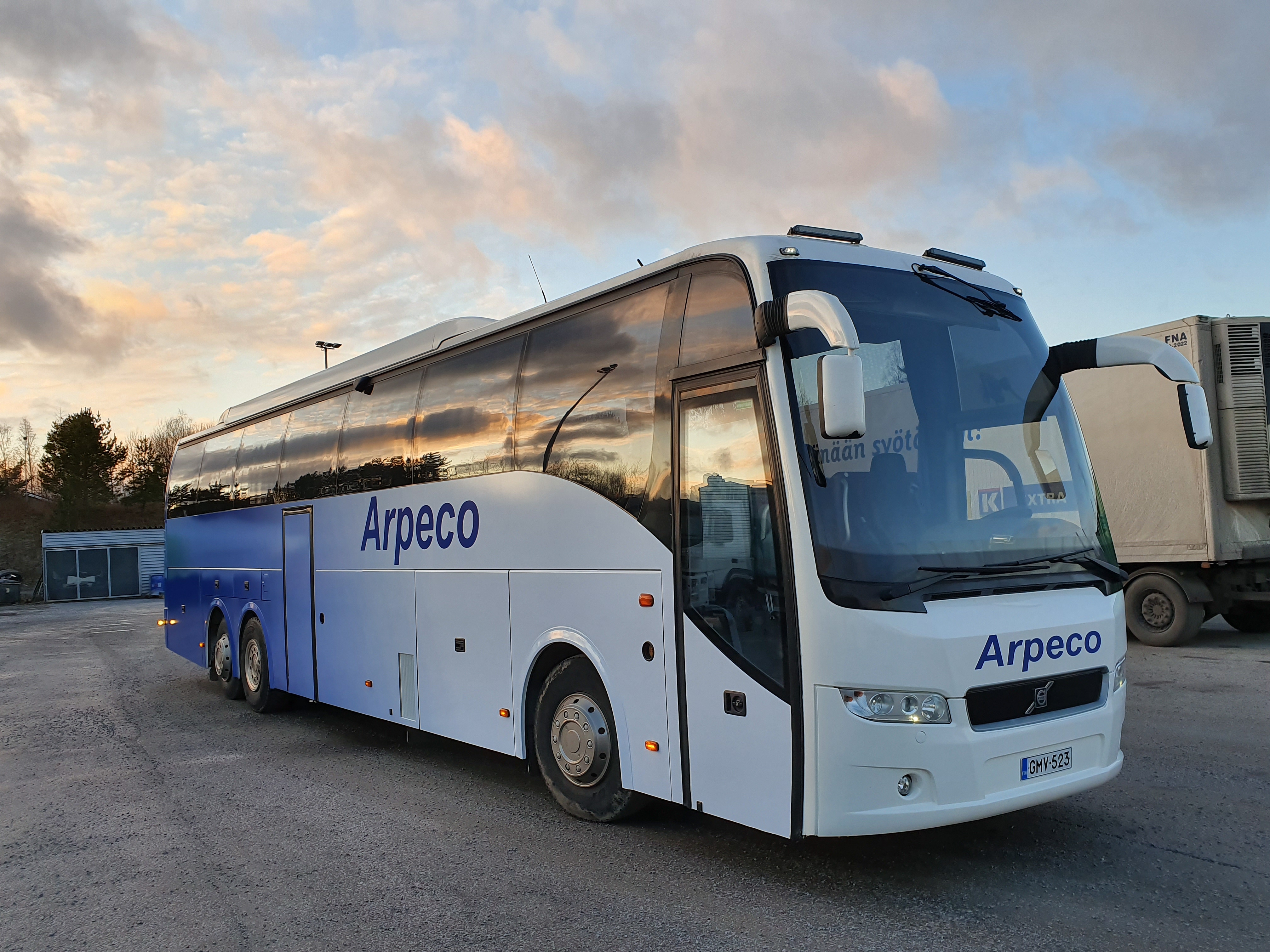
Here's an example: https://arpeco.fi/wp-content/uploads/2020/01/20191231_143830... Can you see those big hatches? They're almost the depth of the bus
As for bulky things, shopping, and taking the kids to school, I use this and would recommend it to anyone.
1. More common driving scooter
+ in Thailand / Vietnam / Indonesia driving scooter is very common even for teenagers
+ easy to find (free) parking place and doesn't require so much space
+ they don't consume much fuel
+ still can have 2nd passenger
+ cheap, mass produced and easy available
+ easy to lock and more heavy so less likely to get stolen than bikes
+ have some (small) trunk space for storage (helmet, groceries, etc.)
+ in taiwan you have electric scooters that easy to swap batteries
+ you can still move forward in traffic jam
E-bicycles on the other hand:
- feel less safe when driving >20km/h (small wheels)
- doesn't have indicators, mirrors, lights out of the box
- feel like too fast for sidewalks and too slow for roads (unless have dedicated bicycle lanes)
- much more expensive, most cannot swap battery or replace it
- much less places to park
- easier to steal (and because they are more expensive they are better target)
- no space for groceries or storing helmet/gears
2. Shared taxi. Thailand has kind of public transport called Songthaew [0] (pickup car with 2 benches of seats) that you stop, pay small fee and it distribute people that go along the same direction. Similarly angkot in indonesia. With some modern app this could be probably even better optimized
3. Motorbike taxi - e.g. gojek in Indonesia, grab bike in Thailand
Until 1976 the law was still extant that they had to keep a bale of hay in the vehicle.
The prices were even regulated
http://www.londonancestor.com/stow/stow-hack.htm
Indeed the Romans even had regulations about road width to ensure drawn carts could pass each other
https://www.alexanderrea.com/project/mcdonalds-happy-world/
It's difficult to summarize the impact of commercial and social collusion while understanding the impact on daily decision making as easily as that.
Of course, all the beautiful people ride around in electric cars with their brains being told indirectly to consume the diet of Mr. Creosote by a conspiracy of corporations that have neither their best interests nor well-being at heart.
Two things provide hope. Young people who, when given the choice, choose not to get a driver's license, and old people who've become accustomed to cars but choose to abstain from car transport moving forward and have the freedom, health, and wisdom to choose other alternatives such as 2 feet, 2 wheels, or mass transit instead.
These choices arise from the fact that time (as in slow-* culture) and health are the new wealth for those who have the privilege to recognize and realize such beliefs as differentiators in the life they seek, not yesteryear's symbols of innovation.
I won't pretend that there are no exceptions to the pros for public transport. Cars are there for a reason too. Sometimes combo is the best [0].
From stereotypes - I'd agree that LA's public transport is orders of magnitude worse than travelling by car. Though it sounds like OC actually never been in a moderately dense European city. You often _cannot_ go directly to your destination with a car [1] and your travel will often take longer [2]. I probably won't be wrong by saying that it will be an order of magnitude more expensive too [3].
If it's a big city - driving will cost you greatly and you will lose time. If it's a moderate city - driving will cost you a lot and maybe it will take similar amount of time. I don't see where it is a win for cars here?
> convenience of putting a large amount of shopping / luggage in the back
How often do you go shopping/carry luggage to the amounts you can't carry? Personally once every week or two.
P.S. I know that there could be exceptions to the rule, but I had in mind travelling inside the cities for common scenarios as going to work to the city centre.
EDIT: Forgot to add. While going with public transport it's great time to catch up on latest podcasts, scroll news, even do minimal work if that's necessary (emails, chats, etc.) or you can just chill in general. Driving will need my 100% attention on the road and probably 80% of the time will make me super stressed and angry.
Also "this new Musk tunnel thing." - I think I wasted a comment against a troll. :) Musk tunnel is a "metro" with significantly less throughput and traffic jams: https://www.youtube.com/watch?v=p8NiM_p8n5A
[0] Often businesses are based in big cities, but a lot of people live in the surrounding area. You drive to the city limit, leave car there (often rather cheap/free if you use public transport) and hop onto the express train that takes you to the city center very fast.
[1] Good luck to park your car in the centre of London, Paris, Berlin, Amsterdam, Copenhagen, Stockholm, etc. and if you could (e.g. office building has parking) - it will cost you dearly;
[2] Traffic is prioritised for public transport. Separate bus lanes, some streets don't even allow cars, priority for trams. Leaving your car is a nightmare too.
[3] Fuel, insurance, road tolls and/or car taxes, maintenance and car price itself, parking.
I wasn't able to find anything like "average car payment for low-income Americans", but this link shows that average car payments are pretty evenly spread across the credit score spectrum, with rates inching up as you go down, probably because of higher interest rates. No idea if credit score is a proxy for wealth though.
https://www.cnn.com/2023/04/15/cars/car-loan-interest-rates-...
A ton of concerning stuff here, most notably that two-thirds of these loans have 5.5-7 year terms now, compared to 30% in 2004. The article it links to shows that for 2023 Q1, the average term is 70 months, down payment is $4k, APR is 11.1% (!!!!), so that the monthly payment is $551 even as down payment increases and amount borrowed decreases.
Again, I don't want to say you're wrong: you can find cheap cars, people survive with clunkers. And the most frustrating part about searching this is that I haven't been able to separate the rich people buying Escalades from the poor people buying entry-level vans, so I don't have a sense of demographic makeup here.
But all of the trendlines are pointing towards car payments being bigger than ever and terms longer than ever. Mash that up with higher interest rates and some lingering supply constraints and it's not a healthy market right now, which is why it doesn't surprise me that people are yearning for a different solution that doesn't involve a heavy reliance on cars.
Or my holiday which involved a ferry and the freedom-car was too expensive to justify bringing on the ferry and too inconvenient to park this side of the ferry, but the train/bus replacement went right to the ferry port?
Or my trip from home to train station which is walkable (if a little boringly far) and I have the freedom to go through town or through the park or through the suburbs, into shops along the way, and straight into the station whereas by car it's 10-20 minutes of stop/start traffic, no meaningful choice of route, no way to stop in anywhere along the way, the train station has almost no on-site parking and the nearby parking isn't gratis? How does car win for 'freedom' there?
Or how about that I have rarely ever driven more than two hours in a day, but if I want to go somewhere far in my car (such as London and back) I would have to commit to driving eight hours - and if I got there and felt unable (tired, ill) to drive back I would be stuck having to drive unsafely because of the freedom-car ball and chain, or arrange a hotel for the night - whereas a train or coach you don't even have to be awake the whole way, let alone concentrating on moving a two-ton vehicle at motorway speeds? Where's the 'freedom' advantage there?
By the time you are doing regular long car journeys it's eating large amounts of your time and money to the point where you are likely only doing that because you are economically trapped by house prices and job locations, rather than because you are free. Cars are good for the medium-short journey of 5-15 miles which is mostly crummy design of putting big box stores and industrial estates with no options except driving, assuming people will drive to them, and thus self-fulfilling prophecy meaning people have to drive to them. Cars are good at this, but an unthinkably expensive way to be good. Next time you see a road, count the cars in terms of $20,000-$60,000 purchase price each. Five cars to a hundred k, fifty cars to a million dollars. Economic boom or burden on the drivers?
From Malcolm Gladwell's 10,000 hours idea, I am well on the way to being a world expert at my old commute, and trundling back and forth over the same bit of motorway for over a decade, ploughing thousands of hours of my life into pushing a pedal and turning a steering wheel, is not a skill worth developing and not any kind of 'freedom' the likes of which the Founding Fathers or the Ancient Philosophers were discussing.
There have been about 110 billion humans on Earth in all history, and over a hundred billion of them lived their entire lives without ever driving twenty minutes to Walmart, driving an hour to the next town for a coffee and a look around, driving eight hours to see Aunt Margaret once every couple of years, driving twenty hours to go skiiing, or driving a week coast to coast to burn some fossil fuels and feel important. And even today, the majority of car journeys are not people free to visit Aunt Margaret, they are people stuck in commutes or driving to stores who would generally prefer not to do that. If everyone who wanted to, could live a high quality of life close to work, how many car commuters would say "I don't want to live close to work and have more free time and less stress, I want my car commute because that's freedom"? Mostly they will say either "I can't afford to live closer to work" or "that's a horrible place to live" not "I love stop-start driving in traffic on a four lane concrete expressway".
[1] Let's it not pass unnoticed that driving is more than just distance and time; driving safely and concentrating and paying proper attention to the signs and conditions and other drivers is effortful and tiring, navigating in unfamiliar areas can be stressful, driving safely is a responsibility. How many drivers are honestly too tired, too distracted, too ill, too medicated, to be safely and responsibly making their journeys on any given day - but have no other reasonable choice but to cross fingers, pray, hope, and push through it?
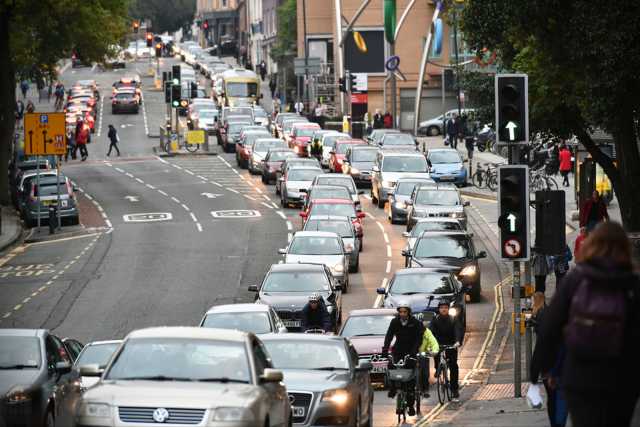
[2] Edit: Using this soapbox to call out car adverts showing drivers on almost empty roads, such as this Ford Focus ad: https://www.youtube.com/watch?v=h-gGFaDZc3k whereas most people's experience of driving is more honestly like this https://evinfo.info/wp-content/uploads/2017/03/london-traffi...
It does take a bit of will and time, but it's a great thing to grumble about at the council meetings; around here all new developments have to have a sidewalk plan (it's not required to be "both sides" but most do that anyway) and connect to the bike paths. They even had a fundraiser a few years ago to raise money to make a connector path, which is quite nice; every business had a little "bike path" jar and it got done.
You said violence is increasing, which is fear-mongering and needs citation.
> Never before in human history have humans lived in densities that they live in modern cities
Citation badly needed. We're in a crisis of low density in almost every urban area on the planet thanks to the auto industry and zoning laws, which I'll explain below.
> I’d want to see evidence that “It’s illegal to build walkable areas in most of the US”.
Ah, so the problem here is that you're interpreting the existence of sidewalks as walkability. That's not what it means: https://en.wikipedia.org/wiki/Walkability.
Walkability is a complex concept dictated largely by zoning, the practice legally defining the type and qualities of structures that can be built. And zoning, almost everywhere in the US, prohibits walkable urban design: https://duckduckgo.com/?q=walkable+neighborhoods+illegal+due...
https://web.archive.org/web/20230519170640/https://www.newyo...
You, ostensibly[1]!
> You should be arguing for smaller cars not less of them.
I'd be more than happy to take both :-)