I'm saddened for my country and hope that this can be a turning point for all of us.
It's currently at 500+ instances of police brutality. https://twitter.com/greg_doucette/status/1272306977872453634
Unfortunately the apple is the police and it's everywhere and armed.
"When you get the data into a nice, clean, dense form, stuff just falls out of it" - Saul Pwanson
It seems important to understand how much that is happening and where. If that data, in combination with protest size/type data is available, it can help us better understand if protests or police are actually impacting COVID transmission (if either).
If we don't have that data available as case numbers come in, it makes the narrative of blaming protesters much more likely to stick, even if it turns out to be inaccurate later, and e.g. the primary cause is unnecessary police actions.
Is anyone doing this? (Does anyone want to start if not?)
Home, Banks, Retail, Restaurants, Hospitals
Yes
Jails, Police station
No
Can you sue police if get sick ?
https://twitter.com/greg_doucette/status/1270402748895412224
Which isn't an example of police brutality.
The second one was this:
https://www.youtube.com/watch?v=hsTkAOe5UTE
Basically a bunch of thugs attack random drivers. One of the thugs jumps into a random car, the car stops, police come, pull the thug out, he resists, they deal with him. I have zero sympathy for the thug.
If you want to create a list for this cause, at least make it good, make it solid. Don't fill it with random junk to inflate the numbers.
I'm not saying the police doesn't do wrong, they absolutely do. We have examples of rapes, unjustified murders and beatings, entrapment. They are extremely rare. I think last year the police in the US killed 9 unarmed black men and 21 unarmed white men.
The fact that you chose to take the video so far out of context means you're not here to argue in good faith at all. Said list isn't for people such as yourself, where no level of evidence could convince you.
400 ... where there are videos. We know that until a video emerges these get swept under the rug, so I'm willing to bet that there are a fair few more than 400 examples of police brutality.
Even when one cop punches "the thug" in the face while he's being walked away while handcuffed?
Other than that, the point remains.
They "arrest" the driver, because he is not following the police instructions to get out of the car, and is actively resisting the police. We don't know if he was actually arrested or just detained. I got handcuffed once and then let go, it wasn't an arrest.
And try not putting 'arrest' in fear quotes, because they literally yanked him out of his car, threw him against his vehicle and arrested him.
Now, how many are unjustified? That's the important question.
One cop was paralyzed from the neck down in Vegas protests: https://www.bostonherald.com/2020/06/14/police-officer-shot-...
Retired police chief killed at 77 by looters in St. Louis: https://thehill.com/homenews/state-watch/500839-retired-st-l...
A federal agent was killed in Oakland in connection with the protests: https://patch.com/california/alameda/fbi-ids-federal-agent-4...
The one-sided narrative against cops is getting out of hand. It's an extremely dangerous job and you cannot treat gangsters with kid gloves while they pack serious weaponry. It's a joke to talk of nerfing or defunding the police for the handful of bad incidents that occur meanwhile over 15K people a year are murdered in the country. It's completely disproportionate and not aligned with statistical reality: cops often have to make split second life or death decisions and they don't get a second shot.
The situation in local jails became a big issue at the beginning of the pandemic. I would reach out to a bail fund in your city (or read more on their web page) to see if there are useful ways to help their broader mission, which will include protestors :).
Some useful context in this slate article:
https://slate.com/news-and-politics/2020/06/bail-funds-donat...
According to the FBI, which publishes the data in the Uniform Crime Reports, from 1980–2018, an average of 85 law enforcement officers were feloniously killed per year.
In 2018 there were 686,665 police in the US.
https://www.cnbc.com/2019/12/27/the-10-most-dangerous-jobs-i...
The sides here are decent folk (police and protesters) against the racists and the violent criminals (police and rioters and looters).
And the police agree: "Three big California police unions release national reform plan to remove racist officers" https://www.sfchronicle.com/bayarea/article/3-big-California...
Their plan includes "a national database of former police officers fired for gross misconduct that would prevent other agencies from hiring them."
75 year old man thrown to the floor for no reason: https://www.youtube.com/watch?v=n4f4dXXbfEg
Two of the officers responsible were suspended. In response, the /ENTIRE DEPARTMENT/ resigned: https://nypost.com/2020/06/05/buffalo-emergency-response-tea...
American police need to be disarmed and fired. The idea of a professional police force (especially an /armed/ police force) makes about as much sense as a professional jury service.
I imagine in general it's safer in most regards than many trades and MOSes but until I see the data I wouldn't want to make an actual assertion.
I'd put this together myself if I felt competent enough to do this properly but by no means am I a data scientist or anyone actually qualified to do this.
This triggers riots and protests, which require the police to work overtime.
They get paid for causing all these problems, and well paid. Their overtime costs must be tremendous. And who ends up paying? We do.
We should claw back police overtime pay for any protests or riots that are caused by the police themselves. I think that's fair and equitable.
From your own link it shows less than 200 deaths of police per year from the last five years. Hundreds as you've used it imho is misleading. Furthermore those stats include accidents which makes them even more misleading. Do you honestly think deaths from cancer related to 9/11 should "count" in the context of this debate? And yet they closely trail and sometimes even eclipse the death of cops by gunfire in the past 5 years.
I do agree that it's a dangerous job but I don't agree that they're "required" to be heavy handed because of "gangsters" with "serious weaponry". The weaponry issue is a gun control one, not a "gangsters" one. There's absolutely NO NEED for so many ARs over there. NONE WHAT-SO-EVER. And I say this as a reformed red-stater expat who had a AK under my bed as a teenager and a 40 smith in the night stand.
From my perspective I think the narrative for cops is disproportionate and out of hand. The ample, arguably overwhelming, footage of cops beating, maiming, shooting, and killing people in the past month alone is ridiculous and should be evidence enough that the police have lost their way. Instead you're in here defending them in spite of overwhelming video evidence to the contrary.
In Australia and NZ the police are legally bound to these key principles.
• Police should only use force that is reasonable, necessary, proportionate and appropriate to the circumstances.
• Police should use no more force than is reasonably necessary for the safe and effective performance of their duties.
• Individual police are accountable and responsible for their use of force and must be able to justify their actions at law
Do you think the video below is a good example of the use of proportionate force? Do you think that shooting was justified? https://twitter.com/i/status/1272177941519257600
On a related note I found this an interesting read.
https://medium.com/@OfcrACab/confessions-of-a-former-bastard...
I can't even think of things they regularly do that can be called heroic? I know they do some good stuff, but nothing that comes close to the level of "hero" in my opinion.
Firefighters, EMTs, nurses, and doctors are all examples of actual heros, IMO.
I think it would be much more productive and realistic to have a really deep study of how policing in America is different from other countries, and what can be done to normalise it. America is pretty gun crazy, and that doesn't make a cop's life any easier. The flip side of that is that some gun crazy people become cops, and shoot people on their knees with weapons engraved with "you're fucked": https://en.wikipedia.org/wiki/Shooting_of_Daniel_Shaver
At 0:16 a cop pushes Adam partially into the passenger window of an SUV, apparently hoping that he will fall out and be injured while the SUV is moving. When the SUV stops, Adam is mobbed by cops and beaten. The driver Bob (a victim of having a cop push someone into his window) is detained, his hands zip-tied. A bystander Charlie who doesn't seem to do anything is also zip-tied. At 1:43 a cop seems to spit in Adam's face and punch him while he's cuffed and being escorted by other cops.
Edited: In your first link:
If soldiers block enemy soldiers inside a 1-block length of street and use chemical weapons on them while preventing them from dispersing, it's a war crime. I don't really know why it should be fine for cops to do it to randoms.
If you made it practically impossable to disburse when using what are basically torture devices in that situation I don't see how it isn't brutality.
This is Ba Sing Se levels of delusion for some people.
In those examples, I’m fairly confident the perpetrators will be arrested and likely justice will be served. In the first two, arrests have already been made and they’ve been charged. Meanwhile, those that murdered Breonna Taylor are still free despite the fact that the police know exactly who the perpetrators were.
We want justice for all.
I don't really want to get into the actual meat of the argument, but please use per-capita death stats so the numbers are actually comparable.
When a cop kills someone, they almost always go unpunished, no matter how unjustified it was.
This is a classic example of bad / misleading marketing on behalf of a reform movement. The "Defund the Police" movement has been poorly named. Yes, there are absolutely some folks on the extreme who truly want to disband the police and live in a place without police, but by and large, the major of people who are supporting this movement mean something else:
Defund == defund the CURRENT police organizational structure (militarized, etc.), reallocate funding for things like homeless support, domestic checks, etc. to other departments better suited to handle them, and KEEP a policing organization which is responsible for a much narrower scope of duty with a reformatted training program, etc.
It should be branded "Reboot the Police", not "Defund the Police"...
These aren't from all the years, they're from approximately May 26th of this year. It's 400 cases in the last 3-4 weeks.
That is a startlingly high number, made worse once you actually start digging into the individual incidents, because you realize they're not just isolated. A lot of these videos aren't, "a single police officer does something shifty", they're, "an entire police unit starts firing tear gas at protestors who are kneeling on the ground." And then you start to read the responses from police unions, some of which outright lie about the incidents or contradict the videos. This isn't a problem with individual officers, it's a problem with high-level commanders and police union leaders -- it's a problem that spans entire units.
I personally went through about 200 incidents for a separate project I was working on, some more in-depth than others. I think people are looking at these lists and thinking, "oh sure, but if you zoom in and examine each incident, it gets better." It really doesn't. It didn't take me long to get accustomed to seeing people tear-gassed, those videos don't even make me blink now. But even with that, I was regularly shocked while I was combing through videos with incidents that I wasn't prepared for.
"Tear gas, tear gas, tear gas, holy heck that police officer just body slammed a protestor! Tear gas, tear gas, holy crap they just punched a reporter in the face!"
And again, 4 weeks. Not years. I would challenge anyone who's saying that these are extremely rare or over-dramatized to sit down and devote an evening to just watching the videos in series. It weighs on you. And it quickly becomes obvious that these are not individual rogue officers, these are police units operating in an environment where they know they will not face consequences for hurting protestors.
False dichotomy.
You can defund the police, by not sending armed, militarized police to do the bullshit parts of their jobs, while still responding to violent incidents.
For 99% of police calls, you don't need an armed gunman to show up. Of the 1% that you currently do, more often than not, that armed officer won't even show up in time.
> what those perps and officers have experienced
Both totally irrelevant to whether or not it's appropriate to punch a handcuffed prisoner in the face while they're not resisting.
If a cop is suffering from PTSD or stress to the point where they can't keep themselves from assaulting a handcuffed prisoner, then I am genuinely very sorry for them, but they're still in the wrong job and they still need to be let go.
The fact is, I'm a white dude in my mid-30's, I make a tech salary, and I'm afraid of the police, because an officer with a hair up somewhere could ruin my life for a period of time, if not for good.
A moment with a search engine will turn up story after story of people in uniform putting their lives on the line to help others.
Personally, I think they're heroes because they're people just like you and me who are willing to risk their lives to help other people. At least most of them are, I believe.
https://docs.google.com/spreadsheets/d/1dXtv2wnutujfXWUHB9Bm...
Police officers die in the line of duty. Yep. It's a dangerous job. You know who else dies in the line of duty? Truck drivers. Truck drivers die at 2x the rate of police officers in America. Do they get a free pass for beating the shit out of people and killing them? Hell no.
https://www.bls.gov/iif/oshwc/cfoi/police-officers-2014.htm
https://www.bls.gov/news.release/pdf/cfoi.pdf
https://www.forbes.com/sites/niallmccarthy/2019/05/08/the-nu...
https://www.policeone.com/coronavirus-covid-19/articles/covi...
The answer is, apparently, nobody. The police should not be above the law they're enforcing. The only thing that's changed is that with the mass adoption of smart phones we're able to see from multiple angles how deep the corruption goes.
Not expecting the answer to be yes, but figured I'd ask.
Personally, I’m not convinced cops need to go for a 100% apprehension rate all the time no matter what with 100% control of every situation.
Mostly because of the rate at which crimes happen without a cop around and then go unresolved.
I'm up for helping, we did the same thing during HKs police brutality videos, please consider seeding this as well; let me know how I can help.
https://torrentz2.eu/9b85dd223c8f92c923f516ed77bbdfcb770f4dd...
Oh, also worth noting the HKPF/PLA just used the same knee-to-neck choke hold on an unarmed female protestor during the 1 year Anniversary protests on June 12th [1].
Edit: It's number 15 and only because 2019 was a near record low year, following decades of decline and improved equipment and training. That's a function of how good they are. And if you make them worse or non-existent, crime will go up.
While the construction industry is accidentally dangerous, cops are victims of intentional violence and hatred. They have to deal with drugged out, abusive, angry people all the time. They have to console rape victims. They have to help assess suicides, murders, deadly car accidents and all kinds of unpleasant bullshit. They see death on the job every single day. It's not a walk in the park. It causes unbelievable stress (especially in high crime districts) and it pays 1/3 of what a junior JS dev makes and they don't get stock options or grants
It's 5x more deadly than average occupation and 6x more injurious. It also causes loads of psychological and emotional stress because they have to deal with people going through some of the worst episodes of their lives...all the time.
Law enforcement is necessary(strictly, a crime investigation unit, a force capable of handling armed/bomb situations, etc.) but something has seriously gone wrong with the way it’s been implemented in many cities, counties, and states.
I’ve had friends who’ve been pulled over while passing through Illinois and asked to hand over their wallets just so the cops can count their money. They only had a few bucks and were let go, but I’m sure if it was a little too much, the cops would’ve claimed it was drug money and taken it. The cops didn’t mention speeding or any sort of crime, so their reason for pulling them over was pretty clear. They probably target non-local people because nobody is going to come back just for a hundred bucks or so, and if they need to make up a ticket on the spot, few people will bother to fight it.
Medical errors, for example, are estimated to cause as many as 250,000 deaths per year [1].
There are millions and millions of daily interactions between police and civilians every year. Sadly, there will be some mistakes, some of which will be caught on camera.
It's important to be aware that what the media can be random, and media coverage is not always correlated with how important or prevalent a problem is.
[1] Johns Hopkins: https://www.hopkinsmedicine.org/news/media/releases/study_su...
Oh cool, a guy on Hacker News cited a John's Hopkins article. Pack it up protestors, racism isn't real and cops aren't tear gasing reporters in the face!
Perhaps the best solution is to have more democracy or community input into policing. It seems like it's happening now in the US (it would be quite different in other countries, where the police is national and considered civil servants; in France you can't elect sheriffs, and police is beyond the responsibility of mayors).
In the end, some communities will vote for a police that's tough, and other communities will vote for a police that's less tough. There will still be issues when criminals used to non-tough cops cross into an area with tough cops, but that's life.
It’s like the Police has a letter of Marque to do piracy. [0] Except that means they are at war with you, not a foreign country.
GP questioned how a profession can exist when it makes so many deadly mistakes. I pointed out that there is another profession, medicine, which also makes lots of deadly mistakes. Some are accidental oversights, but you can also do some searches and find some really bad medical errors. [1] but you can find lots more.
Again, what the media draws attention to, and what is going on in society on a daily basis, are not the same thing. Racism and police misconduct existed before 2020, but it just in the last few weeks really popped onto the media's attention.
And again, because of the sheer size of the United States, you have to look at statistics in addition to anecdotes when you think about policy.
[1] https://www.mdlinx.com/article/jaw-dropping-medical-mix-ups/...
Even if we don't contribute to that personally, can we at least agree to try to avoid doing things to other countries that get in the way of doing that, in really obvious ways like not randomly bombing them and pretending? Can we just admit to ourselves that a lot of global military expenditure is just a certain kind of make work? As Americans, can we then really not think of a slightly more efficient way to allocate the $7.3T that the American government raises every year from tax revenue, much of which we just light on fire policing things parts of people's lives unnecessarily?
Come on. I'm sure we can. This is like taking your hand off the literal stove. I know how horrible this all looks, and it is horrible, but it's also really easy to propose a solution to it. Divest and reinvest. It could be so many flavors of divest and reinvest, and still be a good enough improvement over how things are right now that it would be the most impressive piece of legislation for probably a 100 year span of time if not 200 years. There has to be an opportunistic, ambitious K-street lobbyist or two reading this, right? Wanna take credit for bringing America out of the dark ages? Come on...you know you want to. Now's your chance.
The bar is at the floor. You could write the dirtiest honker of a bill you've ever seen that it could make the ACA look clean. As long as it achieves the right divestments (global windmill fighting) and reinvestments (domestic production infrastructure), you're on the right track. You don't even have to get it completely right the first time. Perfect is the enemy of done here. Just something major and timely, which lets you evangelize divest and reinvest. You can even rebrand it as "digital transformation" if you really want. I would promise to never judge it as management consultant grifting again.
Because if not...I don't know how long this situation will hold. Those riots are just a taste of unease to come, and eventually, the federal branches of the government will understand how much more powerless they are with dislocation of their local constituencies. Someone is going to figure out how to relocate those constituencies.
> Of course, when a pizza delivery driver is injured in a car accident, it is not usually an isolated event; other drivers and passengers are also involved. All too often, the accident is caused by the delivery worker’s negligence. They are racing for tips, trying to uphold the company’s reputation for service, aiming for positive feedback at work, or they are simply checked out and bored because they spend so much time in the car.
Yes, cops frequently kill themselves in traffic accidents as well, but the difference is that they are usually not rushing to a place to put a few dollars in their pocket - but rushing to a place to protect or help someone who called upon them.
[0]https://southfloridainjurylawfirm.com/pizza-companies-take-r...
I can't even think of things they regularly do that can be called heroic? I know they do some good stuff, but nothing that comes close to the level of "hero" in my opinion. They squirt water on hot stuff? Cool.
And those videos have uncovered many instances the the police blatantly lying about their own misconduct in official reports, which is further evidence that the videos are only the tip of the iceberg.
A reference I never expected to see on HN.
It's insane, but then you realize that a significant portion of the US population _still_ only watches television news media and refuses to spend extra time looking at other sources, like Twitter.
The standards of conduct need to be draconially high, because a police officer has the power to ruin a person's life.
[1] - https://www.statnews.com/2016/05/09/medical-errors-deaths-bm...
Also, if he can't keep his cool under those conditions, he has an obligation to change jobs because if he can't handle it he's just putting other people in danger.
They also don’t have a history of killing black people at 2.5x their usual rate of killing people. (They also by and large don’t kill people, in fact they’ve killed so few people there doesn’t exist case law that prevents liability of a firefighter for killing a person. Unlike cops.)
Maybe this type of project would be the thing that gets IPFS off the ground and exposing it to a more mainstream audience.
All I know is Fox News has been caught photoshopping images and lying during their news broadcasts about these incidents.
This is the second time I've made a comment in defense of the police in a specific incident and if it's anything like last time I will be downvoted to oblivion.
Do you have any information to support your claim? (another video perhaps?) I think false claims only hurt those in support of police reform. I'm not suggesting that's your intent.
From the video in the parent post I don't understand how you reached your conclusion as I see something completely different. I see Adam attempting to enter one vehicle at 0:11 that drives off. Then he makes his second attempt with a different vehicle at 0:16 and clearly jumps into the window of an SUV. Stepping forward frame-by-frame it appears that the officer is pulling Adam's shirt[1] which would be the opposite of pushing him in. This is obviously just my opinion from that single video.
I don't want to watch three seasons of it just to understand the reference. A very obscure reference might deserve an explanation to make the remaining 99.9% of the readers able to understand what you mean.
[0]: https://en.wikipedia.org/wiki/Avatar:_The_Last_Airbender#Ba_...
"When a nation hoards weapons, troubles arise from within and from without.
When its leaders try to be cunning and clever, the situation spins further out of control.
When they try to fix things by passing more laws, they only increase the number of outlaws."
民多利器、國家滋昏。
人多伎巧、奇物滋起。
法令滋彰、盜賊多有。
Just as crimes against police are more serious than crimes against civilians (rightly, IMO), crimes by police should also be more serious.
But of those 250,000, some will be small mistake, and some will be epic fuck ups (see [1]).
Similarly, the police shoot around 1,000 people per year. Of those, many are justified, some are are questionable, and a few are epic fuck ups. If you just look at the epic fuck ups, you may believe that policing is completely broken in America. If you look at it in context, you'd probably conclude that the system works well in some cases, not well in other cases, and that there are lots of tradeoffs and no easy answer.
I'd recommend Peter Moskos's blog and podcast (www.copinthehood.com and www.qualitypolicing.com) to get a more even handed perspective than you'd find in the media. I'm not defending every single police shooting, but I think the recent shift in public opinion is not based on a good understanding of policing in America.
[1] https://www.mdlinx.com/article/jaw-dropping-medical-mix-ups/...
https://github.com/2020PB/police-brutality/tree/master/tools...
Even countries with less violent police corps often have episodes like this.
To keep it out of political rallies, just think of police vs hooligans in Europe.
https://github.com/2020PB/police-brutality/tree/master/tools...
This is true, and these videos help show that. There are more and more cases being uncovered where the police blatantly lied about their own misconduct in official reports. For instance, the police claimed the the Buffalo protester fell when video shows the police pushed him over, and the police report for the killing of George Floyd made no mention of holding him down by the neck. If there hadn't been video, I doubt either of those two incidents would have been counted in police misconduct statistics.
Then why link to that study and specifically cite that 250,000 number?
One of the main differences with doctors is when they truly do have an epic fuck up they are personally sued and can potentially lose their medical license. How many of the epic fuck ups by police in the linked Google doc will lead to the officer being sued? How many will lead to them being forced to switch to a different profession? Why do we allow these police to epicly fuck up in ways that we don't allow other professions like doctors? Does tolerating these epic fuck ups among police make them more likely to epicly fuck up in the future?
Statistics are meant to understand and bring meaning to chaotic events, like random car accidents, or randomly rolling a dice, or random mechanical failure of some complex system.
Statistics doesn’t work so well, when human interactions become involved.
And it doesn’t work well in this situation, when it comes to policing, where the officer is of the predominant ethnicity, and the victim is of a minority ethnicity.
However, you can probably infer that if the policing is done where the ethnicity of the officer and the civilian, is of a primary vs. minority ethnicity, that there will be enhanced levels of violence involved. This can be one way to infer the statistics.
At a fundamental level, there are human biases involved. There is no escaping this.
It’s possible that if you and the police officer are of the same ethnicity, then you likely have a lower chance of being assaulted or harassed by the police officer.
However, if you are a minority, or of a different ethnicity than the police officer which is of the primary ethnicity, then your probability of being assaulted or harassed by the officer goes up significantly.
The police enforcement system, is really a reflection of society.
Because it is the society that puts these police officers into positions of authority, and it is the same society that keeps them in authority.
So if the police system is corrupt, then at a fundamental level, the society is corrupt.
You can’t fix the problem, if you can’t even acknowledge that you have a problem.
It’s like Trump’s administration that recently said: There is no systemic racism in American Law Enforcement.
Thus, how can you fix something, if you can’t even acknowledge it.
For example the Rayshard brooks shooting. Why was a gun needed to wake a man sleeping in a car. Why are guns needed to hand out speeding tickets.
I get that guns are needed if a bank is being robbed. But this is glorified customer service work. Imagine your car breaks down and the AAA guy who came to fix it had a gun. Like y tho?
There have been calls to abolish the police. If Seattle can do it, maybe Atlanta and Minneapolis too.
I think that's the right answer: this should be a local decision and each community should decide the level of policing it wants (including none at all).
I don't think it's very difficult to use context to understand what's being said by the commenter.
LA Riots in 1992. Police pulled out to avoid conflict and it resulted in looting and burning for days until the National Guard showed up.
Treatment combined with appropriate work should be the first option. Treatment combined with sick leave should obviously be the second.
Quick spot check in my company's Slack channel -- One person in our team of 12 knew what the reference met.
You have some outliers that are violent and the rest just does their job - keeping the city more safe.
Also don't assume all cases of police officer shooting a person are cases of police brutality - this is for court to prove.
I think it’d be counter-productive if everyone who didn’t understand a reference or technical concept on here wrote a comment asking for a shortcut explanation rather than maybe five minutes Googling and maybe watching a quick YouTube video (in this case).
Perhaps it's because at least some of the people they stop, for speeding or other possible offences, won't take kindly to being stopped and in many parts of the USA, those in the vehicle may be permitted to carry guns of their own...
Glorified customer service work? Far from it
That it does not seem to be happening unless there is video and public outcry suggest the issue is cultural and institutional, not just individual. The good cop is not reporting bad cop and is not testifying against him. Maybe the good cop would be retaliated against, maybe nothing would be done, and all of those are reasons why bad cops are empowered.
I think the issue people are rioting about is that it's not a 1 in a billion chance for everyone. It's more like 1 in a quintillion for a rich white person, and 1 in a million for a person of color. That inequality stems from systemic racism in the police force. What you're saying is that it would be less of a problem if the deaths were evenly distributed across the population. That may be true, but I don't think many people would suggest it as a viable solution to the problem.
Being the imperial power has vast benefits, do you think Rome ruled its provinces just so they had a way to spend money? Being the global power is literally worth money. It's hard to say how much, but I'm pretty sure it's larger than your military expenses.
That said, I'd love to see the US cut back, because your benefit comes at somebody else's cost.
If the net benefit to the US is positive however, do you believe the majority of people would be happy to work more to have the same standard of living, or the majority of well-off Americans would be happy to pay European level taxes to redistribute wealth within the US? I have sincere doubts on both fronts.
OP is saying you’d need to be incredibly delusional to deny police are brutal and there’s a problem.
Frankly I am a bit cynical about politicians declaring the need for police reform. In my country protests are regularly "subdued" with excessive violence but the decision to handle it this way comes from the top, not from police officers.
I think clearer legal rules would help. Also maybe teaching people how to behave in case law enforcement conducts a search. The ability for surveillance and raiding homes should certainly be under intense scrutiny. Because I think the fear of decision makers is the main driver we might see some problems.
> I've been in a few protests and I can easily say that I have never seen more hatred in someone's eyes other than the cops that were beating up people.
That can be true for protesters and criminals too. I am aware of the irony of mentioning them in the same sentence. But the "psychology" study should show, that police is just often required to just do the dirty work and some might adjust to the crime they see in their daily routines. The systematic problems are programs like war on drugs or excessive militarization.
No it's not. Police in Europe is, on average, very kind. When they stop you, you don't have to be afraid of anything, and more often than not you stop them to ask for help, even if it's just to ask for directions.
The rate of police killings is vastly higher in the US than any other Western country. So something is going on there that is not a universal phenomenon.
I mean there’s even a “good cop/bad cop” trope that’s got to be the best example of this kind of behavior—I can’t count how many times police are complicit with straight up torture and abuse of rights on Law & Order.
Granted I think european police is less violent than US (a low bar), but to say that we don't have a problem with this at all is pretty naive. Just look at how french or swedish police have responded to black lives matters protests for example.
Also I've seen it before here not many year ago with comments like "can only compare US to Brazil not any Europen country"
To what extent do these, not uncommon - even here, sets of beliefs contribute to the problems of violence in policing? Not something that seems to me like a good idea to pretend does not exist or is minor or fringe.
I've been stopped on my motorcycle for no reasons by officers in an unmarked car, they kept me 30 min on the road under full summer sun and didn't provide me any reason for stopping me whatsoever. "don't do crimes and the police will leave you alone" doesn't exist
My dad got a ticket for using his mobile phone in a stopped car (engine off, parked) even though he didn't own a mobile phone. I can't come up with a single good interaction me or any member of my family had with the police and as far as I can tell I'm far from the only one.
A quick look at the yellow vests protest will tell you that French riot police are just the same as the American one. They killed a grandma by shooting a tear gas canister into her 4th floor flat [2].. Dozen lost hands, eyes, & c. The only reason it isn't worse is because they're less equipped and have more legal constraints
Potentially nsfl, lost of yellow vests injuries with pics: http://lemurjaune.fr
[0] https://en.m.wikipedia.org/wiki/Death_of_Adama_Traoré
[1] https://www.google.com/amp/s/www.lexpress.fr/actualite/socie...
[2] https://www.google.com/amp/s/www.leparisien.fr/amp/faits-div...
Here is a bit more info:
https://www.oxfordstudent.com/2020/06/05/killology-is-not-a-...
Imagine being legally allowed to own and carry a gun and getting killed because you legally own and carry your gun. How is that logic?
https://edition.cnn.com/videos/us/2017/06/22/philando-castil...
I generally agree. "The left" in Germany does disagree completely, though, so I think it's pretty controversial and not really as simple as you make it out to be.
The fear I think is more along the lines that police can detain you, arrest you and so on. So I just figure, why chance it? I optimize for lowest risk and I view police as an unnecessary risk.
However, people do acknowledge police is authoritative, profile racially, and abuse their power at times.
I think you can acknowledge both without being inconsistent.
Here in the Netherlands _basic_ education is 3 years; and then you have another few years to specialize into a specific topic (abuse, fraud, forensics, narcotics..).
The police department will determine if it is worth ‘paying off’ the remaining loan amount, so they can seize the car and sell it at auction.
One of the great things about HN is that is manages to be an interesting website that usually keeps out of flamewar american politics.
There are plenty of those pretty much everywhere on reddit/internet, and I appreciate that this kind of 'us vs them' posts usually don't stay up long on HN.
I'm a bit disappointed dang unflagged it this time.
Not most. Ireland, Norway, Iceland, New Zealand, United Kingdom, Maldives have police officers work unarmed. Are there others?
I got held at the (utterly empty otherwise) border for 40 minutes. They went through my whole backpack (just wet stinking climbing clothing equipment), did some obscure exercises like taking out all my cash & cards from wallet, counting it, putting into envelope and then back to me and so on.
I was super thirsty, when I asked them for a cup of water they repeatedly ignored it. They yelled at me and were generally super unfriendly, treating me like a criminal. I cross normally (non-covid times) that border several times a week, never anything similar. You can't do much, they have all the power, and they make you feel it.
This is Swiss, don't hold your breath for other european places. There are sane normal policemen, just like everywhere, but there are also fucked up power tripping assholes. They just can be more trigger-happy in places like US.
In one month where the world is filled with hurricanes and every airstrip is flooded.
I am afraid that it is not limited by police. You can see it everywhere. For example, downvoting a post with an alternative opinion and trying to have one opinion is a sign that you will be a good policeman. People like diversity only if it is a minor deviation which in this sense only confirm the dominance of one opinion. And this behavior is visible almost everywhere: police, governments, protests against police, forum moderation etc.
In fact, there are plenty of commentators downthread who don't see it as a mistake either. Years of demonisation and propaganda has gone into supporting the belief that as soon as somebody steps out of line it's necessary to beat them back into line, or shoot them if they do not comply. It's no more a mistake than the millions of people in US prisons: it's policy.
But... aren't there riots everywhere right now? This isn't exactly a normal situation.
Where are you going to get the humans who are able, wanting and willing to live up those higher standards is my question for you.
Last I checked, anyone can decide at any moment to be completely broke, a drug addict, a criminal, an alcoholic, a piece of shit, have an unlimited number of children and everyone else has to support them for some reason.
What kind of standard of conduct is that?
You won't ever get people to conduct themselves properly if ignore evolution and pretend you can magically educate people into not being animals. Americans don't even bother with trying to live up to the education myth, given how much they pay school teachers. They think they can just import people with higher standards of conduct when they have to and outsource the rest. It's more profitable this way you see, to ignore reality, fund bogus economics, manufacture consent and have this planet go to shit. It's more profitable this quarter you see.
"The 81st Precinct covers Bedford-Stuyvesant and Stuyvesant Heights. The NYPD Tapes were secret recordings made by whistleblower officer Adrian Schoolcraft in 2008-2009 proving widespread corruption and abuse in the precinct. After voicing his complaints internally, he faced harrassment by fellow officers. High-ranking NYPD officials eventually ordered an illegal SWAT raid on his apartment, physically abducting him and involuntarily committing him to a psychiatric facility for six days. The license plate “54-EDP” references a “10-54 EDP” call, in which a so-called “emotionally disturbed person” is taken to a hospital via ambulance. The quote is the Deputy Chief ’s recorded order to remove “rat” Schoolcraft to the hospital."
NYPD have made it very clear that if you're a "good" cop, the rest of the cops will destroy you.
Some people just don’t spend their time watching TV.
Profiling is an aspect of systemic racism.
Ok, the EU has 445M citizens[1] which means, by your logic, there should statistically be 40% more police "mistakes" than the US. Except there isn't. It is radically lower[2] (1536 for the USA in 2019 vs 51 for the EU in 2018/19).
[1] https://europa.eu/european-union/about-eu/figures/living_en [2] https://en.wikipedia.org/wiki/List_of_killings_by_law_enforc...
There is also the issue with police chiefs publicly declaring that they will not enforce the orders of their governor.
So, that is a bigger problem to me...
Deciding to only enforce the laws you ‘like’.
We've had children "protesting" here in the UK too despite the police not generally participating in brutality.
You would easily get this from doctors in one month if they were filmed.
Considerably more in fact. Some studies say medical errors contribute to more than 250,000 deaths per year or even more. That's just deaths, not maiming.
Similar logic would apply to a position for a crane operator or a pilot. If an airline had a pattern of pilot errors, and their excuse was “if we required all our pilots to have adequate pilot training and meet stringent skill requirements, it would be very difficult to hire pilots,” would you accept that?
Gun violence in the US is the symptom of very deep problems, you can't consider it just by itself while disregarding the societal issues being it.
And that's not what I said. They certainly won't agree that police in Europe is "on average, very kind".
> However, people do acknowledge police is authoritative, profile racially, and abuse their power at times.
That's an overly euphemistic way of describing "ACAB", which is very common and not controversial on the left.
I guess I'm in favor of obscure references, I think even if I hadn't understood I would think that must mean something really delusional.
It's finally time to put all that facial recognition tech to good use.
Isn't the issue with laws that those breaking them don't usually care about laws? I'm sure you have laws in place against murder, and murder still happens. "But there's a law against burglary, why would you want additional protection and have a strong door" isn't a good argument.
There are good arguments (and the whole issue is a good gun control argument in general), but that really isn't one.
> If you can’t find someone to fill a position as a police officer, I would suggest increasing the compensation or leaving the position unfilled before simply accepting anyone who might want to be a cop with no standards whatsoever.
Let's say we decide to pay police officers 1 million/year and really raise their standards. Great! We did it!
Why don't we just do that across the board? The answer is - we have a limited number of highly capable people.
I see the shortage of highly capable people as a problem. My previous post was a way of highlighting that. One would have to think big picture to understand the point I was making.
Regarding leaving positions unfilled - I'm not sure you've thought this through. Imagine we have a shortage of doctors and your appendix burst. Would you rather a medical student try and save your life at say, an estimated 50% success rate, or simply die?
Maybe the met does have "poor race relations" historically but it isn't anything remotely close to the US police.
It would have to be a lifelong pursuit like a real monk, without much financial incentive. The problem is without trust and respect it wouldn't work since no one would enlist. I'm not sure how you would bootstrap something like that.
I lived for a number of years on a caribbean island–modern, mix of people, pretty crowded, but a police force that was just cool af. They just didn’t get aggressive unless it was absolutely, positively, unquestionably a life or death situation. They weren’t invisible, but they weren’t anywhere near as pervasive as we see in US cities.
And I never felt unsafe there. I would walk through the worst parts of the cities at night and no one bothered you. Sure, there was crime, but basically the same shit you see in US cities where the cops everywhere and hyper-aggressive.
There is something going on with our cops and it’s a large and very deep cultural problem.
Other places have police who are drastically scaled back and the quality of life is so much better.
I’m guessing unless we alter our policing structures to where our police understand they need to make the overall community’s day to day quality of life better, these massive cracks are going to continue to widen.
Again, there were far less police and the world did not fall apart, the daily quality of life was significantly higher.
One of the major hurdles we need to get over is the rather large amount of people (and many of the police also belong to this group) who just don’t understand that people have different interests. A bad analogy, but this is a group of people who rage out when someone has pink or green hair. It’s not enough for them to personally choose to have a buzzcut, they’re furious that everyone else doesn’t also have one.
I could probably come up with a better analogy, but I think one of the answers is in there. I’m not sure how we convince those people to live and let live, because at the heart of our policing emergency is that thought process.
It's not a problem of policeman brutally beating/killing people (its a issue alright but). Its about the organisation protecting and turning blind eye on their misdeeds.
There will be bad apples in any organisation. Be it police fore or church. The problem starts when the perpetrators are protected insted of being ousted.
That emboldens other to do similar and openly advertises to anyone 'Join our org and you can to X, Y, Z with no repercussions'.
Simply put, the defund the police slogans are damaging to the DNC outlooks in November and three major unions basically read the riot act to the DNC and members in Congress that no talk that can come back to collective bargaining being a reason police get away with so much abuse is allowed. Instead it must be that they lack training, the security of their pension system raises anxiety among the forces, and lack of officers incurs overtime furthering anxiety. So the only solution is more money for training, propping up their pension systems, and more money for community policing.
just put it this way, when that was dropped on me from a relative as their new marching orders I thought they were joking.
tl;dr the whole defund the police calling is poison in November and the big influences in politics has called their party to the carpet to change the direction of the debate
I don't blame them, Twitter is it's own special hell and widely regarded as a bubble.
Can you explain why you feel that's terribly unfair? I don't know why somebody would pick Brazil specifically, but you might easily say "compare the US to countries with a similar income inequality". Take the gini coefficient for simplicity [1] and compare the US to Côte d'Ivoire, Argentina, Haiti, and Malaysia or Mexico, Madagascar, El Salvador, and Rwanda, depending on whether you take the CIA's numbers or the World Bank's. If you look at the list, you'll see that the European countries are closer together and in a different area of the list, the US isn't in their group.
Wouldn't that be a better indicator for "similar countries" than average internet speed or NATO membership status?
[1] https://en.wikipedia.org/wiki/List_of_countries_by_income_eq...
There have been multiple instances where the us police shot someone and fired more bullets in this situation than the while german police in a whole year. And i don't mean big standoffs but shooting a single person.
/edit: in 2018 the german police fired a total of 54 bullets on persona killing 11.
https://de.m.wikipedia.org/wiki/Waffengebrauch_der_Polizei_i...
Systemic racism doesn't need animosity for it to happen. Systemic racism is a term for how a system discriminates against race - that might be something like defining how much to spend on schools based on the taxable income of residents. That's not "racist" in the sense that someone deliberately decided to give people of color get less resources, but the outcome of the decision is that people of color get less resources. That is systemic racism. There doesn't need to be any racist intent on the part of any individuals in that system for it to happen (though there often is.)
US police forces seem to have a very short training which, as far as I understand is not centrally vetted by any federal organism? And considering the short training time it seems to be mostly focused on tactical and firearm training.
Compare that with European forces and you see a completely different reality. In Europe the police is generally seen as peace-keepers, force is absolutely a last resort (probably not so true for crowd control units but certainly true for daily policing).
Edit: I know downvote edits are frowned up but... I need to ask: why are people downvoting this? Do you not think NCIS is good example of a mainstream show?
Also, are you suggesting that the riots are peaceful?
I think it’s pretty clear at this point that the communities directly impacted by this behavior find the abuse unacceptable no matter how muddied the “but maybe there isn’t enough abuse yet.” crowd wants to dilute the issue.
And honestly, I live a fairly cushy life, and I find the officers in my city to be stand-offish and aggressive, I can only imagine how utterly horrified Id be if they behaved the way we’re seeing. There is no way anyone in my community would have been as patient if we were subjected to the same level of treatment.
And also, it’s probably important to point out, it isn’t only the physical abuse, the day to day attitude of an overbearing police force can drastically impact your own day to day quality of life.
But yeah, that's pretty radical what you're saying too. Maybe it's fair that you should only compare the richest nation on earth with much poorer developing nations with a short track record of democracy. Not sure I'd agree.
This is wrong.
https://mappingpoliceviolence.org/unarmed lists 1ists at least 104 unarmed black people alone killed by police in 2015.
I went though the first 20, and maybe 8 could have been accidents (one was hit by a car) or otherwise explained (2 pointed toy guns at police).
I would not sit in the car if the police ordered me out. So I wouldn't get beaten. I don't mess with the police.
> And try not putting 'arrest' in fear quotes, because they literally yanked him out of his car, threw him against his vehicle and arrested him.
As I told you. I got handcuffed and put in the back of a police car once. But it wasn't an arrest. They let me go. As a lawyer explained to me later, an arrest is a specific procedure, not just the fact of getting detained/handcuffed.
"Unfortunately we get the intellectuals we deserve".
How do you stop someone pointing a gun at the police officer without brutality?
How do you stop someone attacking a police officer?
How do you stop someone going for their gun?
How do you stop someone going around shooting innocent people?
etc, etc, etc.
So apparently you haven't watched any of the videos, huh?
Guess what? The problem is that police are frequently "on edge" in their normal jobs, and as a result innocent people are seriously injured or die. And worse, police are "on edge" far more around blacks than whites, meaning far more blacks are injured by police than whites.
It doesn't matter what the cause is, it's a problem and is has to stop.
Did you click through the link that post had? It goes to https://medium.com/@Jeff_Jackson/review-of-incident-in-charl... which is pretty long, but about half way though shows an attack on protesters by police. Search for this:
Here is what it looked, sounded, and felt like from the perspective of the protesters as the second police unit quickly appeared in front of them and detonated tear gas and a flashbang
From then on it goes into a lot of depth about the tactics the police used to trap the crowd, teargas them and shot them with pepperballs.
But even then, half of the cases sound like accidents, out of 104. The remaining is pretty close to 47.
Tough is having courage and compassion while being firm. Tough not being an insecure bully. Please don't use "tough" when relating to US police brutality.
Having a decent police force is a solved problem. Just look around for a country with a decent relationship between population and law enforcements. Look what made that happen (Was it 2-3 year police training? mental health screens? No qualified immunity? Central/federal authority governing all police forces? perrhaps ALL OF THE ABOVE?).
Why? Income inequality is correlated with crime rate, why wouldn't you use that to find comparable countries? Seems useful to me, similarly to comparing diabetes rates in countries with similar levels of obesity, not based on average hair color or amount of trees per square mile.
> the richest nation on earth
You'll need to define what "richest" means, I guess. The highest GDP? Largest military spending? Does that mean a lot to somebody that is poor in the US? Would that person possibly be better off in a European country with public health insurance, a vast social safety net, high welfare etc, even though it's not "the richest country on earth" by your standards?
There are plenty of sites that count the number of killings, but this is one of the few that looks for unarmed ones. If you are aware of better or more recent stats (for example the source of this 47 number) I'd love a link.
> half of the cases sound like accidents, out of 104. The remaining is pretty close to 47.
I find it mind-boggling that killing 52 unarmed people by accident is somehow the best case scenario here.
EDIT Also, around 1:37 it looks like someone kicks him when he's lying on the ground, and at 1:45 someone punches him when his hands are cuffed behind his back.
That looks like an example of unnecessary force to me.
- Less immunity, and discharge without pension for blatant violations, for example being caught on camera hiding a badge, or deliberately bumping into someone to be able to argue that they were "assaulted".
- Longer police traning. A 6-12months is how long you should train to be an unarmed mall security guy. Two or three years for a policeman seems like a minimum if you want qualified officers.
- Federal overview of all police and common frameworks for what is allowed and expected by police officers.
- Only qualified policemen should be allowed to be managers anywhere in the hierarchy (e.g. running for a Sheriff should require police traning and N years of experience).
- More training focus on deescalation, dialog and avoiding dangerous situations.
- Mental health screening. You don't want anyone who would become violent when in the wrong situation.
Looks like the original show only (at #2, after NFL). New Orleans is at #22 and Los Angeles at #28.
IMO, the issue is that the US Police are not one organization. There are over 10,000 police departments in America. In some towns, the Sheriff + Deputies are less than 10 people.
Some towns have a Sheriff who is democratically elected. This leads to massive lack of accountability, because there's no chance the Sheriff could be fired before the next election.
Under such a system, why would a Sheriff, or their deputies, ever get deescalation training?
-------------
Washington DC serves as a great example of how confusing this gets when you start actually tracing the power structures.
https://www.cnn.com/2020/06/14/politics/trump-church-protest...
The shear amount of "blame shifting" going on for the Lafayette Park clearing is staggering.
> More than a half-dozen officials from the National Guard, federal law enforcement and public safety agencies have challenged the Trump administration's narrative that the clearing of peaceful protesters outside the White House earlier this month was unrelated to President Donald Trump's subsequent walk to a nearby church for a photo-op, The Washington Post reported Sunday.
...
> But officials told The Post they weren't warned that US Park Police planned to push the perimeter or that force would be used.
...
> The US Secret Service issued a statement Saturday admitting that an agency employee used pepper spray on June 1 during efforts to secure Lafayette Square and clear protesters.
https://www.wusa9.com/article/news/investigations/tear-gas-g...
> US Park Police, Arlington Police, DC Metro Police and the Secret Service have all denied using any kind of chemical irritants in Lafayette Square Monday evening. But WUSA9 crews were there, witnessed tear gas being deployed and collected the canisters afterward.
So at a minimum, there are ~5 Police Forces, each with different accountability structures, involved in the Lafyette Square clearing. It probably was only ONE Police Force that messed up (probably US Park Police??) that was the site of the brutal beatdown.
But all the different organizations get the blame, even if the officers are of completely different organizations.
------------
US Citizens typically have to deal with ~3 police organizations per location. The city (or county) police, the state police, and finally the federal police.
And the Feds are organized into multiple different police: DEA, ATF, FBI, and ICE.
There's a "weak" culture... the "thin blue line" where Police Officers do stand to protect each other, even if they are from different organizations. But when it comes to accepting the blame, they actually shift the blame between each other a lot. So you need to be very knowledgeable about your local police structure before you can even cast blame in a proper manner.
Even if some organizations are considered good (ie: FBI generally has a very good reputation), other organizations (ie: ICE) have a pretty negative reputation in unwanted use of force.
------
Finally, a little example for how confusing this can get.
-- If you have a Sheriff, your only means of accountability is the election next year. A Sheriff and their deputies can pretty much do whatever they want. Any issues must be taken up with the Sheriff themselves in the meantime. If the Sheriff is uncooperative, you're left with voting them out next election (which is surprisingly difficult, because no one pays attention to local politics in America).
-- A Police "Chief" is typically a position that is held accountable by the Mayor. You can ask the Chief for police reforms, but traditionally people complain to the Mayor instead. IMO, this is a bit better than the Sheriff positions, since the Mayor can run on a platform of police reform in theory.
-- A Police Commissioner is held accountable by the City's Board. You need to convince a majority of the board member that there is a problem. Even if you convince your local board member that there's a problem, they will hold no power unless you convince the majority of the board.
-- Some municipalities, such as NYPD, have a citizen complain board, who are the dedicated organization to hear complaints. They'll issue lawyers to citizens who complain about issues to individually represent citizens in court. In these municipalities, the best action you'll get is from the citizen review board.
This is similar, if you know someone you have less incentive to report on one.
The better you know them, the higher is the bar for reporting.
What I read is: If you want to create a list for this cause, at least make it perfect and unassailable in every possible way. Because I only need to point skeptically at one thing to dismiss the whole lot.
Most of us were forced to read 1984 and didn't really enjoy it. ATLA however, is something that we organically grew up with through high-school / college and actually paid attention to.
My group of friends would be aware of 1984 concepts... such as "Big Brother is Watching" (phrases / concepts which have escaped the book and become a thing of their own). But I don't think we'd recognize the phrase "At War with Eurasia".
Honestly, the only reason why I remember "At War with Eurasia" is because I was a quiz-bowl player and was forced to memorize key phrases from many books I barely read. Even if I did read 1984 in my high school classes, it never actually stuck with me.
> that might be something like defining how much to spend on schools based on the taxable income of residents.
is purely economic discrimination. Frankly, I think the recent redefinition is lacking.
Tear-gassing a crowd is police brutality. It'd be illegal to use tear gas in warfare; many police departments around the world have banned tear gas.
You would expect directly elected police to increase accountability, but the question as always is: to whom? If the local electorate is racist, they're going to support racist violence from the police.
The very large number of police organisations produces some stupidities, like a tiny "city" that's mostly funded by stopping people going 1 mile over the speed limit on the nearby highway, but almost all the big problems are the big unitary police forces of the big cities: New York, Chicago, LA, etc.
Their abuse is literally publicly subsidized.
Lawsuit settlements for the police committing human rights abuses should come out of the police pension fund.
Correct; some states have laws mandating training hours for barbers that are longer than that mandated for police [0].
> not centrally vetted by any federal organism
As with many things in the US, these rules are mostly state-based (read: 50 different, often overlapping but also often contradictory systems) but with a patchwork of federal oversight.
For example, in 2012, the federal government stepped in with a judicial document called a "consent decree" aimed at reforming the Seattle police department after "a pattern or practice of excessive force that violates the U.S. Constitution and federal law" [1].
That's an example of federal oversight, but it only happens after problems have already occurred; it only applies to the city of Seattle; and it's temporary. Only a month ago [2] the city was in court petitioning for "we're all better now, federal oversight can end".
After saying in court they were reformed and would no longer use excessive force, Seattle PD used so much tear gas in a residential neighborhood that it seeped into peoples' homes [3]. Then they announced a 30 day ban on use of tear gas [4]. Then about 48 hours later they used tear gas anyway (after using "blast balls" containing "pepper spray gas" the previous night and insisting it didn't count as tear gas). Finally a federal judge stepped in [5] and issued a 14 day ban on its use - another example of our federal oversight being reactive and not proactive.
Oh, and did I mention Seattle PD shot a "less-lethal" grenade round directly at a protester, causing enough blunt force trauma to stop her heart and require life-saving CPR? [6] That was on the same night they used tear gas after promising not to.
And they threw flashbang grenades at the medics who were trying to save her life. [7]
(in case it's not obvious, I'm a Seattle resident and I'm pissed)
Another example of how complicated our justice system can be that might surprise people from other countries is all the levels of police forces we have - city police / county sheriff / state police (plus federal law enforcement - FBI, TSA, border patrol, and so on). Especially in rural areas the county sheriff often wields a tremendous amount of power [8].
0: https://www.cnn.com/2016/09/28/us/jobs-training-police-trnd/...
1: http://www.seattlemonitor.com/overview
2: https://spdblotter.seattle.gov/2020/05/08/city-of-seattle-fi...
3: https://www.thestranger.com/slog/2020/06/04/43840246/seattle...
4: https://crosscut.com/2020/06/seattle-issues-30-day-ban-tear-...
5: https://www.kuow.org/stories/federal-judge-in-seattle-bans-u...
6: https://www.kuow.org/stories/this-26-year-old-died-three-tim...
7: https://www.reddit.com/r/Seattle/comments/gywxhz/folks_i_nee...
8: https://theappeal.org/the-power-of-sheriffs-an-explainer/
Where I live, we drive cars, but we don’t fight the overseas oil wars. We’ve outsourced all that brutality to the US. That lets us smugly reap the benefits and point fingers at Americans for the violent, backwards, gun-toting culture.
No, they should come out of taxpayer funds. The principal is responsible for the actions of their agents.
If the public authority doesn't properly screen, train, supervise, and discipline police to protect civil rights, it is their responsibility and the responsibility of the public who chooses that authority.
Absolving the public authority and the public of responsibility just means that there is reduced incentives to address systemic problems.
I don't. I have a sheriff and I barely keep up with the issue between elections. And to be honest, local police in my area are a non-issue, I've never had issues with them personally. (IMO: this is because I live in a richer suburban area. Police are well paid, college-educated, and low-stress compared to the city police)
Between the county council, my city's mayor, the state governor, the state representative, the state senator, my US Senator, my US Representative, the President, the School superintendant, roughly 4 or 5 different judges, and the sheriff... I'm frankly leaving most of my election sheet blank during elections.
Besides, the Sheriff has been running unopposed for the last decade. Even if there was an issue, its not like there's even another guy for me to vote for.
I'd have much more trust in a Chief or Commissioner setup. I at least know the name of my county executive and somewhat keep up with what my county executive does.
But the only way you can convince me that my local police, that I'm voting for directly, has any issue, is if protests erupted in my local neighborhood. A lot of these videos that are being posted online do not apply to me or my vote.
> The very large number of police organisations produces some stupidities, like a tiny "city" that's mostly funded by stopping people going 1 mile over the speed limit on the nearby highway, but almost all the big problems are the big unitary police forces of the big cities: New York, Chicago, LA, etc.
Is it really? Think about it. The NYC officers who shoved the man were fired pretty quickly. While its basically impossible to fire a Sheriff.
Hypothetically, how would you convince me or raise awareness if my local sheriff was a problem? No major protests were in my neighborhood.
And I'm somewhat connected and informed about these matters. I've got friends who are fully ignorant, or are even 100% on the police side on this issue. How do you expect to convince them to vote for a new sheriff?
No one is drawing the line on race. No one is saying "Let's fix race issues and ignore gender and poverty issues." All of these problems need to be fixed. People are focusing on race right now because several people have been literally killed by police officers who have been charged with their murders.
I've been lurking on hacker news for years and I've never really seen anything quite like it.
See how far you go with a compassionate police in Brazil.
Maybe US cops need to just leave their guns in their cars more often?
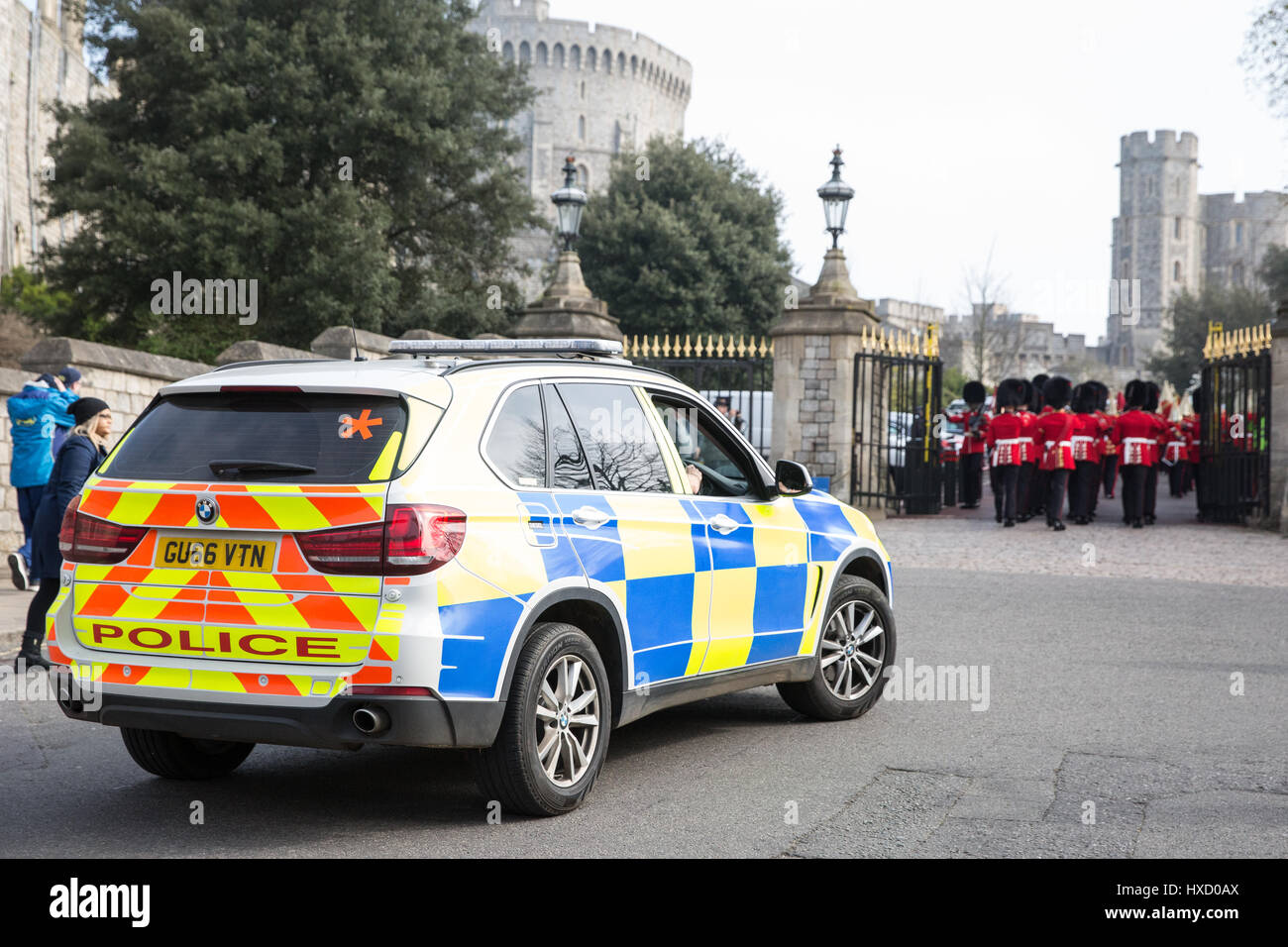
Example: https://c8.alamy.com/comp/HXD0AX/windsor-uk-27th-march-2017-...
I don't think this comparison is as good as you think it is.
Is it not legitimate to want accurate sources of data? This does not mean slightly inaccurate data is unusable, simply that it is slightly inaccurate and this to some degree impugns its legitimacy (as it should).
But of course that's not going to happen. For modern people with attention span of a goldfish it's too much of an effort to read long texts - thus they'll just keep watching the news, or reading short, one-sided tweets full of hate.
Which at the end of the day is what BLM is about, not so much the individual abuses. All that extra policing isn't distributed fairly. There are some communities in the US where the police are the kind of hands-off/come-only-when-called benefactors people expect, and there are some communities where they act more like a street gang controlling their territory, stopping and confronting anyone who seems likely to challenge their authority.
Ever seen some racists pushing their views the last 5 years in the most reactionary fashion? Of course you are drawing the line on race, believe it or not. Ever noticed the talk about white privilege by some latte-slurping pseudo academics saturating any discussion on racism without necessary experience? Some people obviously did.
You can argue that there is an established academic jargon, but I would dispute its accuracy and perspective as well.
This is a problem that could be easily greatly improved with legislation (and without requiring the more radical and controversial step of abolishing civil forfeiture entirely) - each state could legislate that civil forfeiture proceeds are to be paid into the general state budget not kept by the local police forces. This would remove much of the incentive for overuse of civil forfeiture.
What is actually occurring, as I requested. It was a hint that the reply at least wasn't up to the standard of HN.
It does not appear that this is money well spent.
My anecdotal evidence suggests otherwise, but I’d love some real data - how are you measuring that?
At a minimum, watch 100 videos. I did last night, only took about an hour, it's easy to find some to nitpick, some which are ambiguous ... and plenty that are totally horrifying.
If you can watch 100 videos in a row from Greg Doucette's list and say, "the militarization and use of force tactics of US law enforcement are not a problem" then I'd like to hear why you think so given this evidence.
Otherwise you're not speaking from an honest grappling with what these videos contain.
Of course. I don't believe you honestly think that I am advocating for inaccurate sources of data.
However, finding and discussing sources of different quality among hundreds is one thing.
Saying that you only looked at two of them, expressing skepticism towards those two, and then stating that the whole thing is "filled" with "random junk to inflate the numbers" is another. That doesn't seem like the interpretation of someone who's honest about their intentions.
If I read two sentences from your thesis, find issue with them, and then claim that you have clearly filled it with random junk to inflate the word count... yould you characterize my position as believing that some parts of your thesis are "slightly inaccurate and this to some degree impugns its legitimacy"?
On the flip side I'd like to point out that this increased OT often has downstream effects as well, most notably in pensions which are typically based on your last n months of pay. Some contracts include OT in this and some do not. So soon-to-be-retired officers could literally be increasing their pay for the rest of their lives based on increased pay due to working a riot.
There are way too many cases where a cop provokes a confrontation, often by stopping to allow someone else nearby to run into them, and every other cop in the group responds by beating anyone nearby and shoving back anyone with a camera.
You don’t get coordinated responses like that without planning and practice.
Yes, I watched a few from this link, and that admittedly small sample didn't show a single peaceful protester being abused by cops. I suppose you watched more of them?
>Guess what? The problem is that police are frequently "on edge" in their normal jobs, and as a result innocent people are seriously injured or die. And worse, police are "on edge" far more around blacks than whites, meaning far more blacks are injured by police than whites.
Could there be a reason for some of that that is not linked to racism? Are only white policemen more on-edge around black people?
>It doesn't matter what the cause is, it's a problem and is has to stop.
I can agree with that certainly.
It’s not wise to tear gas the people who are going to pay for your retirement.
url - description - what I see in the video
https://www.youtube.com/watch?v=F4_yJjdsJ_0 - trampling a peaceful protestor with a horse - protester stepped into the horse's way without looking in that direction, nobody's fault
https://www.youtube.com/watch?v=suTGneu7tZU - Shoving an unarmed woman to the curb, prompting a seizure that put her in the emergency room - police pushed somebody away from them, clip is cut right at the push, we have no context on what prompted that
https://www.youtube.com/watch?v=Eu1KRskL-0E - doing an intentional hit-and-run with a car door to an unarmed protestor standing in the non-vehicular bike lane - protesters standing in the street in front of emergency vehicles with their lights and sirens on, but the door hit (minor) was definitely intentional and unnecessary
https://www.youtube.com/watch?v=MOzn6rWbpwU - NYPD were just beating a variety of people earlier tonight because they could - police try to arrest some people who are resisting, some other protesters jump the police, police hit people with sticks, get them on the ground, handcuff. No unnecessary violence I can see.
https://www.youtube.com/watch?v=ESAl1OK5V8Y - beating a variety of unarmed protestors for sport - line of policeman pushing protesters back, nothing more
https://www.youtube.com/watch?v=S8CPc_R5iEI - pepper-spraying a variety of unarmed protestors for sport - police pepper spray protesters who got in their face insulting them, but where not violent. Pepper spray unjustified from what I can tell
https://www.youtube.com/watch?v=fGlRSPE2lL0 - Minneapolis PD officer in an SUV indiscriminately sprays random citizens with pepper spray from his car window - yes, because people where getting in the way of police vehicles with lights/siren on in the middle of the street
https://www.youtube.com/watch?v=VH0HPW8Eagk - detonating flashbang grenades in a docile crowd of unarmed protestors for sport - video shot from very far away, we can see nothing of what is going on there
https://www.youtube.com/watch?v=8G0WhaqBRb0 - shooting a random protestor in the neck with a rubber bullet, then detonating more flash-bangs - people surrounding a building with policeman on top, video of low quality with fingers in front of camera, from far away, nothing I can understand
https://www.youtube.com/watch?v=ftLzQefpBvM - Police arresting CNN reportes on air - reporter gets arrested in a very peaceful manner, both him and police are very chill. No context on why.
Those two scenarios are so far apart, attempting to draw a comparison is disturbing.
Basically you're looking at a single specific dataset, like "number of children strangled", and deciding to extrapolate from that whatever you feel like, like "a systemic and perpetual abuse of mothers and babysitters power by evil matriarchs".
Honestly, I credited this crowd with more brains. Horror porn is not an intellectual argument.
> Crime and violence are not homogeneous around the world
It's also a bit defeatist to say that somehow the US is infested with crime and violence and that must always be the case. This isn't a problem that will be solved in just one or two generations. Attitudes take a long time to change, but perhaps Police culture is part of the propblem and not just the solution.
Also, HN is a global community, and even though many television shows are watched internationally, their impact on pop culture overall can be drastically different. So, you can't assume a major show in your country will be readily recognized by your fellow nerds in another country.
Oh, but those aren't the same thing, so they're irrelevant? That's fine, because the examples you gave (pilots, crane operators, fast food chains) also have nothing to do with one another. Not the same number of operators, not the same jobs, not the same safety systems, not the same number of potential cases, not the same risk probability, not the same variables. But why be rational about what we can just get emotional over?
The United States has 330 Million people. To come up with 700 cases of police violence, all you have to do is find 700 people out of 330 Million who are being arrested for something. Find the number of arrests, find the number where people resisted, compare it to the number of cases of police arresting or detaining people without incident. You can't find that data in video clips or the news because nobody reports calm arrests, or non-arrests. I'd be very surprised if anyone cared to find out what the 700 number actually means in context.
This whole document is just horror porn to use for firing up people so they'll get angry and not use their brains. It's a very smart thing to do if you want to push a particular outcome. And I'm not saying that's even a bad thing under the circumstances. But it's quite clearly propaganda.
The statue of a slaver and mass murderer had been controversial for the past 30 years. I wonder if things would have gone differently if the "recontextualisation" plaque had been allowed.
There has, predictably, been a backlash. Resulting in this fiasco where a guy came from Essex to defend some statues he didn't understand ended up urinating on a monument he didn't notice. https://www.bbc.co.uk/news/uk-england-london-53040301
Almost all of them had outright wrong, or heavily misleading titles and/or descriptions with contradictory claims in the comments - and almost none of them provided context to the police actions.
This list is really more about stoking emotions than providing evidence of anything.
I mean look at this one...
https://twitter.com/jayjanner/status/1267111893753307137
A large volume of misleading hyperbolic claims by a biased collector/poster don't get more meaningful through volume of posts.
Every municipality has different rules for officer's conduct. According to the Bureau of Justice Statistics (Part of the Federal US Department of Justice), there are 17,985 US police agencies, of which 15,400 departments govern the 39,044 distinct local governments and municipalities. These are further divided into autonomous administrative districts often referred to as precincts.
The rules for officer misconduct change in each municipality as reactions to prior conduct or complaints. The rules are based on edicts from the state, as well as interpretations of those edicts by the local police department which create internal policy. The level of compliance with creating and updating internal policies varies. No civilian is able to know or predict the various rationale an officer may use or is able to use to behave any particular way. Civilians learn after they have had a bad encounter with an officer, or are in jail or dead. Juries learn on the spot with prosecutor instructions, sometimes those instructions themselves are misleading or incorrect. The public does not necessarily ever learn what the standards were, and the media learns after the fact and only has a patchwork of "isolated incidents" that occurred in frankly different governing systems. When put together, this fuels discontent with police as an amorphous entity, an interpretation which fuels a growing divide of non-solutions.
So the term "justified" and "unjustified" means nothing because it is different and changing everywhere and is a term that only matches your pre-existing worldview, or your predilection to appeal to authority in counties and states you have never set foot in, let alone participate in.
At least in that case you wouldn't have people arguing that the kids deserved it.
> Horror porn is not an intellectual argument.
This isn't porn, this is filming reality as it happens. I know we're all a bit numbed, but this reminds me of the decisions by the Allied forces to document Auschwitz as well as possible when it was overrun, or how the BBC footage of the Ethiopian famine sparked Live Aid. The act of filming has a habit of cutting through all the pseudo-intellectual bullshit from those arguing in favour of the brutality.
Mobs are not the law.
-Traffic cops, patrolmen, and escort/guard details do not need to carry guns. They should not be pulling people over to fish for reasons to search and detain, they should not be arresting people. It's simply not necessary, and we should not use the same people that do SWAT raids for everyday things.
Aside from mass shootings and hostage situations, there are very situations in which shooting is reasonable. Let the criminals get away with the diamonds- imagine you're on the highway when a UPS truck flies past you and the air is suddenly filled with bullets. You're terrified; any one of those could end your life. Then you realize the police are the ones endangering you. Police should be trying to get to safety and get others to safety when guns are fired.
Dominance and submission have zero place in policing and should be legally punishable. The whole concept assumes that criminality is a single entity that will stop doing crimes if the police are dominant enough. It's ludicrous; the police should never be using law as a weapon.
I mean the richest nation on earth bar none. The amount of wealth in the nation. Literally that. The USA cannot plead poverty as an excuse for why anything is worse there than any other nation. Do you see it now?
So what though? Do European countries like the UK (that are usually with the US when it's time to bomb somebody in the Middle East) outsource their domestic violence?
Really, you need to provide some evidence for "we have less crime, less murders, less police violence because the US has more". "The US has more income inequality because it has to fight wars for the European countries" doesn't follow either, so please don't.
TGD #1 shows a woman standing with a sign being run over by a horse. That's absolutely peaceful.
TGD #2 shows a woman who was walking backwards in front of a police officer being shoved so hard she flies several meters back and hits her head on the curb. She was in the officer's face, but she certainly wasn't doing anything close to rioting.
I'll watch more later, but so far that's 2/2 at the top of the list showing peaceful protesters being abused.
> Could there be a reason for some of that that is not linked to racism? Are only white policemen more on-edge around black people?
Depends on what you mean by "racism". There was a series of studies a few years ago that put people in classic "shoot / no shoot" scenarios that police are trained on (i.e., you go through a scenario and have to shoot someone before they shoot you, but only if there's actually a gun). They randomly changed the color of the skin of the people involved. Civilians shot far more blacks than whites in "no-shoot" scenarios. Police shot about the same, but there was a longer delay: meaning, their impulse was to shoot blacks faster, but their training allowed a secondary impulse to come in and moderate the first one. (Sorry I can't find a link just now.)
But there are a host of other issues as well.
These are all late 20s, early 30s people, Brazilians, Scandinavians, Germans, Dutch and so on, 1984 would immediately be known by most, quite a few have read it, none (even if they know about ATLA, what many don't) would get the reference.
Interesting I can cite a conversation I had not long ago with them to act as anecdotal data, I'm really interested to see what is the split here.
I don't think US-citizens by and large want that change bad enough to accept restrictions upon their freedoms and an end to low taxes, European-level wealth redistribution does not seem to be popular in the US. I suppose they'd like the result without doing it. Unfortunately that's like wanting to be great at tennis without wanting to put in the training: understandable, but not happening.
Since it was American made, that makes it a cartoon and not an anime.
1984 is a very popular and influential book.
I fairly confident that if you asked the authors of Avatar The Last Airbender they would tell you straight that they’d based that idea on 1984.
I’d be willing to bet people will be quoting 1984 long after ATLA has been forgotten.
I'm pretty sure that that's what I just proposed, by causing the results of supervision and discipline to trigger negative consequences.
That sounded interesting, so I tried to find some.
First one I found was this https://www.researchgate.net/publication/235256692_Results_f...
-- the conclusion seemed to be exactly counter to what the research you were talking about showed. "In addition, where errors were made, participants across experiments were more likely to shoot unarmed White suspects than unarmed Black or Hispanic suspects, and were more likely to fail to shoot armed Black suspects than armed White or Hispanic suspects."
Is the expectation that curfew is an order that should not be enforced in the strictest sense?
From what I could see on the news, parts of your country were being burned down and looted by some rogue elements who used the cover of peaceful protests to spring into action. To protect the lives and livelihoods of those affected, a curfew was imposed, which was then violated. If I lived in those areas I would have liked to see the curfew enforced as harshly as possible because if it is not enforced then I will lose the local businesses who I depend on to live in that area.
What is the expected approach to law enforcement when extreme measures like curfew orders are not obeyed, particularly during a pandemic?
A lot of these videos seem to be omitting the all-important context. In my country I would want the police to beat the ever loving expletive out of people who do go out in large crowds during a pandemic. I would want the police to use all measures available at their disposal to injure and dissuade people from breaking a curfew and unwittingly providing cover for criminals.
Perhaps in first world countries life has become soft and comfortable so there is some expectation of civil behavior from everyone in society, but clearly that has not happened in the USA and many other countries.
Many of the protests are peaceful, and a lot of anger can be easily empathized with, I can't imagine anyone who was not furious after seeing these horrible videos of police inflicted killings. Under no circumstances can I be convinced that looting and rioting is an acceptable outcome. If protesters know that their peaceful assembly is being hijacked by criminals who go out and loot and riot under the cover they provide, and they go out and protest more, then they are complicit in the rioting.
Perhaps these are cultural differences, but coming from a police where the police are infinitely more barbaric, corrupt, rude and ruthless than the USA, I find the police doing the best they can to manage the absolute mess that the citizens are creating.
You all live in a country where many police wear body cameras. That is privileged beyond anything I can hope to imagine for my country. It's weird to empathize with you when you have it so good.
This is absolutely true, but the problem goes much deeper than just the police force itself. We seem to want to solve every imaginable social problem with police/courts/prisons. Drug abuse needs to be viewed as a public health problem, not a criminal problem. Homelessness as a housing and mental health problem, not a criminal one. Many other issues as economic problems not criminal ones. Address the root cause, rather than sending people with badges and guns. I realize this is easier said than done, but it's clear the old approach is no longer acceptable to society.
The original two posters in this thread were also intimately familiar with Ba Sing Se / Avatar the Last Airbender. So multiple people here are fully aware of the reference and are in good communication.
I probably wouldn't reach for a reference to ATLA myself. But, apparently its popular enough that plenty of different posters in this very discussion are aware of it and able to explain to other people here the concept.
Are there instances where police abuse their power? Yes. Absolutely. But it doesn't help anyone when people are cherry picking instances where escalation of force was warranted, but they do not show the full context leading up to that escalation.
I would like to see meaningful police reform as much as anyone else. But we need to be pragmatic about any examples we cite as "abuse of force". Let's create a list of absolutely cut-and-dry instances of police brutality, then move from there.
I have no doubt that American can-do and talent will get it done.
None.
Just decide what it is, what the scoreboard looks like and get it done as Americans the American way.
I think we need some massive overhauling of how accountability works in police situations and I think that will have to start with shit rolling uphill.
If there is an incentive program doing measurements it must never be measurements of "number of arrests" or similar. It should be measurements of job approval instead.
But, also, rubber bullets are less lethal, not non lethal, and so they should be reserved for situations where life is at risk. If she wasn't throwing molotov cocktails or bricks they shouldn't have used rubber bullets on her.
The other claim is that she was pregnant and thus shouldn't have gone. This is incoherent: we want protests to be non-violent, so we want pregnant women and children to be able to attend.
Thanks for laying out some of that context on Seattle PD.
Minneapolis was burning before the police responded, not after.
I disagree. That's what makes this so much more difficult. If it required planning and practice, we could find the meeting place and itinerary and correct it.
This is much more subtle. This is the kind of thing you can get when you group like minded individuals together and give them power. Without directly orchestrating, they pick up cues and work together.
It's like when a company hires a new person and there's no rule explicitly saying they have to work overtime, but they see everyone else doing it and soon they are too.
Your belief is (?) that the US aggregate violence/whatever is in no meaningful way confounded with the levels you measure in (say) EU nations: any confounding is small enough to make no difference?
We have a population of 200 (nations) of very diverse size and age, all related by historic and present competition and cooperation. Is there any fair shot at comparing apples to apples?
What sort of “evidence” would you reasonably concede to?
Maybe in your country blind, extrajudicial violence is not a no-no. This is not the case in democratic countries.
>To protect the lives and livelihoods of those affected, a curfew was imposed, which was then violated.
This is a) a slippery slope (a corrupt government would declare a curfew every time it wanted to stop protests) and, b) it prioritizes material wealth over a movement that wants to achieve social change (in the grand scheme of things, decreasing racism is much more valuable that the stores of some neighborhoods).
>Under no circumstances can I be convinced that looting and rioting is an acceptable outcome.
Really? Under no circumstances? Social equality movements have produced riots since time immemorial. Do you denounce the acts of Spartacus? The peasants revolt? The French revolution?
People who claim this are usually ignorant about how social change is made.
Few issues with the straightforward narrative you present.
Cops will slowly corral protestors as curfew draws near by setting up blockades or raising drawbridges. Peaceful protestors want to go home but can't. They're confused, and then curfew hits and police begin loading them into wagons. It's not as simple as get home by curfew.
Cops will infiltrate and instigate protests using a variety of tactics, the goal being to escalate tension, and justify the amount of force the cops wish to use.
Similar to your stated preference, they can't wait to be able to justify beating citizens with an overwhelming show of force. It's the fastest way back to status quo. A status quo you admit is broken, but worth using violence to return to. There's a catch-22 in your reasoning here you might be able to poke at.
Body cams and other forms of accountability do not work because the disciplinary board is not independent and not impartial.
Perhaps our countries aren't so different.
states run themselves, and the federal judiciary basically only steps in when state/local governments don't follow their own rules (the presumed expression of the will of the people) or violate the constitution. the constrained executive response follows from the judiciary (and sometimes the legislature).
and that's the way it should be. you want power local and limited, not consolidated and far away. that would only make things like use of force worse.
so the immediate appeal to authority should be to the local, and then state, judiciary and legislature stepping in with corrective actions. the feds aren't of much use here. they're intentionally a line of last (and slow) resort.
All the money made being an imperial power just lines the pockets of the rich.
There are plenty of calls where a mental health professional should either handle the situation entirely or at least be the one calling the shots.
And despite this, it's continually hammered home into their heads that they have a very, very dangerous job. Yeah, you're correct, it's fear from the lies told to them.
In Chicago the curfew didn't start until 9pm. The impression I had during that first week was the curfew was to get most of the law-abiding citizens off the street ("essential workers" were excluded), so the police had less uncertainty to deal with - they were just completely overwhelmed by the amount of rioters and looters.
> Perhaps in first world countries life has become soft and comfortable so there is some expectation of civil behavior from everyone in society, but clearly that has not happened in the USA and many other countries.
Rather agreed here; if anything that week has me leaning towards needing more police, not defunding them.
Quick edit: It seems they're also now on 12-hour days with no time off, apparently expecting more chaos in the coming days.
The worst thing they ever used, as far as I remember, was water cannons and riot shields.
"Address the root cause", exactly, and the root cause is the unjust laws. Though cops pretty much never being found guilty for unjust use of violence is a big one too, and I wonder what law changes can solve that issue.
What does the number of followers have to with whether a statement is true or not? That's absurd. Donald Trump and Elon Musk have tens of millions of followers on Twitter; I have very few. Does that make me a liar?
Second, why shoot to kill and not to incapacitate? Shoot to kill is a policy. Why is that a policy?
The police rule by fear. I’ve never broken the law and yet Im really affraid of cops in the US. I know I should not have a reason to but can’t help but be intimidated by their tactics, their orders, their demeanour. And I act like a scared ghost anytime I get stopped by them: I am afraid that if any answer I’d give them might make them punish me with one more more tickets.
Along with reading your other comments here, I viewed these 4 questions as a bad faith attempt at steering the conversation off topic. When people complain about police brutality, we are not talking about the times when police have to legitimately defend themselves or disarm someone. This thread is specifically about the hundreds of clearly documented examples of unprovoked violence by police in the US over the last few weeks, many of them against journalists, elderly people, kneeling protestors and so on. Please engage with that and don't try to change the subject again.
cops are entitled because unions make them this way. take away their safety net and you seeing more terminations and less bullies and entitled people applying for the job.
Free will is a thing, and the police cannot make you go out and commit vandalism, mayhem, and murder.
When a second one crashed, the focus quickly shifted.
It is a common attitude in aviation that even pilot error is really a systems fault. Perhaps opposing buttons are too close together, or some control requires attention to be diverted at the wrong time, or pilots are allowed to fly too many hours without adequate rest, or plenty of other things that could contribute to predictable human failure.
It seems obvious that we can predict human failure in current policing. If two incidents with a 737 lead to an indefinite grounding, what's the right number for this situation?
In the case of the airplane, grounding does not create a public safety issue. And there are, of course, many alternatives that can keep the overall system up and running in the meantime. The solution to police brutality requires much more thought.
What's the analogous conclusion from this to police brutality videos? You watch 100 and begin to think you should never talk to a cop again?
Sure you can post up a bad conclusion to draw and then attack it. I'm pretty sure there's a name for this sort of thing.
Does this mean that people just do not care, or there is only some minority who thinks that the police is too violent and the rest is ok with that?
Damn. Well that's the best rebuttle I'm going to see this week.
> This isn't porn, this is filming reality as it happens. I know we're all a bit numbed, but this reminds me of the decisions by the Allied forces to document Auschwitz as well as possible when it was overrun, or how the BBC footage of the Ethiopian famine sparked Live Aid. The act of filming has a habit of cutting through all the pseudo-intellectual bullshit from those arguing in favour of the brutality.
To add to this sentiment; this is literally what's going on in the USA right now. Obviously it isn't every cop in every city, or protesters would be exercising their 2nd amendment rights en masse. But these actions documented here are inarguably immoral, and IF they are legal, the law needs to be changed immediately. It's absolutely disgusting, and if seeing these videos of police brutality doesn't invoke that feeling in you, take some time to imagine it's you or your loved one getting beaten, maced, tear gassed. These forms of crowd control are immensely painful, pain that a lot of us have never felt, and they leave lasting damage.
But that only works for super powers? Why is there no trend visible for countries like Switzerland who are traditionally neutral and never fight wars with neighboring countries like France who or Germany who have a larger active military, do engage in NATO wars etc? Why aren't the Chinese shooting each other on a similar scale? Why weren't the Germans during the early 20th century when they were very militaristic? Why were the US already at similar levels in the first half of the 20th century, before becoming a global super power that others may have "outsourced" their wars to?
> What sort of “evidence” would you reasonably concede to?
Minimum requirements: has some sort of rule that allows predictions that can be falsified other than "it's only true in this super specific narrow case of the USA in last 5 decades of human history, but not in any other place or during any other time".
It feels like looking for super complicated reasons that require American Exceptionalism (as in "does not apply to any other country") to explain something that is explained by well-studied phenomena that do not require US citizens to function fundamentally different than other humans in other places or other times.
You may be mistakenly assuming that exhausting the pension fund directly cuts pensions for those covered, which would still be remote just in targeted individuals and time, but there is no necessary relationship there. It just makes it more likely that the public authority would be forced to declare bankruptcy because it can't meet it's pension obligations, at which point it might be able to shed pension obligations for employees (not just those covered by the fund, if the police have a distinct fund!) as part of the bankruptcy, but that could happen as a result of direct settlement payments, as well.
In the fairly common case where the police don't even have even have their own pension fund but contribute to a common fund with other employees, perhaps not even from the same local jurisdiction (e.g., California local governments where often both police and other employees are covered by CalPERS), taking it out of the fund would even lack the symbolic sense that it has in the more simple case.
If you want direct liability for the people doing the immediate wrong, you want an end to, or limitations on, qualified immunity, not redirecting public authoriry liability to pension funds. That, of course, would make the public authority not responsible, but to would mean that individual cops would also be responsible on civil suits.
https://www.theatlantic.com/politics/archive/2018/07/poll-pr...
> Does this mean that people just do not care, or there is only some minority who thinks that the police is too violent and the rest is ok with that?
Yeah, basically. Especially that last part.
If I reported that someone is using corporate assets (printer, laptop) for personal things, my manager would consider me crazy. If I reported someone being bit late, it would be the same.
That is exactly the culture thing. The corporate printer or laptop being used is not being seen as an issue by me, you or anybody else, regardless of what official rules say.
You don't have to be killed "feloniously" to be dead. And you don't have to be killed at all to have your life destroyed.
You can do better than this rhetoric question. The analogous conclusion would be that there is a systemic issue with the police and you'd prefer not to deal with them again, by defunding or dissolving the police force (seems to be a current wish by many).
> Sure you can post up a bad conclusion to draw and then attack it. I'm pretty sure there's a name for this sort of thing.
Sure you can pretend it's a bad conclusion when it's about the effect of watching selected videos and how drawing any conclusions from that is naive.
I am doing the courtesy of telling you why I downvoted you.
If telling you why I downvoted you then also compels me to justify my position in an extended way, then I will not do it in the future. Instead I will just silently downvote when I feel it is warranted.
2) Because there is no such thing as shoot to wound. If you've gotten to the point where you're shooting at someone they need to be dead. Any bullet holes in your body are potentially fatal. Especially the famous leg shot; damage to your femoral artery will kill you extremely quickly.
Germany has 16 state level and one federal, plus customs (not legally a police force with a lot less jurisdiction)
France has two, Police national and Gendamerie.
Obviously a slight oversimplification when counting stuff like the BKA / LKA (maybe the German equivalent to the FBI?) as seperate bodies. But roughly across Europe you have two levels,local and federal. Both are reporting, one way or the other, to the respective Ministeries of the Interior. Quite adifference compared to the US, where the highest authority can be a mayor. or none, if I understood the thing with local Sherrifs correctly.
That's not my impression when people are openly calling for defunding or disbanding police departments. Those who are concerned with the tails are the sane voices drowning in a sea of insanity these days.
I agree that the outliers are the problem, but how uncommon they are cannot be determined in this way.
"Oh well I guess its just really hard." Is NOT an answer.
In fact, you cant really call someone a criminal until they've been convicted of a crime - cue the video of the cops being called by the black store owner, punching him in the face and breaking his jaw while the white thief leaves.
2. Have you ever shot a gun? Have you ever shot a pistol? Now to simulate the Andrenaline dump run few sprints then try again. You CAN NOT shoot to disable this is not a Hollywood movie, it does not work. Most people can’t hit anything past few meters away with a pistol.
Gun is not a taser or a nightstick. It is a lethal weapon and should only be employed when you have a reason to kill.
So if I'm driving drunk, then I'm not prosecuted until there's a victim?
Hm...
At least this one comes clearly labelled and backed by some evidence.
The deep seated issue is the principle agent problem around elected officials. The police threaten the politicians, who don't want to rock the boat, to get a lopsided contract that makes them virtually immune to any oversight. This is why we're literally at "defund the police" - citizens are finally crying uncle and demanding that their city's entire contract be thrown away and redesigned.
Why are you distorting my answer?
Look, I can rephrase it for you: it's also not surprising that there aren't 700 videos of scientists molesting women on arctic research stations.
Where do you aim if you want to "shoot to incapacitate"?
No such place exists on the body. Even using small, low-powered rounds like a .22 rimfire short carry extreme risk of death no matter where you aim.
The answer is more simple. Don't pull out that gun unless what the person is doing warrants death. I don't know that attempting to apprehend a DUI is worth killing someone over. If you're responding to a domestic violence situation where someone's running around with a knife though, it's likely that a gun isn't a terrible consideration.
I think the real issue is getting in the competitive zone. "I'm not going to let this pero beat me" instead of considering if the cure is worse than the disease.
Normal summer weekend you have at least couple dozen people shot(not by cops, so you never hear about them)
If you see a single restaurant chain use horrible ingredients for humans, trans fats, far too many preservatives, high fructose corn syrup, over and over, you should never eat there again. I've personally cut out mcdonalds, and the fast food garbage restaurants. It doesn't mean every restaurant is bad, it means some restaurant models are bad. I still eat shawarma, I still eat indian and thai, and my family still owns an italian restaurant where we also don't try to poison our customers with horrible ingredients.
If you're comparing police to restaurants, then let me ask you, then on a scale of Taco Bell to El Buli, where does the current american system police system lie on the scale? I'd argue it's more like at the dumpster outside of your local mcdonalds.
Your use of "unjustified" is entirely subjective. I don't know what your specific threshold is for justified violence against peaceful protestors, and it's a waste of time to try and guess what that threshold is. It's a waste of time for us to filter the data, only for you to then point out two videos you disagree with and ask everyone to repeat the same work over and over again.
All of the raw data is available to you in a list format. If you think there are errors, then fork the repo, file a pull request, or create an issue. Make your own list that demonstrates your point.
Compare that to the opaqueness of police misconduct/brutality internal investigations, or how frequently even the bad actors that are known to have done wrong, are still granted their pensions. Where is the equivalent payout for a restaurant owner who doesn't follow health rules? Where do you see other restaurant owners banding together to defend a restaurateur who's had their misconduct exposed? Where do you see something equivalent to "qualified immunity" for the food industry?
In other words, this is a great example of a reasonably well-functioning market. If regulating the police behaved much more like regulating the food industry, that would actually be fantastic. In many ways, that is exactly the goal of the protests, to bring a similar level of transparency and accountability and high standards to policing, as most people already expect and has long been standard for the food industry (in developed countries).
What about just thinking that restaurants need serious reform and accountability?
I just want to answer your question about shooting to kill vs incapacitate.
The first part of the answer is that nobody should shoot anyone who they don’t reasonably believe is trying to kill them. This applies to citizens or police. Generally it is the standard applied in citizen self-defense scenarios.
The second part is that shooting isn’t that easy or effective. Certainly not how it appears in the movies. It is hard to hit a 6” moving target in a stressful situation, even at relatively close range, and would require training and practice that simply isn’t available to cops. Added to this, there is no reliable place to shoot someone that will incapacitate them without also being likely to kill them. Surprisingly many people will continue to fight after being shot, so even if the cop had the ability to ‘shoot them in the leg’, for example, they would still be at risk of being killed by an aggressive adversary.
In addition, any responsible use of firearms has to take into account the environment. Handgun bullets are still lethal hundreds of meters from where they are fired. When cops miss their targets, bullets can and do kill bystanders, or ricochet or fragment and cause injury to people not even in the line of fire.
So the guidance to anyone using a gun in self defense is generally to shoot for the ‘center of mass’. This is primary because hitting the central nervous system or vital organs is the only reliable way to stop someone, but also because it’s impractical and unsafe to aim anywhere else.
None of this is meant to justify police shootings. Quite the opposite. I am just explaining why every gun use is necessarily a lethal encounter.
If a politician suggests “shooting them in the leg”, the one thing you can be certain of is that they are completely incompetent on this topic, and can not be trusted to improve matters.
The efforts to "defund police" would solve some of the same problems that police currently address through other means. This would weaken the influence of police unions. For example, spending more to treat drug addiction as a disease rather than paying police to address possession as a crime.
Maybe in your country but in many, many places in the world this is demonstrably not the case.
If you watched 100 videos of kitchen malpractice within restaurants in which:
- The acts of malpractice had broadly consistent characteristics
- The restaurants in question were all owned under the same organizational umbrella
- That organizational umbrella had the authority and exclusive control of the US government
And then drew the conclusion that maybe there were systemic problems that lead to these remarkably consistent issues, you'd be completely rational.
As for your other comparison between this and "the media" curating street interviews, I don't see the parallels at all.
A news outlet using a random interview with a person on the street as evidence that people are "divided over climate change" is clearly manipulative. In this case, a person is saying "Police are routinely using military equipment and force tactics against US citizens in disturbing ways. Here are 700 videos of it as evidence."
https://time.com/5848705/disband-and-replace-minneapolis-pol...
https://en.wikipedia.org/wiki/List_of_killings_by_law_enforc...
United States is between Congo and Iraq when sorted by rate per 10 mil. people.
The first european country is way down that list.
Just to play devils advocate, can't I conclude there is a problem without that problem being the "militarization" of the police force. In other words aren't I allowed to conclude there was a problem prior to the militarization of the police force, and really what we are seeing proliferation of video recordings that are now making us think these acts are new, when the reality is they happened in mass occurred prior to militarization of police...and as scary as it sounds accountability is increasing because of the video?
Then on the extreme end of devils advocate, lets say we all watched 100 videos that made us sick to our stomach...how many millions of police interactions have we not seen that might suggest the bad acts is a drop in the bucket compared to the overall data. Not unlike maybe a few bad actors that have looted or committed arson, or committed murder during the BLM protests, do those acts suggest the entire culture of BLM movement is tainted?
One of the things that really makes me sick about the George Floyd death which doesn't get a lot of attention is that the prosecutors/state attorneys originally swept it under the rug and refused to bring charges. Thank god for the video, even though it didn't stop the act, we all see the tragedy we see the victim we see the cop and attach names and faces...but who knows the names of the prosecutors who watched this video and said "no, nothing wrong here, no charges?" Nameless, faceless people protecting the officers behind the scene enabling offices to act any way they want knowing they will be protected...and maybe if we corrected that problem and officer didn't feel they could act in any fashion they wanted and receive protection perhaps we would see officers act a little differently in the streets.
Generally agree apart from this - if cops don't have training to be expert (or at least above-average good) shooters, then that's a failure. We've read tons of articles about militarization of US police. If they have budget for armored vehicles, for sure they have budget for (very cheap but quality basic) 9mm ammunition for practice.
Those are 'real' accidents; and if some are not, like DUI, there are laws against them that are enforced. If tomorrow, society stops charging DUI offenders people would protest too.
That's not the case with police brutality. We have seen again and again the police face no consequences for their brutality. That's what the people are protesting against. If every one of these cops were appropriately fired, charged and jailed, this wouldn't be a big of an issue. That simply does not happen.
The second point being, theoretically people trust cops to keep law and order and to ensure safety. So it is rightly expected for them to have higher standard of conduct and the fact that this does not happen is a systemic failure.
I think this might be a good example of a larger structural problem. culturally, we accept that going to a bar with friends or having a few glasses of wine at a restaurant is a reasonable thing for an adult to do. but a large portion of the US is set up in a way that bars and restaurants are not within walking distance of homes, and the public transit is poor or nonexistent. if I, a 145 lb male, have a cocktail and a glass of wine at dinner, I'm pretty likely to be above the legal limit by the time I leave. I don't do this; I either drink less or arrange a different way to get home, but I do think the combination of law, culture, and (lack of) infrastructure pushes people towards committing a crime here.
However, it is worth pointing out that there are around 750,000 police officers in the US. It is hard to deny that finding and or training 750,000 highly capable people is a very difficult problem.
No of course not, but there are measures you can take to reduce bad practices, which is why we do those measures for restaurants! Let's make police accountable for their crimes the same way we make restaurant owners and employees accountable for e.g. food safety issues.
The US looks more like a third world country than a developed nation.
Oftentimes, I think people say things like "I don't think a few bad police officers ruin policing just like I don't think BLM is evil because of a few violent actors" because they have empathy for police officers who don't do horrible things, and it's sort of a knee jerk reaction against broadly characterizing people.
The problem, however, is that the two groups aren't equivalent. If we granted every person who identified with the BLM movement the same authority as we do police officers, the presence of violent actors inside BLM protests would be an issue. But we don't.
Police officers are given the utmost authority and deterrence in America. They have particular legal protections, they are authorized by the government to give legally enforceable orders to other citizens, etc. Even if the bad acts are a "drop in the bucket," would that be acceptable? And isn't the fact that these bad acts are persistent—regardless of frequency relative to good acts—at the very least suggestive of systemic issues?
In other words, consistent bad acts—even if infrequent—are a bigger deal when the actor is in such a position of authority. Protest groups are clearly not in such a position—hence their protests.
Police don't have a centralized authority. And it really depends on how big the chain restaurant is if 100 videos would have it shut down.
The better argument is that each one of those restaurants would be exposed and either they would put in enough effort to show they have improved or people would stop eating there. You can't boycott your local police.
However personally speaking I would (and do) in fact discount a reading where even two sentences are highly suspect; it makes it not worth spending the time to read the rest of it.
As another example, I work primarily in data analytics. If I produce a report where even a single number is wrong, it almost immediately calls into question all of the other reporting I produced (did they use the same unreliable source? what transformations did they apply? was any sanity checking performed?). And, as it should.
Accuracy is incredibly important to making things appear legitimate.
Many illegal drugs have a potential of causing harm.
Should the harm be purely physical?
Homelessness is a public nuisance, which we can choose to ignore, but so is walking naked in a school yard, which will be seen as a much more controversial subject.
Most people don't want to defund their police. Per the latest Monmouth poll, about 60% favor the police (compared to ~11% for congress) and most people see the police as their protectors.
Police don't get a lopsided contract by threatening politicians and that's a grossly inflammatory claim. Contracts are negotiated like any other, and given that most people don't want to spend their time being spit on and attacked, it turns out you get to ask for a fair bit of protection in that contract.
> Blaming voters is a fallacy of late-stage Democracy
Blaming anyone else is a fundamental misunderstanding of Democracy. Everyone pretends to like Democracy until they realize not everyone shares their opinion, and then all of a sudden pull out the insults and attacks on fellow voters.
I mean, if you've had a few drinks and get in your car, you're not going to be automatically stopped and ticketed. Instead you're weighing the risk that a cop is going to just happen to catch you.
If the laws are changed so that driving drunk isn't presumptively a crime, but rather that if you're in a crash and found to have high levels of alcohol in your blood, then the crash is assumed to be your fault and will have extremely high penalties, then the difference is just in the details. You'd be balancing a lower risk, but of a much higher cost.
That might not work as well because of some people having poor skills at discounting future risks, but it's not obvious that's the case. It deserves further investigation.
That's really all we need to know to demand radical changes to police culture, if not the entire concept of ubiquitous armed police forces.
Most armed folks are taught that when you draw a gun it's to neutralize a threat. To neutralize is to completely eliminate the threat.
Has anyone here heard similar sentiments while getting a concealed carry license?
Something like 'Don't pull your gun out and point it at someone unless you intend to shoot and kill them. Anything less than that needlessly escalates the severity of a situation by introducing a weapon.'
The idea being that if you pull out a gun and don't use it, all of the sudden you have increased the potential for violence, exposed yourself as armed and willing, lost the element of surprise, and given potential assailants the idea/opportunity to match your use of force. Thus, "shoot to kill."
One problem is that guns are tools for a task, and when you pull out a tool, you want to leverage it as efficiently as possible. Maybe the answer isn't to use the tool differently, but use a different tool entirely.
Notably, the German police is also trained for much longer, three to four years at minimum. They're trained with guns to aim for parts of the body that make it less likely to kill a target instantly or quickly and instead incapacitates them (of course, with a gun you can never know but you can alter the odds) and to only use guns as the very last resort of stopping someone. Every bullet a german police officer fires in the line of duty is accounted for (54 in 2018) and every person killed is investigated by police officers from a different precinct (11 killed in 2018). From what I've experienced and seen, guns seem to be treated as the first weapon of choice for the police officer in the US, which is the wrong mentality.
The real reason they shoot to kill is because they don’t want the victim to sue. A dead man never sued, their families have a lower chance of getting anything though that has started to change with so much footage.
Absolutely, I was taught this in my self-defense shooting class. The question of kill or not kill doesn't enter into it at all. We were trained to neutralize the threat, full stop. The effect on the future health of that threat doesn't enter into it.
And this makes sense when you understand that gunfights don't happen the way you see on TV. There, when someone is hit with a bullet they fall down and stop being a threat. This is not how the world works. In the real world, unless their circulatory system or nervous system is taken offline, they will continue to be a threat. Even if they've been hit through the aorta or femoral artery or something that is likely to be fatal, it'll take a minute or two at least for the effect to occur, and in the meantime, they're going to keep trying to kill you.
Some people have mental issues and normally they twitch a lot. And cops claim they were afraid for their lives, it’s the easy license to kill. I find that barbaric and no wonder we see so much backlash against the police force!!!
I am just curious at this choice of word that seems to be the clarion call, which means entirely different in the dictionary than what is being implied! :-/
Eventually I saw a pattern, surprising since it was common in major cities all across the US and as if there were some single, central training materials. Apparently:
(1) Police are taught to be in control of any contact with a citizen. Recently the police have been taught to act nice initially, but, once it is clear some actual law enforcement is to be involved, be in control.
Being in control can mean that the citizen has been intimidated and made submissive so that they won't resist. Part of this is to demand that a citizen DO some little things, e.g., stand with feet apart, move back 10 feet, or tolerate being falsely accused of something, e.g., "weaving" in the road, being too close to the officer, etc. The officers are looking for things, even trivial, fake things, to object to so that they can object. It's like Captain Sobel in the 101st Airborne training in the series Band of Brothers -- "find some" infractions so that can complain about them and force the soldiers to accept being falsely accused so that they will be more compliant -- the police seem to have borrowed this tactic.
If the citizen does not look submissive, then the officer provokes a defensive reaction from the citizen so that they can arrest the citizen or threaten to arrest them.
Then, finally, maybe arrested, the citizen has been subdued and is submissive, which is what the police wanted to begin with.
(2) The police like to teach citizens, to change their attitude, and do this by hurting them, e.g., hitting them with a club, bending their arms, throwing them to the ground and putting a knee on their neck, spraying them with pepper spray, etc. They regard good police work as meting out "cruel and unusual punishment", with pain and maybe serious injury, without "due process". So, the police want to be absolute dictators on the streets.
(3) In a confrontation with a citizen, the police want some result where they successfully took some law enforcement action, a ticket or an arrest. E.g., in Atlanta, at first they didn't want merely to leave the citizen alone or, if the citizen was drunk, let him call a cab and (ii) later wanted to make sure the citizen was not able just to run away. The reaction to a citizen running away?
"Shoot them and kill them. Gee, they might 'get away'; can't permit that; that would violate due respect for the police; so, shoot the citizen." -- or some such.
(4) The expected, usual approach to an arrest is to throw the citizen to the ground, hold them down with a knee to their neck, their arms behind their back, and put on handcuffs.
From the 100 or so videos I watched, it appeared that (1)-(4) are so standard that they have been taught from some standard source. E.g., in all of that, some semi-bright guy had the idea that it was good to put a knee on a neck, and it appears that that is now standard.
Apparently part of (1)-(4) is the associated support for it from the Blue Line, e.g., police unions, Police Benevolent Associations, liability insurance cities buy for their police, the norm of police sticking together, local prosecutors, DAs, and judges who work daily with police and want to cooperate, politicians who want safe streets, etc. And at times maybe there has been more to police power, e.g., confiscating cash, shakedowns, payoffs, etc.
I'm sure that changing (1)-(4) can be done but won't be easy.
No, I believe injustice anywhere is injustice everywhere. Also, I agree with you the injustice is worse when committed by people in positions of authority acting in that official capacity.
That said I don't condemn everyone based on the acts of one or some, that goes for police and BLM.
>And isn't the fact that these bad acts are persistent—regardless of frequency relative to good acts—at the very least suggestive of systemic issues?
Yes, part of why I am happy about the proliferation of video and want to shine a light on the nameless, faceless prosecutors making decisions behind the scenes to sweep these tragedies under the rug to protect the officers. Again no one talks about it, no one knows the name of the prosecutor who initially watched the video and refused to bring the charges against George Floyd's murder(s), that helps fuel the systemic issues. Video will help with accountability, but that is only helpful for what happens on the streets, we need to also focus on behind the scenes on the nameless, faceless people protecting bad actors.
Let me remind you that the whole discussion started by me highlighting the popularity of The Last Airbender (due to Netflix, as someone pointed out) by comparing it to a mainstream show. I could have taken any popular show but thought taking the one topping the charts would be enough to illustrate it. Apparently not, and in the future I must carefully review the viewing habits of the whole HN community in order to make a point and not offend anyone.
So let me revise the comment: The Last Airbender is as mainstream as any other popular show today.
In Long Island a higher ranked cop would retire after 20 years with a pension of 500k, and in Long Island they really don’t do anything. While that, a new recruit in the Bronx would start at salary of 40k with poor training and lots of headaches. Seems like we need to reform the police!
Discussions about these things just started popping up on NPR and other sources. They brought it up on themselves.
There are crimes that put people at risk but don't always create a victim. Do we allow for crimes that have a risk of a victim even if there isn't a direct victim?
There are crimes where we say that someone is a victim despite their own feelings of being victimized or having suffered a crime. Do those stay as well?
We have crimes where there isn't someone physically hurt and not a direct theft, but there is a reduction in value of items. Do those crimes stay?
Take zoning laws. Is violating a zoning law victimless? If I open a foul smelling poultry factory in the middle of a downtown commercial zone, it could greatly negatively impact that commercial zone to the point where businesses would not be able to afford to stay open. But if that makes it a victim crime, then what about when homeless people living in that same area also drive away customers to the point it no longer functions as a commercial zone?
As for drugs, what happens when companies start selling direct to users? Antibiotics and opioids without needing a doctor's prescription. We already have seen the problems even when doctor prescriptions are required, imagine what happens if drugs are declared a victimless crime and no longer prosecuted.
I think the notion that some crimes are victimless is based on looking at specific incidents that don't have victims and not considering it at scale. Which is to say that the example by the other poster of drunk driving might be a much more fairer comparison than what people originally took it as, because while the relation between the risk and possible victim is easier to understand, the question is if such a relationship is consistently used to justify a victim, not if the relationship is easy to understand.
I've never heard of this practice, and the opposite is regularly taught to various armed forces around the world. I'm curious to read about it, do you have any info or sources to share?
> Per the latest Monmouth poll, about 60% favor the police (compared to ~11% for congress) and most people see the police as their protectors
Unfortunately this instance of corruption is a tough nut to crack. The sheer majority of people will never be victims of the police, just as most people will never be victims of any violent criminal. Hence the focus on video evidence and actually discussing the issue now that it has the spotlight, getting more people to care about these unaccountable criminal gangs calling themselves police. It's called solidarity and the rule of law - caring about what is right even when it does not affect you personally.
>> Blaming voters is a fallacy of late-stage Democracy
> Everyone pretends to like Democracy until they realize not everyone shares their opinion
You just seem to be going on a tangential rant here. I was referring specifically to this tendency to ascribe a democratically-chosen action as the responsibility of everyone who was given a chance to vote. I personally do not hold up Democracy as some sort of ideal, but rather Liberty.
That's nonsense. Evidence is never excluded because it doesn't tell the whole story. If that were the case, admitting any evidence at all would be a rare occurrence. Rather, each side in a case tries to piece together their version of the story with the evidence that is available to them. Generally speaking, evidence is only excluded if it's unreliable (e.g. hearsay) or irrelevant.
Of course if all humans are law abiding citizens there would be no issue to begin with. I think every society with lower crime has significantly smaller police brutality issue with some rare exceptions like Hong Kong.
If you did that, and then decided we needed either better laws concerning food safety, or better enforcement of existing laws... where is the logical issue? If someone was to make the argument that a certain tolerance of bad food handling is to be allowed, then we would need to know the rate to know if we needed to make changes, but if the view point is that no restaurant should be engaging in that behavior then I don't particularly see the issue.
A theory where every nation is a data point can’t get you anywhere. All the nations interact meaning we should reason about the system as a whole.
I say something about a nation, you expect me to back it up with other nations. But there are very few data points, and they are interconnected, and the problem has a huge number of dimensions.
It’s like I claim opposable thumbs are good for tool making and you ask me to show five other body parts where that applies.
If you read the sibling comments they are trying to say NCIS is not mainstream at all since TV ratings mean nothing, making the opposite point of yours. You guys are impossible.
Sure, if there's someone hanging out by themselves then de-escalate and do whatever. The moment there are innocent people in harms way though, that calculus changes.
De-escalation is a great catch phrase, but it's not a universal solution. It's one tool of many, and it has a time and place.
The most obvious answer seems to be to fine the offenders, but really, how do you fine a homeless person?
Just as a synopsis, systemic racism became a more subtle segregation. POC (People or Person of Color) were systematically made to appear more violent and criminal-like over time. Combine that notion with an idealized notion of the police as hero figures and you have a recipe for rationalizing violence against POC.
Mobile phone videos allowed us to see from the victim's perspective just how brutal police have become.
"How it happens that all those mayors and sheriffs are still in the office if police brutality is such a big issue?"
To this point, you need to understand about voting districts and how POC voting power has been diluted and prevented over decades.
That's false. Qualified immunity is a result of a supreme court decision and not part of police contracts. The only thing in most contracts is that police officers who are fired get a chance at mediation for firing disputes.
Police officers do get legal protections, the same way you and I get them. You can't release private records of a police officer, you can't sacrifice them publically to appease an angry group, etc etc.
Actual genres would be "Shonen" (Dragonball Z, Full Metal Alchemist, My Hero Academia), "RomCom" (Ah My Goddess, SNAFU), "Magical Girl" (Sailor Moon, Pretty Cure), Mecha (Gundam), "Sci Fi" (Cowboy Bebop, Ghost in a Shell), "Mindfuck" (Evangeleon, Paprika, Paranoia Agent), or "Isekai" (Overlord, Sword Art, Slime)
And a few shows are blend between genres. Both Inuyasha and Kenshin are Shonen + RomCom blends for example. There are a few shows I can't pin down exactly (Little Witch Academia doesn't seem to follow any genre rules... too many action scenes / stress to be Iyashi. Not enough transformation scenes to be magical girls. Not cute enough to be a moe. Too much supernatural to be slice of life)
---------
Each genre of anime has its own art style, expectations, and writing style. Avatar would probably be a Shonen if I were to pin it to a specific genre (Child protagonist, action scenes aimed primarily at young male audiences... a "Shonen" or young male demographic). Avatar's artstyle is reminiscent of Shonen as well.
Paprika is definitely an "anime", but look at Paprika's art style: https://i.imgur.com/Sf0jtn0.png
Or "Night is short, Walk on Girl": https://i.imgur.com/Tz7w9bo.png
Both Paprika and "Night is short..." are anime and considered anime by the whole community. But stylistically, they are no where close to Avatar, DBZ, Full Metal Alchemist.
--------
The most consistent definition of anime is Japanese origin, or at least "Eastern" cartoons. "Anime-style" describes Avatar, Teen Titans, and RWBY. But its not really acceptable in the community to call those shows "anime". But I guess if we want to get technical about genres and definitions, "Anime" is a word that's too ill-defined to really be useful in these kinds of discussions.
Because there is no place to shoot that will simply incapacitate everyone. The policy is generally shoot to stop the threat not to kill per se. There are many instances where a person will take many rounds in potentially fatal spots and continue like nothing has happened.
> In this free-for-all, the assailant had, in fact, been struck 14 times. Any one of six of these wounds – in the heart, right lung, left lung, liver, diaphragm, and right kidney – could have produced fatal consequences, “in time,” Gramins emphasizes.[1]
[1] https://www.policeone.com/officer-shootings/articles/why-one...
A new system, like the design of a whole new plane requires a lot of political will, funding and time. On the other hand, the solution people are more likely to get is minor adjustments to the design of the plane or system to make it compliant, so the 737 Max can fly again, in some capacity.
Changing the demographic of the police forces to eradicate the choke hold of trigger happy white supremacists on it, will take decades. On the other hand, laws for police accountability and monitoring can be enacted faster, and help put the police system back into place in a format that is a bit more functional.
It doesn't solve the core problem. But, it's a start. It makes it so that fewer people will face police brutality for the next few decades, while longer term efforts to reform law enforcement can take hold in the US.
> The solution to police brutality requires much more thought.
a 100%. It goes deep into the American conception of good and bad, punishment and rehabilitation.
There's also the approach that Minneapolis appears to be taking, disbanding their police department. That works pretty much immediately.
But: - for it to work people should estimate the risks correctly - most people caught DUIing apparently are quite bad in understanding the risks involved
(BTW some people actually do want to eliminate the police)
"Defund the police" in the 'mainstream' such as there is one, means to reduce funding for law enforcement and shift that funding to public health, social workers, and community programs, in a way that reduces the scope of calls police will get, and reduce the number of calls police are required to respond to.
Police Unions are not publicly funded, so defunding them doesn't make sense. Renegotiating collective bargaining agreements with unions does. "Smash Police Unions" has a nice ring to it.
Most of these videos are carefully edited to show one side of the story. Others are stories sharing only their side of the story.
Protester brutality far exceeds police brutality. Criminal brutality faaar exceeds police brutality. Yet the extremist leftists are calling to defund the police, which leads to complete chaos and anarchy. Pathetic reasoning from a stone-age, low-IQ perspective.
Yeah there's no reason to make a fuzz about it. It becomes a bit different when the food and safety inspection routinely comes in and says yeah that's alright, keep going.
Perhaps not at a national level if there's no clear unison there but at least at a local level. Like, for example it doesn't get to me much that Philip Brailsford killed a guy. I've been desensitized much by the internet. The fact that he was rehired to get a lifelong 2500$ a month tho gives a different message about accountability in that area.
Living there would make me look differently at the taxes I pay and make me fearfull and distrustfull of police.
They're not putting their financial future at risk.
Seems like that would embolden mobs to destroy whatever they want. Doesn't seem like an intelligent or sustainable strategy.
In general you're repeating talking points about fragments of what I said, while ignoring my substantive points. For instance, explaining QI doesn't address how the police have also been able to weasel out of criminal and administrative penalties - eg why haven't Breonna Taylor's killers been charged and put in jail, or at the very least quickly fired? There are obviously mundane procedural answers for these, but added up it's a very lopsided contract allowing the police to play Rambo with impunity.
There's a larger issue, though. All laws ultimately are enforced by people with guns who will do violence up to and including death if people don't comply. Some laws are less likely than others to result in death (e.g. drug laws vs. securities fraud), but "is this law worth killing for?" is a question we all should ask when considering what the law should be.
...but the unfortunate reality is that allowing mobs to destroy property become a feedback loop because they then realize that mobs can destroy anything they like with impunity.
That's no way to run a civilization.
The police are uniquely powerful against normal citizens. Not only are these videos clearly representative of a large number of abuses, but their colleagues rarely try to stop those abuses. Few of them will be held accountable. The police are almost always above the law, if not outright immune.
In "cop vs. citizen" when it's just words, cops will always win. Even when there is video, it is difficult to get justice. A cop unjustly hitting someone and a citizen unjustly hitting someone are two different crimes, in my opinion, and the cop committed the far worse of the two.
The fact that everyone watching George Floyd get murdered in slow motion was too scared to tackle that cop is proof enough of the power to kill with impunity that cops have.
Sure, but there's little/nothing that suggests the effect you speculate about, it seems to have no parallel in history although empires have existed before, there are counter examples ... so it seems not too likely that that is the cause. Of course, no two days are the same, no two countries are the same and no two countries are even the same with regard to their not-same-ness on two different days, but countries and cultures move slow enough, and countries and humans are similar enough that we'd see such obvious and large patterns, I believe.
On the other hand, we have other explanations that have supporting evidence, apply to multiple situations etc, so they seem more likely. When you present a new theory, claim that it cannot be falsified because no two countries are exactly the same (and therefore no relationships between countries can be the same), I think you should offer some evidence to support that theory instead of asking others to just accept it.
But I can easily imagine that out of 8 million people living in New York City, a certain number does not want to live at home and actually prefer staying outside.
Are there instances where doctors negligently kill their patients? Absolutely.
That does not mean we need to "radically" change doctor culture, if not the entire concept of doctors performing surgeries with sharp objects.
The RATE is abuse is more important than the mere existence of abuse.
These emotional comments have lost touch with logical thinking. The media is driving people crazy.
https://www.reddit.com/r/GeorgeFloydUnmasked/
There will need to be a lot of discussion // more than be traced using Twitter // to solve any one of these incidents.
That's why we set up a Reddit for threaded discussion. This is Don't Fuck with Cats style.
No, they don't. You can't contract out of criminal sanction, for one thing. You could be indemnified from civil sanction, but QI makes that mostly moot anyway.
And, to the extent they do, those contracts are negotiated with and approved by local elected officials. Work—and, yes, this takes convincing others—to change those officials minds or change the officials, and you change what contracts get negotiated, or even of the police department continues to exist. Cf. Minneapolis (especially, but not exclusivelt) right now, Camden in 2012, etc.
The idea that citizens don't have control of local police through local government is wrong. Normally, local citizens are between actively approving and tacitly tolerating the behavior of police rather than actively seeking change, but they absolutely do have the power should they choose to exert it.
Crime-rates do not correlate with police brutality and mass incarceration.
Canada locks up way fewer people, has way less harsh sentencing than the US, yet Canadian crime rates are not that different from those of the US [0].
It's also really weird to evoke HK in this discussion when the current police response in the US is way worse than anything reported out of HK. Particularly in the context that for the longest time the HK police actually had a rather splendid international reputation [1].
While US police had a "Dirty Harry" like reputation for several decades now, something that's reached its current peak with the whole "blueline" mentality and the glorification of comic vigilantes like the Punisher as a symbol for law enforcement.
As such a whole lot of this is rooted very deeply in policing and incarceration culture and not some countries being inherently "more criminal" than others.
[0] https://youtu.be/wtV5ev6813I
[1] https://www.nytimes.com/2007/06/24/world/asia/24iht-hkpolice...
Fining the homeless seems silly, and unlikely to serve as either a deterrent or as workable compensation for society at large.
Throwing them in a jail is even worse; it is unlikely to deter (part of the problem is that there are mental issues at work which are likely going to make _any_ deterrence ineffective, you need complete solutions for individual cases, or systems in place that reduce the incidence of homelessness and the mental issues strongly correlated to it) - and it is a giant cost to society, not a gain.
There are _NO_ easy answers, that's part of the problem. We can point at the elephant all day, but the current plan of 'lets squawk like a bird loudly' has proven ineffective at chasing the elephant out of the room and also makes no logical sense as to why that should lead to the desired result either. It makes sense to stop the squawking like a bird immediately, even if there isn't yet a plausible plan in place to chase the elephant out.
And you're right, there are some people who are homeless by choice, but they are a tiny, tiny minority, probably less than 1% of the homeless population.
On the other hand, all of the instances of so-called police brutality with context which I've seen elsewhere occur after the police calmly order the protestors to leave a particular area, or to go home because of a curphew order or something else and the protests refuse in a less-than-calm manner.
My question is this: is the police using force to manage a crowd always unjustified in your view?
QI is irrelevant to crimes, it applies to torts. And when carrying out their explicit duties, police are performing ministerial tasks for which government employees, including police, have absolute immunity; it is only outside that space where they enjoy qualified immunity, and whether the requisite nexus to their official duties for QI exists is a legal question for the courts, not a matter which the city can declare dispositively after the fact.
> For instance, explaining QI doesn't address how the police have also been able to weasel out of criminal and administrative penalties
That's not contract, especially for criminal penalties, it's prosecutorial discretion which is entirely a matter of what the public looks for in choosing the (almost invariably locally elected) head public prosecutor who sets prosecutorial policy.
When the most important fact voters weigh in electing a DA is police union endorsements, they literally have no one else to blame but themselves for police impunity before criminal law.
To the user, which is a risk they chose to take.
Now you could argue that the illicit trade is causing harm, but that's the direct result of criminalization and not of people choosing to consume substances.
There's little rejection in left wing parties and German trade unions (with the exception of the police unions, obviously) with regards to ACAB and similar messages, although you won't find anybody running for chancellor embracing it. As they will march with the Black Bloc on ocassion, I don't think you can draw a clear line.
The parties' youth organizations are generally significantly further left, so that's a different story entirely, but that's probably true for any youth organization.
Yet lists like that is all we have to actually quantify the problem because there are literally zero attempts of doing it on a federal level [0].
In that context, I always consider it quite fascinating how the federal US government is allegedly very informed how many protesters are killed by security forces in countries like Iran, yet the same federal US government couldn't tell you how many of its citizens are killed each year by their own police.
[0] https://www.nbcnews.com/news/us-news/one-year-after-ferguson...
They are friendly and don’t over exert their force in a frequent manner like the US.
In US the police just take out their gun for absolutely petty reasons. It’s like they just want to escalate the situation rather than calm it down.
So yes, the problem is American police don’t know how to calm a crowd down. They stand like robots rather than be humans and listen and work with the crowd.
In many instances the first shots are fired by the police.
The crowd has been otherwise quite peaceful exercising their first amendment right.
You're just nitpicking the word "contract". The arrangement with the cities generally result in public prosecutors do not bring charges against the police. That's part of the de-facto contract, even if it is not written down.
> The idea that citizens don't have control of local police through local government is wrong. Normally, local citizens are between actively approving and tacitly tolerating the behavior of police rather than actively seeking change, but they absolutely do have the power should they choose to exert it.
I've been caring about unaccountable police for well over a decade, so forgive me if I don't see myself as having much power to change anything. The vast majority of people will never be victims of the police, so as long as police keep up the illusion of providing safety, they will continue to be supported by the masses.
For what I was referencing specifically, look at Minneapolis city council members' descriptions of what happened to their districts when they previously tried to reign in the police. Yes, those same council members are now at a breaking point where enough is enough, and do actually have the power to act in concert and change things. This doesn't invalidate my description of where the vast majority of cities are with respect to the police unions. And the police unions know this, which is why their instinct is to start riots when citizens protest.
That article doesn't say much about the guy who urinate, how do you know what he knew/understood, or where he came from?
Sure you can, it's what the vast majority of police forces in developed countries are doing all the time [0].
That way they also don't end up shooting innocent bystanders, which is apparently quite a common thing in the US [1] [2]
[0] https://www.theatlantic.com/international/archive/2012/05/ge...
[1] https://www.npr.org/2019/12/06/785561122/4-dead-after-armed-...
[2] https://www.nytimes.com/2013/09/16/nyregion/firing-at-man-in...
On top of that they're a fairly politically active group, so they have an outsized influence on policies, including those that affect them.
But the biggest issue, as you note, is the sheer disparity in who interacts with the police at all.
From a 2015 Bureau of Justic Statistics report
https://www.bjs.gov/content/pub/pdf/cpp15.pdf
Only about 10% of Americans had police-initiated, non-traffic stop contacts.
So 9 out of 10 Americans never see the police, much less have insight as to whether they're too violent.
Blacks 50% more likely than Whites to be subjected to a street stop by police.
Blacks 120% (!) more likely than Whites to be subjected to police force.
And, every single respondent who indicated they were Tasered by police felt it was "excessive" force.
So, yes, fundamentally this is a "rights of the minority" problem - and the minority in this case are younger, poorer, less politically connected, and therefore are underrepresented in discussions about police brutality, effective law enforcement, police training, and other policies which impact them.
I guess my main point -- phrased a bit more aggressively than needed -- was that if you have a huge community-sourced pile of data from multiple people in multiple parts of the country, relating to complex and chaotic situations that are unfolding as we speak, and all you need to dismiss it out of hand is finding a couple of things that you find suspect... well then you're always going to dismiss it.
Identifying, discussing and removing data points that don't belong is absolutely useful and fair. Taking a glance at a mountain of data, pointing out a couple pieces that you don't like and implying that the entire pile is rubbish is neither useful nor fair to me.
And I'm sorry for calling you dishonest, or at least heavily implying it. That was stupid and rash of me.
No, you can't just shoot someone in the leg to disable them. You have very high chances of hitting main arteries anywhere (arms and legs).
Shooting a human being is not like it is in Hollywood movies. Once an officer pulls out his/her firearm and use it they know it means killing the person. That's why they go through other means of less lethal force before drawing.
Edit: Spelling
It's not part of a contract, which is binding and enforceable, and which once and while in place, citizens have very restricted ability to change via the political process. It's part of the policy of the existing elected officials, which is very much amenable to public pressure and elections. Given the context of the discussion is whether or not citizens have the power to effect these things through the political process, pointing out this difference is not “nitpicking”, as the difference is on the exact question being discussed.
Not going to lie, this actually made me laugh[1].
Other than that, you missed my point entirely. When a policeman calmly explains to you that you are not allowed to be in a particular area for 10 mintues and the whole crowd screams in disapproval and refuses to leave, so the police use force to remove the crowd, and someone tapes a 30 second clip of this, you can see how you can get the wrong impression.
Maybe the portestors are in the right and their presence is protected by the first amendment, but that's a whole different story. It'd also be a different story if they weren't allowed to protest at all, but they are. Just not absolutely whenever and wherever they want.
Is that the story behind every single one of these instances? Of course not. But I'd wager it's the story behind a vast majority of them. Unfortunately, there is no way to know if I'm right or not, as these clips do not provide any insight into that. Just senzationalism.
Mexico did a while ago what so many people is asking for, disband a security corp, result? The Zetas.
Why people is ignoring statistics? People kill people of the same race.
Many of that videos is just a bunch of violent people being put as victims by others people agenda. Is like your big brother hits you, then you hit back and just you are punished.
Be careful and thoughtful in your judgments. If possible try to look back in history and search an alike situation outcome.
Sure, there are also some people who violate gun laws. But those people could be a threat to everyone, not just cops, yet surely we wouldn’t justify everyone to preemptively have their guns drawn in all human interactions.
No, it's not that simple. Police escalation itself can put innocent people in harms way. The police can shoot, miss, and kill innocent bystanders. Escalation can provoke a criminal to start shooting and kill innocent bystanders or police. That's not to mention the now better-documented situations where the police escalate against someone who's not a threat and murder them in the process.
Instead of giving the police this crazy gear, we should redirect that money into training for the police. Or maybe some of it should go to schools.
Because they are "innocent until proven guilty". It's not as if they've been going on calls and continuing to kick in doors - the investigation was handed to the FBI (a federal body) and the officers were put on leave until that investigation is finished.
If they are fired and it turns out they were acting lawfully, then the people who fired them will get sued and lose.
> In general you're repeating talking points about fragments of what I said
I'm addressing specific cases and claims you make. We can argue loudly about whether or not the police play Rambo but that's not a productive thing we can debate. I can make specific claims about what is in police contracts versus what it is not and falls under QI or other federal law which supersedes local authority.
The issue is that you feel you are correct, and to that end you're making broad unspecific claims that aren't factual - literally not a matter of true or false but fundamentally so vague so as to not have meaning.
> There are obviously mundane procedural answers for these, but added up it's a very lopsided contract allowing the police to play Rambo with impunity.
That's a great example of exactly what I'm talking about. We have to care about mundane procedural answers. We can't just sacrifice someone to appease the angry mob.
We cannot even get the police to agree that the deaths represent failures: they will usually dig up or even fabricate anything negative about the victim to imply that he or she deserved to die. You can see this happening in the comments here too.
It is not suprising that people want to ground the police.
I'm your age and I never even heard of Avatar the Last Airbender. I'm sure my younger cousins know about it.
This is also a stupid, unnecessary, ongoing tragedy that America insists cannot be avoided despite being the only country where mass shootings happen anything like as regularly.
You should be much more concerned about a criminal harming you than a police officer.
Criminal culture is not, it's something that emerges way more naturally, usually as a direct response to the culture set by police and punishments established by law.
If, for example, the punishment for certain crimes is so high by default that the criminal would rather die than get a sentence that would equal death, then you have taken any and all motivation from that criminal to look for a more reasonable way out, instead preferring to "go out in a blaze of glory" on their own terms.
That's why this whole "tough on crime" approach mostly leads to an escalation on both ends: Cops treat criminals more harshly, criminals respond by acting more harshly themselves because acting more reasonable wouldn't gain them anything anyway so they might as well completely live out their destructive urges.
This is further reinforced through a prison system that's not aimed at rehabilitation, but generally seen as a form of "revenge", as "punishment" and as such victimizes its inmates, which leads to even more resentment, while leaving them utterly unprepared, and with quite a grudge, when they get released back into society.
Which leads to the outcome that it usually won't take long until they get into trouble again [0] because their time in prison taught them nothing except "might makes right" and how sadistic cruelty is a valid way of interaction with other people when you are the one in a position of power.
[0] https://www.prisonlegalnews.org/news/2019/may/3/long-term-re...
the notion of "resisting arrest" allow police to do pretty much whatever they want from the moment you said "no" to one of their asks.
Hell even getting out from your vehicle when a cop tells you to stay in it is "resisting arrest".
this is the main problem. if you give people a way to be legally violent you are responsible for the deaths. its is beyond politics, democrats or republicans allowed these laws and procedures, the neck restraints and other dangerous things for decades.
I'm curious how many protestors or rioters keep their phones on them (with location/COVID apps or otherwise.) Even if they don't, plenty of others are taking the videos.
The idea being that for the roles you'd traditionally want police to cover (response to violent crime), they've successfully received case law that doesn't require that to be one of their duties. https://en.wikipedia.org/wiki/Warren_v._District_of_Columbia And nearly everything else is better handled by social worker like positions addressing the root issues. Police shouldn't be mental health professionals. It's just cheaper to give homeless housing than constantly fine and jail them. The war on drugs has been a policing failure, just like alcohol prohibition was. Low level traffic infractions tend to just be an extra revenue generation scheme aimed at the poor. etc.
We've also got data on the idea that the policing causes crime, from when the NYPD went on strike 2014-2015, and the crime rate plummeted. https://www.nature.com/articles/s41562-017-0211-5
And we've spent decades trying to reform in place, without much progress, because structurally they don't want reform and kneecap the reforms at every opportunity. Better to dump the whole system and it's nomenclature, and rebuild what pieces we want with new roles.
I sincerely wonder why.
My "off-the-top" theory would be that these people are either indeed homeless by choice or they are such assholes that not a single shelter would tolerate them.
How wrong am I?
[1] https://www.hudexchange.info/resource/5948/2019-ahar-part-1-...
That's obviously not the case. We have mountains of data on the problem.
Examining the problem constructively, then each aspect does have different details to pay attention to. But they also have similar shapes with momentum and indirection. Civil and administrative penalties need to be fixed through the explicit contract, which takes a contract cycle and can be derailed behind the scenes by corrupt officials. Criminal penalties need DAs willing to uphold the law, which takes an election cycle and can be derailed behind the scenes by corrupt officials. Analogously to what you said - once a DA is in place, "citizens have very restricted ability to change via the political process".
The biggest issue is that a small chance of a twenty million dollar payout in case of an egregious murder isn't worrisome to a municipality, and specifically to its politicians who's liability is limited to possibly losing their job. Meanwhile if they do advocate for reigning in the police, the union will most certainly make them lose their job at the next election. So while we can talk about municipalities being responsible for the paramilitary forces they're creating in the abstract, this is clearly not an effective mechanism for reigning them in.
as with markets, idiosyncratic conditions like sociopathy can lead to pockets of undue concentrations of power, no doubt.
but it would be even worse if those same conditions were concentrated on and elevated to wider populations. by distributing power, you can more effectively pit one against the other, and have some chance of bettering conditions over time. those chances decrease with power concentration.
Very. Did you actually read the report? The answer is right there:
"On a single night in 2019, roughly 568,000 people were experiencing homelessness in the United States. Nearly two-thirds (63%) were staying in sheltered locations—emergency shelters or transitional housing programs—and more than one-third (37%) were in unsheltered locations such as on the street, in abandoned buildings, or in other places not suitable for human habitation."
So being unsheltered has nothing at all to do with being voluntarily homeless. These are completely orthogonal matters. In fact, the HUD report does not deal with voluntary homelessness at all, almost certainly because the number of such people is so small that they can be safely discounted for public policy purposes.
It is also really hard to assess whether someone is voluntarily homeless. My film was shot in Santa Monica, CA. One of the subjects I interviewed had reliable income, enough to pay the rent somewhere, but not in Santa Monica. Given the choice between being on the street in Santa Monica and being in a low-rent apartment in some random place far from home, he chose to stay in Santa Monica. But all else being equal he would have preferred to be inside. Is that person "voluntarily homeless"?
it's worse if we had the same sordid problems at a state or national level. it's rolling the dice once or 50 times vs. rolling them ~50,000 times.
No, I made general claims about a larger pattern. If you don't agree that police have managed to weasel out of most accountability, then there's really no discussion to be had. Yet you jumped in anyway to push some police-justifying nonsense ("Contracts are negotiated like any other") that grossly contradicts the events under discussion.
>> why haven't Breonna Taylor's killers been charged and put in jail, or at the very least quickly fired?
>Because they are "innocent until proven guilty".
The first step is charging someone, which has not been done. Everyone in jail is innocent - guilty people go to prison. Once again, procedural details that sound sensible while adding up into a constructively corrupt system. The case has been turned over to the FBI precisely due to the local corruption.
As you are implying some alternative justice path for cops, I'll be explicit: To evaluate how well the rule of law is working, you only have to ask yourself what would happen to a non-cop who performed the exact same actions. Specifically, what would have happened to a group of non-cops that committed a home invasion resulting in murder?
This is the third time I've read this in the comments but I can't seem to find any info on "shoot to incapacitate" online. I'm not doubting it, I'm just looking to collect information regarding the topic to share with others. Do you have anything to corroborate this training method?
Additionally, giving them homes has strongly correlated with a reduction in drug trafficking. These programs did not require the participants to stay drug free or to join any programs, but often they were buying/selling for reasons that were addressed by the basic provisions of the programs.
These programs aren't meant for everyone that's homeless. Many people are only homeless temporarily and the existing shelter programs handle those cases somewhat acceptably, but the major contrasting factor with the issues we're currently discussing is that these programs had zero involvement of the police. The police were told explicitly to leave its participants alone and not only did the homelessness issues go away, but their state budgets decreased overall.
You make good points about not being able to fully decriminalize certain things, but there are nuances specific to circumstances that make treating many societal problems as crimes to be less effective and more expensive than properly implemented social programs.
> You should be much more concerned about a criminal harming you than a police officer.
There's a lot wrong with your comment, and one issue is your conclusion obviously does not follow from your (unsourced) statistics. If you want to reason from statistics, they have to be measuring comparable situations, which yours are not. Being killed by police is more like being murdered by a stranger, which is much less common than being murdered by anyone including people known to you [1].
Another issue being armed does not justify a police shooting, which you kind of imply. For instance, Philando Castile was armed, but clearly should not have been shot by police.
[1] https://ucr.fbi.gov/crime-in-the-u.s/2017/crime-in-the-u.s.-...
It is still shooting at people, so potentially deadly. But less so than putting 6 bullets into someone's chest.
> Officers arrested the man for violating a domestic violence no contact order and unlawful possession of a firearm
> the man went into cardiac arrest during processing.
> Correction officers began resuscitation immediately, police said, and the man was transported to the hospital while he still had a pulse. He later died at the hospital.
https://www.post-gazette.com/local/city/2015/07/10/Physical-...
> Ms. Harris declined to comment through an Allegheny County Jail Health Justice project spokeswoman, but she has said that her son took an anti-seizure medication twice daily and called her from the jail to ask for help getting health care workers there to give him the medication
> He died of acute peritonitis due to colon perforation, and the death was ruled natural.
> Our records indicate that within ten minutes of Mr. Smart’s arrival at medical intake, our staff ordered the medications he said he needed, and he received those medications as prescribed. During an emergency event later that evening, our records show that our staff administered additional treatment to Mr. Smart and that he responded to the medical care provided.
This is an extremely misleading website and not a reliable source.
Not necessarily drawn, but isn't that pretty much the reason you have public carry laws in the first place? Surely even the worst of cars does provide sufficient protection against roaming coyotes and mountain lions. The only predator left to fear is another human.
So what's an acceptable rate for the murder of PoC due to ongoing systemic racism and abuse of authority at the hands of the Police?
https://www.theguardian.com/us-news/2020/jun/15/outrage-vide...
It is extremely hard to react with anything but EXTREME vitriol to comments like yours - police are using excessive force deliberately, and then arresting people with no cause who post videos of their crimes.
"Police respond to murder-suicide in Durham" https://www.youtube.com/watch?v=ei4D2toAHQ4
"Man shoots, kills police wearing body cam" https://www.youtube.com/watch?v=ssARbfxqTh0
"Police respond to reported armed robbery on South Hill" https://www.youtube.com/watch?v=T7iOelX_0kY
"Bodycam Footage Shows Woman Falsely Accused Cop of Sexual Assault | New York Post" https://www.youtube.com/watch?v=lTv5VkX_T8o
"Police seek man who tried to rape elderly woman" https://www.youtube.com/watch?v=wWPvXsUmZik
You let me know what pizza delivery driver has to deal with shit like that.
Here's the same logic applied elsewhere:
It's not dangerous to be a black man in America. What's really dangerous is to be a El Salvadoran living in El Salvador(the country with the highest murder rate in the world).
When considering whether or not the use of deadly force was justified in a given situation, the lack of a weapon isn't the trump card indicating the force was not justified that many people think it is.
I’m not asking you to accept anything: I don’t evangelize. In particular I have no theory that generalizes over nations. It seems very limiting. Like ignoring a mechanism I see work in my apartment because it doesn’t hold true for buildings writ large.
Edit: Probably shouldn’t have written “the superpower” posts ago because that makes it sound like a general claim.
And also people like lists.
Even the best handgun shooters in the world are unlikely either to be reliably be able to shoot to incapacitate.
It just isn’t a capacity that handguns have in realistic use cases.
The primary reason police need more training with firearms is so that they become less afraid of them and more generally competent and confident.
That will give them more capacity to exercise better judgement in when they actually need to shoot.
Of course it depends a lot on the training and whether it is aimed at increasing or reducing their fear levels.
That...doesn't stop people from being arrested. Proof of guilt is required before imposing sentence, but arrest happens way before that.
This is a technical nicety not available to a policeman in a real situation. If someone points a gun at them, that someone is a criminal, even if they are "technically" not.
Without more context, I'm guessing their parents took them to a protest and acted illegally. If so, I think that's rather poor parenting.
There doesn't seem to be a link to the full video (or any video), so take that with a grain of salt.
Yep. That is what happens in most cases. Which is why I reject the idea that most cops which shoot black people are racist. Sometimes, as is the case of George Floyd, the individual officer is at fault (even if that does not _necessarily_ mean he is racist), however, in the vast majority of police shootings, the victim is trying to reach for the cop's gun, assaulting the officer, or in some other way is putting the officer's life in danger. So you can not blame the individual shooter in such cases.
You can, however, blame the systems which cause the erratic behavior, that's true. However, we need to have an honest conversation about what the causes actually are.
The gang culture in prisons is indeed a problem, but making prisons less tough would not solve this problem - it would only exacerbated, as gangs would have increased influence over the prison. Of course, in reality many gangs are in cahoots with the prison staff, which is a corruption problem which needs to be solved.
Another problem the article correctly points is non-violent offenders becoming violent as a result of their time in the prisons.
That said, the gang culture in prisons is only an extension of the gang culture outside of prisons. And you can not blame that on tough sentencing, as the gang culture exists in many other places around the world - in the UK grooming gangs, in Sweden's no-go zones, in Romania's gypsy gangs and so on, all countries without harsh sentencing.
So we have a continual cycle of crime-punishment that doesn't mitigate enough, simply because the underlying problems remain, until our country stops with the "you're on your own" mentality and starts supporting social programs better.
There has to be a limit to 'higher standards' humans can live up to, I hope we can agree on that. If you agree, you can't deny that we can't have higher standards indefinitely.
We can have higher standards a little bit and we can fake achieving higher standards a lot by moving highly capable people from one set of jobs to another (from jobs X, Y, Z to police officer by paying them 1 million/year) and doing a marketing campaign that convinces the ignorant masses that real progress has been made.
My previous posts were pointing out that wanting higher standards and not having any standards for the people who create and raise new humans, are incompatible and have to be reconciled if you want to actually have higher standards, not fake higher standards via re-distribution of highly capable people.
Police are expected to acquire control of any situation they are called to through seizing initiative. This means that they don't wait for anyone to take any action, but immediately take verbally or physically dominating actions.
It is nearly impossible to acquire control of US civilians without violating the Constitution or Bill of Rights. Once someone has violated the law, the police are protected in terms of this violation, but because they are trained to acquire immediate control, they most often are violating the rights of people who've broken no laws.
First, a disagreement. Your base assumption that police activity should scale linearly with population. This is just obviously not correct. There are huge, huge differences in countries and crime rates. You can look at differences in homicide rate, for example [1]. The united states has a pretty shockingly high homicide rate for a developed country (4.96 per 100k). This is 5x higher than France or Germany. On the other end you have Japan, which is about 5x lower than France or Germany (25x lower than United States).
But that aside, the important question is: is crime driving police activity, or are the police widely malicious and corrupt? I'll admit that I'm not knowledgable enough to give a good answer to this question, but I'm very skeptical of jumping to a conclusion based on selective evidence on social media or recent news coverage.
[1] https://en.wikipedia.org/wiki/List_of_countries_by_intention...
> Being killed by police is more like being murdered by a stranger, which is much less common than being murdered by anyone including people known to you [1].
The question at play as I understood it is whether, being in a dangerous situation as a bystander, you should call the police knowing that they may respond with lethal force. If someone, even someone you know, is posing a threat to you, then the police pose much less of a threat by several orders of magnitude. Yes, police are imperfect and occasionally kill bystanders, but they kill less bystanders by far than people killed through criminal acts.
This then comes back to our question of de-escalation. If someone is unarmed and behaving violently.. the police will probably successfully de-escalate them and indeed, de-escalation is the correct approach. However, if someone is threatening lethal force, then de-escalation is no longer the correct approach.
Which brings us to the Philando Castile case, in which he was not threatening anyone. He was stopped for a traffic incident.. not waving a firearm around, not because someone was panicking. The police officer who shot him was wrong, and that's why he was charged and faced trial.
> Another issue being armed does not justify a police shooting, which you kind of imply
It's hard to justify shooting an unarmed person. If we are interested in those cases where the police acted wrongfully instead of just those cases in which they acted at all, then that number is important. Yes, there are cases where someone armed is unjustly shot, those cases are obviously more rare.
[^2]: https://www.washingtonpost.com/graphics/investigations/polic...
Let's assume two cases:
1. A programmer, his work involves programming (obvious), going to meetings, printing some reports/codes etc.
The biggest problem he can do is introduce bugs in code by mistake (yes, lives can be lost that way), would you expect his peers to tell on him that he was the guy that introduced a bug that killed 300 people in a plane crash?
2. A cop, his job involves preventing crimes, event violent ones, so he sometimes need to use his gun to prevent some of it, and sometimes he has to shoot a criminal.
His mistakes might be killing innocent person. Same thing can happen to his colleagues, so they protect him (just like any sane community would, like your family) - at least unless he turns out to be some sick sociopath.
Do you see relevance now? If you play with code you can just break code, if you play with guns you can break lives.
A side from that I don't get it why there are so many people that trash cops, but don't say a bad word about looters.
Cops protect us from crimes, small and big. They provide order, there are always black sheep, but there are less of those than you think - good guys also make mistakes.
Without a force that provides protection from crimes we would turn into vendetta like justice - have you been to countries that just went out of war? e.g. after the fall of Yugoslavia, there was no police there only tribe and vendetta justice.
Each utopia turns into dystopia sooner or later (CHAZ).
There is some evil that is done by good guys, and a tribe/community protects them. This is normal human behavior.
Sociopaths are a minority.
Would you protect your child if he/she did a hit&run? Would you report him/her right away?
Twitter as another resource was an example. But yes, you can look on Twitter and find many different perspectives about a topic. I would think someone who knows how to spend some time understanding multiple perspectives of an issue knows how to look in many different places for them.
As far as the rest of your comment, I think you're going way off-base here. Sorry.
If I thought my coworker had deliberately introduced a bug that killed 300 people, I would absolutely turn them in. There is absolutely no question in my mind that I would do that.
But cops do not turn in their own when they deliberately abuse their power. They in fact resign in protest when their own are investigated (Buffalo, NY), and turn out in support when their own are arraigned for abuses of power (Philadelphia, PA).
Police officers are volunteers, not conscripts. They're free at any time to choose a less dangerous profession if they so wish.
Ultimately it doesn't matter if policing was more dangerous than working in an asbestos-uranium mine on a fault line. There's no excuse for law enforcement to be breaking laws without consequence. People who can't tolerate the risks should go do something else.
BTW these are all things that protesters experience, as the police as trained in "crowd control" techniques which involve kettling and provoking masses of people so they can exert force to teach them a lesson.
Look, obviously there are some rare situations where de-escalation is not possible, like the North Hollywood Shootout, but it sounds like you're saying that the police should come in guns blazing whenever they think a suspect is threatening lethal force. That's obviously wrong. Police should try, to the greatest extent possible, to avoid shooting anyone. Whenever possible, they should de-escalate the situation, which refers to stuff like this:
> De-escalation more broadly refers to the strategic slowing down of an incident in a manner that allows officers more time, distance, space and tactical flexibility during dynamic situations on the street. Applying these specific skills increases the potential for resolving the situation with minimized force or no force at all, which reduces the likelihood of injury to the public, increases officer safety and mitigates the immediacy of potential or ongoing threats. A reduction in use of force incidents also reduces community complaints, promotes the perception of procedural justice and, most importantly, promotes resolution of events with the public’s compliance. [1]
Here's one case of what not de-escalating looks like, and the kinds of police attitude problems that are at play here:
> “Last week, there was a guy in a car who wouldn’t show me his hands,” the officer said. “I pulled my gun out and stuck it right in his nose, and I go, ‘Show me your hands now!’ That’s de-escalation.” [2]
[1] https://www.justice.gov/opa/pr/justice-department-applauds-a...
[2] https://www.nytimes.com/2015/06/28/us/long-taught-to-use-for...
+ How do you know your partner is behind you?
+ How do you know he won't take your gun after he uses the taser on you?
+ How do you know it was a taser?
+ Are you confident enough in those answers to miss your daughter's next birthday?
You lost that bet.
Or shoot an accredited camera person in the eye with less than lethal ammunition designed to only be used by shooting at the pavement first?
I am now genuinely curious to know how this is to be achieved, and what safeguards/guarantees are to be encoded so the new org does not devolve into the existing police.
Nevertheless, a large percentage of situations can be de-escalated by police forces. What is even less acceptable, is that in many cases the escalation is originating from police officers. Which is why, to me, de-escalation and conflict management training is lacking among these officers.
Going back to your point, it is a really complex issue and I am not going to claim a deep understanding of US society.
There is a huge percentage of GDP spent on welfare in most EU countries, the welfare and safety nets put in place are (mostly) accepted in the EU because of a sense of solidarity and dignity and a mutual understanding that _anyone_ can be caught in a situation where they are facing social/family/health/finacial issues. Being misfortunate should not be punished with falling through the cracks of society. I get the impression that in the US this type of belief would be an outlier.
However, putting aside the humanitarian values, there is a very practical and utilitarian aspect to EU welfare and social benefits programs, they actually detract people from marginal behaviour because it stops them from being pushed into a corner.
There is a lot of evidence that social welfare safety nets reduce crime. Equally, there is evidence that insufficient welfare correlates with crime rise. [0]
And this I think, is a huge cultural shift. The outrage in the US would be huge if we tried to rationalize that we have to take tax money from everyone, to give free-money to people on the fringes of society, in order to reduce gun violence. However, all the EU policies for the past 40 years confirm this reasoning.
[0] Social determinants of health in relation to firearm-related homicides in the United States: A nationwide multilevel cross-sectional study, D. Kim, 2019 https://journals.plos.org/plosmedicine/article?id=10.1371/jo...
Hiring and firing by this metric is also lacking.
same here. I saw a couple out of 20 that looked like gratuitous police brutality. many were labeled as such and didn't seem likely. The deluge of irrelevant examples and confusing commentary confuses the point.
As Americans, perhaps we should be calling for:
1/ Limits on the power of police to protect bad officers and change prosecutorial discretion.
2/ Limits on the number of interactions between the police and citizenry, which means passing fewer laws.
Look at what led to Eric Garner's death. A politician put a tax of $5.85 on a pack of cigarettes, driving smokes underground. When the police enforce this overcrimininalization, it exposes poor people to unnecessary interactions with cops and potentially violent confrontations.
Good point.
So he knows his taser has the stopping power of a nerf gun at that point. The corollary is that he knows the taser in the hands of the victim is also out of range, also has the stopping power of a nerf gun. After this is known, because it is known, he drops his taser and draws his pistol, which does have the range.
So what? (Two) adults choose to have some interaction that all parties are happy with? Who are us outsiders to claim that their freedoms should be reduced?
The best reason is "splash and fallout" damage? I dont know if you've seen how weed has been used to put people in cages. People in cages! And you come with "splash and fallout" damage as a justification... You lost me.
Drugs, prostitution and being homeless (a.k.a. being poor/ in need of support). Should never've been even considered for crimes. Hence I proposed to have those laws made unconstitutional by some amendment.
And judging by the pictures, very few of the protesters were desperate, tired, hungry, downtrodden, etc. For most, it's an opportunity to virtue signal for a day or two, and then go back to their relatively affluent lives and forget about all of this.
Hardly a one would be caught dead tutoring some inner city kid with their algebra. Far more fun to taunt cops in an impossible position.
Not sure why people can't take their political hat off for HN and try to inform.
Police all around the world use non-lethal force when the law is being broken and the perpetrator is not cooperative. This is absolutely not blind or extra-judicial. The whole point of this is to deter this kind of behaviour, and police are equipped with batons etc. for this reason.
> This is a) a slippery slope (a corrupt government would declare a curfew every time it wanted to stop protests)
I would agree if this was the case in this instance but this is not the case - there was a very obvious need for a curfew given the breakdown of law and order. Death, destruction of property, theft, loss of livelihoods. This is not what one expects in a civilized place.
Material wealth is a disingenuous framing. Someone's grocery shop is not accurately categorised as material wealth - it is their source of livelihood and it is a resource for the neighborhood. As President Obama pointed out in his letter, we all watched that poor old lady sobbing about the fact that she had nowhere else to go to buy groceries. To dismiss this kind of destruction as loss of material wealth is not at all accurate.
> Social equality movements have produced riots since time immemorial. Do you denounce the acts of Spartacus? The peasants revolt? The French revolution?
I denounce anyone who sets the shop of a small storekeeper or restauraunteur on fire, destroying their livelihood. You can go out into the streets and protest but this kind of behaviour is unconscionable and wrong. Setting fire to low income housing? How does this behavior help anyone? It's despicable. Your country can afford to build actual homes for low income folks while millions live in abject poverty and some rioter burns it down, and others justify it as a legitimate protest.
You can enact social change through all sorts of violence but it is most certainly not something that decent and civilized people ought to support. Everyone is rightfully furious at the incident that sparked this entire ordeal. The police presence on the streets was essential given the degree to which people were misbehaving and committing crimes.
It was not broken to the degree that there is rampant arson, theft, violence and murder.
In fact, until it became politically incorrect to say it - the narrative amongst the media and civil society was that people should stay home and stay safe because of the coronavirus pandemic. That was the immediate status quo.
There had been protests by groups who wanted to reopen their businesses to feed their kids, but those protests were met with warnings and lectures about how it is dangerous to do so.
Shortly after, people went out in droves, with no regard for public health or safety or law and order and looted businesses as some perverse act of protest and this seems to be glossed over.
There has obviously been a problem with policing in your country for a long time, and body cams were an attempt to improve the status quo. In fact, body cam footage will be used as evidence the case of the officers who murdered George Floyd. The officers were charged in the average number of days that it takes to do so. They will face a jury, not a disciplinary board.
If the threat of a taser is a threat that warrants lethal force in self defense, the police are reaching for them far too quickly when they deal with people who are non-compliant. It takes very little provocation for most police officers to deploy their taser. I believe they are almost always used against unarmed people (armed people get shot, not tased).
That being said, I am 100% sure that what you are describing also happens, but I'm not so easily convinced that this is the vast majority of the cases captured on video.
For every murder, robbery, rape, etc. that has resulted in a conviction in the USA, there have been policemen involved to arrest and apprehend the criminals. In all of these instances the police have done their jobs and protected innocent civilians from dangerous criminals.
In many other cases, police officers have apparently abused their power and used excessive force on civilians, resulting in all kinds of trauma and often death.
This latter group is either unfit to do the job properly, or has made serious mistakes, or has intentionally inflicted harm on the public.
It feels like the conversation in the USA is being exaggerated to depict all police as brutish thugs with no regard for the welfare of the communities they are sworn to protect. That ironically is the same type of bigotry that many accuse the police of displaying towards some groups.
I do think there's potential for more mandated community service as a response to antisocial behavior. Structure it so people don't have to miss work.
A very large amount of the crimes we prosecute people for are either drug crimes or crimes because of poverty/economic inequality, and these are best addressed with public health and investment.
Even some of the remaining economic crimes - like selling untaxed cigarettes (what Eric Garner was killed for) if they still happen probably don't need public enforcement. Give those that pay the taxes standing to sue those who don't pay the taxes. If those who are paying it aren't bothered enough to pay for enforcement, I don't see why others should be.
Most of what we do in the name of policing is deal with problems that we'd be better off preventing or dealing with by someone other than a man with a gun. This is the low hanging fruit we should pursue immediately, and when we see what's left the opportunities and alternatives for further improvement should become clearer.
It's not at all obvious to me that the majority of policemen don't support the abuses, even if they aren't all getting their hands dirty.
<https://de.wikipedia.org/wiki/Finaler_Rettungsschuss> Details this a bit better; most shots fired by the german police aim to incapacitate an opponent or are fired in a perceived or real emergency situation, the prevention of crimes and prevention of getaway.
The difference between the mentioned cases and the "final and fatal shot" is that the later is used by the police officer with the express and only intent to kill. There are various requirements, mainly that it must be the only viable way to prevent lethal or extensive harm to others.
Please note that the english pages are not as extensive or talk about the US situation so they're less useful.
Interestingly I was having a conversation about police before George Floyd. I had wondered whether policing should be one of those rotational civic duties. All able bodied people spend some time being a policeman. I think spending years only being called when things go bad makes police less sensitive.
Intent to kill is something a sociopath does, do you think police force has more of them than the rest of society?
There was a time when vigilant justice didn't need court, but I don't think we want that to return (witch hunts in middle ages or lynching in 19th and early 20th century USA).
a) That it happens around the world (which by the way it does not, protesters broke curfew laws in e.g. Germany and there was not nearly as much violence), does not make it right and b) there was a lot of indiscriminate violence against non-violent (just breaking curfew is non-violent) protesters. The police have in no way the right to act violently upon just because you have broken the law, the bar is much higher than that.
>I would agree if this was the case in this instance but this is not the case...
Do you understand what "slippery slope" means? This time it was maybe not the case.
>Death, destruction of property, theft, loss of livelihoods. This is not what one expects in a civilized place.
While police stepping on the throat of an innocent civilian until he dies is expected in a civilized place? Those riots did not spring up spontaneously from nothing, they are a reaction to a situation.
>Material wealth is a disingenuous framing. Someone's grocery shop is not accurately categorised as material wealth - it is their source of livelihood and it is a resource for the neighborhood.
So... Material wealth. I don't see where I was disingenuous. Societal progress is much more valuable than any shop.
>I denounce anyone who sets the shop of a small storekeeper or restauraunteur on fire, destroying their livelihood.
So you do denounce all those things I mentioned. You understand that by not having those things we would still live in a pre-feudal society, right? There is no such thing as non-violent change, read a history book.
Should we be happy that a small storekeeper lost his shop? Absolutely not. But we should see it from a historical perspective that this is how change sometimes looks like.
>How does this behavior help anyone?
Again, read a history book. No one is focusing on the poor Roman store owner who had his store burned down by rioting slaves in 70 B.C. No one is focusing on some restaurant being burned down during the Watts riots in 1965. Those are transient events that impact the few (as devastating as they might be for the owners, they are but a drop in the ocean for society as a whole).
>You can enact social change through all sorts of violence but it is most certainly not something that decent and civilized people ought to support.
Until you invent a better way, I will support social change by any means necessary. You focus on the 10 owners who had their stores burned down once. I focus on the millions who are repressed and killed every day.
I can't see how you can classify this as an abuse. Yeah, the cops should have apprehended him instead of pushing him after he started scanning their equipment, or whatever he was doing, but it's very clear from the clip the officers had no intention of harming the man. You even have some guys in green checking on him at the tail end of the video. The officer which pushes him also appears to try to help immediately after the incident - even if it's not exactly clear what he was trying to do -, before he is pushed back in formation.
Did any officer resign in solidarity with George Floyd's murderer? Or in some other incident which we can all agree is an abuse?
No, this is incorrect. Police are trained to stop a threat. Handguns despite what you see in movies are actually quite poor at doing this, so the accepted and common doctrine is “at least 5-6 rounds center mass”.
This is in life or desth situations where that person must be stopped or someone else will die.
If police were trained for one and reassess, they would shoot one. Trained for two; and they’ll a lot two regardless if they have a good sight picture after the first shot or not.
So the training is “stop the threat”, be prepared to shoot 5 rounds center mass as quickly as possible, move, maintain a sight picture, do all the things you need to do but focus on the target first and gun and number of bullets second.
Actually, yes, they are filled with sociopaths. It's well known that lower-intelligence people become police. The police actively reject candidates with higher intelligence because the theory is that they become bored.
Also, it's well known that the occupation attracts bullies, who love the idea of bullying people and having power over regular citizens.
What you end up having is a group of low-IQ bullies, and they control the entire police force, because the "good" cops don't want to rock the boat. The stupid, boisterous bullies are the ones that create the culture of silence and complicity, and ultimately violence. I believe that cops love the idea that they are at war against the common citizen, which is why they draw their guns and escalate situations even before anything has happened.
If the police were genuinely "good", they would act as a unit and reject the bad ones. In fact, the opposite happens, and they keep silent when bad cops commit crimes, and they reject the good ones who try to actually try to be good.
This is the culture that needs to be destroyed and rebuilt.
Those 50 some police did not resign from being police. They resigned from emergency response duties because they were shown that their dept will not support them.
There is also more to that “poor 75yo man” story. He is a professional agitator with a now-deleted social media history of hating the police, despite this hatred he showed up hours early before police did with a police motorcycle helmet he wanted to return because it was the right thing to do, this stated by a Buffalo/NPR reporter who he happened to be there with, while BLM activists knew/recognized him as an agitator and told him to go home, asking him why he was there and replied a few times “just for fun”, then in the full video you can see he is using he is using his phone to scan over police radios (supposedly to skim Bluetooth advertising addresses and RSSI correlation, to get someone information to listen in on private band police traffic), all of this while not wearing a mask up until the interaction with police when suddenly he has “two” masks, one which appears mouth guard of some sorts with a mask over that.
But whatever... it’s a lot easier to just say the police beat this guy (pushed him back from an advancing police line)
https://twitter.com/ConservRachel/status/1268998560412033025...
https://twitter.com/PimpG18/status/1269328910988255232/photo...
https://www.youtube.com/watch?v=9CubkyIzygQ
https://twitter.com/Sep112001/status/1269696080230350849/pho...
Its not really a system I'm a fan of. The voting population only can pay attention to so many issues, we should have our representatives pick (and hold accountable) more positions.
I could put the effort in, that's true. But I'm not going to be obligated to, and I'm not going to be shamed into doing the work to educate you.
I'm glad someone else did!
Any data?
> Also, it's well known that the occupation attracts bullies, who love the idea of bullying people and having power over regular citizens.
Again, data? Isn't it easier to become crook? More pay, less control, more freedom.
I know they are not PhDs but come on.
What you are doing is exactly the same what others do to different races/genders/nationalities, just replace "police" in your sentences with "black", "yellow", "women", "jewish" etc.
Hate against whole occupation, thousands of people. People start poisoning them (have you seen what happened in NY?), their children are bullied at schools.
Pure and simple hate crime.
Haven't seen or heard of any fireworks, which you can be sure the police would not tone down in reports (probably describing them as explosive projectiles).
It certainly isn't easy to keep your cool if things are been thrown at you, but that's the job. It's not an excuse to violently attack protesters who are not throwing things or use inappropriate methods.
But let's assume it's true: unless she was throwing bricks or petrol-bombs police should have used some other method to stop her.