We can talk about wages and employment rates, and race all day long, but those are just details. It's human greed in the end, and our inability to love others like we love ourselves.
"It is not from the benevolence of the butcher, the brewer, or the baker that we expect our dinner, but from their regard to their own self-interest. We address ourselves not to their humanity but to their self-love, and never talk to them of our own necessities, but of their advantages”
The Silicon Valley isn't really an 'American' centre, it's like a 'Global Centre' where for the first time, indiviuals can have massively disproportionate, global impact.
A doctor may earn a big income, but he can only work on so many patients where as some global firms ... the yields are huge.
Coupled with some automation and large scale immigration of unskilled labour in North America which hurts labour, and outsourcing as well ... it creates a schism.
But remember that on a global basis, billions are being lifted out of utter and abject poverty.
It's mostly a good story.
We have to figure out the working class in advanced nations.
I actually do believe that it's mostly about good jobs, decent services, decent community. That's all there really ever was.
Show me the 20 year old dropout. Explain why he/she can't devote themselves to self improvement.
[1] https://poverty.ucdavis.edu/faq/how-does-level-education-rel...
What about when jobs become more and more automated? What about when 2 million truck drivers are put out of work due to self-driving vehicles? Food preparation, Cleaning, Driving, Construction, Science...all of these fields are threatened by automation. Sure there will always be a few jobs to run the machines but what happens as A.I. and Automation take over and we have 80% unemployment?
Capitalism will be rendered pretty much obsolete in a post-industrial society.
Just like humans gathered resources through hunting and gathering, then farming automated that process, then industrialism automated farming....what happens when 'jobs' are automated as our current method of gaining resources?
What's the next stage of society?
Impact is the reason why an elementary school teacher gets paid in the low-to-mid 5 figures and a professional ball player can get paid 7 figures. Usually, a school teacher has 20-30 kids in their classroom, while a professional ball player can indirectly influence tens of thousands of kids and adults in their "buying" decisions.
Impact is why Franz Schubert died poor and why Ozzy Osbourne made millions.
Technology can exponentially increase your reach and your impact. Ozzy in the medieval ages would have been just a tale told between towns. If you are a skilled marketer, the Internet is your oyster.
I think the mentality is shifting a little as millenials and gen z are slowly letting go of the meritocratic myth, but blaming internal motivations more than context is a problem in the American conception of the world we still suffer from as a nation. The inability of us to accept that our actions are not the only determining things in our lives seriously limit our ability to fully comprehend the world and how it really works which leads us to thinking ideas like work requirements are actually sane rather than completely counterproductive.
The biggest winners will be investors in tech, not employees, who will do well, but not as well as capital FYI.
It would be interesting to see what at short term lowering of immigration would have on wage growth.
It seems obvious to me that fewer low skill workers would result in higher wages for those who could most benefit from it.
Why not include some more of his gems?
Civil government, so far as it is instituted for the security of property, is in reality instituted for the defense of the rich against the poor, or of those who have some property against those who have none at all.
No society can surely be flourishing and happy of which by far the greater part of the numbers are poor and miserable.
In regards to the price of commodities, the rise of wages operates as simple interest does, the rise of profit operates like compound interest. Our merchants and masters complain much of the bad effects of high wages in raising the price and lessening the sale of goods. They say nothing concerning the bad effects of high profits. They are silent with regard to the pernicious effects of their own gains. They complain only of those of other people.
>That is, among the poor, two in 100 are working-age adults disconnected from the labor market for unknown reasons. The nonworking poor person getting something for nothing is a lot like the cheat committing voter fraud: pariahs who loom far larger in the American imagination than in real life.
Here's one classic study on the effect:
David Card, "The Impact of the Mariel Boatlift on the Miami Labor Market" (1990), http://davidcard.berkeley.edu/papers/mariel-impact.pdf
Quoting from the abstract: "…This paper describes the effect of the Mariel Boatlift of 1980 on the Miami labor market. The Mariel immigrants increased the Miami labor force by 7%, and the percentage increase in labor supply to less-skilled occupations and industries was even greater because most of the immigrants were relatively unskilled. Nevertheless, the Mariel influx appears to have had virtually no effect on the wages or unemployment rates of less-skilled workers…"
That's a rapid influx of 7% of Miami's population! But the effect isn't obvious to economists, either, and you can find people arguing both sides. This is a fairly balanced article: https://www.npr.org/2017/08/04/541321716/fact-check-have-low...
One thing is for sure, housing prices would skyrocket!
For example: https://www.migrationpolicy.org/sites/default/files/source_i...
So yes, it is likely that immigration rates have a negative effect on the wages of native workers in low barrier of entry positions. You'd have to suspend disbelief to accept the narrative that there is no impact.
source: https://www.migrationpolicy.org/article/frequently-requested...
In fact, the suggestion that tosser00001's main point had anything to do with silly internet points is a minimization/redirection tactic that is itself a more important instance of the very thing being complained about.
https://books.google.com/ngrams/graph?content=rugged%20indiv...
https://rationalwiki.org/wiki/Rugged_individualism
http://teachingamericanhistory.org/library/document/rugged-i...
Regardless, what does this have to do with the discussion?
Yes but where has this happened. I suspect it's happened through automation. Meaning that the productivity gains might not be per employee and might not easily translate into the pockets of workers.
As soon as land becomes private property, the landlord demands a share of almost all the produce which the labourer can either raise, or collect from it. His rent makes the first deduction from the produce of the labour which is employed upon land.
...
The masters, being fewer in number, can combine much more easily; and the law, besides, authorizes, or at least does not prohibit their combinations, while it prohibits those of the workmen. We have no acts of parliament against combining to lower the price of work; but many against combining to raise it. In all such disputes the masters can hold out much longer.
...
Masters are always and everywhere in a sort of tacit, but constant and uniform combination, not to raise the wages of labour above their actual rate. To violate this combination is everywhere a most unpopular action, and a sort of reproach to a master among his neighbours and equals. We seldom, indeed, hear of this combination, because it is the usual, and one may say, the natural state of things, which nobody ever hears of. Masters, too, sometimes enter into particular combinations to sink the wages of labour even below this rate.
...
A man must always live by his work, and his wages must at least be sufficient to maintain him. They must even upon most occasions be somewhat more; otherwise it would be impossible for him to bring up a family, and the race of such workmen could not last beyond the first generation.
...
No society can surely be flourishing and happy, of which the far greater part of the members are poor and miserable. It is but equity, besides, that they who feed, clothe, and lodge the whole body of the people, should have such a share of the produce of their own labour as to be themselves tolerably well fed, clothed, and lodged.
...
Wealth, as Mr Hobbes says, is power.
...
POLITICAL œconomy, considered as a branch of the science of aThe first object of political economy is to provide subsistence for the people statesman or legislator, proposes two distinct objects: first, to provide a plentiful revenue or subsistence for the people, or more properly to enable them to provide such a revenue or subsistence for themselves; and secondly, to supply the state or commonwealth with a revenue sufficient for the public services. It proposes to enrich both the people and the sovereign.
Oh, silly me, that's Adam Smith. So hard to tell them apart.
https://en.wikisource.org/wiki/The_Wealth_of_Nations/Book_I/...
http://oll.libertyfund.org/titles/smith-an-inquiry-into-the-...
not that it should matter, though if you want to help more people, help women with kids. people's lives are complicated in so many ways. it doesn't help to blame the victims (though i prefer to see the folks living tough lives -- especially when that involves also caring for others!! -- as fucking badasses).
(a) let women own their own bodies and lives, and stop blaming them for how fucked up our culture and laws are when it comes to sex and pregnancy
(b) value kids and mothers. stop underfunding childcare, education, and overprotecting domestic abusers and the patriarchy.
Particularly, I think going from a $200k job to starving must be quite the whirlwind journey.
Legal immigration has a comparatively small effect due to the fact that they're part of the skilled labor force and generally fill gaps in our society. The number of people actually holding H1Bs is so small that I find it hard to believe they have any major pull on the various sectors outside of the few firms that are known to be abusing the system.
Fixing the system in a humane way that also doesn't blow up the lower classes is a herculean task.
I worked at a hotel for several years in the early 2000's the housekeeping staff was overwhelmingly black women and men but shifted dramatically to Hispanic women and men after new penny pinching ownership took over and started using some dubious temp agency.
I don't begrudge the immigrants, I'm second gen on one side and wanting a better life is completely reasonable. I do however think it's completely disgraceful that we turn a blind eye to employers that break the law because they don't want to pay a living wage, or want compliant semi-disposable workers.
I've been around to see people over decades, and how their decisions affect their lives. Meritocracy is not a myth. Where people wind up is very much a consequence of their choices.
This isn't the Soviet Union where one is assigned a career, a job and an apartment.
I've seen immigrants arrive here with nothing and become millionaires. That's why everyone wants to come to America. The opportunity is here.
Walmart sells products manufactured in places with weak labor laws, including prison and child labor and no American manufacturer can compete with that. On top of that, they evade taxes using tax havens.
All remittances sent to Mexico by legals + illegals are lower than the amount of money Walmart saves through tax evasion tricks.
By doing all these things, they maximize their profits and tribute fewer taxes. Once in a while, they lobby for a tax holiday so they can bring back that money to the US. They are also not alone, most large corporations are doing exactly the same.
On top of that, while the US is #1 in healthcare spending, most of that money does not result in people receiving healthcare. Most of that money stays in endless loops of self-reinforcing bureaucracy and the highly profitable pharmaceutical industry that sells 1 liter bags of "sodium chloride solutions" (saltwater) for as low as $500.
The US is also #1 in defense spending. But what does that defense spending gets you? development hells like the F-35 JSF, and million dollar rockets shot at random empty tents in the middle east. That's what is in the best interest of the military industrial complex.
I would say that corporations are the ones to blame rather than random guys picking fruit for nothing.
The slaves are all picking cotton for below minimum wage so we don't have the bear the true costs of our clothing. Remove them and there would be serious repercussions for those at the lower strata of society.
This is not looking very nice, to put it mildly.
To say that American capitalism somehow "caused" poverty is contrary to about every statistic.
And the worst part is that this measurement of compensation is actively measured and quantified. Here [1] it is. I'll take their word that productivity since 1973 has increased 77%. In that time real hourly compensation has increased 50% and growing.
That’s an anecdote but there are plenty more like that. All of which is to say that the story the right pushes about immigrants being bad for the economy is just a story and doesn’t necessarily fit the facts.
No it doesn't. This narrative is nonsense. There's a lot of research on the impact of immigration on, for example, Germany. None have concluded that such immigrants are doing anything but supplying desperately needed labor to Germany's economy and have had significant positive benefits [1].
The fact that it is so easy to learn about this (there's plenty of data, much of it free and easily available) and yet people continue to spout this narrative speaks volumes.
True.
But we also have lots of studies showing that the best of the lowest socioeconomic class almost never do better than the laziest of the uppermost socioeconomic class.
I don't know. No one else does either.
You would think that two income earners in a household would increase the economy enough that wages would need to rise due to a subsequent shortage of labor... but it did not.
Wages, in real terms, have largely lost purchasing power to the point where it takes two incomes to have the same (or less) purchasing power than one income did prior to WWII.
Part of it is the productivity gains made post WWII (i.e. we can do more with less labor) but a lot of it is the supply side of labor and competitive pressures pushing the price equilibrium (wages) down.
I'm not making an argument against the entry of women into the workforce. I'm an advocate for 'freedom' so I'm all for women doing what they want as long as they are following the law. My point here is the supply side of labor does not have a large enough increase to the demand side of labor to make up for the decrease in the price of wages.
You see, my parents were both fishermen. It's a grueling, painful job that can destroy your body as you age leaving you with back problems and forcing you to retire early. It also paid poorly and had a lot of risks. Which unfortunately for us, resulted in the loss of his life. His boat had capsized after a routine trip. Turns out there were some issues with the way the boat was built, stuff that should've been caught by the owner. My father and three others died that day.
It was because of his death that my mother filed a wrongful death suit with a lawyer that was luckily working pro-bono, winning a small sum of money that she put in an account to be released on my 18th birthday, money that ended up being the only reason why I was able to go to college and become a software engineer.
So why do I bring this up? It's not for sympathy, but rather to illustrate that my parents were some of the hardest workers I've ever known. They were rewarded for their efforts with little savings, broken bodies and a life of poverty. For a lot of people it doesn't mean a single goddamn thing how hard you work or how hard you try. I bring up personal stories like this because I've talked with coworkers and friends who think that grit and hard work is all you need to make it. That jobs will elevate people out of poverty by virtue of existing.
Immigration applies downward pressure on lower/middle-lower labor classes and harms the power of unions.
I don't blame the immigrants who want to go where the jobs pay more - it's the smart thing for them to do - the blame here lies 100% on the corporations who exploit this (Tyson foods, etc.) and the politicians they ~~bribe~~contribute funds to.
I'm not really supporting or opposing the system, which is a topic for another place, but just mentioning that farming is not like people think it is. So trying to determine what 'market wages' would be like is not really possible when much of the entire industry is operated outside the bounds of the market.
I can concede that unskilled immigration is putting downward pressure on the salaries of low/no skill workers, but the US social inequality is the elephant in the room.
That looks an awful lot like a meritocracy.
Sure, in the hypothetical of instantaneously doubling the population without any time for the market to adjust for increased demand. But if the population doubles over the course of 30 years? That's only about 11 million people a year, the market would expect and adjust to the influx of people easily. Governments would also ideally be devising initiatives and changing policy to promote affordable housing. The high cost of housing in the US is its own issue anyway.
Honestly it sounds like you were born with a certain amount of intelligence, got some money to go to college, and you made the most of it. But where would you be if you had neither, I wonder?
My advice is: invest money into better law enforcement, including ML and AI-based, like crime prediction and drones. Make sure, by a combination of legislative and informal methods, that poor and well to do communities are better separated from each other. Invest more in stuff which gives poor people something to fill their time with, like video games, so they don't do as much crime. And that's it.
If things keep going like this, those millionares will soon have to build their own fortress cities to keep all the undesirable and disgruntled poor people away.
The fact that poor people come to the US doesn't prove anything either, 99,(9)% of them will never be millionares, just like most people won't.
The elderly, with failing ears and minds, have enough trouble understanding the speech of the native population. Subjecting your elderly to nurses that can't be understood at all is elder abuse.
It used to be that these were low paying jobs, packed with immigrants. Since you need a social security number to work, and we’re rather good at finding people who cheat the system, illegal immigration workers isn’t really a thing in factories. But the system and legalization was still exploited so paying immigrants less was possible.
Anyway eventually regulation caught up and ended the low pay loopholes. So now a job at those factories pays half a million kroner a year, or more than I earn as a senior IT-architect.
As a result a lot of our slaughtering houses moved production and enrichment out of the country, but the really interesting thing is the fishing factories. They couldn’t move or outsource production because they need to be located close to where the fish are caught.
Despite the pay hike they still can’t hire enough people without relying on immigration. It turned out that nobody wanted those jobs, even when they pay really well.
Ps. Im not sure what fishing factories and slaughtering houses are called in English but I hope you get the point.
Personally, I have nothing at all against the illegal sort. Day laborers, for instance, tend to be great workers and good people, happy to put in a hard day's work for a $50 and some good meals. At the same time though, I have to consider that this is really distorting the economy since it drags down wages for all people willing to do this work to that level, which is not really fair to people that want to make a living doing this work but want a higher standard of living, to raise a family, etc.
* does not apply if you or your children get shot by the police for being the wrong shade of brown, maimed by unsafe working conditions associated with low-skilled labour, get sacked because you ask for a raise, etc.
I think that was just to add to the shock factor. The point was that his hard work would not have taken him anywhere, were it not for the money brought by his father's accident lawsuit.
Similarily, it wasn’t applying for oodles of financial aid/loans, working throughout college, and applying for scores of scholarships that let me study software engineering - it was the fact that my great-aunt, who I have exactly one memory of, left a fund to cover rent and books each semester. That arbitrary, fortunate fact gave me the substrate with which to form my education.
Hard work will only get you so far when you show up to the pottery wheel without clay.
I don't think that is true. Even if you exclude management jobs, hourly wages have remained roughly steady in real terms since the 1960's: http://www.pewresearch.org/fact-tank/2018/08/07/for-most-us-...
There are also longitudinal effects at play: native-born Americans have seen their wages rise but this is offset by immigrants who generally have lower-than-average wages (but still higher than in the country they emigrated from). Both groups are better off even though average wages haven't changed.
Where I am, the good and the bad, is nearly entirely the sum of my choices. For example, if you floss or not eventually has a large effect on your health. Ditto for the amount you choose to drink, smoke, and exercise. Where you choose to live, who you choose to marry, who you pick for friends, what you do with your free time, do you work to excel in school or do just enough to squeak by, what major do you select in college, it just goes on and on.
The cost of a 1 liter water bag at a hospital is $500.
Walmart evaded $70+ billion dollars in tax. They made that money by keeping all their workforce on medicaid.
That's where you money is going to, not $6 an hour fruit pickers spending all their money in food.
A fair amount of that money went to support my family because by that time my mother and my step father (also a fisherman) were disabled as a result of their job and practically unable to work. It was through that money plus the aid I got from FAFSA that allowed me to get through college and support my parents, though I had to make many other health sacrifices along the way.
Other people aren't as lucky.
Could you point me to one? I've seen a number of studies on averages, and anecdotally, this contradicts my experience, so I'd be interested in whatever data you're referring to.
As far as I can tell almost everyone nowadays supports the idea of having markets which are partially free, but subject to some regulation (which was Smith's position). Hardcore Rand and Marx devotees are on the fringe. We are all just debating the degree and character of the regulation.
We debate within Smith's world because he was right and it's easy to see, free markets tend to produce big winners who have so much wealth and power that they eventually find a way to corrupt the market. Regulation should focus on this basic problem: there's no great social upside to a $100B company becoming an $200B company, whereas there's lots of social upside to promoting lots of competition, small firms, and a sense of fairness so that everyone can pursue their self-interest.
You could argue that by bringing Filipinos in you lower the wages, and as a result, the native population is less interested in taking such jobs, besides lowering the "status" of the job itself.
I was recently looking for a nanny in Spain and most applicants were Spanish females. Despite that, most parents seem to hire foreign nannies from LA because it's cheaper.
That said, it's really sad if the elderly in Belgium are being taken care of by people they barely can understand. What a nice ending of life!
I remember from my time in the Netherlands that the elderly there get regular visits from a specific person whose job is to socialize with them to solve some of the "loneliness" problems. I wouldn't be surprised if something similar happens in Belgium, which is IMO, a growingly anti-social society.
In Spain (which has the highest life expectancy in Europe by the way) many old people are still taken care of by close family members, or in other cases by people from LA who at least speak the same language. I didn't realize how fortunate they actually are.
Why not invest money in education, training and a social security net that gives poorer individuals the means and space to catapult themselves into wealth?
There's something different about the US - capitalism.
I never suggested the parent indicated this.
So now your two SUVs and white McMansion with a picket fence are an "immutable biological trait"?
”For a typical household, a 40 percent increase in farm labor costs translates into a four percent increase in retail prices (0.30 farm share of retail prices x 0.33 farm labor share of farm revenue = 10 percent, farm labor costs rise 40 percent, and 0.4 x 10 = 3.6 percent). If farm wages rose 40 percent, and the increase were passed on fully to consumers, average spending on fresh fruits and vegetables would rise by about $21 a year (4 percent x $530 = $21).
Giving seasonal farm workers a 40 percent wage increase, on the other hand, would raise their average earnings from $11,720 for 1,000 hours of work to $16,400, lifting the average worker above the federal poverty line of $11,770 for an individual in 2015.”
If you consider my situation to be the norm for a lot of poorer students, then you also start to see where the student debt crisis comes from and how it ties into the economic well-being for many people my age. There's a lot of people where they would have no choice but to dive straight into a lot of these predatory loans without prior education or finance knowledge and graduate knee deep in debt.
In another way, I was lucky that I graduated college with only $0 to my name. I could've graduated with -$40,000-80,000.
I think this is an important point that many people seem to gloss over when discussing what humans _deserve_ to be paid.
Many believe the uniqueness of a skill set or how much physical stress is inherent to a position should be the only factors which increase a salary.
But the point you highlight here says that the amount of soul-crushing misery a position entails should also play a significant role when determining salaries.
It seems that in many countries, companies can get away with paying soul-crushing positions so terribly because so many people are coerced into these jobs--forced to choose between incredibly soul-crushing, low paying positions or watch their families starve, become homeless, not be able to afford medical care etc...
Which leads me to wonder if there are any societal changes we could make in order to nudge salaries to reflect when a job is mentally abusive. Similar to how pay typically reflects when a job is physically abusive.
I'm guessing Denmark has a decent safety net which forces companies to actually factor in mental abuse of a position when they're formulating salaries which ensures their citizens are compensated accordingly?
Having been born in a developing countries and went to US for university and work sometime there, I can say that US minimum salary and the other related perks are already significantly way better of most of emerging countries.
Or, perhaps, David Graeber wrote in his book «Bullshit Jobs» that at least a part of the gains inflates the bullshit part of businesses, i. e. more bullshit managers are employed. Of course this means that the hourly pay would rise. I don't know.
* Hard work
* Smart decisions (your mother deciding to go after the other and putting the money off)
* Luck (pro-bono lawyer, and your father's death in some sense)
Both of these things are pretty important - college education can be life altering in terms of career trajectory, and owning a house is an entry point into the wealth ladder and also simply an escape from rent. In real terms, the cost of these has runaway over the past 20-30 years and so people's access to two crucial things that aid social mobility (wealth/housing and education) have been eroding over the years. But apparently because our money can still buy a basket of goods we should be satisfied that our lives haven't gotten any worse.
For me, and I'm pretty sure it's quite complex and I am guilty of Dunning Kruger wrt politics and economics, I simply cannot understand how inflation can get away without finding a way of placing these in the basket of goods used to calculate inflation.
[1] https://nces.ed.gov/fastfacts/display.asp?id=76
[2] https://www.reuters.com/article/us-usa-property-poll/u-s-hou...
Interest rate targeting uses an unemployment buffer to keep wages and therefore prices under control. Poverty for those in work is entirely part of the plan. To fix the poverty problem you need to fix the structural viewpoint and return to the Beveridge condition - everybody must have an alternative living wage job offer available to them so that job competition works properly in favour of people. There must always be more jobs available than people that want them, not slightly fewer.
But that then runs into what Kalecki called "The Political Aspects of Full Employment" - a recommended read if you haven't already: https://mronline.org/2010/05/22/political-aspects-of-full-em...
Truly a 'wicked problem' - tied up with the concept of power
Wait, so they are intentionally keeping food prices higher by paying people to not grow food? I mean, I understand that we need farmers and dipping food price markets isn't ideal, but... wow... what a world.
I think the formula is that you need all three:
-Relatively consistent work ethic
-Decent decision-making
-Some minimal opportunity
Often the argument seems to swing between these absurd positions that it's all about just one of these and the others don't matter. Of course they're all necessary, and different people lack different components. There's no shortage people poor hard-working people. There's also no shortage of people who blew a lot of money or opportunity due to laziness and terrible choices. There's terrible luck events and great luck events. It all matters.
Some smart person said: People are usually correct in what they assert, and incorrect in what they deny. (I think maybe it was Hume).
The factory owners largely didn't care and caused quite a few large scale accidents facing little to no consequence for it.
That only changed in Europe after strikes, unions and socialist programs got punched through (also stuff like the 48 hour work week, 2 days of rest a week, sickdays, social welfare and healthcare and a lot of other stuff that was largely not capitalistic in nature), in the US only after anti-monopoly rulings where deployed en masse (while still paying out the factory owners shitloads of money).
* You need very high import taxes, so goods have to be produced with local labour
* If truly automation were to become pervasive, that needs taxing
* You probably need restrictions to prevent money from crossing borders too easily
* You can't have open borders
(or)
* You have to strongly respond to illegals working (or legalize them, while still killing those illegal jobs), because they'll destroy the bargaining power of others
(this is, incidentally, why for 90% of history leftists and communists were strongly against immigration, and the right was pro-immigration. Even today, the right is still in favor of (limited) immigration, that doesn't seem to have changed much. But I sometimes wonder if it isn't the case that Trump won because a significant portion of the left electorate voted for him because of the labour competition due to immigration and tolerating of illegal immigrants and illegal immigrants' labour)
* Highly skilled/educated immigrants provide a significant boost to economic growth and pay more in taxes than they receive in benefits. I don't recall whether the podcast addressed the impact of these immigrants on the wages of highly skilled native-born workers.
* Low-skill immigrants are a net positive in the long term (i.e., once their children grow up) to the economy as a whole, but their net impacts in the short term are somewhat ambiguous, and there is some evidence that they bring about wage decreases for low-skill native-born workers. While that evidence is not completely clear-cut, it seems likely that there's at least some level of impact. There's also evidence suggesting that some of the displaced native-born workers "climb the ladder" into higher-skill, higher-wage positions when this happens, which may mitigate that impact.
From what I've read more generally, my impression is that outsourcing has a much larger impact on unskilled workers' wages than immigration does, though I don't have a specific source to support that claim.
[0] https://ftalphaville.ft.com/2017/09/15/2193785/podcast-the-e...
[1] https://ftalphaville.ft.com/2017/11/10/2195727/podcast-kim-r...
Turning them away is like turning away a gift of hundreds of thousands of dollars.
The Hispanic staff that doesn't seem to have anything close to living wage is a pervasive feature in the Bay Area too. I'm not sure if, and to what extent, they displaced black workers in the Bay Area though.
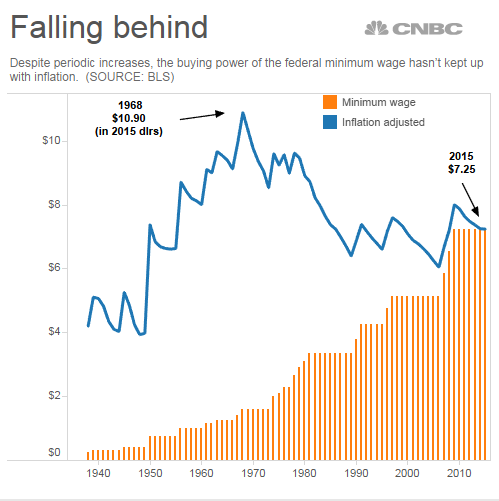
[0] https://sc.cnbcfm.com/applications/cnbc.com/resources/files/...
That's a feature, not a bug.
But yes, the rest of society will become a LOT "poorer" (but still comfortable) for no more than a decent increase in the living standard of the working poor.
Its a kind of thing like the average number of hands per population is less than two. Seems counter intuitive, but when you think about it, it does make sense. One shouldn't relay on the expected value of people having two hands, for global population it's a tad lower.
The US military, especially, is the largest job and training program anywhere in the world, including the military industrial complex (most of those military contracts, incidentally, do not just come with jobs, but with demands that those companies hire x0000 (3 or 4 zeros) in the states that have the highest poverty levels).
I'm not saying it's an ideal occupation (although, hey, Keynes seemed to like it when he was less on guard). So yes, I'd also much prefer them to be building better infrastructure. Or perhaps have a much cheaper postal service.
> That's where you money is going to, not $6 an hour fruit pickers spending all their money in food.
Perhaps. But the inability of the working poor to pick fruit at $15 an hour IS due to (mostly illegal) fruit pickers.
When millions can barely do it, the political and business classes fucked up and they need to fix it. That's the point of goverment, they can tackle systemic issues.
How so? To artificially keep salaries high?
On the lowest rung of society, they're at least 50%. The higher you go the lower the percentage, and it drops off pretty fast.
People not looking for a job aren't included in that 5%, to be considered unemployed you have to be working less than 2 hours a week and looking for work.
More importantly that figure doesn't include the underemployed, those working at least 2 hours but looking for more.
And yet we have such terrible poverty.
When I read stories about poor people in America, always there is lurking just below the surface the key element of scarcity. Not food. Not transportation. Not clothing. Not even, surprisingly, health care. The missing factor in all these broken lives is the simplest thing. Space. Some space to fucking sleep and live.
How can such a large country suffer from a bigger housing crisis than we find in jammed up dense countries like Singapore, South Korea, and India?
Why hasn't the market solved this problem?
Believe it or not, its not impossible to manufacture a living space in a factory and assemble it on site in a day, to provide extremely well made and affordable housing structures.
There is space enough in American cities if density is allowed to be increased. In other words if these fake "liberal" NIMBYs in American cities can be persuaded to give up the precious "character" of their neighborhoods, we can make space for everyone. CHEAP space.
Even at 5% unemployment, your condition can be satisfied. For example, jobs might be unfilled because the candidates are unwilling to move. The candidates might be unqualified... shall we hire a random person as a brain surgeon? There could be a dozen job openings per person, and still the unemployment rate remains above zero.
As you move toward 0% unemployment, you push harder and harder against the problem of unsuitable workers. Reaching 0% is a bit like traveling at the speed of light: it is an unreachable goal, with difficulty rising dramatically as you get close.
Those other solutions suck even more.
Except for a close to 10% that does as good as ever and even better, and who are the ones proposing those other "solutions"...
Seriously, I wonder why this scarcity for quite many is not highlighted as failure of capitalism, why the bailout of banks with tax-money is not marked as "capitalism and free market has failed" just like communism is?
Or, if the dogs are intelligent, they could split those 19 bones to 20 pieces...
Choices is not the same as skills. Meritocracy is about merit, not choices.
Who told you poor people are capable of as good choices as richer people?
When you live life in easy mode is easy to make the right choices.
It's also easy to see some people who managed to play in hard mode and win, and extrapolate to everybody (especially if you don't account for lucky breaks and mitigating factors in their course).
But because a handful managed to win in hard mode, it doesn't make it as easy as those who play in easy mode, nor it makes it any more statistically possible for the masses to win the hard mode gameplay they were dealt.
>Where I am, the good and the bad, is nearly entirely the sum of my choices.
LOL. http://thewireless.co.nz/articles/the-pencilsword-on-a-plate
(One is even tempted to wish upon people saying hat a couple some serious accident or decease that kills their savings or takes their job, or puts them into depression, or have them tend to another family member, and such, to see whether their tune will remain the same...)
Capitalism is failing in a slow, insidious way.
Now, the market cannot solve a problem that is linked to human nature. Humans like living in dense areas rather than on the top of mountains, so space will be more and more expansive as density increase. Nothing unusual. Density also brings more jobs and more commerce so this is a cycle that goes with it.
This being said if you care nothing about living in a modern civilization it is perfectly possible to live far away from cities with very minimum expenses and a lot of land. Thats just not what people want.
Then, if fruit pickers made $20 an hour, you would be getting all of your fruit from Mexico/Central America, and fruit and all products made from it would be more expensive.
Other jobs like gardening and landscaping would simply either not be done, or get done by property owners themselves. Now they will be tired, be less productive at work and have less time for their kids, or, see their property value drop while their local crime rate goes up.
China has a sort of partial capitalism in that some big companies are 50% owned by the state.
Maybe "the market" is not a good tool to solve inequality.
The argument I am arguing against is something like:
Immigrants join the labor force -> They increase the economy -> The increase in the economy increases jobs -> More jobs increase wages.
I think this what you are essentially saying?
The problem here is inflation and productivity. In order for everyone to prosper either:
1. There is no inflation and therefore purchasing power is maintained, or
2. Wage growth and interest rates outpace inflation.
No. 1 will not happen under our current monetary system, and no. 2 has not happened due to:
a) Competition in the labor market has keep real wage growth flat, and
b) The unprecedented (in the history of mankind) money creation (AKA Quantitative Easing) used to bail out financial institutions has destroyed interest rates and created a massive inflation in asset prices.
Another factor is that different jobs impact the economy differently. Or put another way, different jobs create different levels of 'value' in society (the monetary kind not moral kind). The difference between the price of a good or service, and the perceived value of a good or service is the 'consumer surplus'.
Fact is, highly skilled immigration is going to create a higher level of consumer surplus compared to low skilled immigration. Highly skilled immigration in areas where there are shortages is going to also have a bigger impact on economic growth.
I think you will be hard pressed to find anyone arguing against this sort of immigration... the issue that dare not be spoken is the impact low skilled and illegal immigration has on the labor market.
The market did solve the problem and then we blew it by undermining the family unit so we have people dependent on the state with no significant family support.
> Believe it or not, its not impossible to manufacture a living space in a factory and assemble it on site in a day, to provide extremely well made and affordable housing structures.
The soviets tried this approach it doesn't work because you end up with a shitload of crappy communist housing blocks. The correct approach is to develop as much high end housing as possible which pushes all other houses down the depth chart. We want the poor living in houses that the rich used to own - not shittier houses.
At some point we have to realize that the issue isn't wealth or even inequality. The harsh reality is a significant number of the population has a several hundred dollar a day drug addiction and no means of taking care of themselves even if they were handed a blank check.
While I don't necessarily agree with everything the poster is saying--implying that someone is only allowed to discuss topics in which they have a readily available solution would likely ruin most discussion on the internet and it would certainly put a damper on scientific work the world over.
Well my elementary knowledge of economics suggests that the market equilibrium price is the intersection of the supply and demand curves. There is additional demand but at a price lower than can be supplied. It is not profitable to supply housing further, and some demand is not met. This will always be the case (according to my elementary understanding of economics).
That is where socialism comes in in most countries. Since profit motive cannot solve this problem, compassion motive can. Supplying low cost housing without disrupting the rest of the real estate market is managed in a variety of fashions in different countries to greater or lesser success.
I was characterizing what the parent appeared to be saying, so that I could discuss it (that greed is a part of human nature). I was not justifying greed.
I rent an apartment and I don't own a car.
The biggest problem is role models. If your family or friends live a certain way then you tend to copy them unless you're able to think differently or have someone to advise you thru your early years.
Not only that, getting out of poverty is a long-term process that requires hard work in the right areas. But even hard work is not enough. I can do very hard work all my life at a minimum wage job and never get ahead.
At a very basic level getting out seems very simple. All people need to do is to study to get a good job and work hard. But in reality, that's not enough. You need the support system and the right mindset to get you out. Many people can do it but as we see over and over many people can't.
I think the throwing jobs and money at the problem is not enough. I think what would work is to consult young families and young kids that are at risk on what they need to do to get ahead. This needs to be done not once but for years and on a regular basis. It would be similar to a regular check up the way we visit the doctor or dentist.
Then there are things like medical expenses, debt, family members in need of support.
The biggest problem is role models. If your family or friends live a certain way then you tend to copy them unless you're able to think differently or have someone to advise you thru your early years.
Not only that, getting out of poverty is a long-term process that requires hard work in the right areas. But even hard work is not enough. I can do very hard work all my life at a minimum wage job and never get ahead.
At a very basic level getting out seems very simple. All people need to do is to study to get a good job and work hard. But in reality, that's not enough. You need the support system and the right mindset to get you out. Many people can do it but as we see over and over many people can't.
I think that throwing jobs and money at the problem is not the solution. What will work is to consult young families and young kids that are at risk on what they need to do to get ahead plus the support system that will help. This needs to be done not once but for years and on a regular basis. It would be similar to a regular check up the way we visit the doctor or dentist and get advice on what to do.
Because we don't just provide things to people because they are struggling or starving. They have to be literally dying, or appear to be in medical distress, and then we send a fire truck as a first responder, and then they go to the emergency room because we waited until they were dying to provide care, and then we rack up unpayable bills that raise health care prices.
I mean, we create the conditions that cause homelessness, and then literally criminalize the homeless. If that doesn't tell you how little of a shit we give about people in distress, I don't know what will.
America is a land of plenty only for people that already have plenty.
Seems like a paper from a young student who needs to get his 3000 wordcount.
It just bloats the article and makes it difficult to get the information out of it.
I think it's great, it shows there's always a human side to trends and large statistics.
But whether the "enlightenment project" benefits from simply making complaints is a valid question. I still think the answer is no, or at least that if you're going to make a complaint, your position is improved by proposing a solution for discussion. I concede that it might be possible to make an effective and evidence-based counterargument, but are there meaningful social movements which have been based solely on complaining about stuff with no action platform?
From https://www.wola.org/analysis/fact-sheet-united-states-immig...
"While the total number of migrants apprehended at the U.S.-Mexico border is near its lowest level since the early 1970s, the number of apprehended unaccompanied children and families is again on the rise after a dramatic drop in the months following Trump’s inauguration.
This is a vulnerable population who, for the most part, are deliberately seeking out U.S. border security authorities and asking for protection. Affirmative requests for asylum of individuals from Guatemala, El Salvador, and Honduras have increased by 25 percent in fiscal year 2017 compared to 2016.
These people are fleeing for a reason. As White House Chief of Staff John Kelley once put it, the mass migration of children from Central America to the U.S.-Mexico border primarily consists of “[parents that] are trying to save their children.” The countries of El Salvador, Guatemala, and Honduras are facing unparalleled levels of violent crime, with El Salvador and Honduras ranking among the top five most violent countries in the world."
The reason 5% is considered full employment is there will always be a number of people who are unemployed because they are between jobs, for instance their partner has moved or they are rejoining the workforce after pregnancy or even looking for their first job.
No matter how powerful Ancient Rome was, it wasn't even comparable to some third world country today.
Some of the worst offenders are magazine writers. I've read articles that go on and on and yet say nothing.
There needs to be a certain amount of communal spirit in your culture in order to make this work, though. People have to be comfortable with spending most of their time in common spaces such as parks, pubs, and Starbucks instead of hanging out in their own backyard. They also need to be willing to spend money (both publicly and privately) to keep those common spaces in good order.
This might become a non-issue even in America, though, as more and more people just sit in bed and stare at their phones instead of going out.
The lack of morality to vote for decent politicians. Why do US citizens claim to want medicare for all but vote for Democrats or Republicans who do not want medicare for all ?
https://www.youtube.com/watch?v=dX5GSClA8z4&t=207
The lack of morality that private property should be spent to help other persons in need.
The lack of morality that allows an insane military budget and immoral lies and crimes and murder in other countries by political and military and economic warfare.
https://chomsky.info/1990____-2/
https://www.globalresearch.ca/america-has-been-at-war-93-of-...
As an aside, when the word "meritocracy" was coined, it wasn't considered a good thing. It was a bad thing.
This is a traditional, stereotypical belief that in order to escape poverty you have to work harder. This is old understanding of meritocracy and it's no longer valid. The new meritocracy is that you have to learn harder. And now, given all the learning resources available for free on the internet (which is also very accessible nowadays) it's probably the best time ever to self-educate.
Once in a while I walk past a person selling pens/begging for money in my neighborhood. I always wonder how much he could've learnt and improved his life if he spent his time on learning instead of sitting on a bench and begging for money. I have sympathy for people that are poor due to unbearable circumstances such as mental illness or disability. But I honestly don't understand why an otherwise capable person won't make an effort to self-educate in order to break out of poverty.
We aren't natural. We don't need natural evolutionary states. We need unnatural, human-oriented, ethical states.
Interested to know why you're not interested in the human angle.
I don't need "unnatural, human-oriented, ethical states". I'm perfectly happy with a state where I can acquire as many resources as possible, even if that incurs a significant cost to others.
> Why hasnt the government solved this problem?
Maybe the government is not a good tool to solve inequality?
After all, what percentage of your salary before taxes goes to directly help the less fortunate with no middleman? Before you answer: You could probably do more.
Good point. In my birth country you must support your elderly parents by law. Even without the law 99% of families would.
The idea that the government should do it seems crazy.
The government only needs to step in where the elderly have no family, are unable to work, and private charity is not enough.
This means the government only deals with a tiny percentage of people.
Let's assume you are talking about sharing, as that's what the original point was about. Specifically the sharing of 19 bones among 20 dogs, by dividing up the bones.
Assumign by 'naive' you mean wrong, are you saying that it is simply a more optimal situation for one dog to go hungry?
Does the one dog always go hungry, or does one dog (but a different one each time) go hungry?
Do we just let the one dog go hungry each time intentionally, so that in future no dog goes hungry? What if then one day there are only 18 bones for 19 dogs? Do we let that dog die too?
What if a group of 18 dogs is required to take down an animal that provides enough bones, but we let the two other dogs die because sharing is naive?
Well, that pretty fundamentally calls into question rather a lot of all the principles civilisation is founded upon and which permeate nature, even (nature!).
So you better provide some amazing scientifically backed proof of that statement. No, Atlas Shrugged is not scientific proof.
In short, childhood trauma and lack of family support. Often the trauma comes from abuse from their family. These are not problems you can just throw money at.
> I question how much experience you actually have with either the poor or drug addicts.
If you must know my experience I did youth work for inner city kids from 1999-2006 in Langley BC. I then lived and worked in the Vancouver DTES from 2006-2017. I have several close friends and family members who work at Insite Injection Clinic, Portland Hotel Society, HIV/Aids Clinic at St. Paul Hospital, and the Odyssey and Nexus programs in downtown Vancouver.
Perhaps you are unaware what life on the streets is like.
Edit: also, I never said I was a "majority" that has an expensive addiction. I said the number of people is significant - which it undoubtedly is.
You still haven't made a point.
Is the intelligent action the action that is most likely to benefit the group?
Is a group of 20 fed dogs stronger than a group of 20 dogs where one goes hungry and becomes a weak or unstable element?
Seems like you're just trying to somehow rally against equality and/or sharing, by associating them with naivité, like you have some knowledge others do not, because you don't like those words, rather than trying to actually discuss the concepts they represent, specifically in this context, properly.
Eventually I landed on a great company that was willing to do that, but it was a difficult search as an entry-level developer. Would I have been able to pay off my debt? In 5-10 years maybe. That's still a large burden for people to bear, and we're in one of the better paying careers.
Poverty is the inability to know how or be able to survive at a minimum comfortable level in our society.
The causes are many, such as lack of education, addiction, early parenthood, good role models, lack of good health and many more I can't even begin to imagine.
So giving people stuff and housing is only a temporary solution. The solution is so much more and it takes years to get ahead of it.
Look at Venezuela, they tried to solve their poverty problem very simply by basically giving people food and shelter without fixing the fundamental problem of lack of knowledge and the other problems that cause poverty and now they are in worst trouble than ever and yet in theory they had the financial resources to fix the problem.
What you mention is just a start and poverty will always be unless the more fundamental problems are fixed.
The dog can die. It isn't my problem.
(On a more serious note, I fully expect automation to simply lead to automated armies defending the rich from the poor, rather than relieving any suffering anywhere. Productivity increases have not lead to (proportional) wage increases, have not lead to (proportional) reductions in working hours. The internet has not lead to information-driven utopia, but instead ad-serving dystopia. Automation will also fall to the deathly grip of capitalism, as does everything else.)
1. increase in healthcare costs and how health insurance is bound to employment
2. increase in wealth concentration and a shift from cash compensation to asset compensation (Bezos is only absurdly rich if he liquidates his Amazon holding instantly)
So, I would say your portrayal of hourly compensation is disingenuous as well. All of these statistics probably need to be calculated as medians instead of means ("compensation per hour" sounds suspiciously like "total compensation / total hours", which is a mean) in order for it to come close to accurately describing the situation of the median American, because wealth concentration has skewed the mean American into something a lot more optimistic than one would think.
Minimum wages exist for a reason: the job market does not satisfy the conditions for making it an "equilibrium" market. As long as unions are weak, corporations can and will strong-arm the labor force into cheaper and cheaper work.
The fact that it has become a better choice to live on welfare than working with minimum wage is ridiculous.
The first step in making better choices is to realize that one is making choices.
As for fortress thing - you are exaggerating. There isn't so much crime around these days, much less than 30-40 years ago when things were still going fine according to the article.
In the end, it's just the technology change. 40-50 years ago uneducated masses who were members of solid middle class have been factory workers. They are automated away. There isn't anything which could be done about this. Besides, exactly 40-50 years ago, during Jimmy Carter era, same things were said about farmers who found themselves displaced with great improvements in farming productivity. History just repeats itself.
And yes, classes must be sustainable and moving between them should be difficult, only through exceptional personal (genetic) abilities and a lot of effort. Otherwise they are not classes, just people gambling and some of them winning.
Which policies hurt the poor and middle class the most?
Our housing policies, our immigration policies, our trade policies, and our anti-family policies.
Here most elderly either gets support in their own home by professionals (by the local government) or at a home with professional care (run by the local government).
I'd rather spend time with my family on our own terms and not because I have to support them.
You have to keep in mind that everything in the US (health care, education, food industry (which causes the health problem)) is harnessed just for one single purpose: Make money for the share holders. Subsequently the US goverment doesn't serve the people and their interest, it serves the interest of these big companies.
This whole system is optimized for making money for the select few, not to cater for the society by and large. Therefore it creates these unfortunate side effects.
Call me inhumane, but a single story doesn't mean anything. It's just some random point in the set. Drawing any conclusions from such a single point is dangerous (the larger the set, the more), as we humans just love to extrapolate single points and even tend have quite strong emotional defenses about their importance.
To remove the emotional part, just think of something from IT, like response times or test coverages. See, a story of an obscenely long API response (out of thousands) doesn't make much sense anymore. Debugging individual cases may even lead you on a completely wrong track. Unless you want to merely resolve that particular single request.
I'm sorry about the tone. Stories about others make humans relate (which is good), but they also have such undesirable effects (hype over facts, extrapolating, etc).
There are large amounts of cultural and career inertia that you have to overcome to 'pivot' your career towards something wildly different. Not everyone can pivot towards something better especially as times change, education changes and people change. My father never graduated highschool and for him, fishing paid better than other opportunities. It was the same for my step-father.
It was also all that they knew how to do. There were few retraining programs (that they couldn't afford even if they could) and to them, their career was their life. Their friends did it, their parents did it. It was their entire identity.
What I'm doing is effectively the pivot away from the family career. It doesn't change the fact that it left a generation in the dust.
1. Trump’s Travel Ban, Aimed at Terrorists, Has Blocked Doctors - https://www.nytimes.com/2017/02/06/health/trump-travel-ban-d...
2. Trump’s Immigration Order Could Make It Harder To Find A Psychiatrist Or Pediatrician - https://fivethirtyeight.com/features/trumps-immigration-orde...
Both of these are reports on exactly the same issue, but different techniques.
The NYTimes prefers to use pictures of a doctor, along with quotes from various doctors and medical students. "We need him desperately", says someone about an oncologist. "I love this country", says a Syrian doctor about America.
Fivethirtyeight tells the story with statistics. How many doctors are there in America? How many of those are immigrants? How many from these countries? All told in one image. Which specialties do these doctors practice? In which counties do they practice in? No human interest, just the facts.
Me personally, I prefer FiveThirtyEight's style. I read their article and that one image helped me realise what a grave issue it was. They get straight to the point, no fluff. But I totally understand how others might connect more with the NYTimes article. Seeing the story from the perspective of a real, breathing human. Hearing them talk about love, about sacrifice, about family. It humanises the issue and they understand it better. Different strokes.
It's like saying the average net worth of Jeff Bezos and 99 homeless people is 1 billion USD, etc etc
Interesting. We definitely have negative interest rates in some places by now. Now waiting for the income subsidy.
If you reject the PWE then very different possibilities emerge and in particular "full employment" stops looking like a good public policy goal and start looking like you're just trying to waste as much of people's time as possible.
Assuming the natural resources you might want to exploit are living beings, you have to maintain an equilibrium in the environment or you can get resource starvation, which then impacts you directly, either as increased costs or an end to the goods entirely. You can easily see this in things like elephant/rhino poaching, where the unregulated demand will eventually result in no more supply at all. Even slavery requires considering the costs of maintaining the slaves, as if the slaves deteriorate, they won't be as productive, and it will cost you more to acquire new ones. Or if you attempt to take over some new lands, but your diseases wipe out the native population, now you don't have the natives to use as slaves anymore.
In respect to the American economy today, inequality and exploitation can lead to several problems. 1) Lack of skilled workers, 2) ballooning health care prices and increased taxes, 3) political unrest leading to trade problems, not to mention limited business growth, 4) overthrow of government, 5) state taking over commercial entities, 6) economic collapse , 7) massive refugee crisis. Oh wait, that's Venezuela. For us it's just the first few.
No matter what, you will eventually have to consider the costs to others if you want to acquire unlimited resources.
This may differ by country, but you typically only show up in the numbers if you were fired. After all, if you quit your job, you aren't involuntarily unemployed, which is what the numbers are supposed to measure.
How often do people get fired? I remember reading numbers of every 20 years on average (don't have the source handy, I'm afraid), but let's call it every 10 years to make it conservative.
In a situation of true full employment, with a plethora of employers looking for employees, at least low to medium skill workers should be able to find a new job basically immediately -- within a week perhaps. Let's be conservative again and call it two months.
This means people are unemployed for two months every 10 years on average, which translates to ~1.7% frictional unemployment. That's way less than the 5% number you cite.
In fact, several industrialized nations saw unemployment rates below 1% for some time between the Second World War and the 1970s. In other words, achieving well below 2% unemployment rate is absolutely realistic.
If you convert the delta to the 5% number you cite to the US workforce, you get about 5 million people. 5 million people who are suffering simply due to political ideology.
On a more political level, I think it's important to keep in mind that the current situation (where people misleadingly talk about full employment even for unemployment rates much higher than 2%) is very beneficial to employers, because it greatly strengthens their bargaining position. Now add the fact that the majority of funding for economics think tanks is aligned with employer interests, and it's clear why the public discourse may be somewhat skewed and biased towards accepting inhumanely high rates of unemployment.
That doesn't make much sense if the US is a hell-hole of capitalism grinding people into poverty (as immigrants usually have little).
In 2016, 1.49 million immigrants came to the US. The median age is 44, so they're hardly all children.
Meanwhile, an awful lot more want to come but can't get in legally.
> This is the most ridiculous proof that America is the land of opportunity I can imagine.
People run to opportunity, not away from it. https://www.migrationpolicy.org/article/frequently-requested...
Averages and generalizations only tell a portion of the story. Anecdotes can shed light on "noise".
Higher minimal wages and tax credits for small businesses seems healthier.
This entire statement just blows my mind.
Getting people to build enough expensive homes for rich people seems to be an already solved problems. People already build homes as expensive as the market will bear and and the rich buy not one but 2 of them or even more and rent them out to others less rich than themselves. The only way to get people to build a glut such as to devalue their own product would be to provide tax incentives or kickbacks effectively funding rich peoples houses with tax money from the middle class.
Supposing you decided to do this building a glut of "top end" housing enough to move the needle as far as price would be an insanely expensive endeavor. Millions of dollars per unit.
There are 74 million single family homes in the US building out 10% more all at the top end at 2 million per would cost 148 trillion dollars. This is actually more than the 25 trillion it would cost just to give every household their own free 200k house.
Building 1% of the present housing supply would only cost a laughable 14.8 trillion and would barely move anyone up much beyond making it easier for the upper middle class to move from nice house to awesome.
The truly funny thing is that no matter how much top end housing we build the poor would never live in the houses the wealthy used to live in because we would literally let it rot to the ground before the rich would sell it to them for anything like they could afford not because they have a several hundred dollar a day drug addition but because they don't have enough wealth to pay for what it actually costs to build and maintain a nice large rich persons house.
Ultimately if we want there to be a bigger supply of affordable housing then we will build more for 100-200k not mansions for 2-5million because poor people can afford the first and you can build 10-50 of one for the cost of the other. It's simple math.
As a final note if we charitably say several hundred is 3-400 a several hundred dollar a day drug habit is between 109k and 146k per year.
The only people that have several hundred dollar a day drug habits for very long are drug lords and CEOs that are fueled by cocaine.
That's also a single aggregated number. Until the data doesn't cover those millions dire situation, it's a bad data. Emotionless analogy: like a green status page when some percentile of requests is failing.
See, you've mentioned "millions" rather than some "that person.". That's exactly what I mean.
Once there are only 19 dogs left, the number of bones will simply be reduced to (slightly more than) 18, because the prevailing ideology is that there must be 5% unemployment. (This is greatly simplified, of course, but that's the gist of it.)
Eventually you'll stop being lucky. And in any case, it's not always the same dog who gets unlucky. So yes, it is your problem, or at least it will be.
This incentivizes increasing employment percentage. An easy way to do that is by decreasing the value of a job. Suddenly it doesn't ensure you can build a living, own a home, support a family anymore. But it is still used as a primary measure of the wellbeing of the economy.
This is why you need individual stories to interrogate the quality of your data. Afterwards, you obviously need to come up with new measures that more accurately reflect how well the economy is working for the people in it. But the interrogation will have to work on the basis of anecdotes.
Repeated enough, it can create a narrative that the wider groups don't matter as long as you support the few exceptionals. This seems to play out across all sides of US society both in justice (think "headline" prosecution of corrupt individuals in finance etc) and in social welfare. This is not to say that exceptional individuals do not have a disproportionate role in society. They unquestionably do. However I can't think of any of those individuals who has not been enabled by dozens if not thousands of talented others.
I guess I'll contradict myself with the anecdote (I recognize this is totally not representative). I've heard a lot of stories about how "they do this and that, somewhere" based on a news about some single case. Some make sense, but also lots of variants of vaccines and autism stories (mostly, regarding modern politics, so I don't want to describe anything in particular).
A lot of the planet is just terrible. Of the places that aren't terrible many wont let you just sneak in and make a living if you live a cash and carry lifestyle.
At best you can prove that the US is viewed as better than their current abode by people that don't live here.
This is the definition of damning with faint praise.
I’m sorry I can’t give you a better answer being on my phone.
But, Venezuela’s current crisis has about as little to do with commoners working as you could find in a modern-day country. As a small example, how would the arrival of a new president fit into your (kind of derogatory) theory? What evidence do you have for your assertion?
You don't 'give away' resources, they are transformed into other resources. Would you give up the ability to own seven cars for the knowledge that you'll never live under a bridge, no matter what? Many people would.
Most humans remember personal narratives far more efficiently than they parse data tables. Humans who don't operate like this are very much an exception.
So this is a communication technique - part of rhetoric, in fact. And communicating with median readers is what journalists are paid to do.
We are a social species that attained our dominant position on the planet through co-operation.
Then you'll get used to share your 5% , after some time he'll want to have 6.75% and you'll think- well , compared to 5% additional 1.75% is nothing for my safety! After some time other dogs will start to look with keen eyes on lazy dog lifestyle.
I'm assuming you were referring to survival of the fittest, which is commonly misunderstood to be survival of the strongest.
What survival of the fittest actually means is survival of those most adaptive to change, which is not at all what you are describing.
Feature stories have typically attempted to hook the reader not through a news lead, but though a colour intro - and one technique is to introduce an abstract issue by relating it through a case-study. You may not like them, but when done well they can work.
Being done well, however means that the case study should be fairly short and there shouldn't be a mismatch between headline promising one thing and annoying the reader when the opening paragraphs don't deliver.
In traditional print, the combination of headline, subhead and design combined gives you an idea of the type of article you are about to read. However when the headline is simply posted as a link, it can feel like bait-and-switch. You go in expecting a pithy summary of the issues, you get a feature article.
This is a side effect of the way the story is posted, rather than a particular problem with the journalism, in my opinion, though I do think the initial anecdotage is a bit leisurely and meandering in this case, for my taste.
I'm not going to judge you on moral grounds. Instead, consider what would happen if everyone lived like that. What kind of world would we have? I think it would be a hellish dog-eat-dog world.
You may believe that the world is already that way, but at the moment, there is a lot of kindness, compassion and consideration too. Instead of that, if everyone had the attitude of "I got mine, f* you", the world would be unimaginably worse than it is now.
Moreover, that kind of living is unsustainable in the long run. If you collect as many resources as possible to the detriment of others, sooner or later others would try to snatch those back from you, even by violence.
Considering the number of times this has happened in human history, any ideas of kingly invincibility you may have are unlikely to be realistic.
I know you've chosen this because you think it's a reductio ad absurdum counterxample, but really, if the market is desperately short of brain surgeons, you might think it would create more, cheaper places at medical schools.
Medicine is a uniquely restrictive market, hemmed in by legal protections and a labor guild system, but some version of this dynamic is operating in many sectors of the American economy: Companies refuse to pay for training, then whine that they can't find suitable candidates.
Thinking otherwise is delusional.
You still need to cover your basic expenses, homeless or not.
> Storytelling: 90%
A narrative about how one family's poor choices have resulted in negative outcomes and ultimately, suffering.
> Argument: 5%
Lack of wealth and systemic ethnic persecution result in poor choices by victims. Negative outcomes result. As does suffering.
> Solution 5%
Give more money to people who are both suffering and poor.
Do not address the role that personal choices will or have influenced their own suffering.
Do not address personal accountability.
All complex life on earth exists because of cooperation. Competition drives some feature drift, but the biggest step changes happened because of the increase in complexity made possible by cooperation.
Sometimes you win, sometimes you lose. It's the nature of any gamble, and life certainly is one.
That’s common as well if they can mostly look after themselves and only need say a weekly visit from a nurse.
I think the only difference is the children are expected to pay.
It’s maybe half live with their kids and the rest live independently.
> or at a home with professional care
This is common when they need full time care. But this is usually only a small % and not for long.
And again the kids pay.
> I'd rather spend time with my family on our own terms and not because I have to support them.
That’s one way to think about it.
My perspective is my parents supported me for 16 years and so I have a duty to support them.
I think it is good for character, helps people to appreciate life, and helps build meaningful relationships. It also means grandparents get to spend lots of time with their grandchildren.
While taxi drivers sometimes consume rides, I can't imagine anyone thinks they consume 8 hours a day of rides?
For example, you can get an MIT education for free on youtube, you can open a business on github for free, you can get funding for free from kickstarter, you can advertise for free on reddit, you can reach a worldwide market for free via the internet, you can write and sell a book on Amazon for free, and on and on. Nobody needs to know your age, gender, ethnicity, religion, location, disability, marital status, etc.
There's never been such opportunity, right here anywhere in America.
And if you think he meant human nature, I would say that generally, by nature, humans are kind and share with those they see as their people, but the complete opposite with anyone outside that group. Since the market is made up of people only in the abstract to most people, I would say that that nature doesn't tend toward equillibrium between individuals either.
I only hope you won't meet some day a man who wants to "acquire as many resources as possible, even if that incurs a significant cost to others" on a dark alley.
Speaking as an Asian, I grew up in a culture where parents, and elders in general, are super-important. Things are changing now, but many of us are still very close to our parents.
In old-school thought, taking care of one's parents is seen not as an obligation, but as an opportunity to serve them, and to repay them (in some small measure) for the love and care we have received from them in our childhood.
When my grandfather passed away suddenly and unexpectedly in his 60s, my father was distraught that he did not get an opportunity to serve him.
My point is, many of us view the situation differently - not as a burden, but as an opportunity.
However, it is undeniable that sometimes it can be a burden, and for those situations, it would have been excellent to have the government take care of the elderly, as it is done in your country.
Edit: A typo.
You don’t have to go back many generations to see that compared to today almost everyone played on hard mode.
This is revisionism and ignores the whole "internationalism" vs "socialism in one country" debate. It also fails to recognise the history of nativist (far-)right anti-immigration parties and lefty anti-borders activists.
In fact, the US is at or very near the worst among OECD countries in all of the following, and is much closer to Developing countries than Developed countries: infant mortality, child poverty, child health and safety, life expectancy at birth, healthy life expectancy, rate of obesity, disability-adjusted life years, doctors per 1000 people, deaths from treatable conditions, rate of mental health disorders, rate of drug abuse, rate of prescription drug use, incarceration rate, rate of assaults, rate of homicides, income inequality, wealth inequality, and economic mobility. [1]
Or more likely because the pay is not enough to interest the locals.
How does the pay for a nurse compare to a programmer? 2x as much? 3x?
History has shown that once people no longer believe they have a fair chance of achieving prosperity, they revolt. So, even ignoring any other characteristics, your way of social organisation is not stable in the long run.
I'm not sure most parents, Vanessa included, don't know that education is important to their children's future. She likely lacks the opportunity to send her children to a school where they would receive a good education.
> 2. Educate people to not have kids before they're financially and emotionally ready.
I would argue that most people look at having children in terms of opportunity cost. If you're wealthy and have a good career, you tend to put off having children or have fewer children. That's why the birth rate is so low in developed countries compared to that of the developing world.
Is it possible wages often don’t reflect the value of the work people do?
Your anecdote doesn’t really mean much. “Significantly way better” is apparently still not enough.
Similar to why food stamps are cheaper than food education. The administrative burden is prohibitively expensive.
Let’s not consider the thesis at hand here; jobs aren’t the answer. That flies in the face of our corporate sponsored religion.
Of course believing that inherently threatens your status.
This site should best stick to discussion of technology. Whenever social topics come along, the community quickly reveals its ignorance of reality for the majority, and knee jerk defense of its status quo
Maybe take some money out of military spending? Educate the population, the economy soars, and then you can re-increase the military budget 30 years down the line.
Journalist aren't just paid to communicate with median readers, but with all readers. If close to all articles have the same format some readers will be put off by that.
I'm not arguing for removing all personal stories. Just for more of a balance.
The lack of social mobility is well documented, and it's a travesty that's affecting large parts of the developed world still (and shamefully, the UK pretty much leads on it):
https://www.minneapolisfed.org/institute/working-papers/17-2...
https://www.suttontrust.com/newsarchive/disturbing-finding-l...
https://assets.publishing.service.gov.uk/government/uploads/...
https://www.theguardian.com/society/2018/jun/15/social-mobil...
Unfortunately I'm not as well versed in reliable US sources, but there are references through here that the US doesn't exactly beat us hands down on social mobility either.
I do implore everyone to read more on this topic, there's a lot on HN about "meritocracy" and "well, just work harder", but that's just simply not the world we live in. It's a shit-show out there, and people's ability to break through the "class-ceiling" is being stunted, not improved.
I think a roughly accurate statement is that over half of Americans end up within one income quintile of their parents.
That doesn't seem like much mobility to me and many European countries apparently rank better. The American Dream might be mostly marketing at this point.
No. The human society would not collapse if there were fewer fishermen. The fact that the fishermen are so badly paid even if they work so hard, to me is a clear indication that the human society does not value their effort and it would be probably better if they would put their efforts into something else.
>>Is it possible wages often don’t reflect the value of the work people do?
I agree, there is often little correlation between the wage and the value of the work but the rational workers should optimize for the wage not for the value of the work if they don't want to be poor.
Police kill ~1000 people per year in the US and roughly half are white. While there is an inarguabale disparity there, that means your chances of getting shot by police are extremely, vanishingly rare. And the numbers killed each year is in steep decline. Let's abandon the fear mongering rhetoric of getting shot by police is any real threat. It makes good headlines but it's just not likely to happen to 99.9999% of people no matter their "shade of brown" as you say.
There are more worker protections, more systemic empowerment of people in all classes, all genders, all faiths, all backgrounds than ever in history. There's a lot of work to be done and the system is by no means equal. Wealth disparity is real. But the fact is there's more learning resources available for free with which to bootstrap yourself than ever. As someone descended from hard working immigrants who valued education, and who is part of an incredibly racially diverse family, I don't think it's a crap deal at all.
That's a cute clip, but if you look at statistics you'll see Americans with less than a high school degree work on average 7.8 hours a day, and only 30% work on weekends and holidays.
I hear the PWE invoked (usually with a sneer), and reflect that it seems to be referring to exactly how my parents have operated throughout their adult lives, and that if everyone behaved the way my parents have done (to the extent that they are capable, of course), society would function far more effectively and harmoniously.
And then I wonder what I'm missing.
My mother spent her career working in hospitals helping to rehabilitate seriously injured and ill people. In her non-work time she cared for her ageing parents until they passed away. Now she helps raise her grandkids.
My father helped design and build telecommunications networks then ran a company making electronic gadgets that helped school kids learn about science, and environmental researchers gather data.
Both of them have spent much of their non-work time volunteering in the community - at kindergarten, school, church, and more. And they have maintained a healthy social life and done plenty of travel.
They've always been busy, but never burnt out or exhausted. Always occupied and fulfilled, never resentful.
I don't see how any of their work or volunteering is surplus to society's requirements.
I do see that society would be better off if more people were doing the kind of work and volunteering that my parents have always done.
What am I missing here?
If you don't want to follow anyone's rules but your own, I recommend living completely on your own in the wilderness, off the grid and all that. Only then are you responsible only for yourself.
30% is how many people?
What’s their schedule look like if they have kids too?
That’s a cute trick, using cold hard facts to normalize away bullshit
Hard mode is comparable across the same game. Those in 1800 played 1800s game, those in Nigeria play the Nigerian game, etc.
You wouldn't consider it much of a success if a person with huge work, skills, and effort got themselves to 1800-era middle class possessions TODAY, would you?
When you're working a double shift to put food on the table, it's really hard to learn an extra skill set (e.g. programming) and make time to build up a resume on github (or whatever).
The cost isn't really located in the act of "buying" education.
In other words, you "make" decisions only partially, and your choices are shaped by your status in life, before your conscious self can "chose".
http://science.sciencemag.org/content/338/6107/682
https://www.theatlantic.com/business/archive/2013/11/your-br...
https://qz.com/964920/data-show-poor-people-make-better-fina...
http://news.berkeley.edu/2015/03/02/anxious-people-decisions...
I personally work 2 full time jobs, I'm aware how scarce free time can get. I'm certainly not saying that everyone can do it on their own either. Just that cost is a very weak barrier to knowledge and that I agree you need to learn your way out of poverty.
I'm also a big proponent of basic income exactly for the reasons above, but I think the core idea is well founded. Hard work at a job (or two jobs) doesn't usually get you out of a shitty job, where as learning enough to get a better job does.
1) had a job
2) had access to the internet
now trying learning anything for free online when you don't have money for food because you're jobless and don't have access to the internet because you don't have money for that either.
>It's the whole point of all the education available to Americans, most of it free. Choose it, or not. Heck, you can even get an MIT education for free over the internet. It's up to you.
It's only free if your time is worthless.
Else you have opportunity costs. Which are not just monetary (e.g. needing to work long hours to put food on the table) but human too (e.g. tending to a sick relative or raising your kid).
One could still study after his shift flipping burgers for their "MIT education for free over the internet". But they'd still be left without an actual MIT degree, and even following that free education will be much harder than the average HN commenter whose parents splurged for their education.
Spotting a problem usually precedes solutions anyway.
Also don't overlook that America is also supposed to be a country of redemption and second chances, and that we as a society derive strength from that. We foster risk-taking, and we don't throw away people who seriously screw up - but rather capitalize on the fact that those who have overcome serious mistakes often become formidable humans. This is one of the bright spots of American culture, lets not throw it away for the cheap thrill of standing in self-righteous judgment.
Likewise, people know that getting pregnant at 16 is not a great life plan. But the fundamentalist right have been campaigning for decades to control women's reproduction, including to prevent sexual health education, prevent contraception, and to deny access to abortion.
Lack of a social safety net (including health care) means that if you get a few bad breaks you could be living in your car with your kids. Essential medicine (like insulin) which should only cost a few dollars actually costs someone on minimum wage all their disposable income.
Saying that its better than a developing economy misses the point, the US is one of the richest countries in the world, and ordinary people are systematically taken advantage of by their own system of government. It's just tragic.
This [1] is the real median personal income. The data there only starts at 1974 but you once again see a 32% increase in income. Now factor in the change in hours worked. The average American works more than 100 less hours then back then. [2]. These numbers combined along with arguing that most people only saw a real increase in wages of 12% is simply not possible, nor is it possible to simply attribute all growth to the rich.
Now there is this [3]. The numbers from that paper are really what made me start digging into all of this stuff. To give the long and short of it - the poor are becoming middle class, and the middle class are becoming rich. With the net effect being a major decline in the number of poor, a major increase in the number of rich, and a small decline in the number of middle class. Probably not coincidentally, not entirely dissimilar to the hypothetical I proposed where the median can end up being misleading. These 'nobody except the rich are seeing more money' articles seem to be simply untrue, but they are click magnets.
[1] - https://fred.stlouisfed.org/series/MEPAINUSA672N
That said, making good decisions isn't sufficient, especially when you're trying to claw your way out of deep poverty.
You need more than just hard word. You need the opportunity to do the right kind of hard work, which many people lack.
For (2) as I said: libraries are free, coffee shops are free. hotel lobbies are free, heck some whole areas have free Wi-Fi. Internet is very easy to find.
I'll be the first to admit I had a good education, caring and supportive family, and my story would be different and harder without them, but I can't imagine a world that I didn't try to learn something new each day.
Again though, people always try and compare the worst. The solution for someone without a living wage job is a society that doesn't allow that to happen and is a different argument IMO. Getting out of abject poverty is very different than getting out of poverty / being poor.
That said, for someone homeless and jobless, time IS their greatest resource, so learning can be a useful resort. Further no one said they had to do it on their own. The main premise here is that learning is better than hard work for increasing your station. I think that's true regardless of feasibility.
The only kind of children society should encourage is those in stable financially-secure families.
>We foster risk-taking, and we don't throw away people who seriously screw up
These are things some Americans would like to be true, but are actually far from true, and far from universally supported. America IS a cruel society in many ways. Many Americans blame the poor for being poor, and do not support any form of public assistance. The nation does "throw away" people who screw up - the nation has a high incarceration rate.
(Now we could have a debate on the meaning of 'starving', but let's just say there is a broad area between skipping a few meals and dying from lack of food that is all covered by how people use the word.)
Think of it like a hockey team. If your 4th line Center isn't good enough (or you don't have one) you're better off to add a player that is better than your BEST Center because that improves your 1st, 2nd, 3rd, and 4th line. Improving your worst Center only improves your 4th line. Its like that but houses instead of players.
With the Federal minimum wage currently at $7.25/hr, that’s just $15k/year at full-time. That puts many minimum wage workers below many countries’ average wages [1]. But that’s before adjusting for purchasing power parity.
Being a single earner on minimum wage effectively guarantees you and your family will be in poverty in the US. That is effectively not true in most countries in Europe, even the poor ones. You don’t get to live well or anything, but you certainly aren’t planning on poverty.
[1] California, and San Francisco in particular, have a higher minimum wage but also higher expenses. Worse, many low-education workers are waitresses, which often have a “tipped minimum wage” as low as $2.15/hr before tips (again, San Francisco doesn’t do this, but it’s expensive to live here).
It’s not just that it’s hard labour either, it’s also that handling fish is extremely low prestige.
So the story is more about the nuances and complicated nature of the job market. It’s easy to blame immigration, and it’s not like immigration doesn’t have an impact, it’s just that there are a lot more forces at play.
In a magical hand-wavey manner where we ignore alternatives, obvious consequences, and opportunity costs.
They gloss over the reason they are considered a net positive is because almost everyone is.
For example their models will show that if the poorest Americans have lots more kids we will collectively be better off.
It’s pretty much just economists and the Catholic Church who believe it.
Or is this the same old trope with an extra step added?
- Agreed on the single earner families on minimum wage guaranteed to be in poverty. But, pointing somewhere else and saying "It's better there!" seems off to me. Pick a specific policy and advocate for it. Higher minimum wage? Guaranteed housing? Universal basic income?
We're discussing the US here, and for the US this is not correct: https://www.bls.gov/cps/cps_htgm.htm#unemployed
Our ancestors struggled in a much harsher world and got us to a point where we can enjoy easy mode.
Why can’t the poorest Americans do the same?
(1) choose a better school district, i.e. buy or rent housing in a more expensive location -- not applicable to poor parents
(2) read with their young kids; help older kids with homework -- requires time and a good enough living situation and enough education of the parents. Encouraging reading to kids is one of the top parent-education strategies being tried. The amount of help a parent can provide is limited by their own education level and time availability.
(3) Provide a stable environment where kids have good food, space to work quietly and access to books and computers -- this can be hard to impossible for the poor!
(4) transport kids to school every day -- most families in the US are expected to transport kids to neighborhood schools. For the poor, this means walking regardless of weather. In bad weather, attendence of the poor is way down, understandably.
(5) extracurriculars -- other than in-school sports, these typically require fees, parents to drive kids places, and parental time. Not possible for many poor families.
Yes, children who are born into these problems will find it especially difficult to get themselves out of poverty.
Yes, i f you show me a single parent on minimum wage supporting multiple kids and family members, it seems guaranteed that they'll be in poverty.
However, the cause of their poverty isn't that they aren't making enough money. It's that their expense level is too high relative to their income.
Addressing poverty requires reducing the level of expenses relative to earnings. Let's start seeing both sides of that equation addressed.
I don't have exact figures so I'm using 50% like "about half". I suspect though that it's only about half because some of them managed to legalize themselves, and in reality in these very bad jobs there's actually even more than that.
I would have no problem with producing locally where it makes sense, but not to avoid minimum legal standards for wages (or for that matter for other things like environment).
So no, I think not revisionist at all.
I explicitly didn’t want to make this comment about advocating for a policy, but first to make sure we’re all on the same page: the US minimum wage isn’t enough to get by on. I should have added that a huge portion of the labor force is at or near this rate, except again I’m on my phone, so I couldn’t back that with the precise number.
Since you asked, I’m one of the Basic Income folks :).
The article completely ignores the major cause of Vanessa's struggles: she is a single parent trying to raise three children. Where is the father of her children?
If you are not married, do not have children. Just going by the statistics, I suspect Vanessa's children were born out of wedlock.
Also, if you are very young (still in high school) and not on financially sound footing yet, do not have children.
Remedying these problems alone would massively reduce poverty.
Children are a massive financial and time sink, yet according to the Brookings Institute [1]:
"...more than 40 percent of American children, including more than 70 percent of black children and 50 percent of Hispanic children, are born outside marriage."
Many of these children are raised by single mothers and fathers. Sure, married people get divorced, but the number of children raised in single parent households is far less among those born to married adults than those who are not.
It's been clearly shown that the average child raised in a single parent household has worse outcomes than the average child raised in a two parent household.
Cultural issues must be addressed in this country, but everyone seems unwilling to do so because they worry about "blaming the victims".
Well in this case, poverty is clearly being perpetuated by poor decision making on the part of individuals and cultures which perpetuate this poor decision making. The "victims" are at fault.
Culture can be changed, but we must identify and talk about the problems before that change can occur.
[1] https://www.brookings.edu/opinions/three-simple-rules-poor-t...
Probably the religious connection helps illuminate the problem more than it is hiding anything.
The reason this is called a Protestant work ethic is that some Christian sects don't think deeds matter, for them working isn't important, what matters is believing. So a sincere believer who rapes and murders is good, whereas an atheist who is kind and generous is evil. This quickly goes down a No True Scotsman rabbit hole with real Christians, but that's the summary. So the belief that what you do even _matters_ is fundamental to the PWE.
But it turns out that "what you do is what's important" is almost as flawed as "what you believe is what's important". In both cases these rely on a personal God keeping a running tally, they just disagree on what He's counting. But the real world has no personal God keeping that tally, it doesn't exist.
Your parents lives are consequential in their _effects_ not in terms of how much labour they put in to achieve those effects. The PWE quite intentionally doesn't care about those effects, what possible effect could you have next to the will of God anyway?
A lot of States (or maybe cities) have much much higher minimum wages for servers than my state. California, Las Vegas, and maybe New York pay higher than the $2.
I don’t think you’re giving this enough weight. I went to a small unknown state college and got a degree in CS. The CS curriculum was horrible. My saving grace, was that I had been a hobbyist programmer since the mid 80s when my parents bought me my first computer. When I graduated in the mid 90s, I knew I wanted to get out of the small town I grew up in. My choices were to move to a slightly larger city and developing using technology that was already out of date, but would have provided me a salary to support myself, or moving to the major metro area where I still live not making nearly enough to support myself as a computer operator based on an internship that I had the previous year.
There was no way that I could have chosen that job if I my parents hadn’t already bought me a car, paid for insurance, paid my moving expenses, and help me pay my other bills for the first six months.
I “worked hard” but I didn’t have to work two jobs to support myself.
There was another guy who graduated with me, who was just as smart, but didn’t have parents that could help him. He had to get a job in the same place that I avoided like the plague. He’s still working there 20 some years later.
That will do far more for the children of the future than anything else.
Regardless of the correct level before causing a crowding out of employment, what do you believe the purpose of having a minimum wage is (if not to prevent poverty)? Why not just let the market decide?
Edit: I mean this seriously, and don’t intend it as an attack. I’m (personally) unclear on the perceived purpose of the minimum wage.
Edit 2: like many folks, my “we’ve never come close to it” is influenced by http://www.nber.org/papers/w4509 and similar studies, and I’m aware of the opinions that the study was flawed or doesn’t generalize (e.g., https://www.google.com/amp/s/www.forbes.com/sites/timworstal...).
The example I've come across was of musical chairs. If there are 3 seats and 10 people, no matter what, some people will be out of luck.
I find it strange reading all the "get an education" or "don't have babies out of wedlock" attacks. If everyone in the country got PhDs, we still have the same level of poverty. If everyone married and then had babies, we'd still have the same level of poverty.
Lets say every american went to medical school and become doctors. You know what we'd have? A lot of doctors in poverty. If everyone became a software developer like me, we'd have hordes of poor developers.
The dominant economic system ( quasi mercantilistic capitalism with some social protections ) today pretty much guarantees poverty for a portion of the population. It's structurally systematic. The system is designed for income inequality and no matter what, we will have few extraordinary wealthy and lots of people in poverty. This is the dominant trend with a few blips ( the burgeoning of the middle class post ww2 US, but that was an anomally ).
What are some optimal tax rates? What are the target individual finances (food, housing, retirement, etc)? What should government spend money on?
I manifestly do not care what the absolute values are for minimum wage, fees, various tax rates, government spending, etc.
I do care about fairness, equal opportunity, rule of law, and empowerment. I care that people can feed and educate their kids, grow old, and play with their grandkids.
---
I want a SimCity for IRL policy.
Policy makers first simulate their proposals. Then repeat their experiments in the real world.
First a little, then a lot.
Hypothesis, experiment, evaluate. Rinse, lather, repeat.
As circumstances change and new ideas crop up, better strategies displace old strategies.
--
We're geeks. We should be thinking about this stuff systematically. Lead by example.
It would be very bad to kill it without replacement.
Doing nothing will not remove poverty. Still some work is needed at least to bring up natural resources and work on other areas... yes - everything needs some work. Just sitting and complaining will not make anyone richer.
[0] https://stats.bls.gov/opub/reports/minimum-wage/2016/home.ht...
1. Graduate High School 2. Work full-time 3. Don't have a baby out of wedlock
It's that easy.
> "The PWE quite intentionally doesn't care about those effects, what possible effect could you have next to the will of God anyway?"
Can you provide any links to material that back up that claim? It's not how it's described in the Wikipedia page, for what it's worth.
I'll grant you there may be some people who think the kind of things you describe, but does it really have any kind of dominant influence in the world? I see no evidence for that, and I can't see how society could ever have functioned or progressed if it did.
What I see is that well-functioning people in well-functioning societies take care to do things that have positive consequences for themselves, their families and their societies, and try to go about them industriously so as to maximise those positive effects.
And people generally pay close attention to what others are doing, to gauge who is making a positive contribution and who isn't (both on an individual level, and at a corporate/government level). Then we encourage and reward those who make a good contribution, and critique/penalise those who don't (and ideally, help/support those who can't).
Sure, it's not "God" keeping tally, but it's society at large, by making direct observations and sharing their observations through word of mouth and (more recently) through the media.
I'd suggest that society's progress may be faltering because too many people - including many highly-paid and highly-powerful people - are not making a sufficiently positive contribution to society, whilst many people who make a strong contribution don't get adequately rewarded.
But to me that seems more due to an abandonment of the principles of said work ethic, rather than being too heavily beholden to it.
I guess we seem to be talking about different things, so at this stage I don't seem to be missing anything :)
People love to tell me I'm insensitive but I say the community needs to step up and do it part to help raise the children. We won't do that. We harp on about "personal responsibility".
I think most* people who don't already have children (me included) should elect to not have children in the current situation. There is no benefit to having children in the west. We don't care after our parents. How can we expect our children to provide care for us? It makes no sense to have children on am individual level. Yes, a shrinking population can wreak havoc to GDP growth rate but what is this GDP growth doing for people out of work and unable to afford health care in Wisconsin?
There is a stigma associated with not having children. It needs to go away. It needs to be the norm and not the exception to have zero children.
Learning basic personal finance, or a skill, or learning to exercise, or reading about government services, learning cooking etc can go a great deal in fixing one's problems.
Education often involves learning something, its not always reading text books and writing exams.
Inevitably, the market for unskilled labor is an employer market because there will always be a supply of workers unless each and everybody has a job. However skilled somebody is, if he doesn't find a job in his profession, he falls back onto the unskilled labor market in every other profession.
It is correct that minimum wage prevents the existence of some jobs. But it ensures higher wages for all of the unskilled workers who create more value and who are not replaced by a lower bidder.
The jobs that create less value than minimum wage are still available for freelancers. Companies have to buy them as a product or service.
They struggled in an era of economic upward momentum, much mobility, job creation, with a population boom, and when the US emerged as global leader. And from 30s to 70s, in a much more labor and working class friendly climate, when lots of protections and rights were established (the 8-hour work day, pensions, minimum wages, equal rights for women and foreign workers, work safety, etc).
Not on an era of stagnant wages, job outsourcing, automation, over-concentration of money to too few hands, precariousness, eroded labour rights, when other countries emerge as global leaders, and so on.
When playing life's levels, it's not just the conditions you meet that matter, it's the momentum of the whole game environment too. If the game environment constantly upgrades, gives you more guns, ammo, etc, it's easier than playing easier initial conditions but seeing very slow or negative game environment progress.
A person still has to work an uphill run everyday until they reach some financial break through .
Also, there will always be some worse off country to say "look it could be worse, see how lucky you are?" I think that is such a disingenuous and irrelevant point.
Don't get me wrong I enjoy the benefits of a "good" job and I finished college to get where I am.
If a person is poor, and they still think sparing an hour watching a Ivy League university lecture(that can vastly increase their opportunity range) isn't worth your time, they have far bigger problems related to entitlement.
>>Else you have opportunity costs.
And there they have a choice. Which opportunity is more important to one's life?
>>and even following that free education will be much harder than the average HN commenter whose parents splurged for their education.
There is often a huge space between Homelessness and being a billionaire.
You can always start doing work that is better than flipping burgers. And I don't any one will contest the fact that it will take a person years before they reach 6 figure salaries.
Again, even an entry level QA job could pay you better than flipping burger and you can work from there.
But when a person of 16 makes a life altering decision, and we shrug our shoulders and say "they should have known better".
- Many states have a higher minimum wage, so the BLS reports are annoying. They do strictly less-than-or-equal rather than also including “nearby” or even “minimum in state”, making the overall percentage fairly low. I’m guessing data for “What percentage of the labor force makes less than $15/hr” would be more helpful, but is too far from the current minimum wage to be a reasonable discussion.
- Anecdotally, informal labor is driven by workers without the right to work (whether due to immigration status or otherwise). So I don’t think it’s reasonable to suggest that people would suddenly end up below minimum wage; the more likely outcome is as others have suggested: companies will raise prices (keeping the job), invest in automation (removing the job), or both.
Don’t be sexist. She has agency. She has responsibility. She made her bed and now she lies in it. People with your paternalistic condescending thought process are ultimately what holds people like Vanessa back in society in the first place. Don’t take away her agency. She’s responsible for any decisions she’s made, good or bad. And 99% of her 16yr old female peers know that having a kid at 16 is a “ bad decision.” It’s literally sexist as fuck to suggest she was somehow stupid enough or irresponsible enough not to know what she was getting into. Vanessa KNEW she was making a “bad decision” and she CHOSE to make it anyway. Stop pretending like she didn’t choose it. Stop pretending like she has no agency. Stop being sexist. Thank you
The real question is: why won't America care about children?
https://www.forbes.com/sites/brycecovert/2012/07/16/the-rise...
I would argue here that you've confused correlation with causation.
Perhaps a minimum wage 60 hours/week worker just doesn't have the time or energy to make their bed, not an unwillingness. Maybe the poor conditions in a neighborhood are what make it affordable, not preferable. Etc.
You can escape poverty by buying lottery tickets too. Obviously it is all about the probabilities. But if you earn $10/hour (what kind of insane unlivable wage is that?) even if you work 16h/day you'll still be poor.
This might sound harsh, but I do think it's better of for her to hand her children over to foster care or something. Having to support 3 kids with such salary is just too much for her. What I was proposing was "how to prevent future Vanessa"
To many people having a family is the #1 thing you know, the 'economics' are in support of that.
Wealth and poverty for both society and the individual a generational. This generation lifts themselves to a height that makes life better for the next generation. One life time isn't enough to measure whether working hard will make you successful.
Being born into a well off standard is being born into generations of sacrifices and hard work. If the current generation doesn't work hard to maintain they will certainly make life harder for a few generations down the line.
We say that a blanket or jacket "is warm", even though all it's doing is trapping heat that we produce. We say a task "is difficult", even though we are the ones who are having the difficulty in completing it. We say an apple "is red" even if we know that the color we perceive is a property of how light interacts with the apple's matter.
And we often say that people "are poor" rather than "in poverty."
Language exists somewhere between representing the way we think, and affecting the way we think. Attributing poverty to an inherent property of a particular person, rather than their context, seems in line with how we speak (and perhaps think) about a lot of the world around us.
I think this is one reason it is so hard to fix social problems: because the first step must be a critical mass of people who can and will overcome a default way of thinking about the world.
If you're just into shaming people for bad decisions, I'm not.
This is the part you should be focusing on.
You've developed a model to explain why people live in poverty and how they can get out. Yet, as you can plainly see yourself, it doesn't actually jibe with reality.
America has a significant social safety net, but should responsible citizens pay for the upkeep of someone who has multiple children out of wedlock before the age of 20 without any means to support those children? Absolutely not.
People must take responsibility for their own actions.
I think what a lot of us a eluding to, is that some people can work as much as they can, up to burnout, without ever reaching above the poverty line.
I think that would be basically fate for a minority group single mother with low education living in a poor neighbourhood. People could blame her for her life, but except if her kid is exceptional in some way, he/she would also be doomed to be poor, for instance.
That also matches rich kids going through college. It's hardly an indicator of anything in my opinion.
My house is cluttered, mostly because I'm frugal and we live in a house that is a bit too small for our hobbies (art for me, music for the spouse, though we both dabble in the other). I have more money this way.
I'm lazy.
And honeslty, the only time I've really gotten crap for this type of thing is when I'm poor and honestly too freaking tired to do any of this stuff. THere is nothing quite like working for 8 hours, using feet for transportation, and not being able to actually feed yourself well enough to have energy nor keep your house warm enough in the winter to do much. (I kept multiple blankets on). It is really easy to just give up. I wouldn't have gotten anywhere without some help and getting really freaking lucky.
Many schools do not have a great library. That have a library adequate to the school needs. Being able to use said library at school is sometimes difficult. By the time I was in high school, the library was a rare treat in class. They weren't open after school. You could not go there during lunch. My senior year, the school I went to changed and sometimes you could go there during home room period. Before that, not really: It was only 15 minutes most times anyway.
Not everyone has a public library to use either, and even when you do, good luck. You might need transportation.
I will also assume you are talking about older children. Most 13-year olds just don't have a lot of maturity for what you describe. Perhaps a 16 or 17 year old, and hopefully they aren't so poor that they have to work to help support their family or take care of their younger siblings while their parents work.
All in all, it really kind of seems out of touch and looking from the outside in instead of the other way around.
The other states just have to find a reason to can them so i imagine its "somewhat" more difficult.
I'm 100% on board with this. You can make a lot of mistakes in your life and still pull yourself up if you're unencumbered by marriage and kids. I know from personal experience. I was deep in debt and making poor life decisions in my twenties. It took until until my thirties to get my act together. It was hard, but would have probably been impossible if I had kids to worry about providing for. I'd even say that if you are financially able to support a family, I'd still wait until I get through my twenties before starting. With life expectancy up, there's no reason one can't wait.
> It needs to be the norm and not the exception to have zero children.
I get where you're coming from, and I don't look down on anyone who chooses to never have children, but I don't agree on this point. I know quite a few people who have chosen this lifestyle. I thought for a long time I'd never have kids as well. But now that I do, I couldn't imagine not having any. I think it's more important to wait until you're emotionally mature and financially secure enough to do it. If it's not for you, by all means, don't have kids. Being on the other side of it now, though, I can say that it's quite a transformative experience.
Definitly true. However good pay costs a lot of money, so less care workers can be hired with the current budget. Either you have to spend more money or accept a reduction in the level of care.
From my viewpoint, breaking out of poverty comes down to these factors, in order of greatest to least importance:
1. Starting off on the right foot at an early age with regards to academic performance. Circumstances can make this tough. Lack of access to good schools, parents too tired to engage their children (e.g. reading to them and instilling academic curiosity) due to working long shifts at strenuous jobs, lack of attention span on the part of the kids, etc. But coming out of school with good academic performance opens so many more doors than not.
2. Choosing a career path that has good job availability and pay (software development, healthcare industry, etc.). You can be a master of your field or trade, but if there aren't enough positions to fill, or if competition is fierce, or if the industry pays poorly, then what's the point unless you have a deep love of it?
3. Luck. Being in the right place at the right time. Not having a major medical issue. I'd almost consider placing this first.
4. Working hard.
Working hard has its place, but it's last on my list. I've known many people who did the first three and don't work hard, and still remain employed since the job market is so good for what they do. We had a developer who was absolutely terrible, but he'd regularly job hop every 1 to 2 years and get more money in the process. To be fair, the software development industry has some serious flaws in its screening processes, but nevertheless, it seems you can't ever hire enough developers. I'm not condoning being a poor worker, but the reality is that, though hard work has its place, there are more important criteria in raising oneself out of poverty.
Being poor changes how you think and who you are.
This is just social darwinism. Not rly a recipe for sucess I can tell ya.
Maybe I'm an outlier as an individual in my mid-20s, but it's enough to make me question the definition of class on annual income.
I am as well. And have parents enabling this behavior, with an career outcome as bad as you could expect. I can totally understand that part of the political spectrum doesn't want to encourage this at all (favorable interpretation of them), even though they IMO often overshoot that goal and advance less optimal outcomes.
> I will also assume you are talking about older children. Most 13-year olds just don't have a lot of maturity for what you describe.
Your phrasing makes this seem like a natural fact. Finding ways to deeply engrave important values (work hard, strive for greatness, delayed gratification, stuff like that) into future generations seems like a real challenge right now. And what makes stories like [0] so interesting. Evolution doesn't take care of that job for us anymore in a "work or starve" way. Religious "work or go to hell" probably did an ok job for a while, but comes with a lot of other baggage. A very capitalistic "work if you want a decent live" society over many generations leads to increasingly unequal starting conditions for offspring and thus seems especially incompatible with democracy, since it will lead to "the system is rigged, lets burn it down" votes, as recently observed all over the western world.
So what's next? As mentioned in my prior anecdote, mostly letting your children do what they want, thinking this will naturally make them strive for greatness, will probably not work. What are the necessary environmental factors parents and society should provide to shape future humans into productive members of society? I'm sure with all our knowledge, mankind can do better than the earlier simple carrot & stick systems.
Just because the West is no longer hungry doesn’t mean that nobody is.
Compared to working to put food on the table?
Not to mention that after back-to-back shifts, your ability to take in a Ivy League university lecture diminishes compared to somebody whose parents pay for their college...
And that's assuming you even have the necessary background in your underfunded school district and impoverished childhood to seek it and understand it in the first place....
If everyone had PhDs then those PhDs would be able to produce many more goods and services than exist now.
If everyone was doctors, then healthcare would be plentiful, and nobody would suffer from not having access to healthcare.
If the world was full of software engineers, then we would have a plentiful amount of software.
This is easier to consider by thinking about the opposite situation.
Imagine if we got rid of all of the doctors, software engineers, and farmers? What would happen?
We would quickly lose access to all of our healthcare, new software and then all of our food.
The math says you fix housing affordability by building more mansions. Poor people can't afford them and the actual price change is so small for the massive investment that its insane.
Building enough to push 250k houses to 200k would cost more money than the entire GDP and poor people still couldn't make the down payment.
Increasing the housing supply by 1% once again would imply building 7 million homes. Your top end homes cost 2-5 million. This is once again trillions of dollars.
Your post is like saying that in order to ensure everyone can afford groceries we ought to build more 5 star restaurants instead of giving out food stamps.
I believe that without proper financial aid, it may not be possible for everyone to pursue further education.
It's possible to do this, in fact, this is what I did; however, there is a lot more to a college degree than just the loans. You still need to be able to afford college living, food, expenses, etc., and anything which is not covered by loans each semester (which sometimes can be put on a private loan if you're fortunate enough to be able to get someone to cosign for you). I worked all throughout college and still barely made the cut. I had to stop going one year due to financial pressure but was fortunate enough to be hired for a paid co-op internship. This allowed me to save more and continue/finish my degree.
Just offering my perspective, you may or may not already see this.
You could rent a house in the middle of nowhere Tennessee for a couple hundred dollars a month if you wanted.
The problem is instead housing in places that people actually want to live.
My comment was really more about brain development, maturity, puberty (and the hormones that go with it), and things like that. It doesn't mean they are lazy or anything like that at all. These things are learned, and these young people aren't even in high school.
"mostly letting them do what they want" isn't true now and I don't think that has ever been true. As far as what to do next, we can start by trying to make sure folks have stable households which include not only things like shelter, food, and medical care but also things like internet access. These things lessen the stresses that are an issue - being poor won't necessarily make you suffer.
Make sure kids have freedom to explore. Treat kids like they are intelligent (they are, just not mature) and teach what sort of work goes into getting things. Be realistic about what to expect out of life (for example, a chem degree might really wind up working in a lab somewhere). We could do things like showing kids how work and patience pays off by allowing "fun" subjects (arts, music, inclusive sports, "hobby" classes). Increases in freedoms as kids get older so they can experiment with some of their choices (Such as being able to have free contact with friends, choosing one's own classes, ability to not follow in the parent's religion). A 13 year old might not be mature enough to realise what to do to make their future better 15 years into the future, but these sorts of lessons can be taught so when the maturity catches up it'll come together.
(I should note that naturally, some kids are geared more towards some of the long-term planning than others and I cannot speak for all young folks, just what I notice).
>> financially secure
I think the point of the article is that based on the current trajectory, a big chunk of the population will never get there.
I just searched this on Google:
> According to a 2016 GOBankingRates survey, 35 percent of all adults in the U.S. have only several hundred dollars in their savings accounts and 34 percent have zero. Only 15 percent have over $10,000 stashed away.
https://screenshotscdn.firefoxusercontent.com/images/7323d18...
Minimum wage is insufficient yet to put all population into poverty.
If we increase minimum wage to, say, $100/hour, then 99% of population would be not able to find any jobs [that pay minimum wage or more] and that would, effectively, put 99% of population into poverty.
With current $7.25/hr minimum wage only few percent of population cannot find jobs because they do not have enough skills to get minimum wage job.
As an aside, my wife and I are good friends with a couple who only recently let us know that the husband (single earner for the family) has been unemployed since last year, and that they were completely broke and on assistance programs. We were floored, we had no idea, but in hindsight it explained some behaviors we'd witnessed. Anyways, I mention it because they have two young kids, and are trying to have another one. I just can't fathom how, given what they're going through, that having another child is in any way a sensible decision.
It's a sad state of affairs we find ourselves in. Housing prices are astronomical, healthcare costs keep increasing, all while wages remain stagnant. I have great empathy for what people are going through. I'm always mindful that you never know what can happen, one major health issue and it can all go away.
"But we also have lots of studies showing that the best of the lowest socioeconomic class almost never do better than the laziest of the uppermost socioeconomic class."
The entire point is that there is inequality of opportunity and unequal return on equal potential not that there isn't opportunity.
If you recall the post I replied to you said
"So why do penniless immigrants keep coming here? Do they know something poor people in America don't, or are they simply misinformed?"
This is terrible logic. This is a wealthy nation with lots to offer but people here have actual problems here too. You are glibly dismissing these actual problems with bad logic which personally makes me very angry. Who the heck are you.
Imagine if someone was talking about how racism was still a problem in America and you piped in with how your black doctor friend's practice was doing great and people shouldn't let negatives become a self fulfilling prophesy.
Well no shit but what we were actually talking about was inequality in America which we can actually do something about.
From the individual's prospective whatever society does the individual ought to do the best they can and for many decent lives await in spite of challenges. From the perspective of society we ought to try to maximize everyone's chances as best we can.
But somehow I think you meant we should improve the lot of the parents in the hope that that would help the kids.
By sarcastically pretending that this 16-year-old made an affirmative choice to become a parent, the parent is actually trying to shame her for having sex as a teenager.
This goes directly to the heart of the article's point. Rather than confront a system that places some people at a disadvantage (lack of access to birth control or childcare), it's easier to insinuate that a person's hard life is solely the result of their own bad decisions.
My ancestors came here because life in the "Old Country" was so bad that braving the crossing of the Atlantic in cattle class on a ship, coming through Ellis Island, finding out that working in New York wasn't much better, and finally landing in the steel mills and coal mines of Western Pennsylvania was a step UP--but not by much.
Those same ancestors also stood in front of bullets from Pinkertons because that was preferable to allowing their working conditions to continue.
The fact that immigrants move is generally a sign of how shitty the place they are leaving is, not necessarily a sign of how good their destination is.
Something has to give. Perhaps people like me will offset others who want multiple children staying at home.
The meta is that in general people will want fewer children if they are better off. Does that mean poor people will have more children by design? Does that mean we can never get rid of poverty?
"scarcity" being supply, and "wealth" being supply of money which translates to demand for housing. "demand" is people's willingness to purchase something.
> Building enough to push 250k houses to 200k would cost more money than the entire GDP and poor people still couldn't make the down payment.
You have it exactly backwards. Like I say, you're too focused on the literal cost. 250k vs 200k is entirely based on supply and demand.
Lets say we want low income people to be able to afford 2 bedroom 1k sq/ft apartments. To achieve that we need to build more 3-5 bedroom 2k sq/ft places. The wealthy will want the nicer apartments which reduces demand for the 2 bedroom place and that's how they become affordable.
No.
Minimum wage helps software developers to take away jobs from low skilled workers (because it forces employers to automate low-paying jobs).
Most of workers are hurt by minimum wage limit. The higher minimum wage limit is - the more workers are hurt by it.
It does NOT matter if job market is "employer market" or "candidate market". The impact of "minimum wage limit" increase is the same: lower skilled workers lose their jobs to software developers and other higher skilled workers.
"Mansion" is entirely subjective. Its just a way to refer to the nicest homes available.
Well-being is based on production and production is not a zero-sum game. We can have low-income people living in high-end housing. All we have to do is keep building nice homes.
https://en.wikipedia.org/wiki/Socio-economic_mobility_in_the...
Well, the grasshopper's parents couldn't get a bank loan because they were PoC so they had poor investment options, missed out on promotions for similar reasons. Grasshopper got arrested for standing on the street while black and spent 2 months in jail because he didn't have a spare $10k for bond, and lost his job, even though charges were dropped. Ms grasshopper got sick while pregnant and had to pay $30k in hospital fees with an expensive loan. Loss of income meant they couldn't service the loan and they declared bankruptcy. Now they can't get credit for decades. Meanwhile the ant went to college and gets a good job, maximum access to tax breaks, social mobility etc.
So yeah, the poor choice to be born disadvantaged. Seriously, go back to your troll hole.
Edit: in fact, the Wikipedia article directly contradicts your claim, saying "Looking at larger moves, only 4% of those raised in the bottom quintile moved up to the top quintile as adults. Around twice as many (8%) of children born into the top quintile fell to the bottom" - suggesting that the best of the underprivileged are far more successful than the laziest of the over-privileged.
I think my objection to the use of the term "Protestant Work Ethic" as a pejorative is that it can evoke bigotry on multiple fronts.
Most simply, it can be bigoted towards practicing/identifying Protestants.
More broadly, it can be bigoted towards "ordinary hard-working people" like my parents (who, I must point out, are in no sense conservative/right-wing in their politics or social values).
But it can be equally bigoted towards non-Protestants and/or people other than white Europeans/Westerners, by implying that a solid work ethic is uniquely identifiable with Protestants and white Europeans/Westerners, which of course is demonstrably untrue and insulting to people of other cultures/backgrounds.
I now understand that the root commenter was invoking the term as a byword for pointless busywork, as distinct from work that has meaningful outcomes.
But as I said in my parent comment, I'm not convinced that this is an accurate characterisation. At least I'm yet to see evidence for that.
I'm also curious about what people have in mind when they suggest that it shouldn't be considered necessary or important for most people to be working productively (i.e., for the actual betterment of society), in a world that seems to have limitless problems to be solved.
But I guess that's the beginning of a discussion about how we gauge the usefulness of the work people do.
People who make bad decisions will often go without resources. Society thus diverts resources to people who make good decisions. Things work better this way, with much less waste. We get more messed up families if government pays people to have messed up families.
I don't think that "she mothered too young". There is nothing wrong with age 16. The problem is instead that she didn't first find a suitable husband to support her family.
Percentages hides values:
"However, because US income inequalities have increased substantially, the consequences of the "birth lottery" - the parents to whom a child is born - are larger today than in the past. US wealth is increasingly concentrated in the top 10% of American families, so children of the remaining 90% are more likely to be born at lower starting incomes today than the same children in the past. Even if they are equally mobile and climb the same distance up the US socioeconomic ladder as children born 25 years earlier, the bottom 90% of the ladder is worth less now, so they gain less income value from their climb ... especially when compared to the top 10%."
And, those who fall from the top quintile are likely starting at the 80% point and not the 95% point.
Hugo Chávez was brought to power by direct mandate of the underrepresented poor. He nationalized many industries which included the country's oil assets.
He used them to create large-scale social programs to help the poor. It seemed like a great success but once oil prices collapsed the whole situation fell apart because the fundamental problems with poverty were never addressed and we see the result now. An economy that's in chaos. The poor are in worst shape than when Chávez was elected. Not only do they not have what they need but now they have a president, Maduro, that's not fixing the problems because it helps him stay in power by blaming the problems on other sources other than his government.
Poverty can't just be fixed by giving people things. I don't know the answer but it starts by making sure everyone knows how to make a living in the society they live in. Yes, there's a fraction of the people that will never be able to get out and those are the ones you help with food, shelter and whatever else they need but you hope that that's a small minority of the segment.
There are no simple answers.
The immediate alternative that came to my mind is trucking. I have a relative who pivoted from factory work into trucking and working with heavy machinery in his 50's, after the factory jobs dried up. Though he definitely had hard times, it is certainly doable and beats dying or getting crippled working for pennies.
Though far from a cushy job, trucking seems comparable to fishing (e.g. you're away from home for a long periods, doesn't require much education) without the danger and backbreaking nature of the work.
[1] - https://abcnews.go.com/Business/study-28-percent-millionaire...
This is true. But the fact that you're not fixed in your position and could live better is an incentive to keep moving. Thus if you don't stop at the person right above you then there's hope you can make the jump to a better living condition.
> I think what a lot of us a eluding to, is that some people can work as much as they can, up to burnout, without ever reaching above the poverty line.
Again, this is true. But whose fault? I think we could get rid of the concept of poverty line and let people decide for themselves. 2 person making $500/mo in California could be living different lives. It's possible for one of them to not consider themselves poor. But they're out of luck since their poverty status isn't defined by them. It's imposed by the state.
> I think that would be basically fate for a minority group single mother with low education living in a poor neighbourhood. People could blame her for her life, but except if her kid is exceptional in some way, he/she would also be doomed to be poor, for instance.
Story of my life. Illiterate parents, but committed to giving their children a better life. My believe that wealth is generational, that state should define a poverty line stems from this story of my life. It's less a matter of fate than decisions and commitment to exiting a terrible situation.
What am I saying people should do?
In any case, there are many examples in nature where a small percentage of the males do a very disproportionate amount of the mating.
Or at least make your complaint a little specific, like what was tried, what didn't work, etc. As it stands, it's just whining about the general state of things, which I would say isn't actually very useful, unless the goal is to mope collectively.
However, every other job can be continued. Why should people be fired if employers can still make a profit? Minimum wage is like a hidden union that ensures that unskilled workers don't outbid themselves.
A basic income would work here. If people aren't forced to take a job out of economic necessity then unpleasant jobs will need to pay more to attract people to do them.
Or do you just mean things like free education for all?
Conflict is adverted, and every dog continues to work together, as they all feel like participants in a mutually beneficial relationship between themselves as individuals, and the group as a whole.
I don't doubt that it's substantially harder for people who lack financial resources, but it doesn't seem that much harder to me. It seems well within the realm of ordinary stuff that is is a bit more difficult. I admit that maybe there is an aspect of it that I don't understand, but what I see here is both you and this guy seeming to say it was difficult, but then you both managed to do it.
My perspective on a lot of this is that there is a whole generation of kids who went to college with the promise that what they majored in was irrelevant - that they should pursue their passion and things would just work out, because the important thing was going to college. So they majored in things like English, Philosophy, and Psychology. And then they graduated with those degrees expecting the world to pay them a comfortable six figure salary. Except that nobody wanted those skills. Even worse, they took on debt to do it. So upon graduation with a fine mastery of medieval English literature, they found themselves saddled with debt and no job prospects.
People like you and the other guy in this thread, on the other hand, did exactly the right thing. You took on a level of debt that was commensurate with the earning power of the degree you obtained. That's how this is supposed to work. You look at the value you can get out of the degree, and you compare that to the cost of obtaining it, and if a > b, you do it. That worked out for you not because you were lucky, but because you made the right decisions and you put in the effort required to realize the benefits.
That isn't capitalism.
> In later stages it actually did keep those people there because they either couldn't afford to leave the city without half the family starving
I'm not sure what that means. Cities weren't that big. Just walk out and go live on some uninhabited BLM land if you don't want to participate in the capitalist economy.
Well, everything was steered by capital that the factory owners had.
I disagree. Most mentally healthy people are capable of self-education. Self-education is what makes human a human. Being an adult person requires working self-education skill -- using public transit, bank services, mobile phones, internet, microwave ovens, TV sets, driving, etc -- all requires self-education to some extent. Getting professional skills is more difficult, but it just requires more effort, not a completely new skill.
Not everyone is going to be able to find a well-paying tech job. How many times have you come onto this forum seeing active HNers who are tech-literate and have a history of programming employment complain that they cannot find a job?
Look at your neighbors.. everyday people like your grocer or mechanic or mailperson.. Take a look outside your bubble. Not everyone is going to be able to be fluent in tech even with great effort. It's not so much that it's impossible, but that's it's incredibly unrealistic.
The only reason I've been able to work as a programmer is because I lucked into it. I got hooked when I was 12 or so because I found it fun. I had plenty of time and enjoyed it. If I had to do it all over today out of desperation I'm not sure I could will myself to do something completely foreign and uninteresting.
I think you take for granted the knowledge foundation that you were given.
No offense, but this screams of ignorance. If you take into account the poverty tax [1], poor people pay more for many goods, have worse access to many services, and encounter much higher transaction costs to accomplishing normal life.
For example, if you are a single mother in Southside Chicago living in a food desert and far from the main L/Subway/Metro lines, then you take longer to commute to work, to go grocery shopping, to pick your kids up, etc. There are many additional costs to being poor that easily explain why they don't focus on "making their beds" or "organizing their place".
The Atlantic has a good article on decision fatigue and poverty "Your Brain on Poverty: Why Poor People Seem to Make Bad Decisions And why their "bad" decisions might be more rational than you'd think" that is worth a read [2].
[1] https://en.wikipedia.org/wiki/Ghetto_tax
[2] https://www.theatlantic.com/business/archive/2013/11/your-br...
In the situation when employer is forced to pay more -- he, usually, would benefit more if he hires more qualified person (for that higher rate of pay). So less qualified (but cheaper) worker will be fired (or not hired in the first place, if you consider long-term effects of minimum wage increase).