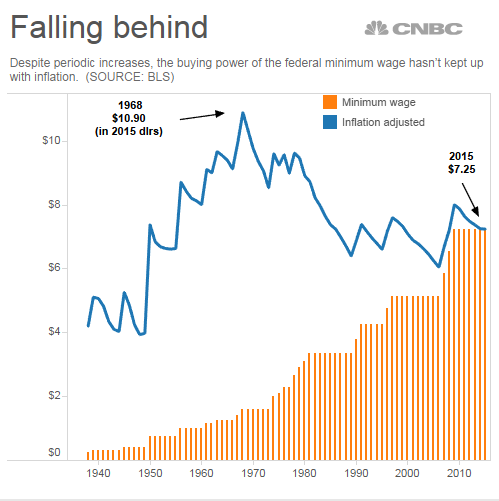
It would be interesting to see what at short term lowering of immigration would have on wage growth.
It seems obvious to me that fewer low skill workers would result in higher wages for those who could most benefit from it.
Here's one classic study on the effect:
David Card, "The Impact of the Mariel Boatlift on the Miami Labor Market" (1990), http://davidcard.berkeley.edu/papers/mariel-impact.pdf
Quoting from the abstract: "…This paper describes the effect of the Mariel Boatlift of 1980 on the Miami labor market. The Mariel immigrants increased the Miami labor force by 7%, and the percentage increase in labor supply to less-skilled occupations and industries was even greater because most of the immigrants were relatively unskilled. Nevertheless, the Mariel influx appears to have had virtually no effect on the wages or unemployment rates of less-skilled workers…"
That's a rapid influx of 7% of Miami's population! But the effect isn't obvious to economists, either, and you can find people arguing both sides. This is a fairly balanced article: https://www.npr.org/2017/08/04/541321716/fact-check-have-low...
One thing is for sure, housing prices would skyrocket!
For example: https://www.migrationpolicy.org/sites/default/files/source_i...
So yes, it is likely that immigration rates have a negative effect on the wages of native workers in low barrier of entry positions. You'd have to suspend disbelief to accept the narrative that there is no impact.
source: https://www.migrationpolicy.org/article/frequently-requested...
In fact, the suggestion that tosser00001's main point had anything to do with silly internet points is a minimization/redirection tactic that is itself a more important instance of the very thing being complained about.
Legal immigration has a comparatively small effect due to the fact that they're part of the skilled labor force and generally fill gaps in our society. The number of people actually holding H1Bs is so small that I find it hard to believe they have any major pull on the various sectors outside of the few firms that are known to be abusing the system.
Fixing the system in a humane way that also doesn't blow up the lower classes is a herculean task.
I worked at a hotel for several years in the early 2000's the housekeeping staff was overwhelmingly black women and men but shifted dramatically to Hispanic women and men after new penny pinching ownership took over and started using some dubious temp agency.
I don't begrudge the immigrants, I'm second gen on one side and wanting a better life is completely reasonable. I do however think it's completely disgraceful that we turn a blind eye to employers that break the law because they don't want to pay a living wage, or want compliant semi-disposable workers.
The slaves are all picking cotton for below minimum wage so we don't have the bear the true costs of our clothing. Remove them and there would be serious repercussions for those at the lower strata of society.
This is not looking very nice, to put it mildly.
That’s an anecdote but there are plenty more like that. All of which is to say that the story the right pushes about immigrants being bad for the economy is just a story and doesn’t necessarily fit the facts.
No it doesn't. This narrative is nonsense. There's a lot of research on the impact of immigration on, for example, Germany. None have concluded that such immigrants are doing anything but supplying desperately needed labor to Germany's economy and have had significant positive benefits [1].
The fact that it is so easy to learn about this (there's plenty of data, much of it free and easily available) and yet people continue to spout this narrative speaks volumes.
I don't know. No one else does either.
You would think that two income earners in a household would increase the economy enough that wages would need to rise due to a subsequent shortage of labor... but it did not.
Wages, in real terms, have largely lost purchasing power to the point where it takes two incomes to have the same (or less) purchasing power than one income did prior to WWII.
Part of it is the productivity gains made post WWII (i.e. we can do more with less labor) but a lot of it is the supply side of labor and competitive pressures pushing the price equilibrium (wages) down.
I'm not making an argument against the entry of women into the workforce. I'm an advocate for 'freedom' so I'm all for women doing what they want as long as they are following the law. My point here is the supply side of labor does not have a large enough increase to the demand side of labor to make up for the decrease in the price of wages.
Immigration applies downward pressure on lower/middle-lower labor classes and harms the power of unions.
I don't blame the immigrants who want to go where the jobs pay more - it's the smart thing for them to do - the blame here lies 100% on the corporations who exploit this (Tyson foods, etc.) and the politicians they ~~bribe~~contribute funds to.
I'm not really supporting or opposing the system, which is a topic for another place, but just mentioning that farming is not like people think it is. So trying to determine what 'market wages' would be like is not really possible when much of the entire industry is operated outside the bounds of the market.
I can concede that unskilled immigration is putting downward pressure on the salaries of low/no skill workers, but the US social inequality is the elephant in the room.
Sure, in the hypothetical of instantaneously doubling the population without any time for the market to adjust for increased demand. But if the population doubles over the course of 30 years? That's only about 11 million people a year, the market would expect and adjust to the influx of people easily. Governments would also ideally be devising initiatives and changing policy to promote affordable housing. The high cost of housing in the US is its own issue anyway.
The elderly, with failing ears and minds, have enough trouble understanding the speech of the native population. Subjecting your elderly to nurses that can't be understood at all is elder abuse.
It used to be that these were low paying jobs, packed with immigrants. Since you need a social security number to work, and we’re rather good at finding people who cheat the system, illegal immigration workers isn’t really a thing in factories. But the system and legalization was still exploited so paying immigrants less was possible.
Anyway eventually regulation caught up and ended the low pay loopholes. So now a job at those factories pays half a million kroner a year, or more than I earn as a senior IT-architect.
As a result a lot of our slaughtering houses moved production and enrichment out of the country, but the really interesting thing is the fishing factories. They couldn’t move or outsource production because they need to be located close to where the fish are caught.
Despite the pay hike they still can’t hire enough people without relying on immigration. It turned out that nobody wanted those jobs, even when they pay really well.
Ps. Im not sure what fishing factories and slaughtering houses are called in English but I hope you get the point.
Personally, I have nothing at all against the illegal sort. Day laborers, for instance, tend to be great workers and good people, happy to put in a hard day's work for a $50 and some good meals. At the same time though, I have to consider that this is really distorting the economy since it drags down wages for all people willing to do this work to that level, which is not really fair to people that want to make a living doing this work but want a higher standard of living, to raise a family, etc.
I don't think that is true. Even if you exclude management jobs, hourly wages have remained roughly steady in real terms since the 1960's: http://www.pewresearch.org/fact-tank/2018/08/07/for-most-us-...
There are also longitudinal effects at play: native-born Americans have seen their wages rise but this is offset by immigrants who generally have lower-than-average wages (but still higher than in the country they emigrated from). Both groups are better off even though average wages haven't changed.
The cost of a 1 liter water bag at a hospital is $500.
Walmart evaded $70+ billion dollars in tax. They made that money by keeping all their workforce on medicaid.
That's where you money is going to, not $6 an hour fruit pickers spending all their money in food.
You could argue that by bringing Filipinos in you lower the wages, and as a result, the native population is less interested in taking such jobs, besides lowering the "status" of the job itself.
I was recently looking for a nanny in Spain and most applicants were Spanish females. Despite that, most parents seem to hire foreign nannies from LA because it's cheaper.
That said, it's really sad if the elderly in Belgium are being taken care of by people they barely can understand. What a nice ending of life!
I remember from my time in the Netherlands that the elderly there get regular visits from a specific person whose job is to socialize with them to solve some of the "loneliness" problems. I wouldn't be surprised if something similar happens in Belgium, which is IMO, a growingly anti-social society.
In Spain (which has the highest life expectancy in Europe by the way) many old people are still taken care of by close family members, or in other cases by people from LA who at least speak the same language. I didn't realize how fortunate they actually are.
”For a typical household, a 40 percent increase in farm labor costs translates into a four percent increase in retail prices (0.30 farm share of retail prices x 0.33 farm labor share of farm revenue = 10 percent, farm labor costs rise 40 percent, and 0.4 x 10 = 3.6 percent). If farm wages rose 40 percent, and the increase were passed on fully to consumers, average spending on fresh fruits and vegetables would rise by about $21 a year (4 percent x $530 = $21).
Giving seasonal farm workers a 40 percent wage increase, on the other hand, would raise their average earnings from $11,720 for 1,000 hours of work to $16,400, lifting the average worker above the federal poverty line of $11,770 for an individual in 2015.”
I think this is an important point that many people seem to gloss over when discussing what humans _deserve_ to be paid.
Many believe the uniqueness of a skill set or how much physical stress is inherent to a position should be the only factors which increase a salary.
But the point you highlight here says that the amount of soul-crushing misery a position entails should also play a significant role when determining salaries.
It seems that in many countries, companies can get away with paying soul-crushing positions so terribly because so many people are coerced into these jobs--forced to choose between incredibly soul-crushing, low paying positions or watch their families starve, become homeless, not be able to afford medical care etc...
Which leads me to wonder if there are any societal changes we could make in order to nudge salaries to reflect when a job is mentally abusive. Similar to how pay typically reflects when a job is physically abusive.
I'm guessing Denmark has a decent safety net which forces companies to actually factor in mental abuse of a position when they're formulating salaries which ensures their citizens are compensated accordingly?
Both of these things are pretty important - college education can be life altering in terms of career trajectory, and owning a house is an entry point into the wealth ladder and also simply an escape from rent. In real terms, the cost of these has runaway over the past 20-30 years and so people's access to two crucial things that aid social mobility (wealth/housing and education) have been eroding over the years. But apparently because our money can still buy a basket of goods we should be satisfied that our lives haven't gotten any worse.
For me, and I'm pretty sure it's quite complex and I am guilty of Dunning Kruger wrt politics and economics, I simply cannot understand how inflation can get away without finding a way of placing these in the basket of goods used to calculate inflation.
[1] https://nces.ed.gov/fastfacts/display.asp?id=76
[2] https://www.reuters.com/article/us-usa-property-poll/u-s-hou...
Wait, so they are intentionally keeping food prices higher by paying people to not grow food? I mean, I understand that we need farmers and dipping food price markets isn't ideal, but... wow... what a world.
* Highly skilled/educated immigrants provide a significant boost to economic growth and pay more in taxes than they receive in benefits. I don't recall whether the podcast addressed the impact of these immigrants on the wages of highly skilled native-born workers.
* Low-skill immigrants are a net positive in the long term (i.e., once their children grow up) to the economy as a whole, but their net impacts in the short term are somewhat ambiguous, and there is some evidence that they bring about wage decreases for low-skill native-born workers. While that evidence is not completely clear-cut, it seems likely that there's at least some level of impact. There's also evidence suggesting that some of the displaced native-born workers "climb the ladder" into higher-skill, higher-wage positions when this happens, which may mitigate that impact.
From what I've read more generally, my impression is that outsourcing has a much larger impact on unskilled workers' wages than immigration does, though I don't have a specific source to support that claim.
[0] https://ftalphaville.ft.com/2017/09/15/2193785/podcast-the-e...
[1] https://ftalphaville.ft.com/2017/11/10/2195727/podcast-kim-r...
Turning them away is like turning away a gift of hundreds of thousands of dollars.
The Hispanic staff that doesn't seem to have anything close to living wage is a pervasive feature in the Bay Area too. I'm not sure if, and to what extent, they displaced black workers in the Bay Area though.
[0] https://sc.cnbcfm.com/applications/cnbc.com/resources/files/...
That's a feature, not a bug.
But yes, the rest of society will become a LOT "poorer" (but still comfortable) for no more than a decent increase in the living standard of the working poor.
The US military, especially, is the largest job and training program anywhere in the world, including the military industrial complex (most of those military contracts, incidentally, do not just come with jobs, but with demands that those companies hire x0000 (3 or 4 zeros) in the states that have the highest poverty levels).
I'm not saying it's an ideal occupation (although, hey, Keynes seemed to like it when he was less on guard). So yes, I'd also much prefer them to be building better infrastructure. Or perhaps have a much cheaper postal service.
> That's where you money is going to, not $6 an hour fruit pickers spending all their money in food.
Perhaps. But the inability of the working poor to pick fruit at $15 an hour IS due to (mostly illegal) fruit pickers.
How so? To artificially keep salaries high?
On the lowest rung of society, they're at least 50%. The higher you go the lower the percentage, and it drops off pretty fast.
Then, if fruit pickers made $20 an hour, you would be getting all of your fruit from Mexico/Central America, and fruit and all products made from it would be more expensive.
Other jobs like gardening and landscaping would simply either not be done, or get done by property owners themselves. Now they will be tired, be less productive at work and have less time for their kids, or, see their property value drop while their local crime rate goes up.
The argument I am arguing against is something like:
Immigrants join the labor force -> They increase the economy -> The increase in the economy increases jobs -> More jobs increase wages.
I think this what you are essentially saying?
The problem here is inflation and productivity. In order for everyone to prosper either:
1. There is no inflation and therefore purchasing power is maintained, or
2. Wage growth and interest rates outpace inflation.
No. 1 will not happen under our current monetary system, and no. 2 has not happened due to:
a) Competition in the labor market has keep real wage growth flat, and
b) The unprecedented (in the history of mankind) money creation (AKA Quantitative Easing) used to bail out financial institutions has destroyed interest rates and created a massive inflation in asset prices.
Another factor is that different jobs impact the economy differently. Or put another way, different jobs create different levels of 'value' in society (the monetary kind not moral kind). The difference between the price of a good or service, and the perceived value of a good or service is the 'consumer surplus'.
Fact is, highly skilled immigration is going to create a higher level of consumer surplus compared to low skilled immigration. Highly skilled immigration in areas where there are shortages is going to also have a bigger impact on economic growth.
I think you will be hard pressed to find anyone arguing against this sort of immigration... the issue that dare not be spoken is the impact low skilled and illegal immigration has on the labor market.
While taxi drivers sometimes consume rides, I can't imagine anyone thinks they consume 8 hours a day of rides?
Or more likely because the pay is not enough to interest the locals.
How does the pay for a nurse compare to a programmer? 2x as much? 3x?
It’s not just that it’s hard labour either, it’s also that handling fish is extremely low prestige.
So the story is more about the nuances and complicated nature of the job market. It’s easy to blame immigration, and it’s not like immigration doesn’t have an impact, it’s just that there are a lot more forces at play.
In a magical hand-wavey manner where we ignore alternatives, obvious consequences, and opportunity costs.
They gloss over the reason they are considered a net positive is because almost everyone is.
For example their models will show that if the poorest Americans have lots more kids we will collectively be better off.
It’s pretty much just economists and the Catholic Church who believe it.
I don't have exact figures so I'm using 50% like "about half". I suspect though that it's only about half because some of them managed to legalize themselves, and in reality in these very bad jobs there's actually even more than that.
I would have no problem with producing locally where it makes sense, but not to avoid minimum legal standards for wages (or for that matter for other things like environment).
It would be very bad to kill it without replacement.
Definitly true. However good pay costs a lot of money, so less care workers can be hired with the current budget. Either you have to spend more money or accept a reduction in the level of care.
A basic income would work here. If people aren't forced to take a job out of economic necessity then unpleasant jobs will need to pay more to attract people to do them.