[1] https://poverty.ucdavis.edu/faq/how-does-level-education-rel...
Here's one classic study on the effect:
David Card, "The Impact of the Mariel Boatlift on the Miami Labor Market" (1990), http://davidcard.berkeley.edu/papers/mariel-impact.pdf
Quoting from the abstract: "…This paper describes the effect of the Mariel Boatlift of 1980 on the Miami labor market. The Mariel immigrants increased the Miami labor force by 7%, and the percentage increase in labor supply to less-skilled occupations and industries was even greater because most of the immigrants were relatively unskilled. Nevertheless, the Mariel influx appears to have had virtually no effect on the wages or unemployment rates of less-skilled workers…"
That's a rapid influx of 7% of Miami's population! But the effect isn't obvious to economists, either, and you can find people arguing both sides. This is a fairly balanced article: https://www.npr.org/2017/08/04/541321716/fact-check-have-low...
For example: https://www.migrationpolicy.org/sites/default/files/source_i...
So yes, it is likely that immigration rates have a negative effect on the wages of native workers in low barrier of entry positions. You'd have to suspend disbelief to accept the narrative that there is no impact.
source: https://www.migrationpolicy.org/article/frequently-requested...
https://books.google.com/ngrams/graph?content=rugged%20indiv...
https://rationalwiki.org/wiki/Rugged_individualism
http://teachingamericanhistory.org/library/document/rugged-i...
As soon as land becomes private property, the landlord demands a share of almost all the produce which the labourer can either raise, or collect from it. His rent makes the first deduction from the produce of the labour which is employed upon land.
...
The masters, being fewer in number, can combine much more easily; and the law, besides, authorizes, or at least does not prohibit their combinations, while it prohibits those of the workmen. We have no acts of parliament against combining to lower the price of work; but many against combining to raise it. In all such disputes the masters can hold out much longer.
...
Masters are always and everywhere in a sort of tacit, but constant and uniform combination, not to raise the wages of labour above their actual rate. To violate this combination is everywhere a most unpopular action, and a sort of reproach to a master among his neighbours and equals. We seldom, indeed, hear of this combination, because it is the usual, and one may say, the natural state of things, which nobody ever hears of. Masters, too, sometimes enter into particular combinations to sink the wages of labour even below this rate.
...
A man must always live by his work, and his wages must at least be sufficient to maintain him. They must even upon most occasions be somewhat more; otherwise it would be impossible for him to bring up a family, and the race of such workmen could not last beyond the first generation.
...
No society can surely be flourishing and happy, of which the far greater part of the members are poor and miserable. It is but equity, besides, that they who feed, clothe, and lodge the whole body of the people, should have such a share of the produce of their own labour as to be themselves tolerably well fed, clothed, and lodged.
...
Wealth, as Mr Hobbes says, is power.
...
POLITICAL œconomy, considered as a branch of the science of aThe first object of political economy is to provide subsistence for the people statesman or legislator, proposes two distinct objects: first, to provide a plentiful revenue or subsistence for the people, or more properly to enable them to provide such a revenue or subsistence for themselves; and secondly, to supply the state or commonwealth with a revenue sufficient for the public services. It proposes to enrich both the people and the sovereign.
Oh, silly me, that's Adam Smith. So hard to tell them apart.
https://en.wikisource.org/wiki/The_Wealth_of_Nations/Book_I/...
http://oll.libertyfund.org/titles/smith-an-inquiry-into-the-...
And the worst part is that this measurement of compensation is actively measured and quantified. Here [1] it is. I'll take their word that productivity since 1973 has increased 77%. In that time real hourly compensation has increased 50% and growing.
I don't think that is true. Even if you exclude management jobs, hourly wages have remained roughly steady in real terms since the 1960's: http://www.pewresearch.org/fact-tank/2018/08/07/for-most-us-...
There are also longitudinal effects at play: native-born Americans have seen their wages rise but this is offset by immigrants who generally have lower-than-average wages (but still higher than in the country they emigrated from). Both groups are better off even though average wages haven't changed.
”For a typical household, a 40 percent increase in farm labor costs translates into a four percent increase in retail prices (0.30 farm share of retail prices x 0.33 farm labor share of farm revenue = 10 percent, farm labor costs rise 40 percent, and 0.4 x 10 = 3.6 percent). If farm wages rose 40 percent, and the increase were passed on fully to consumers, average spending on fresh fruits and vegetables would rise by about $21 a year (4 percent x $530 = $21).
Giving seasonal farm workers a 40 percent wage increase, on the other hand, would raise their average earnings from $11,720 for 1,000 hours of work to $16,400, lifting the average worker above the federal poverty line of $11,770 for an individual in 2015.”
Both of these things are pretty important - college education can be life altering in terms of career trajectory, and owning a house is an entry point into the wealth ladder and also simply an escape from rent. In real terms, the cost of these has runaway over the past 20-30 years and so people's access to two crucial things that aid social mobility (wealth/housing and education) have been eroding over the years. But apparently because our money can still buy a basket of goods we should be satisfied that our lives haven't gotten any worse.
For me, and I'm pretty sure it's quite complex and I am guilty of Dunning Kruger wrt politics and economics, I simply cannot understand how inflation can get away without finding a way of placing these in the basket of goods used to calculate inflation.
[1] https://nces.ed.gov/fastfacts/display.asp?id=76
[2] https://www.reuters.com/article/us-usa-property-poll/u-s-hou...
Interest rate targeting uses an unemployment buffer to keep wages and therefore prices under control. Poverty for those in work is entirely part of the plan. To fix the poverty problem you need to fix the structural viewpoint and return to the Beveridge condition - everybody must have an alternative living wage job offer available to them so that job competition works properly in favour of people. There must always be more jobs available than people that want them, not slightly fewer.
But that then runs into what Kalecki called "The Political Aspects of Full Employment" - a recommended read if you haven't already: https://mronline.org/2010/05/22/political-aspects-of-full-em...
Truly a 'wicked problem' - tied up with the concept of power
* Highly skilled/educated immigrants provide a significant boost to economic growth and pay more in taxes than they receive in benefits. I don't recall whether the podcast addressed the impact of these immigrants on the wages of highly skilled native-born workers.
* Low-skill immigrants are a net positive in the long term (i.e., once their children grow up) to the economy as a whole, but their net impacts in the short term are somewhat ambiguous, and there is some evidence that they bring about wage decreases for low-skill native-born workers. While that evidence is not completely clear-cut, it seems likely that there's at least some level of impact. There's also evidence suggesting that some of the displaced native-born workers "climb the ladder" into higher-skill, higher-wage positions when this happens, which may mitigate that impact.
From what I've read more generally, my impression is that outsourcing has a much larger impact on unskilled workers' wages than immigration does, though I don't have a specific source to support that claim.
[0] https://ftalphaville.ft.com/2017/09/15/2193785/podcast-the-e...
[1] https://ftalphaville.ft.com/2017/11/10/2195727/podcast-kim-r...
[0] https://sc.cnbcfm.com/applications/cnbc.com/resources/files/...
Who told you poor people are capable of as good choices as richer people?
When you live life in easy mode is easy to make the right choices.
It's also easy to see some people who managed to play in hard mode and win, and extrapolate to everybody (especially if you don't account for lucky breaks and mitigating factors in their course).
But because a handful managed to win in hard mode, it doesn't make it as easy as those who play in easy mode, nor it makes it any more statistically possible for the masses to win the hard mode gameplay they were dealt.
>Where I am, the good and the bad, is nearly entirely the sum of my choices.
LOL. http://thewireless.co.nz/articles/the-pencilsword-on-a-plate
(One is even tempted to wish upon people saying hat a couple some serious accident or decease that kills their savings or takes their job, or puts them into depression, or have them tend to another family member, and such, to see whether their tune will remain the same...)
From https://www.wola.org/analysis/fact-sheet-united-states-immig...
"While the total number of migrants apprehended at the U.S.-Mexico border is near its lowest level since the early 1970s, the number of apprehended unaccompanied children and families is again on the rise after a dramatic drop in the months following Trump’s inauguration.
This is a vulnerable population who, for the most part, are deliberately seeking out U.S. border security authorities and asking for protection. Affirmative requests for asylum of individuals from Guatemala, El Salvador, and Honduras have increased by 25 percent in fiscal year 2017 compared to 2016.
These people are fleeing for a reason. As White House Chief of Staff John Kelley once put it, the mass migration of children from Central America to the U.S.-Mexico border primarily consists of “[parents that] are trying to save their children.” The countries of El Salvador, Guatemala, and Honduras are facing unparalleled levels of violent crime, with El Salvador and Honduras ranking among the top five most violent countries in the world."
The lack of morality to vote for decent politicians. Why do US citizens claim to want medicare for all but vote for Democrats or Republicans who do not want medicare for all ?
https://www.youtube.com/watch?v=dX5GSClA8z4&t=207
The lack of morality that private property should be spent to help other persons in need.
The lack of morality that allows an insane military budget and immoral lies and crimes and murder in other countries by political and military and economic warfare.
https://chomsky.info/1990____-2/
https://www.globalresearch.ca/america-has-been-at-war-93-of-...
1. Trump’s Travel Ban, Aimed at Terrorists, Has Blocked Doctors - https://www.nytimes.com/2017/02/06/health/trump-travel-ban-d...
2. Trump’s Immigration Order Could Make It Harder To Find A Psychiatrist Or Pediatrician - https://fivethirtyeight.com/features/trumps-immigration-orde...
Both of these are reports on exactly the same issue, but different techniques.
The NYTimes prefers to use pictures of a doctor, along with quotes from various doctors and medical students. "We need him desperately", says someone about an oncologist. "I love this country", says a Syrian doctor about America.
Fivethirtyeight tells the story with statistics. How many doctors are there in America? How many of those are immigrants? How many from these countries? All told in one image. Which specialties do these doctors practice? In which counties do they practice in? No human interest, just the facts.
Me personally, I prefer FiveThirtyEight's style. I read their article and that one image helped me realise what a grave issue it was. They get straight to the point, no fluff. But I totally understand how others might connect more with the NYTimes article. Seeing the story from the perspective of a real, breathing human. Hearing them talk about love, about sacrifice, about family. It humanises the issue and they understand it better. Different strokes.
That doesn't make much sense if the US is a hell-hole of capitalism grinding people into poverty (as immigrants usually have little).
In 2016, 1.49 million immigrants came to the US. The median age is 44, so they're hardly all children.
Meanwhile, an awful lot more want to come but can't get in legally.
> This is the most ridiculous proof that America is the land of opportunity I can imagine.
People run to opportunity, not away from it. https://www.migrationpolicy.org/article/frequently-requested...
In fact, the US is at or very near the worst among OECD countries in all of the following, and is much closer to Developing countries than Developed countries: infant mortality, child poverty, child health and safety, life expectancy at birth, healthy life expectancy, rate of obesity, disability-adjusted life years, doctors per 1000 people, deaths from treatable conditions, rate of mental health disorders, rate of drug abuse, rate of prescription drug use, incarceration rate, rate of assaults, rate of homicides, income inequality, wealth inequality, and economic mobility. [1]
The lack of social mobility is well documented, and it's a travesty that's affecting large parts of the developed world still (and shamefully, the UK pretty much leads on it):
https://www.minneapolisfed.org/institute/working-papers/17-2...
https://www.suttontrust.com/newsarchive/disturbing-finding-l...
https://assets.publishing.service.gov.uk/government/uploads/...
https://www.theguardian.com/society/2018/jun/15/social-mobil...
Unfortunately I'm not as well versed in reliable US sources, but there are references through here that the US doesn't exactly beat us hands down on social mobility either.
I do implore everyone to read more on this topic, there's a lot on HN about "meritocracy" and "well, just work harder", but that's just simply not the world we live in. It's a shit-show out there, and people's ability to break through the "class-ceiling" is being stunted, not improved.
I think a roughly accurate statement is that over half of Americans end up within one income quintile of their parents.
That doesn't seem like much mobility to me and many European countries apparently rank better. The American Dream might be mostly marketing at this point.
That's a cute clip, but if you look at statistics you'll see Americans with less than a high school degree work on average 7.8 hours a day, and only 30% work on weekends and holidays.
In other words, you "make" decisions only partially, and your choices are shaped by your status in life, before your conscious self can "chose".
http://science.sciencemag.org/content/338/6107/682
https://www.theatlantic.com/business/archive/2013/11/your-br...
https://qz.com/964920/data-show-poor-people-make-better-fina...
http://news.berkeley.edu/2015/03/02/anxious-people-decisions...
This [1] is the real median personal income. The data there only starts at 1974 but you once again see a 32% increase in income. Now factor in the change in hours worked. The average American works more than 100 less hours then back then. [2]. These numbers combined along with arguing that most people only saw a real increase in wages of 12% is simply not possible, nor is it possible to simply attribute all growth to the rich.
Now there is this [3]. The numbers from that paper are really what made me start digging into all of this stuff. To give the long and short of it - the poor are becoming middle class, and the middle class are becoming rich. With the net effect being a major decline in the number of poor, a major increase in the number of rich, and a small decline in the number of middle class. Probably not coincidentally, not entirely dissimilar to the hypothetical I proposed where the median can end up being misleading. These 'nobody except the rich are seeing more money' articles seem to be simply untrue, but they are click magnets.
[1] - https://fred.stlouisfed.org/series/MEPAINUSA672N
(Now we could have a debate on the meaning of 'starving', but let's just say there is a broad area between skipping a few meals and dying from lack of food that is all covered by how people use the word.)
We're discussing the US here, and for the US this is not correct: https://www.bls.gov/cps/cps_htgm.htm#unemployed
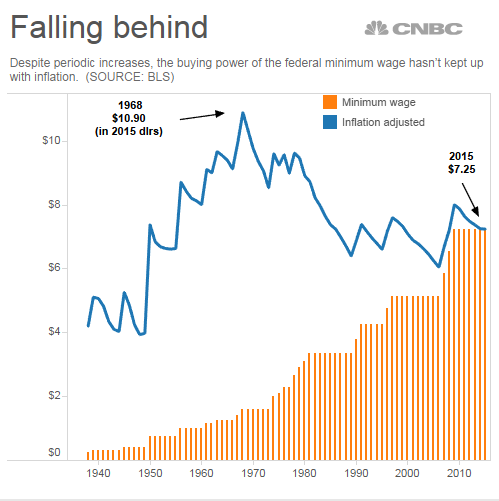
I explicitly didn’t want to make this comment about advocating for a policy, but first to make sure we’re all on the same page: the US minimum wage isn’t enough to get by on. I should have added that a huge portion of the labor force is at or near this rate, except again I’m on my phone, so I couldn’t back that with the precise number.
Since you asked, I’m one of the Basic Income folks :).
The article completely ignores the major cause of Vanessa's struggles: she is a single parent trying to raise three children. Where is the father of her children?
If you are not married, do not have children. Just going by the statistics, I suspect Vanessa's children were born out of wedlock.
Also, if you are very young (still in high school) and not on financially sound footing yet, do not have children.
Remedying these problems alone would massively reduce poverty.
Children are a massive financial and time sink, yet according to the Brookings Institute [1]:
"...more than 40 percent of American children, including more than 70 percent of black children and 50 percent of Hispanic children, are born outside marriage."
Many of these children are raised by single mothers and fathers. Sure, married people get divorced, but the number of children raised in single parent households is far less among those born to married adults than those who are not.
It's been clearly shown that the average child raised in a single parent household has worse outcomes than the average child raised in a two parent household.
Cultural issues must be addressed in this country, but everyone seems unwilling to do so because they worry about "blaming the victims".
Well in this case, poverty is clearly being perpetuated by poor decision making on the part of individuals and cultures which perpetuate this poor decision making. The "victims" are at fault.
Culture can be changed, but we must identify and talk about the problems before that change can occur.
[1] https://www.brookings.edu/opinions/three-simple-rules-poor-t...
Regardless of the correct level before causing a crowding out of employment, what do you believe the purpose of having a minimum wage is (if not to prevent poverty)? Why not just let the market decide?
Edit: I mean this seriously, and don’t intend it as an attack. I’m (personally) unclear on the perceived purpose of the minimum wage.
Edit 2: like many folks, my “we’ve never come close to it” is influenced by http://www.nber.org/papers/w4509 and similar studies, and I’m aware of the opinions that the study was flawed or doesn’t generalize (e.g., https://www.google.com/amp/s/www.forbes.com/sites/timworstal...).
[0] https://stats.bls.gov/opub/reports/minimum-wage/2016/home.ht...
The real question is: why won't America care about children?
https://www.forbes.com/sites/brycecovert/2012/07/16/the-rise...
I am as well. And have parents enabling this behavior, with an career outcome as bad as you could expect. I can totally understand that part of the political spectrum doesn't want to encourage this at all (favorable interpretation of them), even though they IMO often overshoot that goal and advance less optimal outcomes.
> I will also assume you are talking about older children. Most 13-year olds just don't have a lot of maturity for what you describe.
Your phrasing makes this seem like a natural fact. Finding ways to deeply engrave important values (work hard, strive for greatness, delayed gratification, stuff like that) into future generations seems like a real challenge right now. And what makes stories like [0] so interesting. Evolution doesn't take care of that job for us anymore in a "work or starve" way. Religious "work or go to hell" probably did an ok job for a while, but comes with a lot of other baggage. A very capitalistic "work if you want a decent live" society over many generations leads to increasingly unequal starting conditions for offspring and thus seems especially incompatible with democracy, since it will lead to "the system is rigged, lets burn it down" votes, as recently observed all over the western world.
So what's next? As mentioned in my prior anecdote, mostly letting your children do what they want, thinking this will naturally make them strive for greatness, will probably not work. What are the necessary environmental factors parents and society should provide to shape future humans into productive members of society? I'm sure with all our knowledge, mankind can do better than the earlier simple carrot & stick systems.
>> financially secure
I think the point of the article is that based on the current trajectory, a big chunk of the population will never get there.
I just searched this on Google:
> According to a 2016 GOBankingRates survey, 35 percent of all adults in the U.S. have only several hundred dollars in their savings accounts and 34 percent have zero. Only 15 percent have over $10,000 stashed away.
https://screenshotscdn.firefoxusercontent.com/images/7323d18...
https://en.wikipedia.org/wiki/Socio-economic_mobility_in_the...
[1] - https://abcnews.go.com/Business/study-28-percent-millionaire...
No offense, but this screams of ignorance. If you take into account the poverty tax [1], poor people pay more for many goods, have worse access to many services, and encounter much higher transaction costs to accomplishing normal life.
For example, if you are a single mother in Southside Chicago living in a food desert and far from the main L/Subway/Metro lines, then you take longer to commute to work, to go grocery shopping, to pick your kids up, etc. There are many additional costs to being poor that easily explain why they don't focus on "making their beds" or "organizing their place".
The Atlantic has a good article on decision fatigue and poverty "Your Brain on Poverty: Why Poor People Seem to Make Bad Decisions And why their "bad" decisions might be more rational than you'd think" that is worth a read [2].
[1] https://en.wikipedia.org/wiki/Ghetto_tax
[2] https://www.theatlantic.com/business/archive/2013/11/your-br...