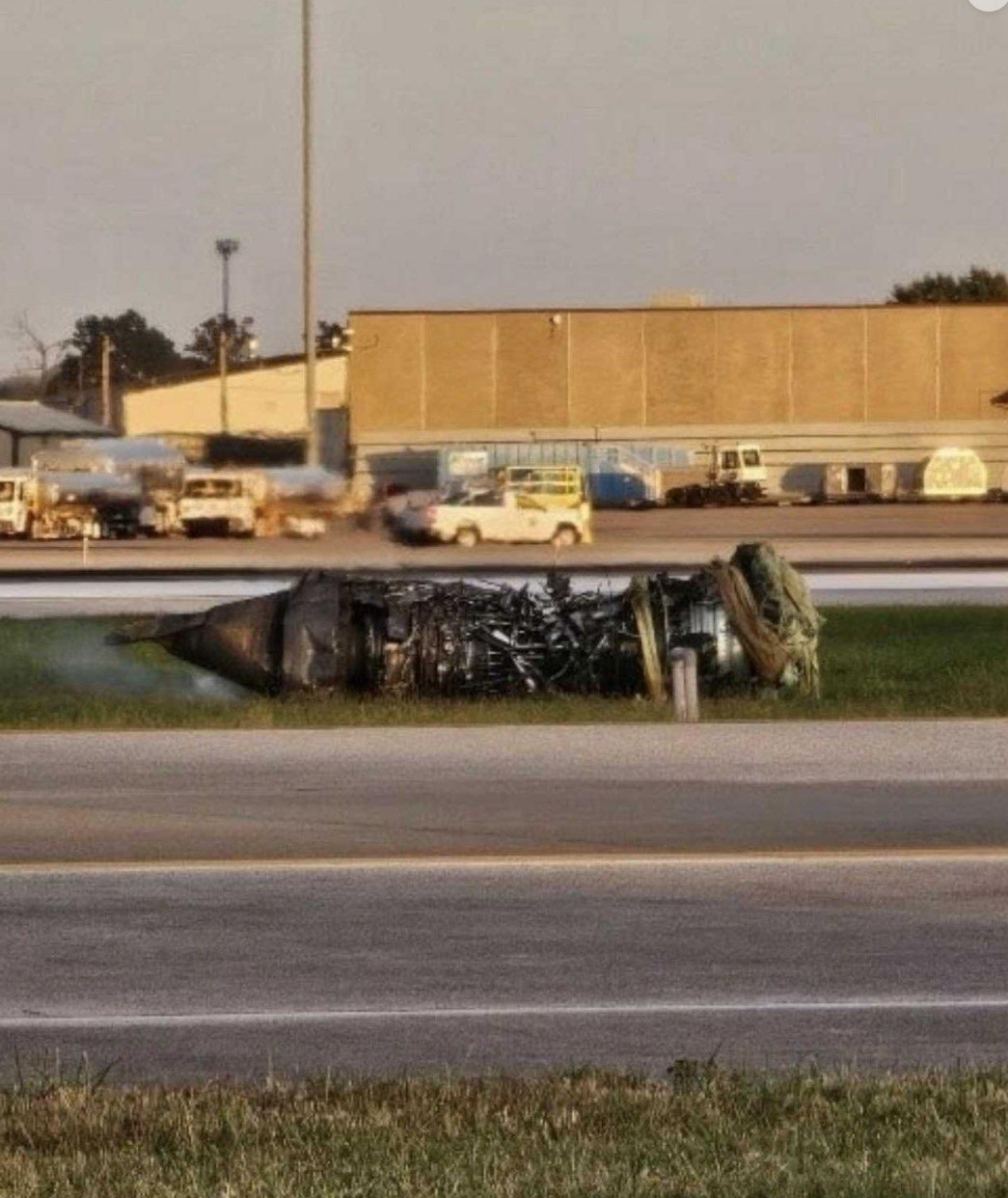
https://x.com/BNONews/status/1985845907191889930
https://xcancel.com/BNONews/status/1985845907191889930
Edit: just the mp4 https://video.twimg.com/ext_tw_video/1985845862409334784/pu/...
There is an incredible amount of ground damage! Just wow, this is very bad https://files.catbox.moe/3303ob.jpg
Flying with two engines and taking off without an engine in a loaded aircraft are two very different things. A lot more thrust is needed during takeoff than after.
In fact, it being normal almost certainly contributed to the scale of this accident, since a single engine failure during the takeoff roll isn't considered enough of an emergency to reject the takeoff at high speed (past a certain speed, you only abort if the aircraft is literally unflyable - for everything else, you take the aircraft & emergency into the air and figure it out there). The crew wouldn't have had any way to know that one of their engines had not simply failed, but was straight-up gone with their wing on fire to boot.
I don't know about the MD-11 itself, but other aircraft from that time period have sensors to detect and report overheat and fire in various parts of the aircraft, including engines and wings.
They were on fire just as they reached V1.
Plane was fully loaded with 38,000 LB of fuel for 12 hour flight to hawaii. Worst case scenario.
Pilots did the heroic thing - they tried to take off instead at 160 MPH to minimize collateral damage (highway and warehouses at the end of the runway) and crash and die somewhere else, instead of go beyond the runway at that speed. Accelerating a fully loaded jet plane at ground level beyond the runway has obvious consequences. They had one choice.
Instead, they clipped the UPS factory because they were so low, they tried to clear it but did not. Plane then hit the ground port wing down, shearing it off entirely, smearing a fireball of jet fuel across half a mile (not an exaggeration) before the plane flipped. Crew were likely dead by before this, footage shows the cockpit being slammed into the ground like a mousetrap by the flip once the port wing was gone and gravity took the starboard wing over.
Physics took over. Plane flipped and rolled upon loss of port wing, smearing a rolling fireball of the remaining fuel load from the starboard wing for another half a mile.
Louisville is now a firestorm as a result.
Respect to the flight crew; rest in peace, they made the best they could out of a really shitty scenario. They flew it all the way down.
Footage:
https://x.com/osinttechnical/status/1985845987684855969?s=46
https://x.com/faytuksnetwork/status/1985849267152699741?s=46
https://x.com/faytuksnetwork/status/1985848132500885995?s=46
https://x.com/faytuksnetwork/status/1985843126934614297?s=46
They were on fire just as they reached V1.
Plane was fully loaded with 38,000 LB of fuel for 12 hour flight to hawaii. Worst case scenario.
Pilots did the heroic thing - they tried to take off instead of accelerate past the runway at ground level at 160 MPH to minimize collateral damage (highway and warehouses at the end of the runway) and crash and die somewhere else.
Instead, they clipped the UPS factory because they were so low, they tried to clear it but did not. Plane then hit the ground port wing down, shearing it off entirely, smearing a fireball of jet fuel across half a mile (not an exaggeration) before the plane flipped. Crew were likely dead by then, footage shows the cockpit being slammed into the ground by the flip once the port wing was gone and gravity took the starboard wing over.
Plane flipped, continued to smear half of the fuel load for another half a mile.
Louisville is now a firestorm as a result.
Footage:
https://x.com/osinttechnical/status/1985845987684855969?s=46
https://x.com/faytuksnetwork/status/1985849267152699741?s=46
https://x.com/faytuksnetwork/status/1985848132500885995?s=46
https://x.com/faytuksnetwork/status/1985843126934614297?s=46
Do runways have some sort of barrier between them and the next "important" thing. It seems like that would be prudent both for cases like this, and breaking failures following landings.
Freeze frame: https://imgur.com/a/c3h8Qd3
Many airports have this problem. The recent korean air disaster which echos this is another example. BTW, this is why most airports, if possible, point out to sea...
To know this, they would have to know they had lost multiple engines. Clearly this is the case by the end, but it's not clear who realized what at what time.
The NTSB investigation will bring more light.
Older airports might have EMAS [1] retrofitted at the ends to help stop planes, but that's designed more for a landing plane not stopping quickly enough (like [2]) - not a plane trying to get airborne as in this case.
[1] https://en.wikipedia.org/wiki/Engineered_materials_arrestor_... [2] https://en.wikipedia.org/wiki/Southwest_Airlines_Flight_1248
Excellent edge-case for IFTTT thermostat. Localized air quality alert --> Intake offline.
https://cdn.discordapp.com/attachments/757091156717862935/14...
Source: https://reddit.com/r/flying/comments/1ooms7t/ksdf_accident/n...
Some do. Here is what it looks like when an overshooting plane utilizes such a barrier: https://www.youtube.com/watch?v=zW71FrX8t_g
179 dead.
Consider the possibility that gigantic flying aluminum tubes filled with tons of flammable fuel hurtling around at hundreds of kilometers per hour comprise a dilemma that has no trivial answers. Even defining what "important thing" means at any given instant is not straightforward.
https://www.wdrb.com/news/ups-plane-catches-fire-and-explode...
> There is an incredible amount of ground damage!
It's fortunate it wasn't taking off the other direction, towards the adjacent downtown of Louisville (https://www.google.com/maps/place/Louisville+International+A...)
As far as the rest of my comment - watch the videos that I linked.
I think pilot training is playing a factor. A normal rotation kills too much energy. One engine can climb when you have some airspeed and get clean, but if you lose too much energy on rotation, the inefficiency of the AoA for the rest of the short flight means that engine can no longer buy you any up. I've seen too many single-engine planes going down while trying to pitch up the whole way down.
So, less aggressive single-engine rotations and energy absorbers at the ends of runways that can't get longer. This seems like the kind of thing where we do it because it removes a significant cause of people dying.
Just watched this angle a few more times: https://x.com/BNONews/status/1985845907191889930
Another crash video shows the aircraft clearly descending before colliding with anything. It manages to go up a bit, so it's fast enough to get airborne. The normal looking rotation kills too much energy. The plane is then too inefficient to maintain speed. AoA goes up while energy goes down. Power available goes negative and then it's over.
More specifically, V1 is the max speed at which you're about to take off, but you can still abort from. They hit that max speed and realized there was a major problem that hypothetically, they could have slowed down from, but realistically was not possible. They had no choice.
You also don't particularly want it to be catastrophically effective as there are real world cases where planes have clipped the fence and then NOT gone on to crash, or at least to crash in a fairly controlled manner with the majority onboard surviving. Hitting a brick wall at 180mph is going to have a 0% survival rate.
Ha, Jeju Air Flight 2216 smashed into a barrier on the second landing attempt in Muan last year [0], and people commented "How could there be a barrier at the end of the runway, so obviously stupid, irresponsible", etc.
Now a plane does not smash into a barrier at the end of the runway and people suggest putting barriers at the end of the runway.
Don't mean to attack parent post, but may I suggest that
a) hordes of experts have thought long and hard about these issues, and it is unlikely that you can encounter this for the first time as a lay person and come up with a solution that has eluded the best engineers for decades ("why don't they attach a parachute to the plane?"), and
b) we are very close to an optimum in commercial aviation, and there are few if any unambiguous ("Pareto") improvements, but rather just tradeoffs. For example: You leave cockpit doors open, terrorists come in and commandeer the plane to turn it into a weapon. You lock the cockpit doors closed, and suicidal pilots lock out the rest of the crew and commandeer the plane to turn it into a weapon of mass-murder-suicide.
There are no easy answers.
[0] https://en.wikipedia.org/wiki/Jeju_Air_Flight_2216
ETA: In 2007 an A320 overran a runway in Brazil and crashed into a gas station, killing 187 pax & crew + 12 on the ground. https://en.wikipedia.org/wiki/TAM_Airlines_Flight_3054
Obviously impossible to tell from some cell phone type videos. Being struck by something is also possible. But it sure does look like an uncontained engine failure.
Yes, it did get airborne for a few seconds but from the video below, it looks like the left wing was damaged by the fire and could not provide enough lift, then the right wing rolled the plane to the left causing the crash.
https://bsky.app/profile/shipwreck75.bsky.social/post/3m4tvh...
When the plane reaches V1, pilots take the hand off the throttle: they're committed to takeoff, even if an engine fails. It is better to take off and fix the problem or land again, than to smash into whatever is beyond the end of the runway.
As I understand it, there is a low speed regime, under 80 knots, where are you stop for basically anything.
Then there is a high speed regime, where you only stop for serious issues, because you now have so much kinetic energy that stopping the plane, while still possible, will involve risk. (i.e. fire from overheated brakes.)
At a certain point, called V1, there’s no longer enough room to stop, no matter what your problem is. You’re either getting airborne or you’re crashing into whatever is ant the end of the runway. In general, getting airborne is the safer option, while obviously still not risk free.
However, this calculation also assumes that the engine fails in an isolated fashion, and its failure did not affect the other engines. If the failure of the left engine threw off debris that damaged the middle engine then we are now talking about a double engine failure. I’m sure the pilots knew there was a problem with the engine when they made the decision to continue, but it’s possible that problems with the middle engine weren’t apparent yet and that it only started to fail once they were committed.
Obviously, this is just speculation, and we will have to wait for the preliminary report at least.
RIP
Surely uncertainty about the situation contributes to defaulting to committing, but what if it's a passenger plane and at V1 pilots know they've lost power? Wouldn't veering into highway at 30 mph be weighted against certain, big loss of life?
Edit: I now see that this has been partially answered by uncle comment
The wings and aerodynamics don't really care if air or air with combustion are flowing around them.
Roll is a consequence of the loss of control due to low speed and the yaw of the good engines. Speed up, rudder works, plane might maintain positive climb.
There's also a very big difference between "Engine failure: something has damaged or jammed enough components that the turbines are no longer spinning fast enough to produce thrust or drive the generators" and "Engine failure: the engine is no longer attached to the aircraft, which is why it is no longer producing thrust". However, both things are reported in the cockpit as ENG FAIL.
(Un)fortunately, cockpit warnings prioritise the what (so to speak) and not the how or why. On one hand, this makes decision-making a lot simpler for the crew, but on the other...well, in rare cases the lack of insight can exacerbate a disaster. Depending on when exactly the engine gave out, this poor crew might have been doomed either way, but they might have been able to minimise collateral damage if they knew just how badly crippled the aircraft was. And there was a very similar accident to this one (actually involving the predecessor of the MD-11, the DC-10), American Airlines 191 - one of the engines detached from the aircraft, damaging the leading edge of its wing in the process, causing that wing to stall when the crew slowed down below the stall speed of the damaged wing in a bid to climb. If they could have somehow known about the damage, the accident might have been avoided entirely as the crew might have known to keep their speed up.
Not saying it's what happened here, but if the heat is intense enough to deform the wing / control surfaces, it matters.
This situation (single engine failure at V1) is something that commercial pilots are certified in at every recurrent certification since it’s one of the most difficult you can be in. The crew now need to climb and go around for a landing on one engine while simultaneously running through the engine failure (and also likely fire) checklist. I don’t know if a double engine failure at V1 on a fully loaded 3 engine aircraft is technically survivable or if it’s something that’s trained on. They were put in an incredibly difficult situation just based on what reports we’ve already seen.
In emergencies, information overload tends to make things worse, not better.
In this case however, with the wing already on fire (the engine is below the wing, so flames coming out of it would be visible behind and under the wing, not in front), I'm afraid that even if they had managed to take off, the fuel tank would have exploded or burned through the wing before they would have had a chance to land. Actually, this looks similar to the 2000 Concorde crash...
> Ground observers reported the aircraft had been delayed for about two hours for work on the left hand engine (engine #1), the engine #1 separated during the takeoff run, the center engine emitted streaks of flames, the aircraft impacted a UPS warehouse and ploughed through other facilities before coming to rest in a large plume of fire and smoke.
Scarily there are communities that have ignored such logic and permitted dense residential development right next to an airport.
It's astonishing that this is a thing. Why aren't we building airports with enough space for a plane to remain on the ground and have plenty of room to decelerate in this situation? I can understand why it can't be retro fitted to existing airports but is it a scenario that's considered at new airports? Just seems like such an absolutely basic safety step.
I'm skeptical whether pilots can realistically make this kind of decision, given that they have no more than a few seconds to make it, and in cases such as this based on very incomplete information about the state of their aircraft.
And now we have technology that allows for cameras everywhere to give a better situational awareness across all critical aircraft surfaces and systems.
It is going to take a little bit of adjusting to, but it will help improve safety in a tremendous way.
And how would the cameras even work? Are the pilots supposed to switch between multiple camera feeds, or do we install dozens of screens? And then what, they see lots of black smoke on one camera, does that really tell them that much more than the ENG FIRE alert blaring in the background?
Maybe this could help during stable flight, but in this situation, when the pilots were likely already overloaded and probably had only a few seconds to escape this situation - if it was possible at all - I can't imagine it being helpful.
After V1 you must be able to take off on only the remaining engines. If that's not possible you must reduce weight until it is possible or you're not allowed to start takeoff at all.
This is why in very warm weather and higher altitude airports (lower performance) sometimes cargo/luggage or even some passengers are left behind, while in colder weather all seats could be used.
Now... not sure how much that is helpful in this kind of emergency, they really didn't have time to do much.
Airports also grow themselves. Some municipal airports sited for small aircraft extend their runways to handle larger planes.
The margin is for example that the plane must not just be able to fly, but also reach a minimum climb gradient to clear obstacles with a bit of safety margin. There is also an allowance for the time it takes from calling abort to actually hitting the brakes. And for example headwind is part of the calculation (it makes the takeoff distance shorter) but only 50% of the headwind is used in the calculations.
But all of those margins are not for the crew to use, the crew must just execute the procedure exactly as trained which means at V1 you're committed to continue the takeoff. And before V1 in case of an engine failure you have to hit the brakes to make sure you can stop before the end of the runway.
What is the difference?
Between V1, Rotate and V2, there’s like a 2-3kts difference (between each of them).
I am not familiar what the procedure is if you have dual-engine failure at or above V1.
Edit: and damage to other engines, possibly engine #2 in the tail ingesting debris in this instance.
So the tl'dr is: the leading very preliminary theory is that the MD-11's left engine fell off the wing just like https://en.wikipedia.org/wiki/American_Airlines_Flight_191 (a DC-10, the immediate predecessor of the MD-11) which was caused by maintenance errors weakening the pylon structure holding the engine.
What strikes me as odd is that this looks like the "naked" engine, without the cowling/nacelle that usually surrounds it? Anyway, if an engine departs the aircraft shortly after (last-minute) maintenance was performed on it, that's indeed suspicious...
Looks really nasty. It seems to have come down in an industrial area, which will significantly reduce casualties. I can’t even imagine this, in a residential area.
Queens, NY has entered the chat…
Well-maintained planes don't do that.
In fact, for awhile (maybe still the case), the #1 killer of skydivers was single engine failure on takeoff from the jump plane (and similar aircraft failures), not accidents ‘while skydiving’.
Work place related accidents always have a certain tragedy to them. Still remember when in the industrial park, my employer is located in, tanks belonging to a trash incinerator for special chemical waste exploded, taking several people with it.
The plane was two engines out and a main fuel tank on fire, fully laden with a full fuel load. No amount of training or improvisation was going to fix that.
If anything it's lucky/professional they crashed into an industrial park and didn't have time for a go around. It would have been an even bigger disaster if they'd crashed into the town centre or a residential area.
Helpful in what way? What are the pilots going to do with the information?
If we don't try to see how it goes, we won't know if it is a good idea or not.
Captains can make the decision to abort the takeoff in the case of absolute power loss or for 'failure to fly' (where the aircraft is clearly not going to fly, e.g. the elevator/pitch controls aren't responding). But the training is adamant: if you're uncertain what has happened after V1 you try to fly the plane away from the runway.
Let's leave that word to mean what it actually means. Louisville experienced a serious fire.
There are two fire detection loops for each engine.[1] Even if both fails (because they get shredded as you say it) the system will report an engine fire if the two loops fail within 5s of each other. (Or FIRE DET (1,2,3,or APU) FAIL, if they got shredded with more than 5s in between without any fire indications in between.)
The detection logic is implemented directly below the cockpit. So that unlikely to have shredded at the same time. But even if the detection logic would have died that would also result in a fire alarm. (as we learned from the March 31, 2002 Charlotte incident.)[2]
In other words it is a very reliable system.
1: page 393 https://randomflightdatabase.fr/Documents/Manuel%20Aviation/...
2: https://www.fss.aero/accident-reports/dvdfiles/US/2002-03-31...
It'd take lots of testing and engineering. But especially in cases where you have multiple warnings going off I imagine that a quick view at an exterior camera can often give you a clearer/faster indication of the situation
the problem might be getting trained and experienced pilots to adjust to it since they are already in a certain flow of habits and skills to apply in their job, but new pilots surely could learn it as they aren't so set on their ways yet and have the opportunity to build this new data into their skillset / habits.
Take-off asks a lot from the engines, and one nasty bit about manufacturing defects is that they can take a while to show up, but the bulk of them usually surfaces when the aircraft are relatively new.
But: this plane was delayed before the flight due to maintenance on engine #1, so that's the first place where I would start looking for issues without any kind of judgment beforehand on what you would expect to find. And that's the main issue with that comment, it assumes a conclusion, that's not how these investigations work because then you might miss the actual cause. And given how critical these machines are it doesn't take much. All it takes is a single, tiny mistake.
The really bad luck here is that it seems as though the failure of engine #1 took the center engine right along with it. That's one of the issues with that particular design, if you have debris from one of the forward engines it could easily get ingested by the rear mounted one.
How many lives do the man hours spent commuting, or toiling away to afford higher rents waste?
IDK how the math pencils out, but an attempt ought to be made before drawing conclusions.
Wanting to be in the air vs wanting to over-run the end of the runway.
1) improper maintenance—American Airlines had used a forklift shortcut to remove the engine and pylon together, rather than following McDonnell Douglas’s prescribed method
2) The detachment tore away part of the wing’s leading edge, rupturing hydraulic lines and severing electrical power to key systems, including the slat-position indicator and stall warning (stick shaker).
3) The pilots followed the standard engine-out procedure and reduced airspeed to V₂, which caused the aircraft to stall and roll uncontrollably left. This procedure was later found out to be incorrect.
Defective maintenance practices, inadequate oversight, vulnerabilities in DC-10 design, and unsafe training procedures combined to cause the crash, killing all 273 people on board and leading to sweeping reforms in airline maintenance and certification standards.
> see UA1175
I'm familiar with the case you are mentioning. I'm also aware that they sent a jump seater to look at the engine. But did seeing the engine provide them with any actionable information? Did they fly the airplane differently than if they would have just seen the indications available in the cockpit?
That's what I'm getting at. I want to abort unsafely. Imagine 400 meters of grass field after the end of the runway, and a water body. I'm asking wether such factors are accounted for, or if plane on ground beyond runway does-not-compute.
You’re correct, but at least LaGuardia airport generally has takeoffs over water.
LaGuardia aircraft landings may happen over dense apartment buildings, but less likely for catastrophic damage (glide path, less fuel, engines are <10% throttle, etc)
https://www.vanityfair.com/news/2015/11/airplane-maintenance...
TDLR 10-20 years ago, the US started allowing maintenance of domestic planes in foreign countries, outside the reach of the FAA’s inspections
See also how FAA allowed Boeing to oversee its own certification for MAX.
It seems like it happened fairly late in the sequence. Not sure how much of a difference it would have made.
The rotation already exacerbates the flow into that engine. Change in flow geometry gets more smoke in its way when it's already eating turbulent air.
We don't know if it just had a disruption or a full-blown stall, but give the way it made it to takeoff speed and then just gave out, stall seems likely.
Similarly, the MD-11 was a cost-restricted update of the airframe to avoid McD being frozen out of the 1990s widebody market by Airbus and Boeing.
McD management wouldn't fund the more ambitious four-engined MD-12, so the trijet's fuselage was stretched and aerodynamic tweaks applied.
The MD-11 never met its performance targets and heralded the end of the Douglas commercial line. It was fairly quickly relegated from pax to cargo service where it has a good payload but little else to commend it.
What generally gets areas in trouble is locations that used to be a good get worse as aircraft get larger and the surroundings get built up. The solution is to send larger airplanes to a new airport, but it’s not free and there’s no clear line when things get unacceptably dangerous.
That works in costal areas, but not inland.
There's no large body of water near the Louisville airport.
https://en.wikipedia.org/wiki/Midway_International_Airport
It's hard to project growth. Things build right up to the limit of the airport for convenient access, then the area grows and the airport needs to grow - and what do you do? Seattle-Tacoma is critically undersized for the traffic it gets and has been struggling with the fact that there's physically nowhere to expand to.
It's hard for me to tell if this suggests a step backwards in application of the reforms instigated after AA191 or that those reforms were never copied over to cargo aviation.
More so, because of strong property rights it's very difficult to stop any development near the airports at all. The airport would have to buy up hundreds of square miles of land to prevent it at a staggering cost.
Lastly, one of the buildings that was hit was the UPS warehouse that stored goods to load on the plane. You want that as close as possible to the airport. Though right at the end of the runway is not the greatest place.
Obviously you’re better off making such decisions early rather than building a huge airport only to abandon it. Thus it’s called urban planning not urban triage.
and
"I can't walk because I have no legs"
https://en.wikipedia.org/wiki/Palisades_del_Rey,_California
Burbank Airport has quiet hours and has left a bunch of commercially zoned area under that takeoff path.
I’m in Atlanta now and they bought up a lot of land around the airport when redeveloping it and do similar zoning tricks for the buffer. One of the buffer zones is the Porsche Experience. It’s loud as heck when you’re on the part of the track closest but not bad where the corporate HQ and paddock is
https://maps.app.goo.gl/zhZdA5tWGAKunM2e8
(This is widely considered a misfeature of San Jose - it limits the height of buildings in downtown San Jose to 10 stories because the downtown is directly under the flight path of arriving flights, it limits runway length and airport expansion, and it means that planes and their noise fly directly over key tourist attractions like the Rose Garden and Convention Center. If we ever had a major plane crash like this one in San Jose it would be a disaster, because the airport is bounded by 101 on the north, 880 on the south, the arriving flight path goes right over downtown, and the departing flight path goes right over Levi's Stadium, Great America, and several office buildings.)
Foreign Repair Stations date back to the 90s [1], the thing is they need to be supervised by an FAA Certified Mechanic. Inspection of these was already a hot issue in the early '00s... No one gave a fuck, it was all about saving costs for a very long time.
The linked 2007 report's second page (!) already leads with this:
> Since 2001, eight commercial air carriers have gone through bankruptcy and one has ceased operations. Fuel prices remain high, and this makes cost control a key factor in both the sustained profitability and overall survival of an airline.
IMHO, this is a perfect example why the government needs to regulate prices in safety-critical industries. The "race to the bottom" must be prevented - sorry, flying NYC-SFO for 70$, that's not sustainable.
[1] https://www.oig.dot.gov/sites/default/files/Web_File_Foreign...
People have an upper limit on their capacity to take in information, and that limit goes down when they are moving quickly to solve problems. Throwing more information at them in those moments increases the risk that they will take in the wrong information, disregard more important information, and make really bad decisions.
So no, it's not cut and dried like you're thinking.
Every time I board a plane, I think what a crazy thing I am doing, but then I remember that I could be safe and snug in my house and still be in a plane crash.
Are you saying higher prices would lead to better safety?
If so, I think it's optimistic to assume that would be the result, rather than just more profits.
I'm all for tighter regulations and enforcement on safety and maintenance, though.
Furthermore (and I don't know if this is related to the cause of this crash), cargo jets tend to be older/refurbished passenger planes that have outlived their useful lives flying passengers.
So while downtown being in the flight path is a risk there was some method to the madness which caused that alignment.
With a total of 273 fatalities, the disaster is the deadliest aviation accident to have occurred in the United States.To be fair, statistically, your living room is far more dangerous than the cabin of an airplane.
(I do not mean to imply that this exact slat retraction is necessarily relevant in the Louisville crash, however - I believe aircraft since AA191 are designed to maintain their wing configuration after loss of hydraulic pressure.)
Higher prices and regulations.
With no floor on pricing, there will always be enough greedy executives who are willing to cut corners to make money in a ruthlessly competitive environment, fully knowing that it is very hard to prosecute a C-level executive personally.
The other possible result will be that eventually the market "agrees upon" a minimum price floor while being in compliance to regulations - but that usually means that the company will be as bare-stripped of assets and reserves as possible, which means in turn that the slightest external shock can (and will) send not just one but multiple companies crashing down hard. We've seen this with Covid - an economy that has optimized itself for decades on running as lean as possible is very sensitive to all sorts of external interruptions. Of course, that's not directly relevant to safety... but indirectly it is, as the inevitable result of that is an oligo-, duo- or monopoly and then, we've seen with Boeing where that ends, incentives aligned too much to cut corners.
This is consuming all mental processing, there are no spare cycles.
This wasn’t a salvageable situation by having more information after the engine separated. If a sensor could have provided a warning of engine failure well before V1, that would be helpful.
I expect the questions will focus on what information existed that should have resulted in aborting the takeoff. Not what information was needed to continue.
But no matter the margin, a plane can always crash on the wrong side of any fence. And people will always build right up to wherever you put the fence as closer to the airport is more convenient for everything airport related.
40+ people died in that one, it's a miracle it wasn't more.
Arrestor beds exist, and given enough space a fully loaded plane at take-off velocity can be stopped in a controlled and safe way.
Cost and space are often the reason why this does not happen.
The vast majority of deaths by train involve "trespassers", which is code for "dimwits who bypassed crossing gates and got smashed by the train that couldn't stop". Usually not even the train drivers are injured, much less the passengers.
But airplanes are very safe - perhaps mostly because it's hard for idiots to drive in front of them.
All things being equal, I would assume that you are safer in an environment that's stationary and reasonably sturdy, rather than in an aluminum tube at 40,000 ft above ground? Ok, as they say, all things are rarely equal, of course people are more likely to die of old age or of various diseases at home rather than while traveling (simply because old and terminally ill people probably don't travel that much), but I would say that skews the statistics against the living room and should be discounted. And at home you can engage in various activities that you probably won't do while on an airplane (electrical repairs, cooking...), but if you get hurt while doing that, that's also not a fault of the living room per se...
Background risk of death from non-natural causes are listed as 1.6 per day; many of those non-natural causes do not exist in an airplane cabin (e.g. you probably aren't going to be murdered because no one has anything more effective than a plastic spork, you probably aren't going to kill yourself, you probably won't be hit by a car). So it seems reasonable to say that being inside an airliner cabin is safer than being outside of one.
Also, this is probably confounded by many super-old or super-sick people not choosing to fly - if you are in an airliner, you are probably healthier than the average person.
Cut fuel & hydraulic lines near that engine (that affect the other engines/ apus) (or less likely structural or aerodynamic problems) is what's going to shift this from "engine failure" recoverable problem to a global nonrecoverable one.
Would you be safer in your living room doing nothing, strapped to a seat, never doing anything remotely hazardous (like walking around), vs the same in a tube in the sky? Yes, of course. But that's not what people actually DO in their living rooms!
Stupid car analogy: airbags help in most cases, but not all. Are they useless?
Regarding UA1175, they had someone extra, but not all flights happen to have someone extra in the cockpit.
Contributing factors:
- Prolonged immobility, which causes blood to pool in the legs
- Low cabin pressure and dehydration from the dry cabin air
This can happen if you accelerated past V2 (V2+20 is normal) before the engine failure and then after the failure you slow down to V2 to get the best climb angle on a single engine plus some safety margins above stall etc.
We need members of the public ready to help in a situation where a pilot goes crazy, and they can’t help with a locked door making it impossible for them to enter.
My magic crystal ball named "the past 50yr of history" says it is unlikely to be the success you envision.
I think greed is what's causing cut corners.
You mention Boeing, and they were quite healthily profitable during the entire time they were cutting corners on the 737 MAX. Airbus wasn't an existential threat. It still isn't, in fact, even after all the fallout.
In addition, the terrain rises in both directions (so sharply on one side that planes can't use ILS when landing from that direction).
Ordinarily yes, but in this case there are reports that the plane underwent a "heavy maintenance check" from Sep 3 to Oct 18, which may have included engine removal and overhaul (source: pprune.org, from a poster who's not given to flights of fancy.)
According to Garp, you just need to buy a pre-disastered home. You'll be safe there.[^1]
(Unfortunately his logic is flawed.[^2])
[^1]: https://www.youtube.com/watch?v=Q3TuoGVNbBs
[^2]: https://xkcd.com/795/
Exactly what happened in this case; the airplane was built in 1991 to carry passengers, and then converted in 2006 for freight.
https://www.planespotters.net/airframe/mcdonnell-douglas-md-...
Ever see Dallas Love Field?
https://maps.app.goo.gl/A94EdexYwfpyeMxa7
Lots of airports are pretty much immediately adjacent to their city centers.
from: https://en.wikipedia.org/wiki/Asiana_Airlines_Flight_214
The 737 Max crashes were also so frequently explained by online commenters as because of “outsourced software engineers” and so on.
But the FAA/NTSB always comes through with fact finding despite the immense political pressure to find these facile explanations. Organizationally, someone once designed these things well, and subsequently it has been preserved so well.
When I see so many American institutions turned to partisan causes through an escalation of “well, they’re doing it” it’s pretty wild that this org remains trustworthy. Wild.
https://en.wikipedia.org/wiki/US_Airways_Flight_1549
Once an engine breaks the question is whether or not it becomes unbalanced, that is one reason why they can become detached from the plane.
Excellent. So in what cases does seeing the engine visually do help? So far we discussed UPS2976 and UA1175 where the presence or absence of the camera didn't change the outcome.
> Regarding UA1175, they had someone extra, but not all flights happen to have someone extra in the cockpit.
You are dancing around my question. What does the pilot do differently based on what they see? If you can't articulate a clear "pilot sees X they do Y, pilot sees Z they do Q" flow then what is the video good for?
in a sibling thread you say "There are countless situations where it can be helpful." But you haven't named even one of those countless situations yet.
I doubt there's a good source of data, but I'd be very curious what the odds of dying in your living room per hour are if you exclude those categories and look at things like house fires, natural disasters, homicide, freak accidents (like planes falling on your house), etc.
Except for the occasional murder who has access to the flight controls.
But also there's a lot of urban and suburban development you'd have to displace to even consider moving the airport near the Ohio River for most miles both up and down stream of Louisville.
Not on the MD-11, anyway.
- Most people don't fly often enough to justify Statistics significance (I for one only flied maybe less than 10 flights in my whole life)
- One flight is going to cover a huge amount of mileage anyway
Edit: Just realized that issue 1 is not an issue, we are going to do an average here anyway, so not individual.
> I'm all for tighter regulations and enforcement on safety and maintenance, though.
That's from my first comment in this thread. I'm not sure what part of my comments make you think you should ask me that question.
What I'm arguing is against the notion that having minimum prices would fix said greed.
Is there actual reason to think they are less safe per hour of time being spend in them as OP claimed?
First, you are correct about trespassers. But even if you only consider passengers, planes are still safer per passenger-mile than trains.
Second, commercial planes are very safe. Private planes... not in the same league.
The industry (edit: planes in particular) is also decades more mature, as is manufacturing in general.
However, it's impossible to argue that deregulation made flying more dangerous, as the GP believes, simply because flying didn't become more dangerous. Sure, maybe we'd be even safer in the air if price deregulation hadn't happened, but that requires an impressive amount of handwaving. Overall, the tradeoff seems to have worked out incredibly well for everyone. The only people who are really in a position to object would be climate researchers.
Either way, to say it's "likely relevant" is a huge leap. We have no idea what caused the crash - it could be a million things and likely some combintation of them.
In contrast, the United States saw 125,700 preventable deaths in the home in 2023.[3] The country had a population of 336,806,231 people back then.[4] This means a probability of approx 1:2,679 (0.037 %).
[1] ATAG Aviation Beyond Borders 2024
[2] ICAO Safety Report 2024 Edition
[3] National Safety Council (NSC) Injury Facts
[4] World Bank
Wide-body (long-haul) airplanes are generally limited by flying hours since they rarely reach their maximum allowed flight cycles.
In contrast, wide-body cargo planes typically fly shorter legs compared to when they are used as passenger carriers. And as a result, they are much more likely to hit their critical cycle limit.
[1]: https://www.flightradar24.com/blog/flight-tracking-news/majo...
Aviation is one of the most regulated industries to the point where I've heard multiple aircraft maintenance people who don't know each other make quips to the tune of "we only cut the stupid corners because cutting the smart ones is illegal".
I'm not saying it should be less regulated but considering that the aircraft was maintained recently I wouldn't be surprised if some dumb "well you didn't say we couldn't do it" thing that isn't technically disallowed but should be covered under some broader "don't be stupid" rule was ultimately a causative factor.
By these metrics commercial flying isn't as safe as you think.
That "extra" 400m of grass? That's for all the other things that can still go wrong even when you follow procedure. e.g., you're below V1 so you abort takeoff, close throttles and hit the brakes. You should be able to safely stop on the runway.
But now your brakes fail because maybe the reason you had to abort was a fire that also managed to burn through your brake lines, or it started to rain just as you were taking off, or...
Now that's where the 400m of safety margin comes in to save your ass (hopefully). It's "extra", you don't plan on using it.
The problem is, it doesn't work out that way. We lost enough people to that madness - as soon as hundreds, if not thousands (see 9/11) of lives are at stake, IMHO the effort to ensure compliance with standards is so massive, the government could (and should...) do the damn job itself.
As to a crash, ditching into an industrial area isn’t significantly worse for the passengers than ditching into a set of rapids, but the rapids are far better for the general public.
- Shirley Jackson
Best advice is always to wait for authoritative statements.
https://www.pprune.org/accidents-close-calls/669082-ups-md11...
It's code for suicide. The remainder are as you described.
Oh I guess it was 2004, not 2005.
Yes, Perfect Landing is a great restaurant!
But that's exactly what a runway is? They're extremely long, have ample safety margins, and have "protected areas" extending out on either end, and outside of that there are regulations about what can and can't be built along the extendend runway centerlines. But jetliners are huge, heavy, fast, and designed to go long distances - the stopping distance of a fully loaded jet at full takeoff speed is measured in miles.
Like a dash cam, they can save the footage only if there is a problem. Surely that would be much better than splicing together many third party camera recordings.
Furthest you can go in a straight land on land is about 7000 miles :).
There are foreign planes entering US airspace every day, carrying thousands of passengers. They are also serviced by foreign technicians, outside the reach of the FAA's inspections, and they seem to be doing just fine.
"Foreign" in itself isn't bad, you just need to choose/require reputable partners. If you outsource your maintenance to the same crews that maintain jets for Polish LOT or Taiwanese China Airlines, you may save some money and yet get excellent service, as those airlines aren't known for having safety problems.
Kosovo or South Sudan would be a different story.
Yeah, the terrain around Louisville poses a challenge for placing an airport, but they could do like Cincinnati does, and have their airport located across the river. Or place it between Frankfurt and Louisville. Or do like Pittsburg and make the terrain flat enough for an international airport.
Grade A Auto Parts on Melton Ave was the initial damaged building. I don't have the name of the chemical place handy.
Med Command setup at River City Metals.
https://www.reddit.com/r/Louisville/comments/1983ko2/what_ha...
The history of how that came to be is worth a read and answers your question better than I could.
https://en.wikipedia.org/wiki/National_Transportation_Safety...
https://www.google.com/maps/dir/Cedarhurst,+NY+11516/John+F....
High quality cameras are actually really rare and expensive.
A lot depends on your overall marketing. The airline can make money on a "stupid tax", e.g. people who didn't check twice the max. allowed weight of their baggage and have to pay a 100 USD/EUR fee for that single extra pound. I have seen it more than once.
People being people, you can almost rely on this happening frequently enough.
If someone said an event happens “occasionally”, I would expect it to be significantly more frequent than 1/300,000,000.
Powerball lottery odds are 1 in 292 million. I wouldn’t say that I “occasionally” win the lottery when I buy a ticket!
The NTSB (and many of their non-US counterparts) are incredibly adept at accident investigation using debris, black boxes and CVRs. Even in cases where the black boxes are damaged and video evidence is available, the video evidence is usually not so helpful as to be able to determine a root cause.
If you take into account that the cameras would be mostly useless in low-light or poor visibility conditions, and the costs associated with maintaining a nationwide network of high-res cameras that cover all runways at all major commercial airports (and ensures their lines of sight and operation through the never-ending renovations going on at these airports), I'm not sure that the benefits of having the cameras make sense.
Had the crash happened in a different direction there might be other complaints, sure, but even airports with large bodies of water neighboring them only generally neighbor a side or two.
You seem to be trying to defend "international", but reality is "international" has become "domestic" as the USA turns into something other than the USA.
I do expect this incident will accelerate the retirement of the balance of the fleet that is still flying and the MD11 will complete its disappearance from the skies in the US before the end of the decade.
This is nonsense. Commercial aviation is already ridiculously, insanely safe and has been for decades. Your proposed solution would not have done anything to prevent the one major accident in the past 15 years of commercial aviation in the US, which was caused by a military helicopter pilot violating an ATC restriction in complex airspace, not a maintenance issue.
What evidence do you have that "NYC-SFO for $70" is not sustainable? From March 2009 to December 2024 years in the US, the fatality rate in commercial aviation was 0.4 per passenger-light-year. That's nearly 15 years of operation with the foreign repair stations that you are accusing of putting profits before safety.
This is, like, the most ridiculous industry possible to demand more regulation of.
One thing that stood out to me was just how long ago that separation was achieved and subsequently ensured.
If you have a long runway and a long runout, you have a much higher V1 than a short runway with tall clearance right at the end, right?
https://simpleflying.com/why-mcdonnell-dougls-md-11-wont-be-...
Firstly, fuck you.
Second, this shop consistently rated higher across all metrics, including those inside the US. Loss time injury rates measured in the millions of man hours.
Third, 80% of my job whilst there was to build software for QA and their rigourous on-going inspection reigeme that included yearly in person audits lasting weeks from FAA inspectors, EASA inspectors and every other country and airline this base overhauled.
Take your uninformed bs and hit the road. You clearly have no idea what you're talking about and insinuating that they're outside the reach of the FAA shows you know exactly 0 about the certification process that keeps millions of people safe on a daily basis.
> I pray they did not use a forklift for the installation of the engine, onwing.
Does anyone understand that? Why wouldn't you use a forklift? Why would that lead to an engine falling off? It seems like you'd need to support the 10,000 lbs engine somehow when reattaching it.
In other situations: - are the wheels out when the sensors say they are not - have a way to visually inspect critical parts of the plane while in flight (so you don't have to do a flyover and the tower to look with binoculars at the airplane)
This is what comes to mind now.
Happy? Or am I still dancing?
https://www.faa.gov/lessons_learned/transport_airplane/accid...
I watch a lot of airplane disasters.
TLDR: you are supposed to properly disassemble and use a proper lift to lower the engine, not shove it in with a fork lift (even though it's quicker).
I don't think this was the cause of this accident though, the engine was on fire before takeoff.
Not an airplane engineer, but I very much doubt anyone has used a forklift to install an engine since 191. Procedures got much more strict.
It's easy to say "just build bigger elsewhere" but unless you go dozens of miles out and add hours to every trip to/from the airport there's no options.
And no, "just fill in every body of water" is not an option. It doesn't work at all in many cases, is hilariously expensive in all cases, and has enormous environmental impact.
There was a significant crash there in 2007: https://en.wikipedia.org/wiki/TAM_Airlines_Flight_3054
Taipei Songshan, Boston Logan and the old Hong Kong Kai Tak to name a few.
Hong Kong Kai Take would be a solid example except it closed in 1998 because of how the city grew. Look at maps from 1950 and it doesn’t look like a bad location for a small airport.
https://en.wikipedia.org/wiki/Engineered_materials_arrestor_...
The notification in the cockpit is likely nothing more than "ENG 2 FIRE" or similar. That could mean anything from "the fire is minor enough and we're at high enough speed that it's significantly safer to take off and then make an emergency landing", to "the engine has exploded and the wing is on fire and catastrophically damaged, so even though aborting takeoff now is dangerous and will likely cause us to overrun the runway, trying to continue would be worse".
It's a judgment call by the pilot to guess which of these is the case (or any possibility in between), and given the probabilities of various failure modes, I think it's fair for a pilot to assume it's something closer to the former than the latter.
I think that statement needs the support of actual evidence. Air incident investigation agencies make detailed reports of the causes of crashes, with specific, targeted recommendations to help ensure that similar incidents don't recur.
If we haven't seen recommendations for cameras like that, then I think it's reasonable to assume that the actual experts here have determined that cameras would not be helpful.
V1 for this plane in those conditions is nearly 200 mph. Even if they shut down all engines and applied full brakes (and assuming the brakes/tires didn't catch fire), they'd still run off the end of the runway with enough kinetic energy to kill themselves and anyone else in the way.
To be fair, the presence of a camera might have changed the outcome of UPS2976. Depending on when the fire developed fully, rejecting the takeoff based on the sheer size of the fireball on the wing might have led to fewer casualties on the ground. This is of course under the assumption of a world where a camera feed is a normal part of the flight deck instruments and there is a standard for the pilot monitoring to make judgments based on it.
I expect pilots are trained explicitly not to do that.
If you can't abort safely, than it follows that the safer course of action is to try to fly. I'm sure there are exceptions to that, but a pilot has barely seconds in which to decide if any of those exceptions apply, so they're not going to abandon procedure unless the situation is clear.
The engine coming completely off tore through hydraulic lines, which were need to keep the slats extended. Airflow forced the slats to retract.
Here's what then happened:
> As the aircraft had reached V1, the crew was committed to takeoff, so they followed standard procedures for an engine-out situation. This procedure is to climb at the takeoff safety airspeed (V2) and attitude (angle), as directed by the flight director. The partial electrical power failure, produced by the separation of the left engine, meant that neither the stall warning nor the slat retraction indicator was operative. Therefore, the crew did not know that the slats on the left wing were retracting. This retraction significantly raised the stall speed of the left wing. Thus, flying at the takeoff safety airspeed caused the left wing to stall while the right wing was still producing lift, so the aircraft banked sharply and uncontrollably to the left. Simulator recreations after the accident determined that "had the pilot maintained excess airspeed the accident may not have occurred.
The ultimate reason so many cities use land reclamation for airports is open water does not lose property value by being near the airport. Thus a given greater metropolitan area regains not just the physical land of the airport but the increased property value from all that land that’s no longer next to an airport.
And some people just won't really get used to it. I've lived near airplane noise and I never got used to it. I also don't sleep better with white noise. I sleep worse.
It actually requires using tunnels or a boat. I used to drive a cab and the I93 + Callahan/Sumner tunnel route was hellish. The Big Dig helped a lot, although sometimes that can get pretty backed up too.
> Look at maps from 1950 and it doesn’t look like a bad location for a small airport.
Generally, airports that are close to major urban centers were developed prior to 1950, including all 3 examples named. Songshan was opened during Taiwan's colonial period as the “Matsuyama Airdrome” serving Japanese military flights (https://www.sups.tp.edu.tw/tsa/en/1-1.htm).
For bigger cities with these old central airports, larger airports were opened later in many cases. I don't think that will ever happen in Boston, although satellite airports in neighboring states like "Manchester-Boston" or TF Greene in Rhode Island try pretty hard.
What a strange comment. I never made any such statement or claim that a science-fantasy level of technology would exist in a decades old aircraft or any aircraft.
I was responding to someone who made the absurd claim that the pilots wouldn't be informed of a fire on the wing, when in fact they would be informed of that (which you seem to agree with). So what's Star Trek got to do with anything?
> It departed from runway 01L Zwanenburgbaan (now known as runway 36C)
Magnetic field change?
An NFL game has a ton of cameras, a ton of camera operators, those fancy cameras on wire things, an onsite editing crew, and an audience.
To get good recordings, you'd need to invest a lot of time and money, and very few of the recordings would ever be watched. Doesn't seem worth the investment given third party recording seem to turn up quite often and video isn't terribly necessary for the investigation.
Some people are gonna have to live with that for the rest of their lives. Not putting blame on humans here, but hopefully this triggers a tightening of procedures, as these kind of tragedies tend to.
And yet, we got hundreds of people dead because Boeing by all accounts clearly isn't regulated enough - and cut corners because airlines wanted to maintain their pilot type ratings.
This should not have happened, at all.
Fast fwd 15 years and now the city is telling us how unsafe it is to live there, passing out studies about how airplane noise will ruin your life, etc. And they made the buyout 'optional', knowing they'd railroad the holdouts, which they did. They'd tear down every house and the road leading to your house as they went, until the holdouts gave in.
All of a sudden my neighborhood is gone. And that awful, noisy, unsafe to live in place...is full of workers in cheap steel warehouses. I guess it's more safe for them.
Many people may not realize, but UPS and Ford absolutely own Louisville. If either says jump, the city government will ask how high?
> In an effort to prevent similar accidents, officials captured and exterminated 1,235 Canada geese at 17 locations across New York City in mid-2009 and coated 1,739 goose eggs with oil to smother the developing goslings.[71] As of 2017, 70,000 birds had been intentionally killed in New York City through programs instituted after the ditching.[72]
It is not reasonable to assume anything.
Air crash investigators are not the experts on airplanes design.
No, they were most likely NOT trying to be heores, its simply the standard thing to do. An aircraft is supposed to be able to take off with one engine inop, and at this speed the expected behaviour is to continue takeoff because that is what has been deemed safest.
There is always a grey area where the decision could go either way, stop or lift off and in this case it looks to me that trying to stop might have been better. But that is literally impossible to diagnose during the few seconds they had.
I think their point just got made in a way that can't be ignored.
But I’ll bite in case it’s an honest question by an honest person; you’ve surely heard of the story based on the ship of Theseus, but what if the ship was replaced with not even ship replacement parts, but totally different things? Would and should you still call it a ship at all? Would it still serve the purpose and function of a ship of it was instead a pile of rocks rather than the components of a ship perfectly joined in a way that allows its characteristics of a ship to serve their purpose in general, even if the specific ship was replaced part by part?
If I could magically snap my fingers and replace all of India or all of Germany with Japanese people or maybe aboriginals of what is today called Australia; would it still make sense to call India, India or Germany, Germany? Why still call them India and Germany at that point since it’s just nonsensical to do so when no one there is Indian or German?
On a more specific level, what is the USA without the ethnicity and cultures that not just made it and everything we take for granted that came from it … all that democracy and freedom stuff… possible in the first place, but the people who built it on those foundations?
To me it seems like over of those PE leveraged buyouts that ends up hitting the whole company to siphon off the value and leave an empty just in its place; you know, like what has essentially been done to all of America for the last 50 or so years. Now people wonder why the whole collective west cannot even muster the industrial capacity to even supply the Ukraine, let alone ourselves.
Maybe it will be something, and it might even still be called the USA if you swap everything behind the branded facade out with something totally different like how Berkshire Hathaway still carries the name but has absolutely not a single connection to either of the original companies. But keeping the name does not make Berkshire Hathaway a textile manufacturing company. What is America when people have successfully replaced the people and neutralized and eradicated the Constitution that is a thorn in the eyes of extremely terrifying people?
It always baffles my mind a bit that such basic things have to be explained like what you are essentially asking, i.e.,” how can replacing something with something totally different mean it is not the same thing as it was before”. I don’t mean that as a personal insult, it’s just concerning and curious how fundamental lower order thinking is failing or maybe just being eroded or even just driven out. It feels like full fledged civilization cognitive devolution, like being asked why one should avoid doing things that will cause death; on the level of collapse of the most fundamental survival instincts. It’s quite curious from a historical perspective.
What is the USofA other than wave after wave of immigrants mixing together with Chinese railway workers, Spanish speaking holdovers from New Spain, and migrants from every corner of the earth?
That is a propaganda psyop that was the wedge that Americans were not in any way equipped to see or defend against because they thought they were untouchable in “fortress America” protected by seas and weak neighbors. For context, for the first 200 years of America’s existence until 1975, America was basically a purely Germanic European civilization and even nation, depending on your definition. For context; the Anglo Saxons, the Dutch, the Germans, i.e., the founders of America; are all Germanic people. Although they played a rather secondary role, even the French, i.e., the Franks (I don’t want to hear it, French people! Yes, you’re special and unique flowers.) are also a Germanic people, even though that gets a bit more complicated the more special you get.
There are literally not even any Africans that made it to the Americas on their own volition to this day. Not one. There are no founding stock Hindi speakers. There are not even Spanish founders of America since Germanic culture did not and clearly still does not mesh well with whatever we want to call the culture of the group called Hispanics in America; and I personally appreciate Spanish and Hispanic culture and countries on an individual level.
It was no Semitic philosophy that could have even produced the Constitution. It was neither Hindu or any other reincarnation based mindset that restrained government power through the Constitution … how would it when you believe you just reincarnate and this is not a one-shot? It cannot … thus, it, among all the other cultures, did not. It all, solely and only came out of European cultures; people who respected the Greeks and Romans for their accomplishments, and didn’t instead try to destroy them and erase and replace their culture and knowledge and history as is being done now all throughout the “west”.
What happens when you’ve strangled the single most effective and productive engine of civilization in human history, Europe? I sure don’t know exactly because it’s never been done in 3000+ years of civilization, but someone’s going to find out, even if it happens after I’ve gone and we haven’t just let narcissistic psychopaths snuff out life on this planet and possibly even in the whole universe.
Rivers have a nice property where they tend to be the lowest thing around because water flows downhill and are quite long. For approaches from other directions half the time you end up crossing the river at some angle which acts as a buffer zone, thus reducing the total land lost as a buffer zone.
He has since posted a 15 min video[0] with more detail.
Oddly enough the pamphlets they kept sending out focused on irritability, poor grades, confusion, sleep problems, etc, and never mentioned the possibility of being fragged by a wayward jet.
I say that only partially in jest, looking at a map now, we were only 2 or so miles as the crow flies from the end of their runway and in the direct path..
I'm trying to imagine this same thing happening with a subdivision in the same location where this plane crashed and the headlines that would have generated. As bad as this is, that alternative disaster would have been on an entirely different level.
I also hope that as a result of this crash there will be a global review of the placing of airports, especially the ones that are pretty much in cities with the flight path directly over houses during final approach and just after take-off.
This is a good example:
https://www.youtube.com/watch?v=NiPyrfEuOeo
And yes, they're space constrained. But, given enough time...
Regulations for locked cockpit doors were only introduced after 9/11, IIRC.
>They had one choice.
>Physics took over.
>Louisville is now a firestorm as a result.
Incredible writing.
2. Arguably, these crashes were due to the FAA's failure to apply existing regulations, not a lack of adequate regulation in the first place! I don't have any problem with better funding for the FAA to do their job effectively.
Somewhere I have a GoPro video of me on my motorcycle waiting for a freight train at a crossing in traffic while a 747 flies overhead ("Planes, Trains, and Automobiles"). It's a pretty transportation-dense area.
The MD-11 was late to that party, and by the time they started flying they were already allowing twins to go farther. Now the limit is all the way up to 370 minutes from the nearest airport for some twins, and most are capable of flying transatlantic.
Also, the map you're looking at there is relatively low resolution. I would suggest looking at it in https://maps.dot.gov/BTS/NationalTransportationNoiseMap/; make sure to switch the "Modes:" to "All Modes"
If Flock is going to retain footage indefinitely, why not the FAA/airport, to?
This is absolutely archaic thinking.
Reminds me of when I worked in data centers, pre-Snowden, and the official position on recording was how could we possible afford enough hard drives to store everything?!.
It doesn't seem to be such a terrible idea, though i do stand to be corrected.
1. Boeing wants no more responsibility for these airframes. Good call by the Board.
2. MD-11 style engine arrangement is an entire design flaw in itself. You can only recover from an uncontained engine failure at V1 if two engines remain. Good luck with that since on the MD-11, engine #2's intake is in the debris field of the other two turbines.