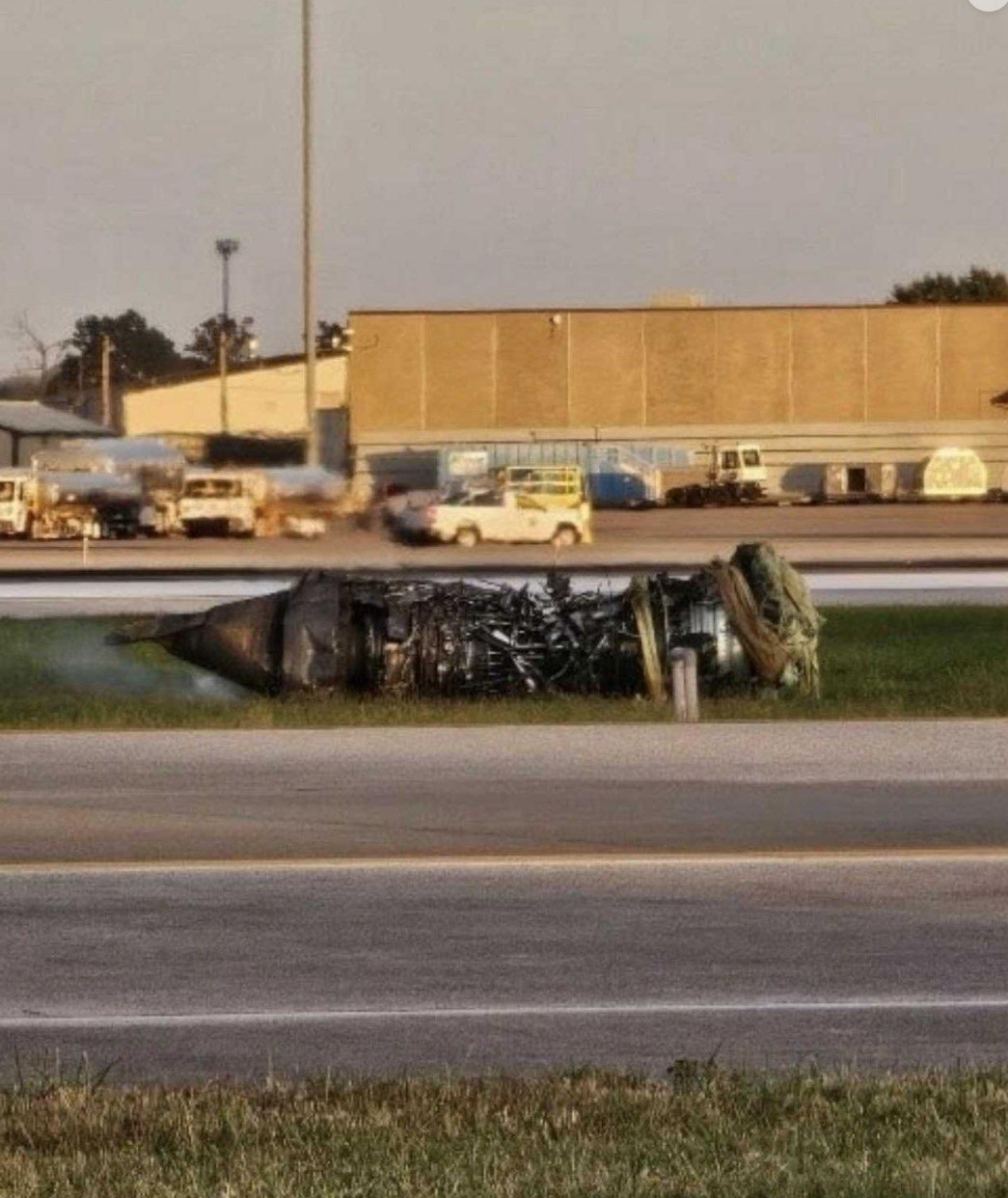
Flying with two engines and taking off without an engine in a loaded aircraft are two very different things. A lot more thrust is needed during takeoff than after.
In fact, it being normal almost certainly contributed to the scale of this accident, since a single engine failure during the takeoff roll isn't considered enough of an emergency to reject the takeoff at high speed (past a certain speed, you only abort if the aircraft is literally unflyable - for everything else, you take the aircraft & emergency into the air and figure it out there). The crew wouldn't have had any way to know that one of their engines had not simply failed, but was straight-up gone with their wing on fire to boot.
I don't know about the MD-11 itself, but other aircraft from that time period have sensors to detect and report overheat and fire in various parts of the aircraft, including engines and wings.
Freeze frame: https://imgur.com/a/c3h8Qd3
https://cdn.discordapp.com/attachments/757091156717862935/14...
Source: https://reddit.com/r/flying/comments/1ooms7t/ksdf_accident/n...
Obviously impossible to tell from some cell phone type videos. Being struck by something is also possible. But it sure does look like an uncontained engine failure.
There's also a very big difference between "Engine failure: something has damaged or jammed enough components that the turbines are no longer spinning fast enough to produce thrust or drive the generators" and "Engine failure: the engine is no longer attached to the aircraft, which is why it is no longer producing thrust". However, both things are reported in the cockpit as ENG FAIL.
(Un)fortunately, cockpit warnings prioritise the what (so to speak) and not the how or why. On one hand, this makes decision-making a lot simpler for the crew, but on the other...well, in rare cases the lack of insight can exacerbate a disaster. Depending on when exactly the engine gave out, this poor crew might have been doomed either way, but they might have been able to minimise collateral damage if they knew just how badly crippled the aircraft was. And there was a very similar accident to this one (actually involving the predecessor of the MD-11, the DC-10), American Airlines 191 - one of the engines detached from the aircraft, damaging the leading edge of its wing in the process, causing that wing to stall when the crew slowed down below the stall speed of the damaged wing in a bid to climb. If they could have somehow known about the damage, the accident might have been avoided entirely as the crew might have known to keep their speed up.
In emergencies, information overload tends to make things worse, not better.
In this case however, with the wing already on fire (the engine is below the wing, so flames coming out of it would be visible behind and under the wing, not in front), I'm afraid that even if they had managed to take off, the fuel tank would have exploded or burned through the wing before they would have had a chance to land. Actually, this looks similar to the 2000 Concorde crash...
Scarily there are communities that have ignored such logic and permitted dense residential development right next to an airport.
And now we have technology that allows for cameras everywhere to give a better situational awareness across all critical aircraft surfaces and systems.
It is going to take a little bit of adjusting to, but it will help improve safety in a tremendous way.
And how would the cameras even work? Are the pilots supposed to switch between multiple camera feeds, or do we install dozens of screens? And then what, they see lots of black smoke on one camera, does that really tell them that much more than the ENG FIRE alert blaring in the background?
Maybe this could help during stable flight, but in this situation, when the pilots were likely already overloaded and probably had only a few seconds to escape this situation - if it was possible at all - I can't imagine it being helpful.
Now... not sure how much that is helpful in this kind of emergency, they really didn't have time to do much.
What is the difference?
Edit: and damage to other engines, possibly engine #2 in the tail ingesting debris in this instance.
Queens, NY has entered the chat…
In fact, for awhile (maybe still the case), the #1 killer of skydivers was single engine failure on takeoff from the jump plane (and similar aircraft failures), not accidents ‘while skydiving’.
Helpful in what way? What are the pilots going to do with the information?
If we don't try to see how it goes, we won't know if it is a good idea or not.
There are two fire detection loops for each engine.[1] Even if both fails (because they get shredded as you say it) the system will report an engine fire if the two loops fail within 5s of each other. (Or FIRE DET (1,2,3,or APU) FAIL, if they got shredded with more than 5s in between without any fire indications in between.)
The detection logic is implemented directly below the cockpit. So that unlikely to have shredded at the same time. But even if the detection logic would have died that would also result in a fire alarm. (as we learned from the March 31, 2002 Charlotte incident.)[2]
In other words it is a very reliable system.
1: page 393 https://randomflightdatabase.fr/Documents/Manuel%20Aviation/...
2: https://www.fss.aero/accident-reports/dvdfiles/US/2002-03-31...
It'd take lots of testing and engineering. But especially in cases where you have multiple warnings going off I imagine that a quick view at an exterior camera can often give you a clearer/faster indication of the situation
the problem might be getting trained and experienced pilots to adjust to it since they are already in a certain flow of habits and skills to apply in their job, but new pilots surely could learn it as they aren't so set on their ways yet and have the opportunity to build this new data into their skillset / habits.
How many lives do the man hours spent commuting, or toiling away to afford higher rents waste?
IDK how the math pencils out, but an attempt ought to be made before drawing conclusions.
Wanting to be in the air vs wanting to over-run the end of the runway.
> see UA1175
I'm familiar with the case you are mentioning. I'm also aware that they sent a jump seater to look at the engine. But did seeing the engine provide them with any actionable information? Did they fly the airplane differently than if they would have just seen the indications available in the cockpit?
You’re correct, but at least LaGuardia airport generally has takeoffs over water.
LaGuardia aircraft landings may happen over dense apartment buildings, but less likely for catastrophic damage (glide path, less fuel, engines are <10% throttle, etc)
The rotation already exacerbates the flow into that engine. Change in flow geometry gets more smoke in its way when it's already eating turbulent air.
We don't know if it just had a disruption or a full-blown stall, but give the way it made it to takeoff speed and then just gave out, stall seems likely.
What generally gets areas in trouble is locations that used to be a good get worse as aircraft get larger and the surroundings get built up. The solution is to send larger airplanes to a new airport, but it’s not free and there’s no clear line when things get unacceptably dangerous.
That works in costal areas, but not inland.
There's no large body of water near the Louisville airport.
https://en.wikipedia.org/wiki/Midway_International_Airport
It's hard to project growth. Things build right up to the limit of the airport for convenient access, then the area grows and the airport needs to grow - and what do you do? Seattle-Tacoma is critically undersized for the traffic it gets and has been struggling with the fact that there's physically nowhere to expand to.
Obviously you’re better off making such decisions early rather than building a huge airport only to abandon it. Thus it’s called urban planning not urban triage.
and
"I can't walk because I have no legs"
https://en.wikipedia.org/wiki/Palisades_del_Rey,_California
Burbank Airport has quiet hours and has left a bunch of commercially zoned area under that takeoff path.
I’m in Atlanta now and they bought up a lot of land around the airport when redeveloping it and do similar zoning tricks for the buffer. One of the buffer zones is the Porsche Experience. It’s loud as heck when you’re on the part of the track closest but not bad where the corporate HQ and paddock is
https://maps.app.goo.gl/zhZdA5tWGAKunM2e8
(This is widely considered a misfeature of San Jose - it limits the height of buildings in downtown San Jose to 10 stories because the downtown is directly under the flight path of arriving flights, it limits runway length and airport expansion, and it means that planes and their noise fly directly over key tourist attractions like the Rose Garden and Convention Center. If we ever had a major plane crash like this one in San Jose it would be a disaster, because the airport is bounded by 101 on the north, 880 on the south, the arriving flight path goes right over downtown, and the departing flight path goes right over Levi's Stadium, Great America, and several office buildings.)
People have an upper limit on their capacity to take in information, and that limit goes down when they are moving quickly to solve problems. Throwing more information at them in those moments increases the risk that they will take in the wrong information, disregard more important information, and make really bad decisions.
So no, it's not cut and dried like you're thinking.
So while downtown being in the flight path is a risk there was some method to the madness which caused that alignment.
This is consuming all mental processing, there are no spare cycles.
This wasn’t a salvageable situation by having more information after the engine separated. If a sensor could have provided a warning of engine failure well before V1, that would be helpful.
I expect the questions will focus on what information existed that should have resulted in aborting the takeoff. Not what information was needed to continue.
Cut fuel & hydraulic lines near that engine (that affect the other engines/ apus) (or less likely structural or aerodynamic problems) is what's going to shift this from "engine failure" recoverable problem to a global nonrecoverable one.
Stupid car analogy: airbags help in most cases, but not all. Are they useless?
Regarding UA1175, they had someone extra, but not all flights happen to have someone extra in the cockpit.
My magic crystal ball named "the past 50yr of history" says it is unlikely to be the success you envision.
In addition, the terrain rises in both directions (so sharply on one side that planes can't use ILS when landing from that direction).
Ever see Dallas Love Field?
https://maps.app.goo.gl/A94EdexYwfpyeMxa7
Lots of airports are pretty much immediately adjacent to their city centers.
Excellent. So in what cases does seeing the engine visually do help? So far we discussed UPS2976 and UA1175 where the presence or absence of the camera didn't change the outcome.
> Regarding UA1175, they had someone extra, but not all flights happen to have someone extra in the cockpit.
You are dancing around my question. What does the pilot do differently based on what they see? If you can't articulate a clear "pilot sees X they do Y, pilot sees Z they do Q" flow then what is the video good for?
in a sibling thread you say "There are countless situations where it can be helpful." But you haven't named even one of those countless situations yet.
But also there's a lot of urban and suburban development you'd have to displace to even consider moving the airport near the Ohio River for most miles both up and down stream of Louisville.
As to a crash, ditching into an industrial area isn’t significantly worse for the passengers than ditching into a set of rapids, but the rapids are far better for the general public.
Yeah, the terrain around Louisville poses a challenge for placing an airport, but they could do like Cincinnati does, and have their airport located across the river. Or place it between Frankfurt and Louisville. Or do like Pittsburg and make the terrain flat enough for an international airport.
https://www.google.com/maps/dir/Cedarhurst,+NY+11516/John+F....
Had the crash happened in a different direction there might be other complaints, sure, but even airports with large bodies of water neighboring them only generally neighbor a side or two.
In other situations: - are the wheels out when the sensors say they are not - have a way to visually inspect critical parts of the plane while in flight (so you don't have to do a flyover and the tower to look with binoculars at the airplane)
This is what comes to mind now.
Happy? Or am I still dancing?
It's easy to say "just build bigger elsewhere" but unless you go dozens of miles out and add hours to every trip to/from the airport there's no options.
And no, "just fill in every body of water" is not an option. It doesn't work at all in many cases, is hilariously expensive in all cases, and has enormous environmental impact.
There was a significant crash there in 2007: https://en.wikipedia.org/wiki/TAM_Airlines_Flight_3054
Taipei Songshan, Boston Logan and the old Hong Kong Kai Tak to name a few.
Hong Kong Kai Take would be a solid example except it closed in 1998 because of how the city grew. Look at maps from 1950 and it doesn’t look like a bad location for a small airport.
The notification in the cockpit is likely nothing more than "ENG 2 FIRE" or similar. That could mean anything from "the fire is minor enough and we're at high enough speed that it's significantly safer to take off and then make an emergency landing", to "the engine has exploded and the wing is on fire and catastrophically damaged, so even though aborting takeoff now is dangerous and will likely cause us to overrun the runway, trying to continue would be worse".
It's a judgment call by the pilot to guess which of these is the case (or any possibility in between), and given the probabilities of various failure modes, I think it's fair for a pilot to assume it's something closer to the former than the latter.
I think that statement needs the support of actual evidence. Air incident investigation agencies make detailed reports of the causes of crashes, with specific, targeted recommendations to help ensure that similar incidents don't recur.
If we haven't seen recommendations for cameras like that, then I think it's reasonable to assume that the actual experts here have determined that cameras would not be helpful.
To be fair, the presence of a camera might have changed the outcome of UPS2976. Depending on when the fire developed fully, rejecting the takeoff based on the sheer size of the fireball on the wing might have led to fewer casualties on the ground. This is of course under the assumption of a world where a camera feed is a normal part of the flight deck instruments and there is a standard for the pilot monitoring to make judgments based on it.
The engine coming completely off tore through hydraulic lines, which were need to keep the slats extended. Airflow forced the slats to retract.
Here's what then happened:
> As the aircraft had reached V1, the crew was committed to takeoff, so they followed standard procedures for an engine-out situation. This procedure is to climb at the takeoff safety airspeed (V2) and attitude (angle), as directed by the flight director. The partial electrical power failure, produced by the separation of the left engine, meant that neither the stall warning nor the slat retraction indicator was operative. Therefore, the crew did not know that the slats on the left wing were retracting. This retraction significantly raised the stall speed of the left wing. Thus, flying at the takeoff safety airspeed caused the left wing to stall while the right wing was still producing lift, so the aircraft banked sharply and uncontrollably to the left. Simulator recreations after the accident determined that "had the pilot maintained excess airspeed the accident may not have occurred.
The ultimate reason so many cities use land reclamation for airports is open water does not lose property value by being near the airport. Thus a given greater metropolitan area regains not just the physical land of the airport but the increased property value from all that land that’s no longer next to an airport.
And some people just won't really get used to it. I've lived near airplane noise and I never got used to it. I also don't sleep better with white noise. I sleep worse.
It actually requires using tunnels or a boat. I used to drive a cab and the I93 + Callahan/Sumner tunnel route was hellish. The Big Dig helped a lot, although sometimes that can get pretty backed up too.
> Look at maps from 1950 and it doesn’t look like a bad location for a small airport.
Generally, airports that are close to major urban centers were developed prior to 1950, including all 3 examples named. Songshan was opened during Taiwan's colonial period as the “Matsuyama Airdrome” serving Japanese military flights (https://www.sups.tp.edu.tw/tsa/en/1-1.htm).
For bigger cities with these old central airports, larger airports were opened later in many cases. I don't think that will ever happen in Boston, although satellite airports in neighboring states like "Manchester-Boston" or TF Greene in Rhode Island try pretty hard.
What a strange comment. I never made any such statement or claim that a science-fantasy level of technology would exist in a decades old aircraft or any aircraft.
I was responding to someone who made the absurd claim that the pilots wouldn't be informed of a fire on the wing, when in fact they would be informed of that (which you seem to agree with). So what's Star Trek got to do with anything?
Fast fwd 15 years and now the city is telling us how unsafe it is to live there, passing out studies about how airplane noise will ruin your life, etc. And they made the buyout 'optional', knowing they'd railroad the holdouts, which they did. They'd tear down every house and the road leading to your house as they went, until the holdouts gave in.
All of a sudden my neighborhood is gone. And that awful, noisy, unsafe to live in place...is full of workers in cheap steel warehouses. I guess it's more safe for them.
Many people may not realize, but UPS and Ford absolutely own Louisville. If either says jump, the city government will ask how high?
It is not reasonable to assume anything.
Air crash investigators are not the experts on airplanes design.
I think their point just got made in a way that can't be ignored.
Rivers have a nice property where they tend to be the lowest thing around because water flows downhill and are quite long. For approaches from other directions half the time you end up crossing the river at some angle which acts as a buffer zone, thus reducing the total land lost as a buffer zone.
Oddly enough the pamphlets they kept sending out focused on irritability, poor grades, confusion, sleep problems, etc, and never mentioned the possibility of being fragged by a wayward jet.
I say that only partially in jest, looking at a map now, we were only 2 or so miles as the crow flies from the end of their runway and in the direct path..
I'm trying to imagine this same thing happening with a subdivision in the same location where this plane crashed and the headlines that would have generated. As bad as this is, that alternative disaster would have been on an entirely different level.
I also hope that as a result of this crash there will be a global review of the placing of airports, especially the ones that are pretty much in cities with the flight path directly over houses during final approach and just after take-off.
This is a good example:
https://www.youtube.com/watch?v=NiPyrfEuOeo
And yes, they're space constrained. But, given enough time...
Somewhere I have a GoPro video of me on my motorcycle waiting for a freight train at a crossing in traffic while a 747 flies overhead ("Planes, Trains, and Automobiles"). It's a pretty transportation-dense area.
Also, the map you're looking at there is relatively low resolution. I would suggest looking at it in https://maps.dot.gov/BTS/NationalTransportationNoiseMap/; make sure to switch the "Modes:" to "All Modes"