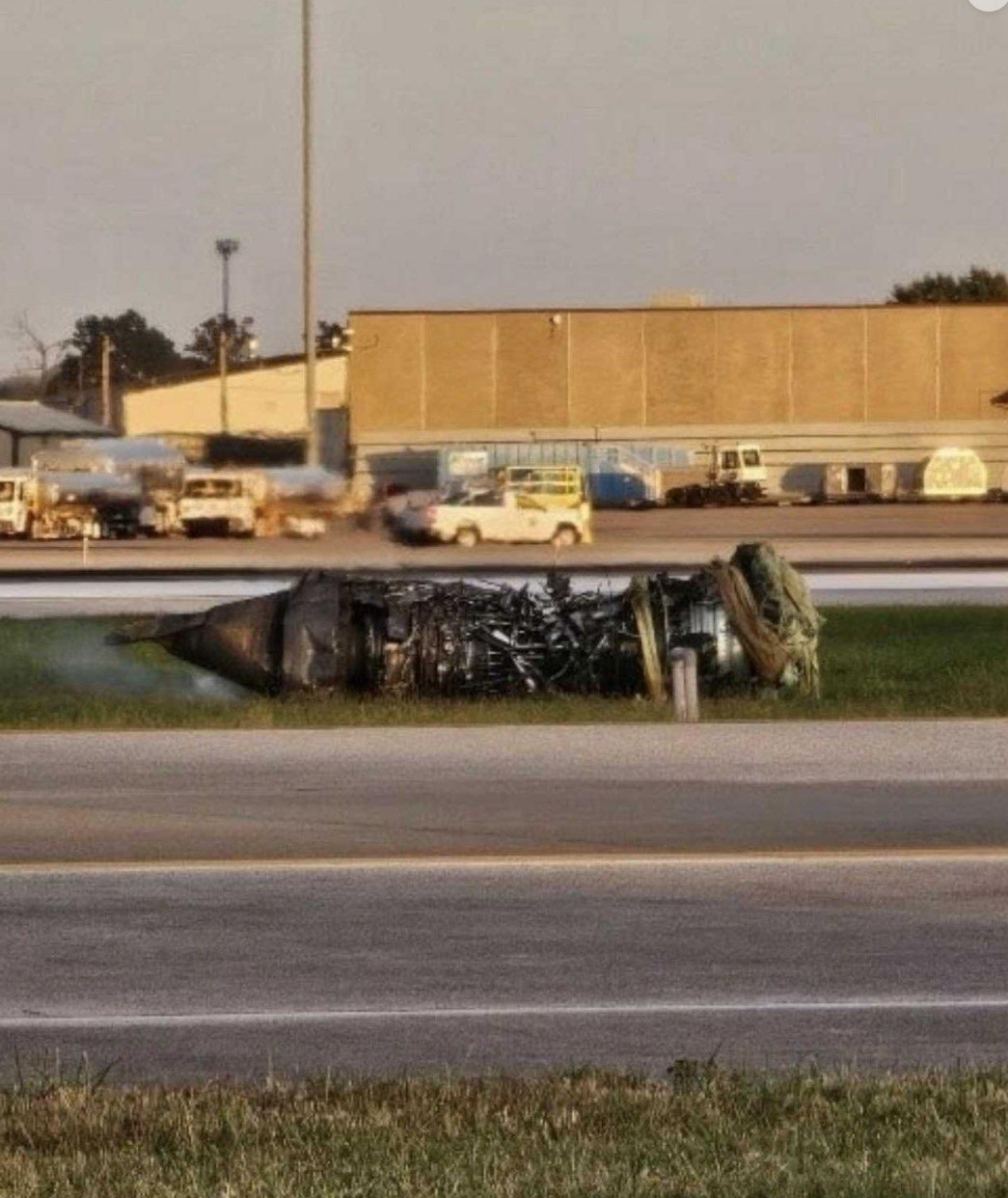
https://x.com/BNONews/status/1985845907191889930
https://xcancel.com/BNONews/status/1985845907191889930
Edit: just the mp4 https://video.twimg.com/ext_tw_video/1985845862409334784/pu/...
There is an incredible amount of ground damage! Just wow, this is very bad https://files.catbox.moe/3303ob.jpg
They were on fire just as they reached V1.
Plane was fully loaded with 38,000 LB of fuel for 12 hour flight to hawaii. Worst case scenario.
Pilots did the heroic thing - they tried to take off instead at 160 MPH to minimize collateral damage (highway and warehouses at the end of the runway) and crash and die somewhere else, instead of go beyond the runway at that speed. Accelerating a fully loaded jet plane at ground level beyond the runway has obvious consequences. They had one choice.
Instead, they clipped the UPS factory because they were so low, they tried to clear it but did not. Plane then hit the ground port wing down, shearing it off entirely, smearing a fireball of jet fuel across half a mile (not an exaggeration) before the plane flipped. Crew were likely dead by before this, footage shows the cockpit being slammed into the ground like a mousetrap by the flip once the port wing was gone and gravity took the starboard wing over.
Physics took over. Plane flipped and rolled upon loss of port wing, smearing a rolling fireball of the remaining fuel load from the starboard wing for another half a mile.
Louisville is now a firestorm as a result.
Respect to the flight crew; rest in peace, they made the best they could out of a really shitty scenario. They flew it all the way down.
Footage:
https://x.com/osinttechnical/status/1985845987684855969?s=46
https://x.com/faytuksnetwork/status/1985849267152699741?s=46
https://x.com/faytuksnetwork/status/1985848132500885995?s=46
https://x.com/faytuksnetwork/status/1985843126934614297?s=46
They were on fire just as they reached V1.
Plane was fully loaded with 38,000 LB of fuel for 12 hour flight to hawaii. Worst case scenario.
Pilots did the heroic thing - they tried to take off instead of accelerate past the runway at ground level at 160 MPH to minimize collateral damage (highway and warehouses at the end of the runway) and crash and die somewhere else.
Instead, they clipped the UPS factory because they were so low, they tried to clear it but did not. Plane then hit the ground port wing down, shearing it off entirely, smearing a fireball of jet fuel across half a mile (not an exaggeration) before the plane flipped. Crew were likely dead by then, footage shows the cockpit being slammed into the ground by the flip once the port wing was gone and gravity took the starboard wing over.
Plane flipped, continued to smear half of the fuel load for another half a mile.
Louisville is now a firestorm as a result.
Footage:
https://x.com/osinttechnical/status/1985845987684855969?s=46
https://x.com/faytuksnetwork/status/1985849267152699741?s=46
https://x.com/faytuksnetwork/status/1985848132500885995?s=46
https://x.com/faytuksnetwork/status/1985843126934614297?s=46
Freeze frame: https://imgur.com/a/c3h8Qd3
Older airports might have EMAS [1] retrofitted at the ends to help stop planes, but that's designed more for a landing plane not stopping quickly enough (like [2]) - not a plane trying to get airborne as in this case.
[1] https://en.wikipedia.org/wiki/Engineered_materials_arrestor_... [2] https://en.wikipedia.org/wiki/Southwest_Airlines_Flight_1248
https://cdn.discordapp.com/attachments/757091156717862935/14...
Source: https://reddit.com/r/flying/comments/1ooms7t/ksdf_accident/n...
Some do. Here is what it looks like when an overshooting plane utilizes such a barrier: https://www.youtube.com/watch?v=zW71FrX8t_g
179 dead.
Consider the possibility that gigantic flying aluminum tubes filled with tons of flammable fuel hurtling around at hundreds of kilometers per hour comprise a dilemma that has no trivial answers. Even defining what "important thing" means at any given instant is not straightforward.
https://www.wdrb.com/news/ups-plane-catches-fire-and-explode...
> There is an incredible amount of ground damage!
It's fortunate it wasn't taking off the other direction, towards the adjacent downtown of Louisville (https://www.google.com/maps/place/Louisville+International+A...)
I think pilot training is playing a factor. A normal rotation kills too much energy. One engine can climb when you have some airspeed and get clean, but if you lose too much energy on rotation, the inefficiency of the AoA for the rest of the short flight means that engine can no longer buy you any up. I've seen too many single-engine planes going down while trying to pitch up the whole way down.
So, less aggressive single-engine rotations and energy absorbers at the ends of runways that can't get longer. This seems like the kind of thing where we do it because it removes a significant cause of people dying.
Just watched this angle a few more times: https://x.com/BNONews/status/1985845907191889930
Another crash video shows the aircraft clearly descending before colliding with anything. It manages to go up a bit, so it's fast enough to get airborne. The normal looking rotation kills too much energy. The plane is then too inefficient to maintain speed. AoA goes up while energy goes down. Power available goes negative and then it's over.
Ha, Jeju Air Flight 2216 smashed into a barrier on the second landing attempt in Muan last year [0], and people commented "How could there be a barrier at the end of the runway, so obviously stupid, irresponsible", etc.
Now a plane does not smash into a barrier at the end of the runway and people suggest putting barriers at the end of the runway.
Don't mean to attack parent post, but may I suggest that
a) hordes of experts have thought long and hard about these issues, and it is unlikely that you can encounter this for the first time as a lay person and come up with a solution that has eluded the best engineers for decades ("why don't they attach a parachute to the plane?"), and
b) we are very close to an optimum in commercial aviation, and there are few if any unambiguous ("Pareto") improvements, but rather just tradeoffs. For example: You leave cockpit doors open, terrorists come in and commandeer the plane to turn it into a weapon. You lock the cockpit doors closed, and suicidal pilots lock out the rest of the crew and commandeer the plane to turn it into a weapon of mass-murder-suicide.
There are no easy answers.
[0] https://en.wikipedia.org/wiki/Jeju_Air_Flight_2216
ETA: In 2007 an A320 overran a runway in Brazil and crashed into a gas station, killing 187 pax & crew + 12 on the ground. https://en.wikipedia.org/wiki/TAM_Airlines_Flight_3054
Yes, it did get airborne for a few seconds but from the video below, it looks like the left wing was damaged by the fire and could not provide enough lift, then the right wing rolled the plane to the left causing the crash.
https://bsky.app/profile/shipwreck75.bsky.social/post/3m4tvh...
> Ground observers reported the aircraft had been delayed for about two hours for work on the left hand engine (engine #1), the engine #1 separated during the takeoff run, the center engine emitted streaks of flames, the aircraft impacted a UPS warehouse and ploughed through other facilities before coming to rest in a large plume of fire and smoke.
So the tl'dr is: the leading very preliminary theory is that the MD-11's left engine fell off the wing just like https://en.wikipedia.org/wiki/American_Airlines_Flight_191 (a DC-10, the immediate predecessor of the MD-11) which was caused by maintenance errors weakening the pylon structure holding the engine.
What strikes me as odd is that this looks like the "naked" engine, without the cowling/nacelle that usually surrounds it? Anyway, if an engine departs the aircraft shortly after (last-minute) maintenance was performed on it, that's indeed suspicious...
Work place related accidents always have a certain tragedy to them. Still remember when in the industrial park, my employer is located in, tanks belonging to a trash incinerator for special chemical waste exploded, taking several people with it.
There are two fire detection loops for each engine.[1] Even if both fails (because they get shredded as you say it) the system will report an engine fire if the two loops fail within 5s of each other. (Or FIRE DET (1,2,3,or APU) FAIL, if they got shredded with more than 5s in between without any fire indications in between.)
The detection logic is implemented directly below the cockpit. So that unlikely to have shredded at the same time. But even if the detection logic would have died that would also result in a fire alarm. (as we learned from the March 31, 2002 Charlotte incident.)[2]
In other words it is a very reliable system.
1: page 393 https://randomflightdatabase.fr/Documents/Manuel%20Aviation/...
2: https://www.fss.aero/accident-reports/dvdfiles/US/2002-03-31...
1) improper maintenance—American Airlines had used a forklift shortcut to remove the engine and pylon together, rather than following McDonnell Douglas’s prescribed method
2) The detachment tore away part of the wing’s leading edge, rupturing hydraulic lines and severing electrical power to key systems, including the slat-position indicator and stall warning (stick shaker).
3) The pilots followed the standard engine-out procedure and reduced airspeed to V₂, which caused the aircraft to stall and roll uncontrollably left. This procedure was later found out to be incorrect.
Defective maintenance practices, inadequate oversight, vulnerabilities in DC-10 design, and unsafe training procedures combined to cause the crash, killing all 273 people on board and leading to sweeping reforms in airline maintenance and certification standards.
https://www.vanityfair.com/news/2015/11/airplane-maintenance...
TDLR 10-20 years ago, the US started allowing maintenance of domestic planes in foreign countries, outside the reach of the FAA’s inspections
https://en.wikipedia.org/wiki/Midway_International_Airport
It's hard to project growth. Things build right up to the limit of the airport for convenient access, then the area grows and the airport needs to grow - and what do you do? Seattle-Tacoma is critically undersized for the traffic it gets and has been struggling with the fact that there's physically nowhere to expand to.
https://en.wikipedia.org/wiki/Palisades_del_Rey,_California
Burbank Airport has quiet hours and has left a bunch of commercially zoned area under that takeoff path.
I’m in Atlanta now and they bought up a lot of land around the airport when redeveloping it and do similar zoning tricks for the buffer. One of the buffer zones is the Porsche Experience. It’s loud as heck when you’re on the part of the track closest but not bad where the corporate HQ and paddock is
https://maps.app.goo.gl/zhZdA5tWGAKunM2e8
(This is widely considered a misfeature of San Jose - it limits the height of buildings in downtown San Jose to 10 stories because the downtown is directly under the flight path of arriving flights, it limits runway length and airport expansion, and it means that planes and their noise fly directly over key tourist attractions like the Rose Garden and Convention Center. If we ever had a major plane crash like this one in San Jose it would be a disaster, because the airport is bounded by 101 on the north, 880 on the south, the arriving flight path goes right over downtown, and the departing flight path goes right over Levi's Stadium, Great America, and several office buildings.)
Foreign Repair Stations date back to the 90s [1], the thing is they need to be supervised by an FAA Certified Mechanic. Inspection of these was already a hot issue in the early '00s... No one gave a fuck, it was all about saving costs for a very long time.
The linked 2007 report's second page (!) already leads with this:
> Since 2001, eight commercial air carriers have gone through bankruptcy and one has ceased operations. Fuel prices remain high, and this makes cost control a key factor in both the sustained profitability and overall survival of an airline.
IMHO, this is a perfect example why the government needs to regulate prices in safety-critical industries. The "race to the bottom" must be prevented - sorry, flying NYC-SFO for 70$, that's not sustainable.
[1] https://www.oig.dot.gov/sites/default/files/Web_File_Foreign...
Every time I board a plane, I think what a crazy thing I am doing, but then I remember that I could be safe and snug in my house and still be in a plane crash.
(I do not mean to imply that this exact slat retraction is necessarily relevant in the Louisville crash, however - I believe aircraft since AA191 are designed to maintain their wing configuration after loss of hydraulic pressure.)
40+ people died in that one, it's a miracle it wasn't more.
According to Garp, you just need to buy a pre-disastered home. You'll be safe there.[^1]
(Unfortunately his logic is flawed.[^2])
[^1]: https://www.youtube.com/watch?v=Q3TuoGVNbBs
[^2]: https://xkcd.com/795/
Exactly what happened in this case; the airplane was built in 1991 to carry passengers, and then converted in 2006 for freight.
https://www.planespotters.net/airframe/mcdonnell-douglas-md-...
Ever see Dallas Love Field?
https://maps.app.goo.gl/A94EdexYwfpyeMxa7
Lots of airports are pretty much immediately adjacent to their city centers.
from: https://en.wikipedia.org/wiki/Asiana_Airlines_Flight_214
https://en.wikipedia.org/wiki/US_Airways_Flight_1549
Once an engine breaks the question is whether or not it becomes unbalanced, that is one reason why they can become detached from the plane.
[1]: https://www.flightradar24.com/blog/flight-tracking-news/majo...
Best advice is always to wait for authoritative statements.
https://www.pprune.org/accidents-close-calls/669082-ups-md11...
Oh I guess it was 2004, not 2005.
Yes, Perfect Landing is a great restaurant!
https://www.reddit.com/r/Louisville/comments/1983ko2/what_ha...
The history of how that came to be is worth a read and answers your question better than I could.
https://en.wikipedia.org/wiki/National_Transportation_Safety...
https://www.google.com/maps/dir/Cedarhurst,+NY+11516/John+F....
If someone said an event happens “occasionally”, I would expect it to be significantly more frequent than 1/300,000,000.
Powerball lottery odds are 1 in 292 million. I wouldn’t say that I “occasionally” win the lottery when I buy a ticket!
https://simpleflying.com/why-mcdonnell-dougls-md-11-wont-be-...
https://www.faa.gov/lessons_learned/transport_airplane/accid...
I watch a lot of airplane disasters.
TLDR: you are supposed to properly disassemble and use a proper lift to lower the engine, not shove it in with a fork lift (even though it's quicker).
I don't think this was the cause of this accident though, the engine was on fire before takeoff.
Not an airplane engineer, but I very much doubt anyone has used a forklift to install an engine since 191. Procedures got much more strict.
There was a significant crash there in 2007: https://en.wikipedia.org/wiki/TAM_Airlines_Flight_3054
https://en.wikipedia.org/wiki/Engineered_materials_arrestor_...
The engine coming completely off tore through hydraulic lines, which were need to keep the slats extended. Airflow forced the slats to retract.
Here's what then happened:
> As the aircraft had reached V1, the crew was committed to takeoff, so they followed standard procedures for an engine-out situation. This procedure is to climb at the takeoff safety airspeed (V2) and attitude (angle), as directed by the flight director. The partial electrical power failure, produced by the separation of the left engine, meant that neither the stall warning nor the slat retraction indicator was operative. Therefore, the crew did not know that the slats on the left wing were retracting. This retraction significantly raised the stall speed of the left wing. Thus, flying at the takeoff safety airspeed caused the left wing to stall while the right wing was still producing lift, so the aircraft banked sharply and uncontrollably to the left. Simulator recreations after the accident determined that "had the pilot maintained excess airspeed the accident may not have occurred.
It actually requires using tunnels or a boat. I used to drive a cab and the I93 + Callahan/Sumner tunnel route was hellish. The Big Dig helped a lot, although sometimes that can get pretty backed up too.
> Look at maps from 1950 and it doesn’t look like a bad location for a small airport.
Generally, airports that are close to major urban centers were developed prior to 1950, including all 3 examples named. Songshan was opened during Taiwan's colonial period as the “Matsuyama Airdrome” serving Japanese military flights (https://www.sups.tp.edu.tw/tsa/en/1-1.htm).
For bigger cities with these old central airports, larger airports were opened later in many cases. I don't think that will ever happen in Boston, although satellite airports in neighboring states like "Manchester-Boston" or TF Greene in Rhode Island try pretty hard.
He has since posted a 15 min video[0] with more detail.
I'm trying to imagine this same thing happening with a subdivision in the same location where this plane crashed and the headlines that would have generated. As bad as this is, that alternative disaster would have been on an entirely different level.
I also hope that as a result of this crash there will be a global review of the placing of airports, especially the ones that are pretty much in cities with the flight path directly over houses during final approach and just after take-off.
This is a good example:
https://www.youtube.com/watch?v=NiPyrfEuOeo
And yes, they're space constrained. But, given enough time...
Also, the map you're looking at there is relatively low resolution. I would suggest looking at it in https://maps.dot.gov/BTS/NationalTransportationNoiseMap/; make sure to switch the "Modes:" to "All Modes"