I'm not aware of Chinese authorities getting quite that draconian (yet) at the normal border entry points in Beijing, Shanghai, etc. However, I think it's still worth following the general advice that if you have sensitive data on your devices, leave them at home and use a burner phone/laptop + restore from the cloud later.
However, the implications are still ominous.
I'm curious, how did China develop into such a police state? Anyone able to point me to some reading on the subject?
https://www.sueddeutsche.de/politik/china-app-ueberwachung-t...
FWIW I got a Huawei phone (Honor 10 Lite) for under 200 EUR, but much cheaper phones than that are available.
Edit: To be clear this is not to avoid Chinese surveillance. That's unavoidable whatever you do because China is a police state. It's to separate out that surveillance from my contacts and my regular life at home. (I also think it's at least arguable that the Chinese government has a duty to look closely at what foreigners are up to. It's not an argument that I agree with myself very much because it infringes freedom while also making the wrong trade-offs, but given we live in a world of nation states it follows logically from that.)
So with this stance (ie. against "side-loading" - what a crappy term) not only you make things worse for everyone (not being able to use their own devices as they see fit) even though they wouldn't be visiting China, you also validate region locking (another shitty practice that has no place in a global internet and only serves whoever wants to divide people) including any tech necessary for it (and thus monetary incentives for whoever implements it) and not solve the issue at hand (people being forced to install malware) since it can be done just as easily through normal routes.
No, if you do not want such stuff then speak against it and do not put yourself in a position to be affected by it (do not visit China, use burner phones, whatever).
If the malware roots the device, probably not, but if it takes read.sms permissions, it should only get ciphertext. if it replaces the main SMS messenger, then it breaks, but you'd know.
I just did a rough threat model on this exact scenario and worked with the assumption that Signal's MasterSecret covered it in the sms DB - but haven't done a thorough code review yet.
Not a good direction but also not enforced in my experience.
7. Public-facing social media platforms and identifiers/handles used during the last five years. This includes any websites or applications the applicant has used to create or share content (photos, videos, status updates, etc.) as part of a public profile.
I was advised by my lawyer that this covers Reddit and HN, and Facebook/Instagram (if I had any of those which I don't any more).
The lawyer didn't mention github however, but someone can search my name and find that in 1 click anyway, that's hardly private information.
Is this known to be possible? I would've thought it isn't (at least without the user entering their passcode and "trusting" the device).
I can (and would) opt out of taking my phone to China. I can't easily dodge US' requirements.
These two bully super-powers really give me a bad feeling about the future...
I'm all set with authoritarian dictatorships with torture camps and organ harvesting.
I'm curious if anyone managed to grab a look at these as well.
The key to Communism in the Maoist approach was absolute central control and the sweeping away of all obstacles; if you stood in the way of, objected to, or even were insufficiently enthusiastic about its plans you would be murdered.
Economic control was gradually loosened in the latter half of the 20th century, but political control remains tight.
I'm guessing in 99% of cases this information is either ignored or dumped into a database where a surveillance dragnet will lightly touch every record regularly looking for specific matches.
But in the remaining 1% it will be abused to skirt around someone's human rights.
And maybe they're hoping to catch some really dumb terrorists that write down the "Death to America" forum on that list.
I do find it interesting that the form is not compatible with anonymous posting like 4chan.
Even ancient Imperial China was very much like this. To the point where China basically had no such thing as a legal system in the Western sense! The only kind of dispute resolution was mutually-assured destruction via criminal-like prosecution, basically "If I think you've been trying to cheat me out of something, I can get government goons to beat you up, for theft or whatever." And the government goons often beat up both disputants, for good measure. It's surprising that they even managed to build a halfway-functioning society and keep it going for thousands of years, out of such crudities.
Right, do you want to enter the country or not? Click that button, sir.
Quite different from the rest of China.
In modern times the traditions of the past remain even after the natural barriers of communication time and mobilization speed have been eradicated by modern technology. The rules of the past become a part of the culture, language, and customs of the people, even after they are theoretically obsolete. Finally, there is a natural fear of retribution you see when a minority oppresses the majority for a long time. The minority doesn't want to be treated as they treated the majority for so long, and are terrified that if they give an inch they'll find themselves hanging from a pole just like so many of their victims.
It's an alternative civilization!
The last 30 years we've seen it develop at a rate that is obviously impossible given the experience of all other countries. Yet this, very different, country does it.
It's good to have diversity in governance systems and be able to see the different outcomes, even from systems everyone "knows" shouldn't work.
Perhaps it is more illustrative to compare it with physical stores. The Google Play Store is one store, F-Droid is another well-known one, and there are others. Allowing only Google to install apps on your device would be like allowing people to only buy products from a store controlled by the producer of the product, reasoning that other stores might modify the product. If cheese was solely a Dutch product, the Dutch producer would get to prohibit Americans from buying cheese at stores other than a single Dutch chain, with no oversight of the American government (such as the FDA) for fear of product manipulation. They might infect it! Bringing it back to Android, I (a Dutchman) would only be allowed to get my apps from the Google store which is within some foreign jurisdiction.
1. Your complete travel history over the last 15 years, including source of funding for travel, in chronological order.
I don't know anyone who would be able to answer that one accurately.
It's the biggest reason why I am a huge fan of the idea of mandatory prosecution. If we can't afford to prosecute all the crimes we have on the books perhaps we have too many crimes on the books
Not just a while. The US Patriot Act gave powers to allow border controls to hold people indefinitely without cause.
NSA could monitor all of us without installing any spyware.
China should improve its surveillance techniques!
Regarding email address, it's under "contact information" same as "home address". What's the problem?
Regarding social media, it says "optional", so...?
Of course, this is typical for dystopian governments. If everyone is technically guilty of a crime, and there is selective or variable enforcement, then you can justify the punishment that you want to mete out to specific people.
PRC may be blazing the trail, but as the tech becomes proved and available, I won't be surprised to see creeping adoption in more "free" countries (especially following crises).
Your devices will all be hacked with industrial espionage malware, and just in case you don't have anything on those devices, you will be given devices as "gifts"—like flash drives and WiFi-equipped smart home devices--that will exploit any devices you didn't bring with you.
INAE, but I believe the usual policy is to accept the gifts but discard them at the first opportunity.
https://www.bbc.co.uk/news/technology-48118558
https://eu.usatoday.com/story/tech/2019/05/01/u-s-customs-ca...
https://www.zdnet.com/article/warrantless-phone-laptop-searc...
This style of argument is deflection, and it gets us nowhere.
It's very effective in redirecting the focus away from one bad actor and onto another bad actor, though.
I've been lucky not to experience this myself, but I imagine it is bad to experience the "different outcomes" firsthand when the governance system -- novel as it might appear from a distance -- has foundations in violent suppression of individual freedom.
I am pretty sure the next generation will never see anything other than complete surveillance by countries or corporations. And for them it will seem normal.
What if the profile isn't part of a person's profile? As in it has zero relation to their "real" life.
We should be critical of our own government. Panarky clearly agrees with this (me too). The difference is that the conversation is about China. We can also have a conversation about the US or <insert any Western country> and how they are not respecting people's freedom. But this conversation is about China. It's also a conversation that needs to be had.
Plus this redirection is similar to "Bob shot a guy 30 times." "Oh yeah? Bill punched a guy". Neither Bob or Bill are likely good guys, but come on... Bob is definitely worse and Bill's actions don't really relate to how we want to condemn Bob's actions.
This action almost certainly violates some of these rights (articles 18-21 come to mind: Articles 18–21 sanctioned the so-called "constitutional liberties", and with spiritual, public, and political freedoms, such as freedom of thought, opinion, religion and conscience, word, and peaceful association of the individual.)
I definitely can't recall every one of those I had been on in the last decades.
https://www.brianmadden.com/opinion/How-do-you-block-sideloa...
Basically you create an enterprise profile for your phone and block sideloading of apps as a policy ("Disallow_Install_Unknown_Sources). Same with iOS.
This is hyperbolic. It's potentially reprehensible and almost certainly oppressive. But it's not unlawful in a state without the rule of law.
Is Urumqi really an international hub? I can’t imagine anyone flying through that city for any trip that didn’t originate or terminate in China. Chengdu is much more of the hub these days.
But, it’s the broadness of the definition that’s of concern. That forum you registered at a year ago to ask a random question, never to return? Covered. Dating sites? Yep. Stack Overflow, Quora, etc. definitely. Yelp? For sure.
Then there are sites you can probably twist the definition to cover. Amazon might make this list, since you have the ability to post a public “wish list.” Things like Rover would count, because you have a “pet profile” and can post reviews of sitters, even though nobody says Rover is a social networking app.
Then there’s the class of “sites an adversary with unlimited resources for lawyers” might press to include. You posted a comment on a random blog? We consider your comment history to be your “public profile,” etc. The potential for overreach is huge, even if we don’t get to absurd levels such as this.
And I ain't gonna research when I last used each of those accounts.
I flew through it once, and now I will never do it ever again...
I do feel that bigger name European airlines opting to reroute flights to China through Chengdu had all of above in mind
The US is a massive country that ~75 million foreigners visit each year. In 2018 that figure hit an all-time record high near 78 million, which is in curious contrast to your setup premise.
With so many people visiting the US every year, you surely can produce a very large number of examples of toursts being held indefinitely - for many years even, one imagines - without cause.
I don't think the two countries are even remotely comparable on this front.
Take the anecdote of the person to whom you replied. Lots of people will tell that person's friend, "oh, just let it go, the border agent didn't really mean anything." And if the person complains to a higher authority, the complaint is staggeringly likely to get brushed off, if not used in exactly the opposite way the person intended when filing it.
At a previous job of mine, I worked for the phone-based customer service while another team in the same group operated service windows for in-person assistance. No authority here at all, just answering questions. More often than not, if someone filed a complaint about how one of our window clerks had treated them, the supervisor delivering the complaint to the clerk treated it as a joke. "Well, it says here you told the woman she should smile more. I pulled the security tape and she was pretty cute. Sure would have looked nicer if she had smiled, yeah?" Yeah boss, sure would have! "Darn right, can't fault you there, so we'll just toss this one as unwarranted, yeah?"
I don't know. It seems kind of weird to want to restrict the conversation like that, but I guess I kind of see your point.
> Plus this redirection is similar to "Bob shot a guy 30 times." "Oh yeah? Bill punched a guy".
The way I saw it, the neighborhood is turning kind of bad. Someone comments "Bob shot a guy 30 times", and another adds "Bill punched a guy". Neither of these people have met Bob nor Bill and don't really care about them in particular, but their interest lies in the neighborhood as a whole.
It is basically changing the topic when you have no effective rebuttal to an argument/issue.
It also creates a false equivalence between the real issue and the "whatabout" issue.
In this case, GP has no answer to China going FAR beyond any reasonable measure by requiring any tourist to install spyware on their phone so they can access all private conversations, so GP wants to ignore that and talk about public info the US requires visitors disclose at the border.
The false equivalence is created by treating as parallel and roughly equivalent govt actions the requirement to install spyware vs divulging of SocMed accts.
I'm NOT saying that divulging SocMed accts could be a definite threat to a variety of classes of people, especially journalists writing undercover. But even for that specific example, which is worse, enumerating your public SocMed accounts, or installing spyware on your phone, which will divulge far more? Not even in the same ballpark.
In sum, Whataboutism is not only damaging the conversation, it can often also be a method of disingenuous argument.
A big part of the 50-cent party's job [1] is to promote negative western news stories.
China was one of the poorest countries on earth in the 1980s.
Then again, when some lunatic American colonists tried an alternative system of governance everyone knew was absurd and evil, it worked out surprisingly well.
I guess what I most of all am arguing against is unified world government.
"There is an increasing trend around the world to treat borders as law-free zones where authorities have the right to carry out whatever outrageous form of surveillance they want," Omanovic said. "But they’re not: the whole point of basic rights is that you’re entitled to them wherever you are. Western liberal democracies intent on implementing increasingly similar surveillance regimes at the border should look to what China is doing here and consider if this is really the model of security they want to be pursuing."
I believe strongly in the right to privacy, but I have to admit, I do not want anyone coming into my country who has beheading videos on their phone. Unless they are a journalist or something, obviously.
So, no, I would not be OK with the government violating the Constitution.
Answer: approximately zero
How many terrorists would be deterred by this policy?
Answer: none
How many ordinary people would be more likely to carry out attacks or harbour resentment towards the USA because of policies like these?
Answer: more than 0
https://www.learnliberty.org/blog/t-he-constitutional-rights...
And what if it was a scene from saw or something?
It's just pathetic to see this kind of whataboutism keeps coming up on this website. The US and China have very different political systems, the former is democratic republic, the later is authoritarian. It is not a close comparison.
>Apple devices were not spared scrutiny. Visitors’ iPhones were unlocked and connected via a USB cable to a hand-held device, the journalist said. What the device did could not be determined.
But not before they have technically entered..
(and no, this doesn't mean i'm anti immigration)
edit: or pro searching, etc
https://en.m.wikipedia.org/wiki/Border_search_exception
https://oceanservice.noaa.gov/facts/population.html
It’s also been hypothesized that the “border” could be expanded to include many more. International airports are arguably ports of entry. Native American territories and embassies + consulates are considered foreign soil.
But here we go, we've started an alarmist comment thread where we've extended this out way beyond the current implementation, extending it into some kind of dystopian future where this kind of thing is universal. Time to get a burner phone and lock ourselves at home with our tin foil hats tightly in place!
All countries have always been paranoid when it comes to more contested and less stable regions. It's nothing new nor a surprise. Is this situation a good thing? No. It's been a human rights problem for decades.
Still, we should stop freaking out, that would be great.
This is not the customs and border process in China as a whole. It's not a reason to cancel a trip to Shanghai or Beijing or Xi'an.
https://news.ycombinator.com/newsguidelines.html
Edit: a user emailed to point out that this article is itself one of the original sources, because vice.com aka Motherboard was one of the investigating parties. That was my mistake! Sorry.
Then keeping privacy in mind, I should be able to scroll around my gallery and play a few sound files to convince the authorities. Another option would be to ask for the source code and an hour to compile it, then run the app, provided an audit has shown no malicious functionalities.
Someone who hoards beheading videos is not ordinary and it's perfectly in line with the international norms to be able to exclude undesirable people from entering into a country. E.g. Canada won't let people who have past criminal convictions enter, like a DUI.
In reality, comparables sometimes are and sometimes aren't relevant. You have to make that argument case by case for it to have any meaning. Invoking a generic word as if it magically decides the matter is just the sort of thing the HN guidelines ask commenters not to do.
To pick an example from another, hopefully distant enough, flamewar topic: if someone complains that dynamic programming languages have runtime errors and someone replies, "what about null pointer exceptions in $static-lang?", it's reasonable to argue about whether and how that is comparable. What's not reasonable is to exclaim "Whataboutism! The topic is errors in dynamic languages. Stop trying to change the subject." That amounts to "you can't say that because I spoke first", and that's not how conversation works. The question of what's relevant is an intimate part of the discussion itself. It's not something that whoever-spoke-first gets to control. Indeed, if anyone did control that, they would have the power to control the entire conversation. Past explanations for anybody who wants more:
https://news.ycombinator.com/item?id=19862258
https://news.ycombinator.com/item?id=19471386
Like GP said, it derails discussions into talking about a different bad actor than the actual one committing the bad behavior, while (intentional or not) minimizing said behavior. In short, just because the bad behavior exists elsewhere does not justify doing the bad behavior, or makes it any less bad, and the act of pointing it out can be a poor attempt at distraction from culpability.
There used to be flights through Urumqi on EU-China routes just 2 years ago with stops just in it or in Almaty by quite a number of airlines.
The accursed flight I was on was done by China Southern
> China Snares Tourists’ Phones in Surveillance Dragnet by Adding Secret App
and subtitle :
> Border authorities routinely install the app on the phones of people entering the Xinjiang region by land from Central Asia, gathering personal data and scanning for material considered objectionable.
Considering the scale of what China is accused of doing in Xinjiang and China's role as the vanguard of modern surveillance, what is alarmist about this?
Do you think that China is unwilling to use this same tech at the Pudong airport?
It's not bad because it's exceptional, it's bad because it inerhently is. If else the fact that it is normal makes it even worse
Huawei is likely one of the companies that contributed to this very Xinjiang endeavour [0].
Even if it's not directly related, by buying a Huawei phone, you are voting with your money to support a company that's been hurting innovation with IP theft through the years [1].
[0] https://www.forbes.com/sites/zakdoffman/2019/05/25/huawei-ac...
[1] https://www.wsj.com/articles/huaweis-yearslong-rise-is-litte...
I’ve flown out of Urumqi once on a domestic. Even that domestic flight required a one night layover in Xian. Annoying.
Leaving a posh phone at home to take my old phone I could do without moral complications. I could even say I left my posh phone at home because I didn't want it lost/stolen on my travels. That would not be lying even if the real reason was that I didn't want it violated by a customs officer.
The article you cite just says that they supplied networking equipment, how is that different than, for example, U.S. conecetration camps using Dell laptops? Would you also blame Dell?
I swear whenever China/Huawei is mentioned on HN, the comments transform into a huge propaganda machine.
China does it to protect their people from people that want to undermine and dismantle the party
This is true! This is exactly what we want to happen! These are security reasons from their perspective
Can you see how that is not so different? In the US we are as oblivious to the exact nature and motives of security threats too, and tolerate our border and surveillance agencies to preempt an unspecified threat. The mere existence of scrutiny doesnt make the systems that different.
I'd bet I can make you never buy another IBM product. :)
> Huawei said they would "provide industry-leading products and services... to build a safer and smarter society with the public security department of the autonomous region." Three months later, the company launched the Huawei Urumqi DevCloud to "promote the development of the software information industry in the district and all of Urumqi."
If that's not enough, please read this another article also from forbes [0].
[0] https://www.forbes.com/sites/zakdoffman/2019/04/25/huawei-xi...
Kind of ridiculous hyperbole here; there may have been the usual establishment bootlickers saying that, but the US was hardly the first Republic in the world.
No poison gas, no aerial strategic bombing, no blitzkrieg, dive bombers or machine guns. But 20-70 million people dead nevertheless.
Look at the previous century and how quickly they modernized.
As for other examples of extreme growth this century. Look at South Korea, Taiwan, the USSR etc... China shows a difference in scale due to population size, but it's growth rate was certainly not unprecedented.
https://www.scmp.com/news/china/diplomacy/article/2189605/us...
Not sure what's wrong with avoiding Chinese surveillance. And why you think having a burner phone to separate US and Chinese life is not an act to avoid surveillance.
Are you sure they did? At the time republicanism was in vogue because Roman classicalism was currently in fashion. However these same men (particularly Hamilton) spoke very negatively about democracy, considering it a road to tyranny.
So at the time, democracy was considered absurd and perhaps evil. But were republics? The UK had an experience with republicanism before America, under Cromwell (that left a bad taste in the mouths of many monarchists) but even so it changed the way a lot of people thought. John Locke for instance predates the American revolution.
For the United States, many land owners were concerned with these radical ideas of free people and a republic, e.g. breaking away from autocracy, because they believed that people would be inherently prone to chaos and violence.
For China, the opposite is true. People are concerned about the autocratic dictatorship that subdues personal freedom to the goal of the PRC and state, as they believe human progress, kindness and trust will be stifled and ultimately destroyed in such a system.
I find it quite interesting.
States of emergency have been called in the past for various regions in Western Europe where violent separatist movements were active, but those moments have mainly abated, and besides, Western European governments these days are not so fond of mass surveillance as China.
Just across the strait of Gibraltar, however, one does encounter a similar situation in Morocco, namely in the region of Western Sahara which Morocco occupied back in the 1970s. Western Sahara is historically populated by a different ethnicity (the Saharawis) who chafed at Moroccan control of the region. Foreigners traveling on the roads through the region will encounter a long series of police roadblocks, and police do occasionally demand social-media accounts and passwords from travelers. The situation is vaguely like Xinjiang, although the Moroccan police are much more laidback, so a person can refuse to give them information and just bullshit about not having Facebook or Whatsapp. Compared to the very organized and rigorous Chinese police state, the Moroccan forces are pretty amateur.
It takes a particular kind of cruelty to see the world from the eye of effectiveness only, and that thinking propagates through society.
No surprise that Chinese have been found to be the least honest and least trustworthy society in many experiments and studies, e.g.
https://science.sciencemag.org/content/early/2019/06/19/scie...
https://www.scmp.com/lifestyle/article/1879850/chinese-most-...
We are embedded in society, always. One should be careful thinking only about effectiveness and efficiency, and not individual dignity. There's a feedback.
May be good to make the distinction between the Xinjiang Uyghur Autonomous Region† in the very north-west of China and the rest of China itself. The surveillance, monitoring, detention, "education", and de-radicalisation that are happening in Xinxiang are not to my knowledge representative of the rest of China. It is, of course, very troublesome that this illiberal dragnet exists anywhere in China. We would do well to remember that the crackdown (on the face of it) is a heavy-handed response to multiple Uyghur Muslim terrorist attacks‡ over decades that have claimed the lives of many and injured many more.
While an argument could be made that if any part of China is a police state then all of it is the same could have been said of, for instance, the United Kingdom at the height of the Troubles. At the time the UK deployed watch towers, mass stop and search checkpoints, and harsh anti-terrorism laws that encroached on everyone's freedoms. This was in Northern Ireland but the rest of the UK was relatively unaffected. And nobody at the time that I'm aware of called the UK a police state. The measures were seen as a clumsy response to localised terrorism.
What I'm saying is: yes we know that China is authoritarian, yes we know that it is totalitarian (bar Hong Kong and even that is crumbling…), yes we know China employs a (some would say draconian) social credit scoring system – but it might even still be a stretch to label China in its entirety as a police state when the measures being discussed (installing surveillance apps on phones at security crossings) are localised to one region of ~25 million people out of a country of ~1.4 billion. I'd like to think that if the whole of China was treated the same way there would be an uprising. For the record the ethnic composition of Xinjiang is: 45.84% Uyghur, 40.48% Han, 6.50% Kazakh, 4.51% Hui, 2.67% Other.
Calling WeChat "a kind of malware", what do you mean by this? I would see a miniscule difference between WhatsApp or Facebook Messenger or whatever and WeChat – none of these corps, be they Tencent or Facebook or whoever are cuddly and friendly, they're all out to extract as much revenue and profit from the eyeballs they engage as humanly possible. If you think WeChat is a kind of malware I expect you think the same about WhatsApp and FB Messenger. If you don't, why don't you? Is WeChat actually required in China? I can't find any article to corroborate this claim. Or are you just saying that it's extremely inconvenient to get by without it. One could say the same about Google or Facebook services in the West.
China was a communist military dictatorship. All resources went to the military, while millions starved to death.
Not only was China poor on an African level. It had a communist command economy. Compare to how the former Soviet block countries have floundered in the same period, despite starting from a higher economic level.
Maybe South Korea and Taiwan are comparable, I don't know. China's rise is still by its size the biggest event in world history the last 30 years. And no one in 1989 would have predicted it.
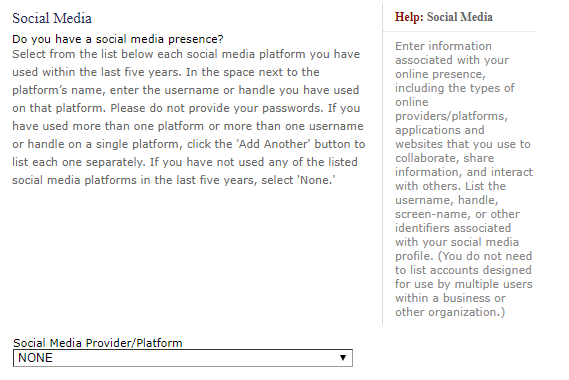
Here’s what the form actually says;
> Select from the list below each social media platform you have used within the last five years. In the space next to the platform’s name, enter the username or handle you have used on that platform. Please do not provide your passwords. If you have used more than one platform or more than one username or handle on a single platform, click the ‘Add Another’ button to list each one separately. If you have not used any of the listed social media platforms in the last five years, select ‘None.’”
Here’s a screenshot of the form:
https://cimg6.ibsrv.net/gimg/www.flyertalk.com-vbulletin/569...
It's effectively totalitarian, special economic zones aside. We've seen what happens if they try to stir the pot politically. Their relative "freedom" is exercised with a guillotine permanently above their heads and no legal rights.
Everyone is surveilled across every arena of life.
And if you really think people only disappear in Xinjiang, look at the history (and continuing present) of human rights or democracy activists. [0]
[0] https://www.hrw.org/news/2019/05/30/human-rights-activism-po...
However, large companies in China are tightly coupled with government when it comes to national security issues, while there is probably more pushback in the US.
Put it another way, where do you draw the line in terms of how the government is allowed to behave in regards to its citizens since you can pretty much excuse any abusive behavior under the reasoning of "security reasons"?
In a world like today, are you blaming people moving to other regions just to get jobs? Because that is what happens in China and else where in the world. It has nothing to with “getting rid of minorities”.
I believe the Chinese government apparatus is in that business.
Regarding the surveillance for surveillance sake, I don't see much difference. I see you describe exactly what I did.
I just can't stand those comments, they remind me of Trump- “No one knows China better than me” Although they basiclly know nothing, just as Trump.
As well as the UDHR, we also have international human rights treaties such as the International Covenant on Civil and Political Rights (ICCPR). As a treaty, it is binding on those countries which have ratified or acceded to it (signature alone does not legally bind one to a treaty, it merely expresses an intention to ratify it in the future.) On that point, it is worth noting that PRC signed the ICCPR in 1998, but as yet has not ratified it, so is not legally bound to it. (Previously, in 1967, ROC signed it, but never ratified it either; PRC's position is that ROC's 1967 signature was legally void, hence their own signature in 1998.)
(Technically speaking, an unratified signatory, while not bound to the terms of the treaty itself, is obliged under Article 18 of the Vienna Convention on the Law of Treaties (VCLT) to "refrain from acts which would defeat the object and purpose of a treaty" – but it is difficult to see how that article could be applicable to the case of China and the ICCPR.)
When you say individual freedom, I think you really mean individual political freedom. Excluding Xinjian, China has probably more freedom in day-to-day life for individuals than, say, America because it has less violent crime, less imprisonment, and lower regulatory barriers to doing business. It might be that it can only achieve these good things by restricting political freedom.
Even when they do restrict individual freedom, like with the one child policy, and internal travel restrictions, that has the aim of making the overall society better. There's a trade-off between individual freedom and survival and growth of the society. Too much freedom is anarchy and too little is totalitarianism. Where is the sweet spot?
https://news.ycombinator.com/newsguidelines.html
Edit: we had to ask you this before (https://news.ycombinator.com/item?id=19989263). We ban accounts that repeatedly violate the site guidelines, so please don't do this.
We'll see your Huawei and raise you AT&T
"The NSA considers AT&T to be one of its most trusted partners and has lauded the company’s “extreme willingness to help.” It is a collaboration that dates back decades [...] The NSA exploits these relationships [..] commandeering AT&T’s massive infrastructure and using it as a platform to covertly tap into communications processed by other companies."
https://theintercept.com/2018/06/25/att-internet-nsa-spy-hub...
WeChat doesn't have end-to-end encryption, while other apps have them. So the difference is not minuscule. Any communication on Wechat is interceptible by Chinese govt agencies. https://www.theguardian.com/world/2012/dec/07/wechat-chinese...
Wechat doesn't fit the definition of a "malware", but it is a weapon that Chinese govt uses to monitor it's citizens.
<<--Is WeChat actually required in China? I can't find any article to corroborate this claim. Or are you just saying that it's extremely inconvenient to get by without it. One could say the same about Google or Facebook services in the West.-->>
Read this https://www.nytimes.com/2018/09/20/opinion/learning-to-survi...
Hire a car+driver? Mysteriously cancelled at the last minute. Pressure on any translaters/fixers you may have. Drive somewhere that isn't the hotel? Find that there's an accident and you can't pass that way. Shops that close, constant tailing from security and police, general harassment, and nobody will talk to you because they believe they'll disappear.
So by that reckoning any program supporting smtp is a "kind of malware"? Or http?
> Is WeChat actually required in China
Not for a typical westerner visiting Beijing, Shanghai etc. Most places will take cash or international credit cards. For immigrants, sure.
Xinjiang may well be different, but it's not on the typical western tourist/business track.
Malware in the baseband firmware could theoretically intercept or disrupt radio traffic, or migrate from the firmware to the phone via other exploits in the OS to gain even more control. In essence, it's a particularly nasty thing that surveillance states would definitely use to their advantage.
This is why 'burner' devices should be exactly that - destroyed after use, because you simply cannot trust them after they've been anywhere near an invasive surveillance setting.
This sort of thing has had a lot of pushback lately from well meaning but IMHO misguided folks who complain about "cultural appropriation".
You aren't asked to forget your cultural traditions, you're asked to bring your neighbors into them. To share the culture. But also to admit that the edges are probably going to be sanded off and you're going to see people from outside of your group participating.
Better question is: what are they able to pull off the device while it's unlocked?
That's what I said. Other developing countries have grown just as fast or faster. The difference is that China happens to have the largest population in the world.
>Not only was China poor on an African level. It had a communist command economy. Compare to how the former Soviet block countries have floundered in the same period, despite starting from a higher economic level.
China voluntarily introduced capitalism in a controlled fashion. Former Soviet countries were the remnants of a collapsed nation. They aren't particularly comparable during the time period you're looking at.
Holding people indefinitely without need of cause, and without a clear legal way for them to communicate with other people, there can be no information on this. It's like asking for pictures of the inside of a black hole, or a message when you reach the area that causes your phone to explode. And on the way out? They can force them to sign anything to say that it didn't happen.
Yes, this does sound very conspiracy-esque. But we're talking about a country that tried to assassinate Castro 600 times, and several times poison him to make his beard fall out. Doesn't that also sound crazy? We have clear evidence that the US has these powers, and thanks to guantanamo and what's currently happening in the ICE camps, we have clear evidence that they will use that sort of legislation when it suits them. Even if it clearly violates international and domestic human rights laws.
Another answer is that the sheer sum of people that that is happening to, doesn't matter. It's the fact that the government has granted itself those powers in the first place, that matters here.
As an analogy, I don't care that nobody in the camp has hit my child over the head with a large stick, I care that they have gone to the pain of stating, in their code of conduct and in the contract of attending the camp, that they can hit my child over the head with a large stick if they wish, with no repercussions, and that my child is responsible. Do you see?