Not a good direction but also not enforced in my experience.
7. Public-facing social media platforms and identifiers/handles used during the last five years. This includes any websites or applications the applicant has used to create or share content (photos, videos, status updates, etc.) as part of a public profile.
I was advised by my lawyer that this covers Reddit and HN, and Facebook/Instagram (if I had any of those which I don't any more).
The lawyer didn't mention github however, but someone can search my name and find that in 1 click anyway, that's hardly private information.
I can (and would) opt out of taking my phone to China. I can't easily dodge US' requirements.
These two bully super-powers really give me a bad feeling about the future...
I'm all set with authoritarian dictatorships with torture camps and organ harvesting.
I'm guessing in 99% of cases this information is either ignored or dumped into a database where a surveillance dragnet will lightly touch every record regularly looking for specific matches.
But in the remaining 1% it will be abused to skirt around someone's human rights.
And maybe they're hoping to catch some really dumb terrorists that write down the "Death to America" forum on that list.
I do find it interesting that the form is not compatible with anonymous posting like 4chan.
1. Your complete travel history over the last 15 years, including source of funding for travel, in chronological order.
I don't know anyone who would be able to answer that one accurately.
It's the biggest reason why I am a huge fan of the idea of mandatory prosecution. If we can't afford to prosecute all the crimes we have on the books perhaps we have too many crimes on the books
Not just a while. The US Patriot Act gave powers to allow border controls to hold people indefinitely without cause.
Regarding email address, it's under "contact information" same as "home address". What's the problem?
Regarding social media, it says "optional", so...?
Of course, this is typical for dystopian governments. If everyone is technically guilty of a crime, and there is selective or variable enforcement, then you can justify the punishment that you want to mete out to specific people.
https://www.bbc.co.uk/news/technology-48118558
https://eu.usatoday.com/story/tech/2019/05/01/u-s-customs-ca...
https://www.zdnet.com/article/warrantless-phone-laptop-searc...
This style of argument is deflection, and it gets us nowhere.
It's very effective in redirecting the focus away from one bad actor and onto another bad actor, though.
What if the profile isn't part of a person's profile? As in it has zero relation to their "real" life.
We should be critical of our own government. Panarky clearly agrees with this (me too). The difference is that the conversation is about China. We can also have a conversation about the US or <insert any Western country> and how they are not respecting people's freedom. But this conversation is about China. It's also a conversation that needs to be had.
Plus this redirection is similar to "Bob shot a guy 30 times." "Oh yeah? Bill punched a guy". Neither Bob or Bill are likely good guys, but come on... Bob is definitely worse and Bill's actions don't really relate to how we want to condemn Bob's actions.
I definitely can't recall every one of those I had been on in the last decades.
But, it’s the broadness of the definition that’s of concern. That forum you registered at a year ago to ask a random question, never to return? Covered. Dating sites? Yep. Stack Overflow, Quora, etc. definitely. Yelp? For sure.
Then there are sites you can probably twist the definition to cover. Amazon might make this list, since you have the ability to post a public “wish list.” Things like Rover would count, because you have a “pet profile” and can post reviews of sitters, even though nobody says Rover is a social networking app.
Then there’s the class of “sites an adversary with unlimited resources for lawyers” might press to include. You posted a comment on a random blog? We consider your comment history to be your “public profile,” etc. The potential for overreach is huge, even if we don’t get to absurd levels such as this.
And I ain't gonna research when I last used each of those accounts.
The US is a massive country that ~75 million foreigners visit each year. In 2018 that figure hit an all-time record high near 78 million, which is in curious contrast to your setup premise.
With so many people visiting the US every year, you surely can produce a very large number of examples of toursts being held indefinitely - for many years even, one imagines - without cause.
I don't think the two countries are even remotely comparable on this front.
Take the anecdote of the person to whom you replied. Lots of people will tell that person's friend, "oh, just let it go, the border agent didn't really mean anything." And if the person complains to a higher authority, the complaint is staggeringly likely to get brushed off, if not used in exactly the opposite way the person intended when filing it.
At a previous job of mine, I worked for the phone-based customer service while another team in the same group operated service windows for in-person assistance. No authority here at all, just answering questions. More often than not, if someone filed a complaint about how one of our window clerks had treated them, the supervisor delivering the complaint to the clerk treated it as a joke. "Well, it says here you told the woman she should smile more. I pulled the security tape and she was pretty cute. Sure would have looked nicer if she had smiled, yeah?" Yeah boss, sure would have! "Darn right, can't fault you there, so we'll just toss this one as unwarranted, yeah?"
I don't know. It seems kind of weird to want to restrict the conversation like that, but I guess I kind of see your point.
> Plus this redirection is similar to "Bob shot a guy 30 times." "Oh yeah? Bill punched a guy".
The way I saw it, the neighborhood is turning kind of bad. Someone comments "Bob shot a guy 30 times", and another adds "Bill punched a guy". Neither of these people have met Bob nor Bill and don't really care about them in particular, but their interest lies in the neighborhood as a whole.
It is basically changing the topic when you have no effective rebuttal to an argument/issue.
It also creates a false equivalence between the real issue and the "whatabout" issue.
In this case, GP has no answer to China going FAR beyond any reasonable measure by requiring any tourist to install spyware on their phone so they can access all private conversations, so GP wants to ignore that and talk about public info the US requires visitors disclose at the border.
The false equivalence is created by treating as parallel and roughly equivalent govt actions the requirement to install spyware vs divulging of SocMed accts.
I'm NOT saying that divulging SocMed accts could be a definite threat to a variety of classes of people, especially journalists writing undercover. But even for that specific example, which is worse, enumerating your public SocMed accounts, or installing spyware on your phone, which will divulge far more? Not even in the same ballpark.
In sum, Whataboutism is not only damaging the conversation, it can often also be a method of disingenuous argument.
A big part of the 50-cent party's job [1] is to promote negative western news stories.
"There is an increasing trend around the world to treat borders as law-free zones where authorities have the right to carry out whatever outrageous form of surveillance they want," Omanovic said. "But they’re not: the whole point of basic rights is that you’re entitled to them wherever you are. Western liberal democracies intent on implementing increasingly similar surveillance regimes at the border should look to what China is doing here and consider if this is really the model of security they want to be pursuing."
In reality, comparables sometimes are and sometimes aren't relevant. You have to make that argument case by case for it to have any meaning. Invoking a generic word as if it magically decides the matter is just the sort of thing the HN guidelines ask commenters not to do.
To pick an example from another, hopefully distant enough, flamewar topic: if someone complains that dynamic programming languages have runtime errors and someone replies, "what about null pointer exceptions in $static-lang?", it's reasonable to argue about whether and how that is comparable. What's not reasonable is to exclaim "Whataboutism! The topic is errors in dynamic languages. Stop trying to change the subject." That amounts to "you can't say that because I spoke first", and that's not how conversation works. The question of what's relevant is an intimate part of the discussion itself. It's not something that whoever-spoke-first gets to control. Indeed, if anyone did control that, they would have the power to control the entire conversation. Past explanations for anybody who wants more:
https://news.ycombinator.com/item?id=19862258
https://news.ycombinator.com/item?id=19471386
Like GP said, it derails discussions into talking about a different bad actor than the actual one committing the bad behavior, while (intentional or not) minimizing said behavior. In short, just because the bad behavior exists elsewhere does not justify doing the bad behavior, or makes it any less bad, and the act of pointing it out can be a poor attempt at distraction from culpability.
Leaving a posh phone at home to take my old phone I could do without moral complications. I could even say I left my posh phone at home because I didn't want it lost/stolen on my travels. That would not be lying even if the real reason was that I didn't want it violated by a customs officer.
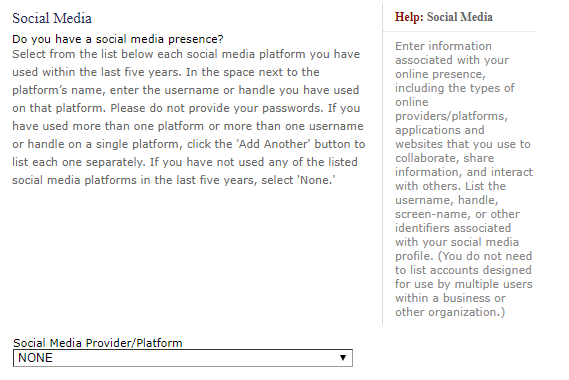
Here’s what the form actually says;
> Select from the list below each social media platform you have used within the last five years. In the space next to the platform’s name, enter the username or handle you have used on that platform. Please do not provide your passwords. If you have used more than one platform or more than one username or handle on a single platform, click the ‘Add Another’ button to list each one separately. If you have not used any of the listed social media platforms in the last five years, select ‘None.’”
Here’s a screenshot of the form:
https://cimg6.ibsrv.net/gimg/www.flyertalk.com-vbulletin/569...
Holding people indefinitely without need of cause, and without a clear legal way for them to communicate with other people, there can be no information on this. It's like asking for pictures of the inside of a black hole, or a message when you reach the area that causes your phone to explode. And on the way out? They can force them to sign anything to say that it didn't happen.
Yes, this does sound very conspiracy-esque. But we're talking about a country that tried to assassinate Castro 600 times, and several times poison him to make his beard fall out. Doesn't that also sound crazy? We have clear evidence that the US has these powers, and thanks to guantanamo and what's currently happening in the ICE camps, we have clear evidence that they will use that sort of legislation when it suits them. Even if it clearly violates international and domestic human rights laws.
Another answer is that the sheer sum of people that that is happening to, doesn't matter. It's the fact that the government has granted itself those powers in the first place, that matters here.
As an analogy, I don't care that nobody in the camp has hit my child over the head with a large stick, I care that they have gone to the pain of stating, in their code of conduct and in the contract of attending the camp, that they can hit my child over the head with a large stick if they wish, with no repercussions, and that my child is responsible. Do you see?