If true - how fast could a new transmission line from France to Germany pay for itself?
So it looks like solar and wind have more than compensated for the nuclear power shortages.
The olympic games will put this news to test and I guess we will find out soon if this news is indeed true.
Germans would get the full cost which is much higher than the quoted price here. Besides nuclear power is not flexible enough to amp it up and down according to demand (unlike coal or petrocarbon industries).
TLDR More interconnector capacity, battery storage, and renewables needed (my analysis).
[1] https://www.oecd-nea.org/upload/docs/application/pdf/2021-12...
[2] https://app.electricitymaps.com/zone/FR?wind=false&solar=fal...
[3] https://www.euractiv.com/section/coal/news/france-extends-li...
https://en.wikipedia.org/wiki/Synchronous_grid_of_Continenta...
(There are several HVDC links between those grids, but as I understand it that adds capacitance for the purpose of pricing.)
Nuclear reactors are already very cost ineffective when used as baseload. Theyre ridiculously cost ineffective when used for load following since it's basically curtailment.
This is why most countries tend to use gas or hydro/pumped storage for load following (or, increasingly, batteries as theyve been plummeting in price).
A market where a good fluctuates between profitable and not is not one very attractive to investment.
Playing the video game Victoria 3 has taught me a lot about healthy markets. You have to play both sides of supply and demand to get to the prices you need
"French electricity prices turned negative as a drop in demand and surging renewables output prompted some nuclear reactors to power down."
The sensible thing will be to use renewables on top of nuclear rather than overbuild nuclear, like what France is doing. But that will also eat into capacity factor when it's more windy and sunny like what France experiences.
Just something to keep in mind when you hear people talk about nuclear costs. Multiply it by at least 1/0.7 if they haven't taken this into account.
As a result, nuclear power becomes less competitive. However, renewables work poorly during the winter time. In Europe, they can go down for multiple _weeks_ at a time, far beyond any storage capabilities. And the only power plants that can fill the gap are fossil fuels.
End result: more fossil generation.
[1] https://www.bbc.com/news/articles/czkkgnp1d2xo
[2] https://app.electricitymaps.com/zone/ES?wind=false&solar=fal...
[3] https://app.electricitymaps.com/zone/PT?wind=false&solar=fal...
I've found this https://www.oecd-nea.org/nea-news/2011/29-2/aen-infos-suivi-... even if it isn't really clear, you have a graph that show you a typical year on a french reactor, and load followinf the german reactors used to do over a day.
Nuclear fission reactors have problems in other domains like being a huge liability during a military conflict, and dependance on uranium supply from the Sahel.
Also, nuclear plants in France are starting to suffer from water shortages; since an overheating plant is a problem it means that they take water at the expense of other uses, which is an externality they currently don't pay for because the economics of these plants is so terrible already.
I really want to like niclear but I have never been able to see the math work (and I've been paying intermittent attention for 40 years).
Then, there's everything else - you'd have to look at their budget to see if the proceeds from electricity are funding other programs.
Oil briefly went negative a few years ago. If you decided to build a storage business dependent on negative oil prices for profit, you might just be coming online around now, and very much poorer than you were before. (Of course you would in fact have stopped a long time ago.)
Functionally they could get there by just building a few more reactors.
Ontario, Canada would disagree with you: nuclear is 10.1¢/kWh, hydro is 6.2¢, (methane/natural) gas is 11.4¢; see Table 2:
* https://www.oeb.ca/sites/default/files/rpp-price-report-2023...
Of course hydro-electric dams typically flood many hectares of land for the reservoir. The current ones are getting refurbished:
* https://www.cbc.ca/news/canada/toronto/niagara-ontario-power...
Ontario's nuclear fleet are also in the middle of a bunch of refurbs:
* https://www.cbc.ca/news/canada/toronto/ontario-nuclear-power...
Some of which are finished:
* https://www.opg.com/releases/opg-celebrates-the-early-comple...
Live data on Ontario's grid:
* https://ieso.ca/power-data § "Supply" tab
Solution: we must stop electricity pricing based on energy produced (which made sense when using fossil fuel) and switch to a pricing mechanism where you pay for available power because that's where the marginal cost is increasing.
https://data.nordpoolgroup.com/auction/day-ahead/prices?deli...
The easy answer is that financiers don't want it, so it won't happen.
https://www.gov.ca.gov/2024/04/25/california-achieves-major-...
https://www.energy.ca.gov/data-reports/energy-almanac/califo...
https://cleantechnica.com/2024/06/02/solar-passes-100-of-pow...
https://futurism.com/the-byte/california-solar-electricity-p...
https://app.electricitymaps.com/zone/US-CAL-CISO?wind=false&...
Solar panel production on the other hand is exponential and growing much faster than overall power consumption. It can be very, very favorable to build batteries and that's why grid scale battery production is taking off. There is in fact a storage business dependent on energy arbitrage over time, it's lucrative, and all indications suggest it will continue to be lucrative for many years to come.
Not at all. Nobody has really put forth "too cheap to meter" as a rationale for nuclear for 50 years or more.
The issue is that nuclear is currently the only reliable base load generation technology that doesn't produce carbon (except perhaps hydro for reasonable definitions of "reliable"). The other top technologies either produce carbon (natural gas and coal) or are unreliable (solar and wind).
I actually don't believe nuclear is "the future" because I think renewables + battery storage will be more economical going forward and less politically dicey. But France is currently the envy of the world for their energy generation save for some countries with unique environments that allow for a lot of carbon-free generation (e.g. Norway with hydro and Iceland with geothermal).
The line can't just go a few metres across the border. Let's say it connects Dortmund, in the German industrial heartland on the French side of the country, with Chooz, the site of a nuclear plant near the German border. French nuclear plants are evenly distributed around the country [0], so that should be a reasonable choice. That's 250 km.
High voltage transmission costs around €2m/km to build [1] and carries around 2 GW of power [2].
So your line costs €500m to build and makes €13 x 2000 = €26,000 an hour and pays for itself after 20,000 hours or three years.
You might reasonably say you wouldn't expect to capture all of the €13 per MWh in arbitrage profits, and perhaps this disparity was a short-lived aberration. But actually it's not: electricity futures in France are priced €25 cheaper than their equivalent contracts in Germany [3], so you could reasonably expect to capture a good portion of that - if you split the surplus between you, the consumer and the producer you can still get €9.
Of course, one problem with this free money is that your competitors are already doing it. The gap is expected to narrow over time thanks to interconnectors like this, increased generation in Germany, and French nuclear plants going out of service [3]. Still, with increasing electrification of the energy market, this kind of power transmission seems like a good business to be in and a good investment for national governments and grid operators.
[0] https://www.researchgate.net/figure/Map-of-French-nuclear-po...
[1] https://www.researchgate.net/publication/358793859_Cost_of_e...
[2] https://web.ecs.baylor.edu/faculty/grady/_13_EE392J_2_Spring...
[3] https://montelnews.com/news/e15ef79e-2905-41ca-9124-165d7469...
Ergo, if you're using nuclear and energy became "too cheap to meter" then someone was not doing their job properly. If Tesla overestimated market demand and has to give away cars for free, would you say it means Tesla is the car of the future?
French nuclear power is run by EDF, which although 85% owned by the French government has “a mandate to make a profit for its shareholders”
But just pricing per kWh can work. If the limit is available capacity at 6PM, then those kWh are the most profitable and capacity will be built to meet demand at 6PM.
And even if it weren't a misquote, "Living up to a quote from 1954" is not how we judge whether a power source is still worth investing in for the future.
[0] https://www.thisdayinquotes.com/2015/09/too-cheap-to-meter-t...
It will take a lot of investment in storage tech (beyond lots of people using their EV car batteries as time-shifting storage, though that's certainly a good use!) in order to get prices smoothed out so that electricity generated at 1PM can be used at 11PM.
* Long term I have to imagine this is just "cheap" because there's got to be tons of industries that can use intermittent free energy.
There are also technical and economic reasons this may not work beyond just inelastic vendor pricing, there is cost to transmission(loss) and all the step down that has to happen before electricity is at your door, that cost will be always positive so it may not actually be net positive.
At steep enough negative pricing this could be profitable, however at that point power plants with the highest costs and easiest scale down/ shut down procedures will start acting.
Projects like the one at Dinorwig (pumped hydro-storage) are more viable solution for excess capacity.
* https://octopus.energy/smart/intelligent-octopus-go/ - 7.5p per kWh
* https://www.ovoenergy.com/electric-cars/charge-anytime - 7p per kWh
https://presse.economie.gouv.fr/08062023-letat-redevient-lac...
It’s not some design issue that you can fix with small modular reactors or whatever. Every time anything significant goes wrong people kept adding systems to prevent it happening again. Sometimes that’s something physical like a wall or redundant system, and other times it’s longer procedures and more paperwork. This has been great for avoiding another SL-1, 3 mile island etc, but mitigating every possible risks isn’t cheap. https://en.wikipedia.org/wiki/SL-1
For example there was once an expensive issue where foreign material fell into the spent fuel pool where fixing it significantly extended an outage at a single reactor so now everyone working on anything at any reactor takes significant steps to mitigate that risk. Great things working as intended except now something that might have cost 100k now costs significantly more because of that mitigation effort.
Extend that to any significant issue across hundreds of reactors and 50+ years and suddenly triple checking to avoid every fuck up means doing anything is really expensive. Worse very little of it is wasted effort, there’s just far more ways to fuck up in practice than in theory.
PS: I do believe it’s possible to have safe and cheap nuclear power, it’s just going to look very different than what we’re doing today.
Beyond that, leaving out storage costs, what are the technologies that can cover the world's storage? And in what quantities?
Because if I think of lithium, wouldn't it be an environmental disaster to extract and recycle all the materials involved?
In general, I don't understand why basically nuclear is to be replaced.
While a 1 GW coal plant might burn as much as 4 million tons of coal a year, a comparable nuclear power plant only consumes some 30 tons of fuels rods per year - but depending on ore quality and U-235 enrichment level, that might translate to 300,000 tons of uranium ore that needs to be mined and converted into fuel rods through an expensive multi-step process. Coal is much dirtier in terms of average daily emissions (though there's always the catastrophic failure risk with nuclear).
Solar / wind / storage operating costs are limited to maintenance and battery replacement, which can still be considerable.
This is the most wild thing I've ever read on this website. Pick just about any security and you'll see that buying and selling it over time fluctuates between profitable and not profitable. If something was always profitable everyone would do it and get infinitely rich. Arbitrage wouldn't exist. Economies would shut down.
In my opinion, if someone says we should just have all nuclear, it means they are dealing in absolutes, maybe God in politics and debate, but they ignore that reality is much more complicated, as technology meets economics and politics (and much more).
(Again, AFAIK) nuclear energy is great when it comes to meeting the "baseline" requirements, roughly the level below which energy consumption of a region never drops. It is because nuclear energy cannot be scaled up and down quickly, so it's not adequate for peaks.
To balance the peaks and keep the network stable, you need energy sources that can increase their output in seconds (or less?).
That's also one of the issues with wind and solar, you can't choose when it is available and when it isn't, so coal etc is still needed to make sure that energy production and consumption is practically equal at all times.
It's been true for 50 years, assuming it will be true for another decade or two is not wishful thinking.
> Beyond that, leaving out storage costs, what are the technologies that can cover the world's storage? And in what quantities?
Batteries for short term storage and pumped hydro for long term storage.
> Because if I think of lithium, wouldn't it be an environmental disaster to extract and recycle all the materials involved?
No.
> In general, I don't understand why basically nuclear is to be replaced.
It's inevitable that the cheapest solution will win. Not the best, but the cheapest.
A history of the phrase, which was originally said in 1954 (seventy years ago):
> Only a few days later, Strauss was a guest on Meet the Press. When the reporters asked him about the quotation and the viability of "commercial power from atomic piles," Strauss replied that he expected his children and grandchildren would have power "too cheap to be metered, just as we have water today that's too cheap to be metered."[4]
* https://en.wikipedia.org/wiki/Too_cheap_to_meter
It was never meant to be taken as $0:
For a long time water was paid for in a flat rate, and one could certainly envisage where electricity was the same: the power company would pick some kind of median/average to charge folks.. Of course most folks have metered water/sewage nowadays, and so metered electricity is less strange.
My cynical side was quick to point out that I would fire up my crypto miners if electricity was free for a few hours a day. After talking to him more I realized we both had different take aways from the story of "the tragedy of the commons" I lightened the conversation up by informing him he could do folding from home for a few hours to make sure his excess power went to a noble cause & thwart my zero sum approach.
Could you read the article please?
The lumbering beasts, which actually do hate changing output at all, turned off before the renewables.
Secondly, another below comment already explains that no, there's not a shortage.
Thirdly, please for f*ks sake, engage your brain and think what the impact of 700 euros a month (high in 2022) to negative prices now has on industry. What the everloving ** do I charge my customers?
Maybe this: >>40679507
But what matters for economics is the volume exchanged at this negative price, that is if you are a buyer with infinite capacity to absorb kWh how much money you'll make yearly?
Anyone with a good URL?
I think this is a little simplistic. Pumped hydro is very reliant on finding suitable geography which ultimately limits the potential capacity. I think it's more likely that grids of the future will rely on a variety of storage solutions (pumped hydro, consumer EVs, grid scale batteries etc.) and smarter load-shedding rather than any single solution being dominant.
There is good news though. With electric car sales slowing down (at least in the west) there is a surplus of batteries on the market, which makes grid storage projects more affordable. The incentives are currently pushing us towards decarbonizing our electric infrastructure faster and that is wonderful. As long as the politicians don't do anything dumb like slap huge tariffs on solar cells or something we should be making some real progress towards a green future.
Negative prices allow for some weird actions to become profitable - like starting an empty washing machine, turning in the light in an empty room or needlessly heating some water tank. Basically everything we are used to think of as waste. It sounds absurd, but it's not really a big deal.
I'm still curious about the actual MWh's traded for negative prices as well
Well it's one thing though to use the storage for a cell phones and some cars, another to keep all the industries and homes going on.
Do you have any data about what you claim?
For example in italy of hydro, nothing has been built for decades, everything that could be used has been used. If we want to go further, it's necessary to destroy valleys.
Your arguments do not go beyond whishful thinking... At least you need some data.
MartienVisser on twitter has some great graphs about the energy market, but I'm on my phone and banned twitter from that.
This has nothing to do with what anyone actually said. Just ask any 60-something, mild conservative. The meme exists, even though the actual quote was slightly more mealy mouthed.
It was always nonsense anyway. Electricity generation is mostly a deregulated market in most places, so nobody would spend billions on a Nuclear plant that wasn't guaranteed to make back it's money. It was always a thought terminating cliche.
I dunno, if electricity was free only for a few hours, I would use it to charge batteries, and then use that stored electricity later in the day when it's not free.
If electricity was free most or all of the time, and/or if I could store more than I could use, then sure, I'd probably use it for unnecessary things that some might consider wasteful (not crypto mining; I'm allergic).
But they do. Often literally.
Negative prices usually happen because of laws requiring minimum utilization, or subsides, or because they are so small and rare that it is not worth having someone on place to turn the switch.
My understanding is that the costs around nuclear aren't due to the technology being expensive (something that yes, we would expect to get cheaper over time), but because of the -- IMO necessary -- regulatory and safety regime surrounding nuclear power. Costs that I wouldn't expect to change all that much (and maybe even increase with time).
With storage, the cost is mainly the technology. As the tech improves, the cost decreases.
I get that opinions differ on this (clearly you have a different take), but that's fine; reasonable people can disagree.
(To be clear, I don't believe solar/wind is the be-all, end-all. Base load generation is still a problem there, and neither source is reliable or consistent in the way that something like nuclear is.)
Besides, you still have to pay back for the construction and the fuel, it's never gonna be free.
You are correct that they are not.
But this is due to policy, not physics. It's obvious to shut-down the fossil fuel plants first, but after then, there's no physical reason why they can't keep shutting power plants down.
Anyway, agreed, adding storage is a much better solution than focusing on the management of renewables.
What they charge customers in France is also controlled by the government (and not the same thing). The difference is simply made up by tax payer money. Of course being connected to the rest of the European market and also having a lot of their own renewables, this just means that bill is getting larger and larger for the French government whenever there is a surplus of wind and solar. Which is probably happening quite often now.
Here are some details on a deal the French government struck with nuclear operator EDF recently: https://www.clearygottlieb.com/news-and-insights/publication...
It's indeed a great example why commercial nuclear plants without extensive state support is not really a thing. Most places that have nuclear plants, also feature heavy government involvement and state funding. That plant that Bill Gates is involved with that recently started construction work, only still exists because of extensive state involvement.
But that fraction is still interesting: since p=c must be respected, and there is always some small delta that is hard to predict and has to be covered. The spot price is not relevant to consumer prices, but it is relevant to the cost for energy providers to fine-tune their supply.
Not really. If all vehicles on the road where 100% PEV’s your looking at ~250 TWh in batteries. 1/5 of that would be ~50TWh.
Global electricity demand is about 70 TWh per day. You don’t need 70 TWh worth of storage if daily production is > daily demand. It all comes down to which is cheaper, extra storage or extra generating capacity. However ~25 TWh of storage is likely sufficient for a grid equally stable as what we have today. (100% EV’s would increase that 70TWh/day but that’s offset by charging them when power is cheap.)
It's very frequent indeed. I noticed that it's mostly during sunny days in late spring / summer / early fall (solar). Much more rare is randomly at night (stormy days).
Solar is still pretty small in national grid charts, but I suspect that residential solar just reduces demand from the grid and doesn't show up as production.
Since we're being pedantic, as I understand it, the grid operators don't usually tell plants what to do (outside of system stress response, curtailment, etc), the grid operator shares the forecast, and when the price forecast is low, fossil fuel plants are likely tell the grid operator they'd rather shutdown than produce power at low/negative prices. For solar plants, there's no fuel cost, and there might be subsidies, so producing at a negative market price might still be positive for the generator and there's no reason to turn it off. For nuclear, fueling schedules don't really change based on use, so there's no reason to not provide optimum power outage other than for grid stability.
Grid scale storage should reduce price swings, since storage plants will tend to show up on the demand side when prices are low and the supply side when prices are high; although perhaps price swings will become bigger when prediction fails --- if storage fills up by noon you'll have a lot of excess supply until sunset; if storage empties by midnight, you may have a lot of excess demand until sunrise.
I doubt the economics work, but I'd love to live in a world where a lot of the grid's battery storage is based on backup batteries people have at their houses with the added bonus of reducing their billing costs.
But the way these networks work, you can often build up the interconnects where there's a pricing/availability disparity, and pretty soon you have a vast interconnect. Because if Germany's grid pricing benefits from relatively unconstrained interconnection with France, there's going to be a pricing disparity at Germany's other borders. Of course, grid borders don't necessarily reflect national borders, and national interconnection projects have to happen too.
That said, the top 5 countries by peak load in wikipedia are France, Germany, UK, Italy, and Spain, which are all either France or neighbors of France.
[1] https://en.wikipedia.org/wiki/Synchronous_grid_of_Continenta...
And geothermal, as you mention below. But, like hydro, it only works in certain geographic areas
Usually clients want consistency in the output. (they depend on the product/service)
Business owner usually wants consistency in employee/machinery output. (They cost money)
To me it seems that only low priority computation (incl. con-coins) is such industry. (Investment kind of reused, and relatively few employees)
There will be some shift to adjust to intermitency (e.g. Worker hours might be shifted to the time when solar generates the most energy to take advantage of the price)
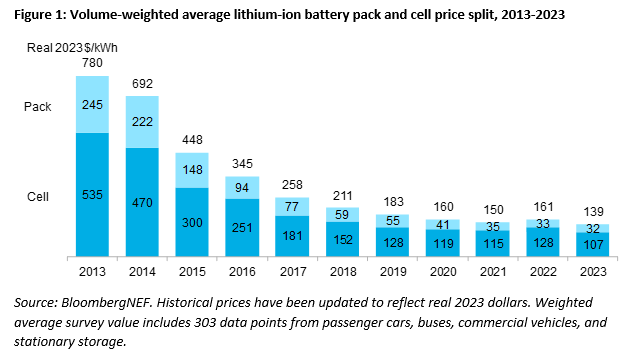
However, I don't think the decline in battery prices is primarily due to the technologies used. Instead, it's more about economies of scale and demand, which help optimize prices.
From my perspective, nuclear energy is on a similar path but with significantly less investment. A major portion of nuclear costs stems from the lack of economies of scale.
In my opinion, the arguments against nuclear energy contribute to the perception of its economic inefficiency. If people don't believe in it or don't want it, there will never be an opportunity to achieve economies of scale.
Here its quite well documented: https://www.construction-physics.com/p/why-are-nuclear-power...
https://energy.ec.europa.eu/topics/markets-and-consumers/cap...
I’m not sure this needs to be a goal to be honest.
It’s more practical for us to become accustomed to agile tariffs and have our own batteries + charging the car when prices drop than to hope for large scale storage solutions. In the UK the average solar install now includes batteries as prices come down on them.
We can already do this today fairly easily, and with open tariff APIs plus more integrated devices it will become easier.
Pumped hydro has been the cheapest by far and proven at scale far beyond any other solution including grid scale batteries, but only works in specific geographies and up to a fixed scale.
Grid scale batteries, pumped hydro, molten salts or other grid scale storage are all viable options provided TCO is cheaper than arbitrage that comes from price fluctuations.
This is no different than arbitrage in say commodity markets by taking delivery of the goods like say how U.S. government is using its strategic oil reserves these days.
If we find out in a few decades that the price of solar, batteries or renewables is no longer going down (and the reasons could be many, like a war, or a plateau in penetration), it could be enough to ruin those expectations. And discover that putting all our hopes in a single event could be our downfall.
Besides, even if daily storage is feasible, with current trends, we're still a long way from seasonal storage...
That's my opinion, which is why I think it's necessary to invest and believe in all technologies, without looking for the one we like the most or looks the most promising, since it leads to big bias and overestimation.
Without a proper grid not possible. The various countries block the expansion for political reasons. They would loose their power.
Sorry but where do you see this 80% drop? When the price of storage seems close to reaching a plateau (which by the way is also what I assumed in previous comments).
I understand being optimistic, but you claim to know the future while also denying the present... It's ironic.
Furthermore, no one could have predicted the mass protests, scandals, and fears that nuclear energy has sparked over the decades. These factors have significantly reduced the hype and investment in the sector.
The heating is provided via hot water radiators that are not at all adjustable, there are no thermostats in individual apartments! So if the weather is not very cold, your apartment can become too hot. While it's still sub-freezing outside.
Newer apartment buildings have adjustable radiators with thermostatic valves, but it's far from common.
In France, we get those in the exceptional event that we need more than a little fossil generation for a day.
It's expensive, but seems to actually work at removing fossil generation from the grid almost completely.
Negative prices meant the grid is inefficient to me; that's not a good thing. When you build a factory you want it operating as much as possible, otherwise ROI falls. That's worth more than a few plants.
In Australia, this has been happening for some time - plants are literally having their output dialled back (or even being disconnected entirely) during peak times by the market operator.
[1] https://www.abc.net.au/news/2021-10-23/solar-farm-overload-h... [2] https://reneweconomy.com.au/aemo-slashes-output-of-five-big-...
Like I'm not an expert on fertilizer production, but it seems pretty likely to me that you could draw that box around ammonia production and build out capacity that relatively cheaply, while leaving what I imagine to be the more operationally complex and capital intensive steps of extracting phosphates (via sulphiric and phosphoric acid) and potassium (which has nitric and sulphiric acid as biproducts), and combining that nitric acid with the ammonia (into ammonium nitrate) alone.
In some cases if you have excess production capacity (because you have unpredictable or seasonal load and you aren't currently at a peak) you don't necessarily even need more production capacity at all, just the ability to store a bit more of the inputs and outputs in a buffer.
It can be quite profitable from what i heard, in relation to installing solar cells.
https://www.pv-magazine.com/2024/03/07/battery-prices-collap...
We don’t need the price of solar or batteries to keep falling, or for large exponential growth to occur. Simply maintaining the current rate of solar energy installs over the next 25 years would result in a renewable heavy grid.
China is currently on pace to install ~300 GW of solar power in 2024 assuming they continue that for 25 years and give a minimal 15% capacity factor that’s already at 100% of their current electricity consumption before those panels hit end of life. Granted, demand would increase over that time period but keeping up with demand doesn’t require crazy exponential growth here.
Grid batteries are in a similar situation, companies aren’t installing them at scale because they don’t need to but there’s plenty of excess battery manufacturing capacity right now to fill the need as it shows up. Basically at current rate of renewable installs there becomes an economic incentive to slowly ramp up grid batteries.
When it comes to grid scale storage, I think there will be rapid advancements because the constraints for what what makes a good grid battery is so different from what makes a good laptop or EV battery, and we've really only recently been investigated batteries with those constraints. I.e. for decades battery tech has been concerned about things like weight-to-capacity ratios, recharge times, etc. Most of that hardly even matters for fixed, installed batteries at power plants.
France will have enough trouble rebuilding its declining nuclear fleet in the coming decades for their own energy needs, so any infrastructure that bets on France being able to supply neighbors as well will have a quick expiration. France is actually importing a lot of renewables in winter, because they heat homes with old electric heating (i.e. no heat pumps) and bad insulation that looses much more heat than homes in other countries and their nuclear supply can't cope with that.
In all likelyhood what will do the electricity decarbonization trick in Germany is threefold: more electricity transmission inside the country and with other renewable-heavy countries, continued quick buildout of renewables in Germany and a bit of battery storage, outlawing of coal and lignite in <10 years. The renewable gaps in the medium term will be fewer and shorter and will be filled with natural gas plants which are easy and cheap to build, even when they are just kept in standby most of the time. In the long term they will be made obsolete by even more lines and battery storage. Imported nuclear will likely play no relevant role at any stage. Like anything every bit helps a bit, but it won't change anything in the grand scale.
We already have a non-negligable amount of battery storage in German homes, but currently the incentives are laid out so that they will power these homes at night only. I believe we are loosing out on a bit of efficiency by not using it yet to feed back into the grid when needed. This could be enabled by smart meters and dynamic pricing in the future. It would also allow better to move household electricity demand into the times when renewables are most abundant.
In addition there are more general system costs (the need for capacity payments to ensure electricity can be generated at peak times, as well as maintaining plants in reserve in case the weather isn't what was forecast the day ahead).
By this line of argument, negative prices on sunny/windy days increase the price of electricity to the consumer, since all of these subsidies need to be recouped (either by the tax or energy systems).
Don't forget that we still produce most of our energy from coal, oil and gas. Most of that needs and will be replaced by electricity so there is a huge need for more electricity.
See https://ec.europa.eu/commission/presscorner/api/files/docume... where the European Commission approved the plan for the French state to give aid to push renewable deployment in France.
I google translated section 2.2 (paragraph 9) of the ruling document
> ... As such, the French authorities consider that there are “positive external effects” linked to the development of renewable electrical energies, in particular the reduction of greenhouse gas emissions from the electricity sector and the benefits in terms of robustness of the electricity sector. electricity supply linked to a more diversified electricity mix. These external effects are positive for the community but cannot be “monetized” by the investor. The French authorities consider that public support is necessary to have an investment in renewable energies that meets the expected collective benefits.
I would have expected inflation and interest rate changes to have negatively affected the viability of renewables. That is certainly the case for offshore wind in the UK (AR5 failed to produce any bids, AR6 has 66% higher maximum bid).
> Most reactors began construction by 1974; following the Three Mile Island accident in 1979 and changing economics, many planned projects were canceled. More than 100 orders for nuclear power reactors, many already under construction, were canceled in the 1970s and 1980s, bankrupting some companies.
How does that square with your recollection? Or were lots of nuclear power plants being constructed in the 1980s, and the article is very wrong?
[0] https://en.wikipedia.org/wiki/Nuclear_power_in_the_United_St...
UK interest rates went significantly higher than ECB ones.
And if you sign up for those ULO rates you also get 28.6¢ on-peak rates. The average over the entire day stays at 11.1¢ (see Table ES-2).
I guess they want to flatten the demand curve and reduce its cyclic nature: there's a cost to dealing with the traditional peaks times as well in various types of capacity.
https://scholar.google.co.uk/citations?view_op=view_citation...