Nuclear fission reactors have problems in other domains like being a huge liability during a military conflict, and dependance on uranium supply from the Sahel.
Also, nuclear plants in France are starting to suffer from water shortages; since an overheating plant is a problem it means that they take water at the expense of other uses, which is an externality they currently don't pay for because the economics of these plants is so terrible already.
I really want to like niclear but I have never been able to see the math work (and I've been paying intermittent attention for 40 years).
Then, there's everything else - you'd have to look at their budget to see if the proceeds from electricity are funding other programs.
Functionally they could get there by just building a few more reactors.
The easy answer is that financiers don't want it, so it won't happen.
Not at all. Nobody has really put forth "too cheap to meter" as a rationale for nuclear for 50 years or more.
The issue is that nuclear is currently the only reliable base load generation technology that doesn't produce carbon (except perhaps hydro for reasonable definitions of "reliable"). The other top technologies either produce carbon (natural gas and coal) or are unreliable (solar and wind).
I actually don't believe nuclear is "the future" because I think renewables + battery storage will be more economical going forward and less politically dicey. But France is currently the envy of the world for their energy generation save for some countries with unique environments that allow for a lot of carbon-free generation (e.g. Norway with hydro and Iceland with geothermal).
Ergo, if you're using nuclear and energy became "too cheap to meter" then someone was not doing their job properly. If Tesla overestimated market demand and has to give away cars for free, would you say it means Tesla is the car of the future?
French nuclear power is run by EDF, which although 85% owned by the French government has “a mandate to make a profit for its shareholders”
And even if it weren't a misquote, "Living up to a quote from 1954" is not how we judge whether a power source is still worth investing in for the future.
[0] https://www.thisdayinquotes.com/2015/09/too-cheap-to-meter-t...
https://presse.economie.gouv.fr/08062023-letat-redevient-lac...
It’s not some design issue that you can fix with small modular reactors or whatever. Every time anything significant goes wrong people kept adding systems to prevent it happening again. Sometimes that’s something physical like a wall or redundant system, and other times it’s longer procedures and more paperwork. This has been great for avoiding another SL-1, 3 mile island etc, but mitigating every possible risks isn’t cheap. https://en.wikipedia.org/wiki/SL-1
For example there was once an expensive issue where foreign material fell into the spent fuel pool where fixing it significantly extended an outage at a single reactor so now everyone working on anything at any reactor takes significant steps to mitigate that risk. Great things working as intended except now something that might have cost 100k now costs significantly more because of that mitigation effort.
Extend that to any significant issue across hundreds of reactors and 50+ years and suddenly triple checking to avoid every fuck up means doing anything is really expensive. Worse very little of it is wasted effort, there’s just far more ways to fuck up in practice than in theory.
PS: I do believe it’s possible to have safe and cheap nuclear power, it’s just going to look very different than what we’re doing today.
Beyond that, leaving out storage costs, what are the technologies that can cover the world's storage? And in what quantities?
Because if I think of lithium, wouldn't it be an environmental disaster to extract and recycle all the materials involved?
In general, I don't understand why basically nuclear is to be replaced.
While a 1 GW coal plant might burn as much as 4 million tons of coal a year, a comparable nuclear power plant only consumes some 30 tons of fuels rods per year - but depending on ore quality and U-235 enrichment level, that might translate to 300,000 tons of uranium ore that needs to be mined and converted into fuel rods through an expensive multi-step process. Coal is much dirtier in terms of average daily emissions (though there's always the catastrophic failure risk with nuclear).
Solar / wind / storage operating costs are limited to maintenance and battery replacement, which can still be considerable.
In my opinion, if someone says we should just have all nuclear, it means they are dealing in absolutes, maybe God in politics and debate, but they ignore that reality is much more complicated, as technology meets economics and politics (and much more).
(Again, AFAIK) nuclear energy is great when it comes to meeting the "baseline" requirements, roughly the level below which energy consumption of a region never drops. It is because nuclear energy cannot be scaled up and down quickly, so it's not adequate for peaks.
To balance the peaks and keep the network stable, you need energy sources that can increase their output in seconds (or less?).
That's also one of the issues with wind and solar, you can't choose when it is available and when it isn't, so coal etc is still needed to make sure that energy production and consumption is practically equal at all times.
It's been true for 50 years, assuming it will be true for another decade or two is not wishful thinking.
> Beyond that, leaving out storage costs, what are the technologies that can cover the world's storage? And in what quantities?
Batteries for short term storage and pumped hydro for long term storage.
> Because if I think of lithium, wouldn't it be an environmental disaster to extract and recycle all the materials involved?
No.
> In general, I don't understand why basically nuclear is to be replaced.
It's inevitable that the cheapest solution will win. Not the best, but the cheapest.
A history of the phrase, which was originally said in 1954 (seventy years ago):
> Only a few days later, Strauss was a guest on Meet the Press. When the reporters asked him about the quotation and the viability of "commercial power from atomic piles," Strauss replied that he expected his children and grandchildren would have power "too cheap to be metered, just as we have water today that's too cheap to be metered."[4]
* https://en.wikipedia.org/wiki/Too_cheap_to_meter
It was never meant to be taken as $0:
For a long time water was paid for in a flat rate, and one could certainly envisage where electricity was the same: the power company would pick some kind of median/average to charge folks.. Of course most folks have metered water/sewage nowadays, and so metered electricity is less strange.
Well it's one thing though to use the storage for a cell phones and some cars, another to keep all the industries and homes going on.
Do you have any data about what you claim?
For example in italy of hydro, nothing has been built for decades, everything that could be used has been used. If we want to go further, it's necessary to destroy valleys.
Your arguments do not go beyond whishful thinking... At least you need some data.
This has nothing to do with what anyone actually said. Just ask any 60-something, mild conservative. The meme exists, even though the actual quote was slightly more mealy mouthed.
It was always nonsense anyway. Electricity generation is mostly a deregulated market in most places, so nobody would spend billions on a Nuclear plant that wasn't guaranteed to make back it's money. It was always a thought terminating cliche.
My understanding is that the costs around nuclear aren't due to the technology being expensive (something that yes, we would expect to get cheaper over time), but because of the -- IMO necessary -- regulatory and safety regime surrounding nuclear power. Costs that I wouldn't expect to change all that much (and maybe even increase with time).
With storage, the cost is mainly the technology. As the tech improves, the cost decreases.
I get that opinions differ on this (clearly you have a different take), but that's fine; reasonable people can disagree.
(To be clear, I don't believe solar/wind is the be-all, end-all. Base load generation is still a problem there, and neither source is reliable or consistent in the way that something like nuclear is.)
Besides, you still have to pay back for the construction and the fuel, it's never gonna be free.
What they charge customers in France is also controlled by the government (and not the same thing). The difference is simply made up by tax payer money. Of course being connected to the rest of the European market and also having a lot of their own renewables, this just means that bill is getting larger and larger for the French government whenever there is a surplus of wind and solar. Which is probably happening quite often now.
Here are some details on a deal the French government struck with nuclear operator EDF recently: https://www.clearygottlieb.com/news-and-insights/publication...
It's indeed a great example why commercial nuclear plants without extensive state support is not really a thing. Most places that have nuclear plants, also feature heavy government involvement and state funding. That plant that Bill Gates is involved with that recently started construction work, only still exists because of extensive state involvement.
Not really. If all vehicles on the road where 100% PEV’s your looking at ~250 TWh in batteries. 1/5 of that would be ~50TWh.
Global electricity demand is about 70 TWh per day. You don’t need 70 TWh worth of storage if daily production is > daily demand. It all comes down to which is cheaper, extra storage or extra generating capacity. However ~25 TWh of storage is likely sufficient for a grid equally stable as what we have today. (100% EV’s would increase that 70TWh/day but that’s offset by charging them when power is cheap.)
And geothermal, as you mention below. But, like hydro, it only works in certain geographic areas
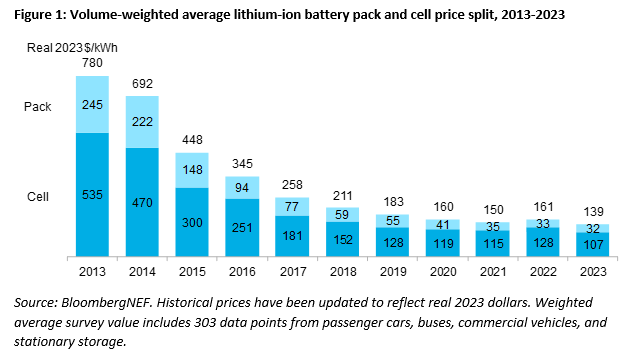
However, I don't think the decline in battery prices is primarily due to the technologies used. Instead, it's more about economies of scale and demand, which help optimize prices.
From my perspective, nuclear energy is on a similar path but with significantly less investment. A major portion of nuclear costs stems from the lack of economies of scale.
In my opinion, the arguments against nuclear energy contribute to the perception of its economic inefficiency. If people don't believe in it or don't want it, there will never be an opportunity to achieve economies of scale.
Here its quite well documented: https://www.construction-physics.com/p/why-are-nuclear-power...
If we find out in a few decades that the price of solar, batteries or renewables is no longer going down (and the reasons could be many, like a war, or a plateau in penetration), it could be enough to ruin those expectations. And discover that putting all our hopes in a single event could be our downfall.
Besides, even if daily storage is feasible, with current trends, we're still a long way from seasonal storage...
That's my opinion, which is why I think it's necessary to invest and believe in all technologies, without looking for the one we like the most or looks the most promising, since it leads to big bias and overestimation.
Sorry but where do you see this 80% drop? When the price of storage seems close to reaching a plateau (which by the way is also what I assumed in previous comments).
I understand being optimistic, but you claim to know the future while also denying the present... It's ironic.
Furthermore, no one could have predicted the mass protests, scandals, and fears that nuclear energy has sparked over the decades. These factors have significantly reduced the hype and investment in the sector.
In France, we get those in the exceptional event that we need more than a little fossil generation for a day.
It's expensive, but seems to actually work at removing fossil generation from the grid almost completely.
Negative prices meant the grid is inefficient to me; that's not a good thing. When you build a factory you want it operating as much as possible, otherwise ROI falls. That's worth more than a few plants.
https://www.pv-magazine.com/2024/03/07/battery-prices-collap...
We don’t need the price of solar or batteries to keep falling, or for large exponential growth to occur. Simply maintaining the current rate of solar energy installs over the next 25 years would result in a renewable heavy grid.
China is currently on pace to install ~300 GW of solar power in 2024 assuming they continue that for 25 years and give a minimal 15% capacity factor that’s already at 100% of their current electricity consumption before those panels hit end of life. Granted, demand would increase over that time period but keeping up with demand doesn’t require crazy exponential growth here.
Grid batteries are in a similar situation, companies aren’t installing them at scale because they don’t need to but there’s plenty of excess battery manufacturing capacity right now to fill the need as it shows up. Basically at current rate of renewable installs there becomes an economic incentive to slowly ramp up grid batteries.
When it comes to grid scale storage, I think there will be rapid advancements because the constraints for what what makes a good grid battery is so different from what makes a good laptop or EV battery, and we've really only recently been investigated batteries with those constraints. I.e. for decades battery tech has been concerned about things like weight-to-capacity ratios, recharge times, etc. Most of that hardly even matters for fixed, installed batteries at power plants.
> Most reactors began construction by 1974; following the Three Mile Island accident in 1979 and changing economics, many planned projects were canceled. More than 100 orders for nuclear power reactors, many already under construction, were canceled in the 1970s and 1980s, bankrupting some companies.
How does that square with your recollection? Or were lots of nuclear power plants being constructed in the 1980s, and the article is very wrong?
[0] https://en.wikipedia.org/wiki/Nuclear_power_in_the_United_St...