Not at all. Nobody has really put forth "too cheap to meter" as a rationale for nuclear for 50 years or more.
The issue is that nuclear is currently the only reliable base load generation technology that doesn't produce carbon (except perhaps hydro for reasonable definitions of "reliable"). The other top technologies either produce carbon (natural gas and coal) or are unreliable (solar and wind).
I actually don't believe nuclear is "the future" because I think renewables + battery storage will be more economical going forward and less politically dicey. But France is currently the envy of the world for their energy generation save for some countries with unique environments that allow for a lot of carbon-free generation (e.g. Norway with hydro and Iceland with geothermal).
Beyond that, leaving out storage costs, what are the technologies that can cover the world's storage? And in what quantities?
Because if I think of lithium, wouldn't it be an environmental disaster to extract and recycle all the materials involved?
In general, I don't understand why basically nuclear is to be replaced.
It's been true for 50 years, assuming it will be true for another decade or two is not wishful thinking.
> Beyond that, leaving out storage costs, what are the technologies that can cover the world's storage? And in what quantities?
Batteries for short term storage and pumped hydro for long term storage.
> Because if I think of lithium, wouldn't it be an environmental disaster to extract and recycle all the materials involved?
No.
> In general, I don't understand why basically nuclear is to be replaced.
It's inevitable that the cheapest solution will win. Not the best, but the cheapest.
A history of the phrase, which was originally said in 1954 (seventy years ago):
> Only a few days later, Strauss was a guest on Meet the Press. When the reporters asked him about the quotation and the viability of "commercial power from atomic piles," Strauss replied that he expected his children and grandchildren would have power "too cheap to be metered, just as we have water today that's too cheap to be metered."[4]
* https://en.wikipedia.org/wiki/Too_cheap_to_meter
It was never meant to be taken as $0:
For a long time water was paid for in a flat rate, and one could certainly envisage where electricity was the same: the power company would pick some kind of median/average to charge folks.. Of course most folks have metered water/sewage nowadays, and so metered electricity is less strange.
Well it's one thing though to use the storage for a cell phones and some cars, another to keep all the industries and homes going on.
Do you have any data about what you claim?
For example in italy of hydro, nothing has been built for decades, everything that could be used has been used. If we want to go further, it's necessary to destroy valleys.
Your arguments do not go beyond whishful thinking... At least you need some data.
My understanding is that the costs around nuclear aren't due to the technology being expensive (something that yes, we would expect to get cheaper over time), but because of the -- IMO necessary -- regulatory and safety regime surrounding nuclear power. Costs that I wouldn't expect to change all that much (and maybe even increase with time).
With storage, the cost is mainly the technology. As the tech improves, the cost decreases.
I get that opinions differ on this (clearly you have a different take), but that's fine; reasonable people can disagree.
(To be clear, I don't believe solar/wind is the be-all, end-all. Base load generation is still a problem there, and neither source is reliable or consistent in the way that something like nuclear is.)
Not really. If all vehicles on the road where 100% PEV’s your looking at ~250 TWh in batteries. 1/5 of that would be ~50TWh.
Global electricity demand is about 70 TWh per day. You don’t need 70 TWh worth of storage if daily production is > daily demand. It all comes down to which is cheaper, extra storage or extra generating capacity. However ~25 TWh of storage is likely sufficient for a grid equally stable as what we have today. (100% EV’s would increase that 70TWh/day but that’s offset by charging them when power is cheap.)
And geothermal, as you mention below. But, like hydro, it only works in certain geographic areas
However, I don't think the decline in battery prices is primarily due to the technologies used. Instead, it's more about economies of scale and demand, which help optimize prices.
From my perspective, nuclear energy is on a similar path but with significantly less investment. A major portion of nuclear costs stems from the lack of economies of scale.
In my opinion, the arguments against nuclear energy contribute to the perception of its economic inefficiency. If people don't believe in it or don't want it, there will never be an opportunity to achieve economies of scale.
Here its quite well documented: https://www.construction-physics.com/p/why-are-nuclear-power...
If we find out in a few decades that the price of solar, batteries or renewables is no longer going down (and the reasons could be many, like a war, or a plateau in penetration), it could be enough to ruin those expectations. And discover that putting all our hopes in a single event could be our downfall.
Besides, even if daily storage is feasible, with current trends, we're still a long way from seasonal storage...
That's my opinion, which is why I think it's necessary to invest and believe in all technologies, without looking for the one we like the most or looks the most promising, since it leads to big bias and overestimation.
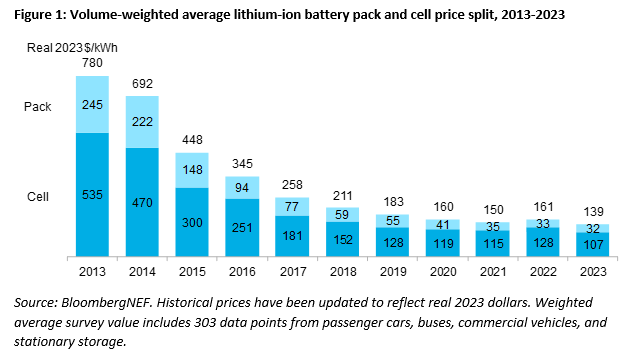
Sorry but where do you see this 80% drop? When the price of storage seems close to reaching a plateau (which by the way is also what I assumed in previous comments).
I understand being optimistic, but you claim to know the future while also denying the present... It's ironic.
https://www.pv-magazine.com/2024/03/07/battery-prices-collap...
We don’t need the price of solar or batteries to keep falling, or for large exponential growth to occur. Simply maintaining the current rate of solar energy installs over the next 25 years would result in a renewable heavy grid.
China is currently on pace to install ~300 GW of solar power in 2024 assuming they continue that for 25 years and give a minimal 15% capacity factor that’s already at 100% of their current electricity consumption before those panels hit end of life. Granted, demand would increase over that time period but keeping up with demand doesn’t require crazy exponential growth here.
Grid batteries are in a similar situation, companies aren’t installing them at scale because they don’t need to but there’s plenty of excess battery manufacturing capacity right now to fill the need as it shows up. Basically at current rate of renewable installs there becomes an economic incentive to slowly ramp up grid batteries.
When it comes to grid scale storage, I think there will be rapid advancements because the constraints for what what makes a good grid battery is so different from what makes a good laptop or EV battery, and we've really only recently been investigated batteries with those constraints. I.e. for decades battery tech has been concerned about things like weight-to-capacity ratios, recharge times, etc. Most of that hardly even matters for fixed, installed batteries at power plants.