TLDR More interconnector capacity, battery storage, and renewables needed (my analysis).
[1] https://www.oecd-nea.org/upload/docs/application/pdf/2021-12...
[2] https://app.electricitymaps.com/zone/FR?wind=false&solar=fal...
[3] https://www.euractiv.com/section/coal/news/france-extends-li...
https://en.wikipedia.org/wiki/Synchronous_grid_of_Continenta...
(There are several HVDC links between those grids, but as I understand it that adds capacitance for the purpose of pricing.)
[1] https://www.bbc.com/news/articles/czkkgnp1d2xo
[2] https://app.electricitymaps.com/zone/ES?wind=false&solar=fal...
[3] https://app.electricitymaps.com/zone/PT?wind=false&solar=fal...
I've found this https://www.oecd-nea.org/nea-news/2011/29-2/aen-infos-suivi-... even if it isn't really clear, you have a graph that show you a typical year on a french reactor, and load followinf the german reactors used to do over a day.
Ontario, Canada would disagree with you: nuclear is 10.1¢/kWh, hydro is 6.2¢, (methane/natural) gas is 11.4¢; see Table 2:
* https://www.oeb.ca/sites/default/files/rpp-price-report-2023...
Of course hydro-electric dams typically flood many hectares of land for the reservoir. The current ones are getting refurbished:
* https://www.cbc.ca/news/canada/toronto/niagara-ontario-power...
Ontario's nuclear fleet are also in the middle of a bunch of refurbs:
* https://www.cbc.ca/news/canada/toronto/ontario-nuclear-power...
Some of which are finished:
* https://www.opg.com/releases/opg-celebrates-the-early-comple...
Live data on Ontario's grid:
* https://ieso.ca/power-data § "Supply" tab
https://data.nordpoolgroup.com/auction/day-ahead/prices?deli...
https://www.gov.ca.gov/2024/04/25/california-achieves-major-...
https://www.energy.ca.gov/data-reports/energy-almanac/califo...
https://cleantechnica.com/2024/06/02/solar-passes-100-of-pow...
https://futurism.com/the-byte/california-solar-electricity-p...
https://app.electricitymaps.com/zone/US-CAL-CISO?wind=false&...
The line can't just go a few metres across the border. Let's say it connects Dortmund, in the German industrial heartland on the French side of the country, with Chooz, the site of a nuclear plant near the German border. French nuclear plants are evenly distributed around the country [0], so that should be a reasonable choice. That's 250 km.
High voltage transmission costs around €2m/km to build [1] and carries around 2 GW of power [2].
So your line costs €500m to build and makes €13 x 2000 = €26,000 an hour and pays for itself after 20,000 hours or three years.
You might reasonably say you wouldn't expect to capture all of the €13 per MWh in arbitrage profits, and perhaps this disparity was a short-lived aberration. But actually it's not: electricity futures in France are priced €25 cheaper than their equivalent contracts in Germany [3], so you could reasonably expect to capture a good portion of that - if you split the surplus between you, the consumer and the producer you can still get €9.
Of course, one problem with this free money is that your competitors are already doing it. The gap is expected to narrow over time thanks to interconnectors like this, increased generation in Germany, and French nuclear plants going out of service [3]. Still, with increasing electrification of the energy market, this kind of power transmission seems like a good business to be in and a good investment for national governments and grid operators.
[0] https://www.researchgate.net/figure/Map-of-French-nuclear-po...
[1] https://www.researchgate.net/publication/358793859_Cost_of_e...
[2] https://web.ecs.baylor.edu/faculty/grady/_13_EE392J_2_Spring...
[3] https://montelnews.com/news/e15ef79e-2905-41ca-9124-165d7469...
And even if it weren't a misquote, "Living up to a quote from 1954" is not how we judge whether a power source is still worth investing in for the future.
[0] https://www.thisdayinquotes.com/2015/09/too-cheap-to-meter-t...
* https://octopus.energy/smart/intelligent-octopus-go/ - 7.5p per kWh
* https://www.ovoenergy.com/electric-cars/charge-anytime - 7p per kWh
https://presse.economie.gouv.fr/08062023-letat-redevient-lac...
It’s not some design issue that you can fix with small modular reactors or whatever. Every time anything significant goes wrong people kept adding systems to prevent it happening again. Sometimes that’s something physical like a wall or redundant system, and other times it’s longer procedures and more paperwork. This has been great for avoiding another SL-1, 3 mile island etc, but mitigating every possible risks isn’t cheap. https://en.wikipedia.org/wiki/SL-1
For example there was once an expensive issue where foreign material fell into the spent fuel pool where fixing it significantly extended an outage at a single reactor so now everyone working on anything at any reactor takes significant steps to mitigate that risk. Great things working as intended except now something that might have cost 100k now costs significantly more because of that mitigation effort.
Extend that to any significant issue across hundreds of reactors and 50+ years and suddenly triple checking to avoid every fuck up means doing anything is really expensive. Worse very little of it is wasted effort, there’s just far more ways to fuck up in practice than in theory.
PS: I do believe it’s possible to have safe and cheap nuclear power, it’s just going to look very different than what we’re doing today.
A history of the phrase, which was originally said in 1954 (seventy years ago):
> Only a few days later, Strauss was a guest on Meet the Press. When the reporters asked him about the quotation and the viability of "commercial power from atomic piles," Strauss replied that he expected his children and grandchildren would have power "too cheap to be metered, just as we have water today that's too cheap to be metered."[4]
* https://en.wikipedia.org/wiki/Too_cheap_to_meter
It was never meant to be taken as $0:
For a long time water was paid for in a flat rate, and one could certainly envisage where electricity was the same: the power company would pick some kind of median/average to charge folks.. Of course most folks have metered water/sewage nowadays, and so metered electricity is less strange.
Could you read the article please?
The lumbering beasts, which actually do hate changing output at all, turned off before the renewables.
Secondly, another below comment already explains that no, there's not a shortage.
Thirdly, please for f*ks sake, engage your brain and think what the impact of 700 euros a month (high in 2022) to negative prices now has on industry. What the everloving ** do I charge my customers?
Maybe this: >>40679507
What they charge customers in France is also controlled by the government (and not the same thing). The difference is simply made up by tax payer money. Of course being connected to the rest of the European market and also having a lot of their own renewables, this just means that bill is getting larger and larger for the French government whenever there is a surplus of wind and solar. Which is probably happening quite often now.
Here are some details on a deal the French government struck with nuclear operator EDF recently: https://www.clearygottlieb.com/news-and-insights/publication...
It's indeed a great example why commercial nuclear plants without extensive state support is not really a thing. Most places that have nuclear plants, also feature heavy government involvement and state funding. That plant that Bill Gates is involved with that recently started construction work, only still exists because of extensive state involvement.
It's very frequent indeed. I noticed that it's mostly during sunny days in late spring / summer / early fall (solar). Much more rare is randomly at night (stormy days).
Solar is still pretty small in national grid charts, but I suspect that residential solar just reduces demand from the grid and doesn't show up as production.
But the way these networks work, you can often build up the interconnects where there's a pricing/availability disparity, and pretty soon you have a vast interconnect. Because if Germany's grid pricing benefits from relatively unconstrained interconnection with France, there's going to be a pricing disparity at Germany's other borders. Of course, grid borders don't necessarily reflect national borders, and national interconnection projects have to happen too.
That said, the top 5 countries by peak load in wikipedia are France, Germany, UK, Italy, and Spain, which are all either France or neighbors of France.
[1] https://en.wikipedia.org/wiki/Synchronous_grid_of_Continenta...
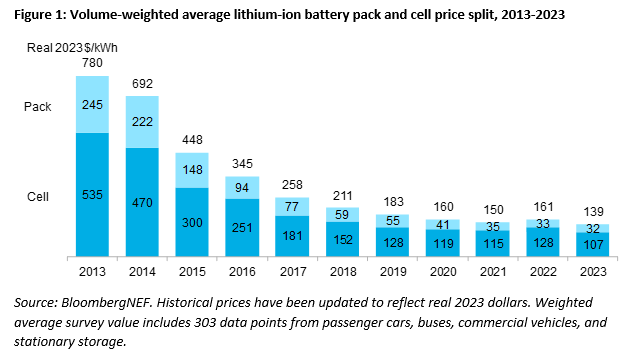
However, I don't think the decline in battery prices is primarily due to the technologies used. Instead, it's more about economies of scale and demand, which help optimize prices.
From my perspective, nuclear energy is on a similar path but with significantly less investment. A major portion of nuclear costs stems from the lack of economies of scale.
In my opinion, the arguments against nuclear energy contribute to the perception of its economic inefficiency. If people don't believe in it or don't want it, there will never be an opportunity to achieve economies of scale.
Here its quite well documented: https://www.construction-physics.com/p/why-are-nuclear-power...
https://energy.ec.europa.eu/topics/markets-and-consumers/cap...
Sorry but where do you see this 80% drop? When the price of storage seems close to reaching a plateau (which by the way is also what I assumed in previous comments).
I understand being optimistic, but you claim to know the future while also denying the present... It's ironic.
In Australia, this has been happening for some time - plants are literally having their output dialled back (or even being disconnected entirely) during peak times by the market operator.
[1] https://www.abc.net.au/news/2021-10-23/solar-farm-overload-h... [2] https://reneweconomy.com.au/aemo-slashes-output-of-five-big-...
https://www.pv-magazine.com/2024/03/07/battery-prices-collap...
See https://ec.europa.eu/commission/presscorner/api/files/docume... where the European Commission approved the plan for the French state to give aid to push renewable deployment in France.
I google translated section 2.2 (paragraph 9) of the ruling document
> ... As such, the French authorities consider that there are “positive external effects” linked to the development of renewable electrical energies, in particular the reduction of greenhouse gas emissions from the electricity sector and the benefits in terms of robustness of the electricity sector. electricity supply linked to a more diversified electricity mix. These external effects are positive for the community but cannot be “monetized” by the investor. The French authorities consider that public support is necessary to have an investment in renewable energies that meets the expected collective benefits.
I would have expected inflation and interest rate changes to have negatively affected the viability of renewables. That is certainly the case for offshore wind in the UK (AR5 failed to produce any bids, AR6 has 66% higher maximum bid).
> Most reactors began construction by 1974; following the Three Mile Island accident in 1979 and changing economics, many planned projects were canceled. More than 100 orders for nuclear power reactors, many already under construction, were canceled in the 1970s and 1980s, bankrupting some companies.
How does that square with your recollection? Or were lots of nuclear power plants being constructed in the 1980s, and the article is very wrong?
[0] https://en.wikipedia.org/wiki/Nuclear_power_in_the_United_St...
https://scholar.google.co.uk/citations?view_op=view_citation...