For example, I know artists who are vehemently against DALL-E, Stable Diffusion, etc. and regard it as stealing, but they view Copilot and GPT-3 as merely useful tools. I also know software devs who are extremely excited about AI art and GPT-3 but are outraged by Copilot.
For myself, I am skeptical of intellectual property in the first place. I say go for it.
There is no arguing against it though, you can't stop it, all this stuff is coming eventually to all of these areas, might as well try and find ways to use the oppurutinies while you can while some of this is still new.
But to be honest if your code is open source im pretty sure Microsoft don't care about licence they'll just use it cause "reasons" same about stable diffusion they don't give a fuk about data if its in internet they'll use it so its topic that probably will be regulated in few years.
Until then lets hope they'll get milked (both Microsoft and NovelAI) for illegal content usage and I srsly hope at least few layers will try milking it asap especially NovelAI which illegally usage a lot of copyrighted art in the training data.
When Microsoft steals all code on their platform and sells it, they get lauded. When "Open" AI steals thousands of copyrighted images and sells them, they get lauded.
I am skeptical of imaginary property myself, but fuck this one set of rules for the poor, another set of rules for the masses.
We need regulation around it.
Nope. DALL-E generates images with the Getty Watermark, so clearly there’s copyrighted materials in its training set: https://www.reddit.com/r/dalle2/comments/xdjinf/its_pretty_o...
I am also not a hypocrite; I do not like DALL-E or Stable Diffusion either.
As a sibling comment implies, these AI tools give more power to people who control data, i.e., big companies or wealthy people, while at the same time, they take power away from individuals.
Copilot is bad for society. DALL-E and Stable Diffusion are bad for society.
I don't know what the answer is, but I sure wish I had the resources to sue these powerful entities.
What did the photograph do to the portrait artist? What did the recording do to the live musician?
Here’s some highfalutin art theory on the matter, from almost a hundred years ago: https://en.wikipedia.org/wiki/The_Work_of_Art_in_the_Age_of_...
If you try to outlaw it, the day before the laws come into effect, I'm going to download the very best models out there and run it on my home computer. I'll start organising with other scofflaws and building our own AI projects in the fashion of leelachesszero with donated compute time.
You can shut down the commercial versions of these tools. You can scare large corporations from banning the use of these tools by corporations. You can pull an uno reverse card and use modified versions of the tools to CHECK for copyright infringement and sue people under existing laws AND you'll probably even be able to statistically prove somebody is an AI user. But STOPPING the use of these tools? Go ahead and try, won't happen.
Conservatism consists of exactly one proposition, to wit:
There must be in-groups whom the law protects but does not bind, alongside out-groups whom the law binds but does not protect.
—Composer Frank Wilhoit[1]
[1]: https://crookedtimber.org/2018/03/21/liberals-against-progre...
For what it's worth, the people I know who are opposed to this sort of "useful tool" don't discriminate by profession.
For some reason, code seems to lend itself to exact copying by AIs (and also some humans) rather than comprehension and imitation.
That can't possibly be a valid claim, right? AFAIK copyright is "gone" after the original author dies + ~70 years. Before fairly recently it was even shorter. Something from 1640 surely can't be claimed under copyright protection. There are much more recent changes where that might not be the case, but 1640?
> When Jane Rando uses devtools to check a website source code she gets sued.
Again, that doesn't sound like a valid suit. Surely she would win? In the few cases I've heard of where suits like this are brought against someone they've easily won them.
They are still their own separate works!
If a painter paints a person for commission, and then that person also commissions a photographer to take a picture of them, is the photographer infringing on the copyright of the painter? Absolutely not; the works are separate.
If a recording artist records a public domain song that another artist performs live, is the recording artist infringing on the live artist? Heavens, no; the works are separate.
On the other hand, these "AI's" are taking existing works and reusing them.
Say I write a song, and in that song, I use one stanza from the chorus of one of your songs. Verbatim. Would you have a copyright claim against me for that? Of course, you would!
That's what these AI's do; they copy portions and mix them. Sometimes they are not substantial portions. Sometimes, they are, with verbatim comments (code), identical structure (also code), watermarks (images), composition (also images), lyrics (songs), or motifs (also songs).
In the reverse of your painter and photographer example, we saw US courts hand down judgment against an artist who blatantly copied a photograph. [1]
Anyway, that's the difference between the tools of photography (creates a new thing) and sound recording (creates a new thing) versus AI (mixes existing things).
And yes, sound mixing can easily stray into copyright infringement. So can other copying of various copyrightable things. I'm not saying humans don't infringe; I'm saying that AI does by construction.
[1]: https://www.reuters.com/world/us/us-supreme-court-hears-argu...
Not sure I agree, but I can at least see the point for Copilot and DALL-E - but Stable Diffusion? It's open source, it runs on (some) home-use laptops. How is that taking away power from indies?
Just look at the sheer number of apps building on or extending SD that were published on HN, and that's probably just the tip of the iceberg. Quite a few of them at least looked like side projects by solo devs.
"There is no such thing as liberalism — or progressivism, etc.
There is only conservatism. No other political philosophy actually exists; by the political analogue of Gresham’s Law, conservatism has driven every other idea out of circulation."
If I take a song, cut it up, and sing over it, my release is valid. If I parody your work, that's my work. If you paint a picture of a building and I go to that spot and take a photograph of that building it is my work.
I can derive all sorts of things, things that I own, from things that others have made.
Fair use is a thing: https://www.copyright.gov/fair-use/
As for talking about the originals, would an artist credit every piece of inspiration they have ever encountered over a lifetime? Publishing a seed seems fine as a nice thing to do, but pointing at the billion pictures that went into the drawing seems silly.
I imagine that Disney would take issue with SD if material that Disney owned the copyright to was used in SD. They would sue. SD would have to be taken off the market.
Thus, Disney has the power to ensure that their copyrighted material remains protected from outside interests, and they can still create unique things that bring in audiences.
Any small-time artist that produces something unique will find their material eaten up by SD in time, and then, because of the sheer number of people using SD, that original material will soon have companions that are like it because they are based on it in some form. Then, the original won't be as unique.
Anyone using SD will not, by definition, be creating anything unique.
And when it comes to art, music, photography, and movies, uniqueness is the best selling point; once something is not unique, it becomes worth less because something like it could be gotten somewhere else.
SD still has the power to devalue original work; it just gives normal people that power on top of giving it to the big companies, while the original works of big companies remain safe because of their armies of lawyers.
There is no such thing as being a Liberal or Progressive, there is only being a Conservative or anti-Conservative, and while there is much nuänce and policy to debate about that, it boils down to deciding whether you actually support or abhor the idea of "the law" (which is a much broader concept than just the legal system) existing to enforce or erase the distinction between in-groups and out-groups.
But that's just my read on it. Getting back to intellectual property, it has become a bitter joke on artists and creatives, who are held up as the beneficiaries of intellectual property laws in theory, but in practice are just as much of an out-group as everyone else.
We are bound by the law—see patent trolls, for example—but not protected by it unless we have pockets deep enough to sue Disney for not paying us.
They are absolutely completely and utterly bullshit. Nobody with half an ear for music will mistake my playing of Bach's G Minor Sonata with Arthur Grumiaux (too many out of tune notes :-D). But yet, YouTube still manages to match this to my playing, probably because they have never heard it before now (I recorded it mere minutes before).
So no, it isn't a valid claim, but this algorithm trained on certain examples of work, manages to make bad classifications with potentially devastating ramifications for the creator (I'm not a monetized YouTube artist, but if this triggered a complete lockout of my Google account(s), this likely end Very Badly).
I think it's a very relevant comparison to the GP's examples.
It's not, but good luck talking to a human at Youtube when the video gets taken down.
> Again, that doesn't sound like a valid suit. Surely she would win?
Assuming she could afford the lawyer, and that she lives through the stress and occasional mistreatment by the authority, yes, probably. Both are big ifs, though.
I wonder if there is a crowdfunding platform like gofundme, for lawsuits. Or can gofundme itself can be used for this purpose? It would be fantastic to sue the mega polluters, lying media like Fox etc.
That said, even with a lot of money, are these cases winnable? Especially given the current state of Supreme Court and other federal courts?
I'm not a lawyer, but my understanding is that while the "1640's violin composition" itself may be out of copyright, if I record myself playing it, my recording of that piece is my copyright. So if you took my file (somehow) and used it without my permission, and I could prove it, I could claim copyright infringement.
That's my understanding, and I've personally operated that way to avoid any issues since it errs on the side of safety. (Want to use old music, make sure the license of the recording explicitly says public domain or has license info)
But it can still be weaponized to prevent legitimate resubmissions of parallel works, that can potentially deplatform legitimate users, depending on the reviewer and the clarity of the rebuttal.
BTW, what happened after the photograph is that there were less portrait artists. And after the recording there were less live musicians. There are certainly no less artists nor musicians, though!
Let me be perfectly clear. I'm all for the tech. The capabilities are nice. The thing I'm strongly against is training these models on any data without any consent.
GPT-3 is OK, training it with public stuff regardless of its license is not.
Copilot is OK, training on with GPL/LGPL licensed code without consent is not.
DALL-E/MidJourney/Stable Diffusion is OK. Training it with non public domain or CC0 images is not.
"We're doing something amazing, hence we need no permission" is ugly to put it very lightly.
I've left GitHub because of CoPilot. Will leave any photo hosting platform if they hint any similar thing with my photography, period.
It has indeed happened.
https://boingboing.net/2018/09/05/mozart-bach-sorta-mach.htm...
Sony later withdrew their copyright claim.
There are two pieces to copyright when it comes to public domain:
* The work (song) itself -- can't copyright that
* The recording -- you are the copyright owner. No one, without your permission, can re-post your recording
And of course, there is derivative work. You own any portion that is derivative of the original work.
That's freedom of speech for everyone who can afford a lawyer to bring suit against a music rights-management company.
I haven't been following super closely but I don't know of any claims or examples where input images were recreated to a significant degree by stable diffusion.
Do you have any evidence for those claims, or anything resembling those examples?
Music copyright has long expired for classical music, and big shots are definitely not exempt from where it applies. Just look at how much heat Ed Sheeran, one of the biggest contemporary pop stars, got for "stealing" a phrase that was literally just chanting "Oh-I" a few times (just to be clear, I am familiar with the case and find it infuriating that this petty rent-seeking attempt went to trial at all, even if Sheeran ended up being completely cleared, but to great personal distress as he said afterwards).
And who ever got sued for using dev tools? Is there even a way to find that out?
So even if we’re assuming these were wholly original works that the author placed under something like a Creative Commons license, the fact that it incorporated an image they had no rights to would at the very least create a fairly tangled copyright situation that any really rigorous evaluation of the copyright status of every image in the training set would tend to argue towards rejecting as not worth the risk of litigation.
But the more likely scenario here is that they did minimal at best filtering of the training set for copyrights.
I disagree, but this is a debate worth having.
This is why I disagree: humans don't copy just copyrighted material.
I am in the middle of developing and writing a romance short story. Why? Because my writing has a glaring weakness: characters, and romance stands or falls on characters. It's a good exercise to strengthen that weakness.
Anyway, both of the two people in the (eventual) couple developed from my real life, and not from any copyrighted material. For instance, the man will basically be a less autistic and less selfish version of myself. The woman will basically be the kind of person that annoys me the most in real life: bright, bubbly, always touching people, etc.
There is no copyrighted material I am getting these characters from.
In addition, their situation is not typical of such stories, but it does have connections to my life. They will (eventually) end up in a ballroom dance competition. Why that? So the male character hates it. I hate ballroom dance during a three-week ballroom dancing course in 6th grade, the girls made me hate ballroom dancing. I won't say how, but they did.
That's the difference between humans and machines: machines can only copyright and mix other copyrightable material; humans can copy real life. In other words, machines can only copy a representation; humans can copy the real thing.
Oh, and the other difference is emotion. I've heard that people without the emotional center of their brains can take six hours to choose between blue and black pens. There is something about emotions that drives decision-making, and it's decision-making that drives art.
When you consider that brain chemistry, which is a function of genetics and previous choices, is a big part of emotions, then it's obvious that those two things, genetics and previous choices, are also inputs to the creative process. Machines don't have those inputs.
Those are the non-religious reasons why I think humans have more originality than machines, including neural networks.
https://en.m.wikipedia.org/wiki/Viacom_International_Inc._v.....
https://www.radioclash.com/archives/2021/05/02/youtuber-gets...
For being sued for looking at source here is the first result on Google
https://www.wired.com/story/missouri-threatens-sue-reporter-...
These things are tools to make more involved things. You're not going to be remembered for all the AI art you prompted into existence, no matter how many "good ones" you manage to generate. No one is going to put you into the Guggenheim for it.
Likewise, programmers aren't going to become more depraved or something by using Copilot. I think that kind of prescriptive purism needs to Go Away Forever, personally.
Those are effectively cases of cryptomnesia[0]. Part and parcel of learning.
If you don't want broad access your work, don't upload it to a public repository. It's very simple. Good on you for recognising that you don't agree with what GitHub looks at data in public repos, but it's not their problem.
In other words: the banal observation that people care far more when their stuff is stolen than when some stranger has their stuff stolen.
For copyright, the act of me creating something doesn't deprive you of anything, except the ability to consume or use the thing I created. If I were influenced by something, you can still be influenced by that same thing - I do not exhaust any resources I used.
This is wholely different from physical objects. If I create a knife, I deprive you of the ability to make something else from those natural resources. Natural resources that I didn't create - I merely exploited them.
Because of this, I'm fine with copyright (patents are another story). But I have some issues with physical property.
So? No one needs to stop it totally. The world isn't black and white, pushing it to the fringes is almost certainly a sufficient success.
Outlawing murder hasn't stopped murder, but no one's given up on enforcing those laws because of the futility of perfect success.
> If you try to outlaw it, the day before the laws come into effect, I'm going to download the very best models out there and run it on my home computer. I'll start organising with other scofflaws and building our own AI projects in the fashion of leelachesszero with donated compute time.
That sounds like a cyberpunk fantasy.
Are you sure?
I'm not familiar with the exact data set they used for SD and whether or not Disney art was included, but my understanding is that their claim to legality comes from arguing that the use of images as training data is 'fair use'.
Anyone can use Disney art for their projects as long as it's fair use, so even if they happened to not include Disney art in SD, it doesn't fully validate your point, because they could have done so if they wanted. As long as training constitutes fair use, which I think it should - it's pretty much the AI equivalent of 'looking at others' works', which is part of a human artist's training as well.
The first is that people only recognize the problems with the things that they're familiar with, which you would kind of expect.
The other option is that there's a difference in the thing that people object to. My impression is that artists seem to be reacting to the idea that they could be automated out of a job, where programmers are mostly objecting to blatant copyright violation. (Not universally in either case, but often.) If that is the case, then those are genuinely different arguments made by different people.
Among many others. Classical music may have fallen into public domain, but modern performances of it is copyrightable, and some of the big companies use copyright matching systems, including YouTube's, that often flags new performances as copies of recordings.
But surely the answer should be to fix the broken YT system and to educate politicians to abstain from baseless threats, not to make AI researchers pay for it?
Right, that's my point... I can sue anyone for anything, doesn't mean I'll win.
Do you have examples? Because SD will generate photoreal outputs and then get subtle details (hands, faces) wrong, but unless you have the source image in hand then you've no way of knowing whether it's a "source image" or not.
Trademarks require active defense to avoid genericization. Copyright may be asserted at the holder's discretion.
This becomes particularly onerous when trolls claim copyright on published recordings of environmental sounds that happen to be similar but not identical to someone else's but they do have a legitimate claim on the original recording.
And as computers get more powerful and the models get more efficient it'll become easier and easier to self host and run them on your own dime. There are already one click installers for generative models such as stable diffusion that run on modest hardware from a few years back.
I agree with you that it is also possible that people posted Getty thumbnails to some sites as though they are public domain, and that is how the AIs learned the watermark.
If we didn't live in a Capitalist society, that would be fair. But we currently do. That Capitalist society cares little about the well being of artists unless it can find a way to make their art profitable. Projects like DALL-E and Midjourney pillage centuries of human art and sell it back to us for a profit, while taking away work from artists who struggle to make ends meet as it is. Software Developers are generally less concerned about Copilot because they're still making 6 figures a year, but they'll start to get concerned if the technology gets smart enough that society needs less Developers.
An automated future should be a good thing. It should mean that computers can take care of most tasks and humans can have more leisure time to relax and pursue their passions. The reason that artists and developers panic over things like this is that they are watching themselves be automated out of existence, and have seen how society treats people who aren't useful anymore.
> For myself, I am skeptical of intellectual property in the first place. I say go for it.
I'm in a similar boat but this is precisely the reason I object so strongly to Copilot. IP has been invented & perpetuated/extended to protect large corporate interests, under the guise of protecting & sustaining innovators & creative individuals. Copilot is a perfect example of large corporate interest ignoring IP when it suits them to exploit individuals.
In other words: the reason I'm skeptical of IP is the same reason I'm skeptical of Copilot.
Anyone with a mouth can run it and threaten a lawsuit. If fact, I threaten to sue you for misinformation right now unless you correct your post. Fat lot of good my threat will do because no judge in their right mind would entertain said lawsuit because it's baseless.
Disagree, outputting training data as-is is not cryptomnesia. This is not Copilot's first case. It also reproduced ID software's fast inverse square root function as-is, including its comments, but without its license.
> If you don't want broad access your work, don't upload it to a public repository. It's very simple.
This is actually both funny and absurd. This is why we have licenses at this point. If all the licenses is moot, then this opens a very big can of worms...
My terms are simple. If you derive, share the derivation with the same license (xGPL). Copilot is deriving my code. If you use my code as a derivation point, honor the license, mark the derivation with GPL license. This voids your business case? I don't care. These are my terms.
If any public item can be used without any limitations, Getty Images (or any other stock photo business) is illegal. CC licensing shouldn't exist. GPL is moot. Even the most litigious software companies' cases (Oracle, SCO, Microsoft, Adobe, etc.) is moot. Just don't put it on public servers, eh?
Similarly, music and other fine arts are generally publicly accessible. So copyright on any and every production is also invalid as you say, because it's publicly available.
Why not put your case forward with attorneys of Disney, WB, Netflix and others? I'm sure they'll provide all their archives for training your video/image AI. Similarly Microsoft, Adobe, Mathworks, et al. will be thrilled to support your CoPilot competitor with their code, because a) Any similar code will be just cryptomnesia, b) The software produced from that code is publicly accessible anyway.
At this point, I even didn't touch to the fact that humans are trained much more differently than neural networks.
The recording destroyed the occupation of being a live musician. People still do it for what amounts to tip money, but it used to be a real job that people could make a living off of. If you had a business and wanted to differentiate it by having music, you had to pay people to play it live. It was the only way.
It's quite a common complaint because some of the most popular prompts involve just appending an artist's name to something to get it to copy their style.
You cant sue if you dont have money, a big corp can sue even if they know they are wrong.
If I take a song, cut it up, and sing over it, my release is valid
"valid", how? You still have to pay royalties to the copyright holder of the original song, and you don't get to claim it as your own.
It completely destroyed the jobs of photo realistic portrait artists. You only have stylised portrait painting now and now that is going to be ripped off too.
Me too. I think copyright and these silly restrictions should be abolished.
At the same time, I can't get over the fact these self-serving corporations are all about "all rights reserved" when it benefits them while at the same time undermining other people's rights. Microsoft absolutely knows that what they're doing is wrong. Recently it was pointed out to me that Microsoft employees can't even look at GPL source code, lest they subconsciously reproduce it. Yet they think their software can look at other people's code and reproduce it? What a load of BS.
I'll forgive them for going for it the second copyright is gone. Then it won't be a crime for any of us to copy Windows and Office either. You bet we're gonna go for it too.
Yes, I'm sure.
> I'm not familiar with the exact data set they used for SD and whether or not Disney art was included, but my understanding is that their claim to legality comes from arguing that the use of images as training data is 'fair use'.
They could argue that. But since the American court system is currently (almost) de facto "richest wins," their argument will probably not mean much.
The way to tell if something was in the dataset would be to use the name of a famous Disney character and see what it pulls up. If it's there, then once the Disney beast finds out, I'm sure they'll take issue with it.
And by the way, I don't buy all of the arguments for machine learning as fair use. Sure, for the training itself, yes, but once the model is used by others, you now have a distribution problem.
More in my whitepaper against Copilot at [1].
Presumably by "the masses" you meant "the large corporations"?
Usually, "the masses" means "the common people" ... i.e. not much different from "the poor."
If you meant corporations, I'm 100% behind this comment.
You put it as a remix, but remixes are credited and expressed as such.
Outputting training data as-is without attribution is just plain plagiarism. You don't get to put verbatim text from textbooks in your academic papers either.
I think that the argument being made by some artists is that the training process itself violates copyright just by using the training data.
That’s quite different from arguing that the output violates copyright, which is what the tweet in this case was about.
That sounds like the pro-innovation bias: https://en.m.wikipedia.org/wiki/Pro-innovation_bias
But your reasoning boils down to I don't like it so it mustn't be that way. That's never been necessarily true.
At any rate piracy is rampant so clearly a large body of people don't think even a direct copies is morally wrong. Let alone something similar.
You're acting as though there are constant won and lost cases over plagiarism. Ed Sheeran seems to defend his work weekly. Every case that goes to court means reasonable minds differ on the interpretation of plagiarism legally.
So what's your point?
Because it seems the main thrust of your argument is I should argue with Microsoft instead (*who own GitHub lol*)? That's all you got to hold back the tide of AI? An appeal to authority?
I don’t see Midjourney (et al) as remixes, myself. More like “inspired by.”
I am against Copilot because Microsoft is training the models with public data disregarding copyright (also, doesn't include it's own code).
To add to that, there is provisions to lock her out of pushing new videos to the platform if the number of unresolved copyright claims passes some low number (3?).
So she loses new revenue until her claims prevail, and of course the entity which the claim is made for knows that and has no incentive to help her (don't they even get the monetization from her videos in the meantime ?)
Put another way, AI's are tools that give more power to already powerful entities.
When it’s a faceless mass of 100k employees…? Not so much.
Its all the same they just dont realize this.
If you asked every developer on earth to implement FizzBuzz, how many actually different implementations would you get? Probably not very many. Who should own the copyright for each of them? Would the outcome be different for any other product feature? If you asked every dev on earth to write a function that checked a JWT claim, how many of them would be more or less exactly the same? Would that be a copyright violation? I hope the courts answer some of these questions one day.
This is a fascinating observation and I think there's a lot of truth to it. But maybe our inference should be that these systems mistreat each of us, even if it's difficult to see unless it's falling on you.
Maybe a more important question than whether or not this is a violation of intellectual property is whether this is a violation of human dignity, not that it's illegal (though in this case, it may be) but that it's extremely rude in a way that we don't necessarily have the vocabulary for yet.
https://twitter.com/ebkim00/status/1579485164442648577
Not sure if this was fed the original image as an input or not.
Also seen a couple cases where people explicitly trained a network to imitate an artist's work, like the deceased Kim Jung Gi.
Thousands at least. Some of which would actually work.
Not a lawyer, of course, but I think slapping the Getty logo on a work claiming "fair use" and then releasing the work under public domain would be a case of misrepresentation, because Getty still has a copyright claim on your work. Regardless of the copyright status, it's still a clear trademark violation to me.
Does it matter? If you examined every copyright lawsuit on earth over code, how many of them would actually be over FizzBuzz?
It’s only logical that people twist and bend the rules.
Anyway, this kind of bs will go on until people start bringing companies to court over this.
I still don’t get why don’t lawyers start offering their services for a cut of the damages… there probably is good money to be made by suing companies that put copyright-infringing ai in production.
When it comes to being an AI that understands coding concepts, I don't want it to regurgitate code verbatim.
When it comes to being a product, I don't want it to plagiarize.
All I can take away from this is the absurdity of intellectual property laws in general. I agree with the GP, if people are sharing stuff, it's fair game. If you don't want people using stuff you made, keep it to yourself. Pretending we can apply controls to how freely available info is used is silly anyway
I think over time we are going to see the following:
- If you take say a star wars poster, and inpaint in a trained face over luke's, and sell that to people as a service, you will probably be approached for copyright and trademark infringement.
- If you are doing the above with a satirical take, you might be able to claim fair use.
- If you are using AI as a "collage generator" to smash together a ton of prompts into a "unique" piece, you may be safe from infringement but you are taking a risk as you don't know what % of source material your new work contains. I'd like to imagine if you inpaint in say 20 details with various sub-prompts that you are getting "safer".
So question one in the back of our heads should be "Are we promoting progress here?" That most often means protecting the little guy, and that's why I think it's mostly necessary, and also must be evaluated very skeptically.
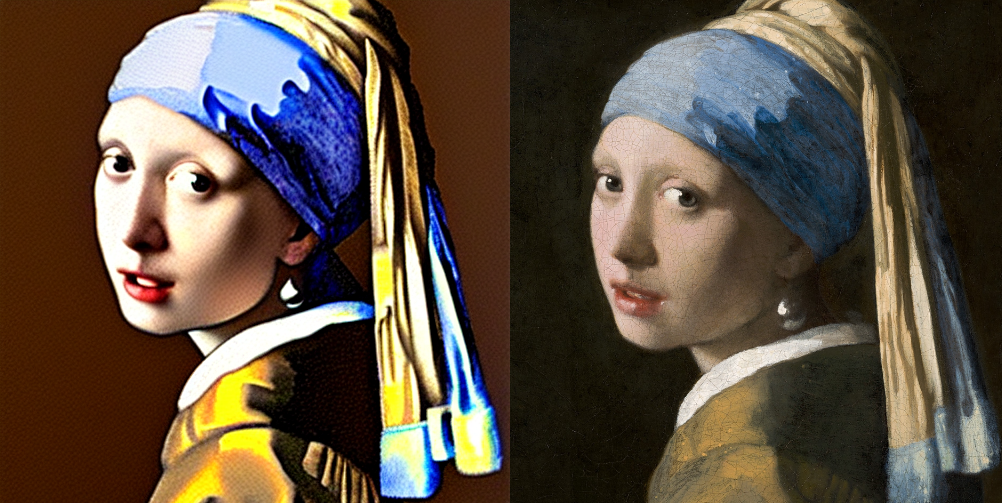
Left: “Girl with a Pearl Earring, by Johannes Vermeer” by Stable Diffusion Right: Girl with a Pearl Earring by Johannes Vermeer
This specific one is not copyright violation as it is old enough for copyright to expire. But the same may happen with other images.
from https://alexanderwales.com/the-ai-art-apocalypse/ and https://alexanderwales.com/addendum-to-the-ai-art-apocalypse...
If you “trace” another artists work the hammer comes down though. For Copilot it’s way easier to get it to obviously trace.
Left: “Girl with a Pearl Earring, by Johannes Vermeer” by Stable Diffusion Right: Girl with a Pearl Earring by Johannes Vermeer
This specific one is not copyright violation as it is old enough for copyright to expire. But the same may happen with other images.
from https://alexanderwales.com/the-ai-art-apocalypse/ and https://alexanderwales.com/addendum-to-the-ai-art-apocalypse...
Even if deduplication efforts are done, that painting will still be in the background of movie shots etc.
Stable Diffusion and DALL-E give a ton of power to individuals, hence why they are popular.
It feels like you're doing a cost analysis instead of a cost-benefit analysis, i.e. you're only looking at the negatives. It's a bit like saying cars are bad because they give more power to the big companies who sell them + put horse and buggy operators out of a job.
Code is only protected to the degree it is creative and not functionally driven anyway.
So the reduced band of possible expression often directly reduces the protectability-through-copyright.
Even that if done by a person as far as I understand it would not constitute a copyright infringement. It's a separate work mimicking Vermeer's original. The closest real world equivalent I can think of is probably the Obama Hope case by AP vs Shepard Fairy but that settled out of court so we don't really know what the status of that kind of reproduction is legally. On top of that though the SD image isn't just a recoloring with some additions like Fairy's was so it's not quite as close to the original as that case is.
Neither GPT nor Dall-e produces content that anyone can point to and say “they are laundering MY work”.
The closest we’ve been to that point is the image generators spitting out copyright watermarks, but they are not clearly attributable to any one single image (afaik).
I didn’t intend to argue anything or draw any conclusions. Just making an observation based on conversations with friends and coworkers.
The big difference is that cars were a tool that helped regular people by being a force multiplier. Stable Diffusion and DALL-E are not force multipliers in the same way. Sure, you may now produce images that you couldn't before, but there are far fewer profitable uses for images than for cars. Images don't materially affect the world, but cars can.
Yes, the way Copilot was trained was morally questionable, but probably legaly fine (Github terms of service).
There is no doubt the result is extremely helpful though.
That’s actually fine (kind of the idea of specifying a license). What is not fine is using that code in non-GPL licensed code.
We are talking ‘de facto’ here, not ‘de jure’. It may be legally problematic, but anything made public once is never going back in the box.
I can imagine Mona Lisa in my head, but it doesn't really "exist" verbatim in my head. It's only an approximation.
I believe copilot works the same way (?)
So much for “generation” - it seems as if these models are just overfitting on extremely small subset of input data that it did not utterly failed to train on, almost that there could be geniuses who would be able to directly generate weight data from said images without all the gradient descent thing.
So very similar to how the music industry treats sampling then?
Everybody using CoPilot needs to get "code sample clearance" from the original copyright holder before publishing their remix or new program that uses snippets of somebody else's code...
Try explaining _that_ to your boss and legal department.
"To: <all software dev> Effective immediately, any use of Github is forbidden without prior written approval from both the CTO and General Councel."
This was of course a leading question. The point was to get you to think about what artists did in response to the photograph. They changed the way they paint.
I'm positive that machine learning will also change the way that people create are and I am positive that it will only add to the rich tapestry of creative possibilities. There are still realistic portrait painters, after all, they're just not as numerous.
Without that context, fizzbuzz is not that different from a matrix transpose function to me.
[0] https://en.m.wikipedia.org/wiki/Quod_licet_Iovi,_non_licet_b...
Sometimes the original information is there in the model, encoded/compressed/however you want to look at it, and can be reproduced.
Don't worry. At that time all of the available hardware will refuse to run any software unless it comes with a signed license from one of the big three.
https://www.nytimes.com/2022/09/30/books/early-cormac-mccart...
I suppose whoever wants to pay the fees would “own” these things ?
If a small time artist has their work stolen, they probably won't be able to fight it very well. They might be able to get a few taken down, but the sheer number will make it impossible to keep up.
Disney, on the other hand, will have armies of lawyers going after any copyright violation.
It seems the same whether AI is involved or not.
Nonetheless that’s problematic for folks relying on the copyright as of now.
I feel for artists here, devs won’t go hungry or jobless.
Until there are a large amount of court cases, the burden of proof is on you to say that this is copyright infringement.
That sounds like a you problem, not a us problem.
As of yet, no court has said that any of this is illegal.
So tough luck. Go take it to the supreme court if you disagree, because right now it actually seems like people can do almost whatever they want with these AI tools.
Your objection simply doesn't matter, until there is a court case that supports you. You can't do anything about it, if that doesn't happen.
An example: https://twitter.com/DaveScheidt/status/1578411434043580416
> I also know software devs who are extremely excited about AI art and GPT-3 but are outraged by Copilot.
The fear is not unwarranted though. I can clearly see AI replacing most jobs (not just in tech) but art, crafts, music and even science. There probably will be no field untouched by AI in this decade and completely replaced by next decade.
We have multiple extinction events for humanity lined up: Climate Change, Nuclear Apocalypse and now AI.
We will have to not just work towards reducing harm to the Planet, but also work towards stopping meaningless Wars and figuring out how to deal with unemployment and economic crisis that is looming on the horizon. The only ones to suffer in the end would be the "elites" (or will they be the first depending on how quickly Civilization goes towards Anarchy?).
Can't say for sure. But definitely gloomy days ahead.
> Yes, many of us will turn into cowards when automation starts to touch our work, but that would not prove this sentiment incorrect - only that we're cowards.
>> Dude. What the hell kind of anti-life philosophy are you subscribing to that calls "being unhappy about people trying to automate an entire field of human behavior" being a "coward". Geez.
>>> Because automation is generally good, but making an exemption for specific cases of automation that personally inconvenience you is rooted is cowardice/selfishness. Similar to NIMBYism.
It's true cowardice to assume that our own profession should be immune from AI while other professions are not. Either dislike all AI, or like it. To be in between is to be a hypocrite.
For me, I definitely am on the side of full AI, even if it automates my job away, simply because I see AI as an advancing force on mankind.
Because you are right: a few, and a small time artist can fight. Hundreds and thousands of copies, or millions, and even Disney struggles. That's why Disney would go after the model itself; it scales better.
One of the reasons Roald Dahl was such a great writer is his life experiences. Read his books Boy and Solo.
Stable Diffusion actually has a similar problem. Certain terms that directly call up a particular famous painting by name - say, the Mona Lisa[0] - will just produce that painting, possibly tiled on top of itself, and it won't bother with any of the other keywords or phrases you throw at it.
The underlying problem is that the AI just outright forgets that it's supposed to create novel works when you give it anything resembling the training set data. If it was just that the AI could spit out training set data when you ask for it, I wouldn't be concerned[1], but this could also happen inadvertently. This would mean that anyone using Copilot to write production code would be risking copyright liability. Through the AI they have access to the entire training set, and the AI has a habit of accidentally producing output that's substantially similar to it. Those are the two prongs of a copyright infringement claim right there.
[0] For the record I was trying to get it to draw a picture of the Mona Lisa slapping Yoshikage Kira across the cheek
[1] Anyone using an AI system to "launder" creative works is still infringing copyright. AI does not carve a shiny new loophole in the GPL.
[1] https://en.wikipedia.org/wiki/SCO_Group,_Inc._v._Internation....
In my opinion the only thing that should be an infringement regarding code is copying entire non trivial files or entire projects outright.
A 100 line snippet should not be copyrighteable. Only the entire work, which you could think as the composition of many of those snippets.
The scenes à faire doctrine would certainly let you paint your own picture of a pretty girl with a large earring, even a pearl one. That, however, is definitely the same person, in the same pose/composition, in the same outfit. The colors are slightly off, but the difference feels like a technical error rather than an expressive choice.
"Copying" a style is not a derivative work:
> Why isn't style protected by copyright? Well for one thing, there's some case law telling us it isn't. In Steinberg v. Columbia Pictures, the court stated that style is merely one ingredient of expression and for there to be infringement, there has to be substantial similarity between the original work and the new, purportedly infringing, work. In Dave Grossman Designs v. Bortin, the court said that:
> "The law of copyright is clear that only specific expressions of an idea may be copyrighted, that other parties may copy that idea, but that other parties may not copy that specific expression of the idea or portions thereof. For example, Picasso may be entitled to a copyright on his portrait of three women painted in his Cubist motif. Any artist, however, may paint a picture of any subject in the Cubist motif, including a portrait of three women, and not violate Picasso's copyright so long as the second artist does not substantially copy Picasso's specific expression of his idea."
https://www.thelegalartist.com/blog/you-cant-copyright-style
For literally everything but music, yes.
Even by the standards of copyright technicality, music copyright is weird. For example, if you ask a lawyer[0] what parts of copyright set it apart from other forms of property law[1], they would probably answer that it's federally preempted[2] and that it has constitutionally-mandated term limits.
Which, of course, is why music has a second "recording copyright", which was originally created by states assigning perpetual copyright to sound recordings. I wish I was making this up.
So the musical arrangement that constitutes that song from 1640? Absolutely public domain. You can tell people how to play Monteverdi all damned day. But every time you record that song being played, that creates a new copyright on that recording only. This is analogous to how making a cartoon of a public-domain fairy tale gives you ownership over that cartoon only. Except because different performers are all trying to play the same music as perfectly as possible, the recordings will sound the same and trip a Content ID match.
Oh, and because music copyright has two souls, the Sixth Circuit said there's no de minimus for sampling. That's why sample-happy rap is dead.
If you want public domain music on your YouTube video you either record it yourself or license a recording someone else did. I think there are CC recordings of PD music but I'm not sure. Either way you'll also need to repeatedly prove this to YouTube staff that would much rather not have to defend you against a music industry that's been out for blood for half a century at this point.
[0] Who, BTW, I am very much NOT
[1] Yes, yes, I know I'm dangerously close to uttering the dangerous propaganda term "intellectual property". You can go back to bed Mr. Stallman.
[2] Which means states can't make their own supra-federal copyright law and any copyright suit immediately goes to federal court.
Now a human can take inspiration from like 100 different sources and probably end up with something that no one would recognize as derivative to any of them. But it also wouldn't be obvious that the human did that.
But with an ML model, it's clearly a derivative in that the learned function is mathematically derived from its dataset and so is all the resulting outputs.
I think this brings a new question though. Because till now derivative was kind of implied that the output was recognizable as being derived.
With AI, you can tweak it so the output doesn't end up being easily recognizable as derived, but we know it's still derived.
Personally I think what really matters is more a question of what should be the legal framework around it. How do we balance the interests of AI companies and that of developers, artists, citizens who are the authors of the dataset that enabled the AI to exist. And what right should each party be given?
It's similar to saying that any digital representation of an image isn't an image just a dataset that represent it.
If what you said was any sort of defense every image copyright would never apply to any digital image, because the images can be saved in different resolutions, different file formats, or encoded down. e.g. if a jpeg 'image' was only an image at an exact set of digital bits i could save it again with a different quality setting and end up with a different set of digital bits.
But everyone still recognises when an image looks the same, and courts will uphold copyright claims regardless of the digital encoding of an image. So goodluck with that spurious argument that it's not copyright because 'its on the internet (oh its with AI etc).
An example: a dyslexic friend and a dyslexic family member: their writing communication skills of both is now fine in part because their jobs required it from them (and in part because technology helps). I also had one illiterate friend, who has taught himself to read and write as an adult (basic written communication), due to the needs of his job. Learn by doing, and add observation of others as an adjunct to help you. Even better if you can get good coaching (which requires effort at your craft or sport).
Disclaimer: never a writer. Projecting from my other crafts/sports. Terribly written comment!
The reason doesn't really matter...
But the machine learning model has studied every single one of them.
And maybe more preposterous, if its dataset had no FizzBuzz implementation would it even be able to re-invent it?
I feel this is the big distinction that probably annoys people.
That and the general fact that everyone is worried it'll devalue the worth of an experienced developer as AI will make hard thing easier, require less effort and talent to learn and thus making developers less high demand and probably lower paid.
A broadcaster of copyrighted works is not protected against infringement just because they expect viewers to only watch programming they own.
This is a mostly irrelevant red herring setting up professions against each other. Instead we should cooperate on a costly yet necessary decision of instituting a basic income, especially prioritizing professions about to be superseded by modern ML.
Obviously, our decision-making class views the topic of instituting a realistic basic income right now as something extremely unpleasant, and so it goes.
People who helped to bootstrap the AI should be compensated, at the very least by being able to live a modest lifestyle without having to work. Simple as.
An artist should credit when they are directly taking from another artist. Erasure poems don’t quite work if the poet runs around claiming they created the poem that was being erased.
But more importantly SD allows you to take and use existing copyright works and funny-launder them and pass them off as your own, even though you don’t own the rights to that work. This would be more akin to I take a photograph you made and sell it on a t shirt on red bubble. I don’t actually own the IP to do that with.
Sounds like MS has devised a massive automated code laundering racket.
This means MS really shouldn't have used copyleft code at all, and really shouldn't be selling copilot in this state, but "luckily" for them, short of a class action suit I don't really see any recourse for the programmers who's work they're reselling.
(Sorry I didn't log my experiment results at the time. None of it was related to work I'd done - I used time adjustment functions if I remember correctly)
But anyway, how I see stable diffusion being different is that it's a tool to generate all sorts of images, including copyrighted images.
It's more like a database of *how to* generate images rather than a database *of* images. Maybe there isn't that much of a difference when it comes to copyright law. If you ask an artist to draw a copyrighted image for you, who should be in trouble? I'd say the person asking most of the time, but in this case we argue it's the people behind the pencil or whatever. Why? Because it's too easy? Where does a service like fiver stand here?
So if a tool is able to generate something that looks indistinguishable from some copyrighted artwork, is it infringing on copyright? I can get on board with yes if it was trained on that copyrighted artwork, but otherwise I'm not so sure.
Current AI is not replacing anything yet but I feel we are only a few years before AI can do a better job at drawing or programming than someone with years of practice. Sure, you can utilise those tools to stay ahead. But will AI prompt engineer be as emotionally satisfying as drawing for real?
To make it concrete, imagine the latest Disney movie poster. You redraw it 95% close to the original, just changing the actual title. Then you sell your poster on Amazon at half the price of the actual poster. Would you get a copyright strike ?
I have to assume this is just people being protective of their own profession and consequently, setting up a high bar for what constitutes as performance in that profession.
Oh, actually I remember now -- I think the copyright complaint specifically said what recording they thought I was infringing, and it was the correct piece.
The interesting part is if AI will be considered a tooling mechanism much like the tooling used to record and manipulate a music sample into a new composition.
It is current at the SCOTUS so we should see a ruling for the USA sometime in the next year or so.
https://en.m.wikipedia.org/wiki/Andy_Warhol_Foundation_for_t...
Obviously, that would not entitle anyone to rip those elements from your work and use them in a way that was not fair use. The Getty watermark could fall into this category: public domain pictures using the watermark fairly (for transformative commentary/satire purposes) could go into the network, which uses that information to produce infringing images.
Trademarks are a different story, but trademark protections are a lot narrower than you might think.
The point is that it's very conceivable that the neural network is being trained to infringe copyrights by training entirely with public-domain images.
Warhol’s estate seems likely to lose and their strongest argument is that Warhol took a documentary photo and transformed it into a commentary on celebrity culture. Here, I don’t even see that applying: it just looks like a bad copy.
https://www.scotusblog.com/2022/10/justices-debate-whether-w...
As GP says, no one really cares, but it seems hard to satisfy SA... even if you are pasting into open source, is your license compatible with CC?
Perhaps I'm over-thinking this.
This is why we have a market. We let billions of individuals vote on what they think is useful or not, in real-time, multiple times a day, every day. If AI-generated images are less desirable than what came before, then people won't use them or pay to use them in the long run. They'll die like other flash-in-the-pan fads have died, artists will retain their jobs en masse, and OpenAI won't gain much if any power.
The entire idea of the market is to ensure that if some entity is gaining money/power, that's happening as a result of it providing some commensurate good to the people. And if that's not happening, or if the power is too great, that's why we have laws and regulatory bodies.
The main problem I see with generating attribution is that the algorithm obviously doesn't "know" that it's generating identical code. Even in the original twitter post, the algorithm makes subtle and essentially semantically synonymous changes (like the changing the commenting style). So for all intents and purposes it can't attribute the function because it doesn't know _where_ it's coming from and copied code is indistinguishable from de novo code. Copilot will probably never be able to attribute code short of exhaustively checking the outputs using some symbolical approach against a database of copyleft/copyrighted code.
It is, yes. For example, a neural network can't invent a new art style on its own, or at least existing models can't, they can only copy existing art styles, invented by humans.
It looks like it wouldn't in the UK, probably wouldn't in the US but would in Germany. The cases seem to hinge on the level of intellectual creativity of the photograph involved. The UK said that trying to create an exact copy was not an original endeavour whereas Germany said the task of exact replication requires intellectual/technical effort of it's own merit.
https://www.theipmatters.com/post/are-photographs-of-public-...
This stance allows me to do whatever do I want with any software or work you put out there, regardless of the license you attach to it, since it's your problem, not mine.
However, this is not the mode I operate ethically.
> As of yet, no court has said that any of this is illegal.
I assume this will be tested somehow, sometime. So I'm investing in popcorn futures.
> Your objection simply doesn't matter, until there is a court case that supports you. You can't do anything about it, if that doesn't happen.
You know, this goes both ways. Same will be very valid for your works, through your own reasoning.
I'm not claiming that they did. What I said is, Copilot emitted the exact implementation in IDs repository, incl. all comments and everything.
> But your reasoning boils down to I don't like it so it mustn't be that way. That's never been necessarily true.
If you interpret my comment with that depth and breadth, I can only say that you are misinterpreting completely. It's not about my personal tastes, it's about ethical frameworks and social contracts.
> At any rate piracy is rampant so clearly a large body of people don't think even a direct copies is morally wrong. Let alone something similar.
I believe if you listen to a street musician for a minute, you owe them a dollar. Scale up from there. BTW, I'm a former orchestra player, so I know what making and performing music entails.
> You're acting as though there are constant won and lost cases over plagiarism. Ed Sheeran seems to defend his work weekly. Every case that goes to court means reasonable minds differ on the interpretation of plagiarism legally.
When there's a strict license on how a work can be used, and the license is violated, it's a clear case. That AI is just a derivation engine, and the license that derivations carry the same license. I don't care if you derive my code. I care you derive my code and hide the derivations from public.
It's funny that you're defending close-souring free software at this point. This is a neat full-circle.
> So what's your point?
All research and science should be ethical. AI research is not something special which allows these ethical norms and guidelines (which are established over decades if not centuries) to be suspended. If medicine people act with quarter of this lassiez faire attitude, they'd be executed with a slow death. If security researchers act with eighth of this recklessness, their career are ruined.
> That's all you got to hold back the tide of AI?
As I aforementioned, I'm not against AI. It just doesn't excite me as a person who knows how it works and what it does, and the researchers' attitude is leaving a bad taste in my mouth.
Actually, no it doesn't. This topic is about AI training on code.
Courts have not held that this is illegal.
But there are absolutely other things, that people might do with code, that break copyright law.
> it's your problem, not mine.
Oh, but it would be your problem as well, if you break the law, and someone else sues you for it.
That's the difference. AI training is not against the law. Other things, that you are imagining in your head right now, very well could be, and you could lose.
> Same will be very valid for your works
Not if what you are hypothetically doing breaks the law, and AI training doesn't break the law.
So that the difference, which makes the reasoning legitimate.
Actually yes. I'm not against the tech. I'm against using my code without consent for a tool which allows to breach the license I put my code under.
IOW, if Copilot understood code licenses and prevented intermixing incompatibly licensed code while emitting results for my repository, I might have slightly different stance on the issue.
I tried out of curiosity. Here[1] are the first 8 images that came up with the prompt "Disney mickey mouse" using the stable diffusion V1.4 model. Personally I don't really see why Disney or any other company would take issue with the image generation models, it just seems more or less like regular fan art.
Laws are just codified version of ethics. Just because it's not codified in law, it doesn't mean it's ethically correct, and I hold ethics over laws. Some people call this conscience, others call this honor.
Just because it's not deemed illegal, it's not deemed ethical. These are different things. The world has worked under honor and ethical codes for a very long time, and still works under these unwritten laws in a lot of areas.
Science, software and other frontiers value ethics and principles a great deal. Some niches like AI largely ignore these, and I find this disturbing.
However, some people prefer to play the game with the written rules only, and as I said, I'm investing in popcorn futures to see what's gonna happen to them.
I might tank and go bankrupt of course, but I will sleep better at night for sure, and this is more important for me at the end.
I'm passionate about computers, yes. This is also my job, yes, but I'm not the person who'll do reckless things just because an incomplete code of written ethics doesn't prevent me to do it.
I'd rather not do anything to anyone which I don't want to receive. IOW, I sow only the seeds which I want to reap.
The issue is in how it creates the output. Both Dalle and Copilot can work only by taking work of people in past, sucking up their earned know how and creations and remixing it. All that while not crediting (or paying) anyone. The software itself might be great but it only works because it was fed with loads of quality material.
It's smart copy&paste with obfuscation. If thats ok legally. You can imagine soon it could be used to rewrite whole codebases while avoiding any copyright. All the code will technically be different, but also the same.
It’s not satisfying to painstakingly work on something that I could have generated with an AI in seconds.
And a quite reasonable code of ethics is thst people do not have absolute, complete control over their intellectual property, and instead only have the ability to control it in certain circumstances.
Things like fair use, which makes this legal, exists for many very good reasons.
So yes, the code of ethics that society has decided on, includes perfectly reasonable exception, such as fair use, and it is your problem, not ours, that you have some ridiculous idea that people should have complete, 100% authoritarian control over their IP.
And no, people not having infinite control over IP, does not allow you to extend this reasonable exception, to you being able to do literally anything to other people's IP.
What I say with the GPL license is clear:
If you derive anything from this code base, you're agreeing and obliged to carry this license to the target code base (The logical unit in this case is a function in most cases).
So the case is clear. AI is a derivation engine. What you obtain is a derivation of my GPL licensed code. Carry the license, or don't use that snippet, or in AI's case, do not emit GPL derived code for non-GPL code bases.
This is all within the accepted ethics & law. Moreover, it's court tested too.
People are not agreeing though.
They are not agreeing, because there is a perfectly reasonable ethical and legal principle called fair use, which society has determined allows people to engage in limited use of other people's IP, no matter what the license says.
> Carry the license, or don't use
Or, instead of that, people could reasonably use fair use, and ignore the license, as fair use exists for many good legal and ethical reasons.
And no, you do not get to extend that out, to doing anything you want to do, just because there is a reasonable exception called fair use.
> do not emit GPL derived code for non-GPL code bases
Or, actually, yes do this. This is allowed because of the reasonable ethical and moral principle called fair use, which allows people to ignore your license.
On the subject of trademarks the issue is as far as I know even more on the end user because the protections on them is around use in commerce and consumer confusion not about just recreating them like copyright protections.
Thanks for the discussion, and have a nice day.
I may not further comment on this thread from this point.
Copilot on Python makes me x5 more productive. I used Copilot in Beta for a year and continue paying for it now.
For example: I can make a command line data wrangling script for a novel data set in a few minutes with a few prompts with full complement of extras (proper argparse parameters with sane defaults, ready to import etc etc). # reasonable comments included for free as well
Before copilot I could do the same in about 20-30minutes but my code would be a mess with little commenting. I would spend 30-60 minutes just looking up docs for various libraries.
Now without Copilot, if all I was doing was writing data wrangling scripts 4 hours a day I could approach this Copilot like productivity for a single task.
However with Copilot I can switch problem domains very quickly and remain productive.
Interestingly, on something like CSS or Javascript - Copilot is helping only slightly, maybe because my local training set is insufficient and my web-dev prompts are too generic.
So I think AI can be fantastic force multiplier in a skillset that you already are reasonably familiarity. I can handle the 5-10% wtf Python code that Copilot produces.
I do not particularly like copyrights and do wish Copilot had been trained on private Microsoft code as well.
This is the problem of applying the idea of ownership to ideas and expression like art. Art in particular is a very remix and recombination driven field.
Huh? "Legal universal agreement" has never been required to push something to the fringes in a particular country.
If (in the US) these models were declared to be copyright infringement, or the users were required to pay license feeds to the creators of the data that was used to build the models, they will vanish from the public sphere. GitHub/Microsoft's legal department will pull Copilot down immediately, and development will effectively cease. No US company will sponsor development, and no company will allow in-house use. It will be dead.
Some dude might still run the model in his bedroom in his spare time on his own hardware, but that's what irrelevance looks like.
> And as computers get more powerful and the models get more efficient it'll become easier and easier to self host and run them on your own dime. There are already one click installers for generative models such as stable diffusion that run on modest hardware from a few years back.
If that's the only way you can run something, because it's illegal, you're describing a fringe technology right there.
The fantasy is the idea that doing what you describe will matter.
My real worry is downstream infringement risk, since fair use is non-transitive. Microsoft can legally provide you a code generator AI, but you cannot legally use regurgitated training set output[1]. GitHub Copilot is creating all sorts of opportunities to put your project in legal jeopardy and Microsoft is being kind of irresponsible with how they market it.
[0] Note that we're assuming published work. Doing the exact same thing Microsoft did, but on unpublished work (say, for irony's sake, the NT kernel source code) might actually not be fair use.
[1] This may give rise to some novel inducement claims, but the irony of anyone in the FOSS community relying on MGM v. Grokster to enforce the GPL is palpable.
Also, register your code with the copyright office.
Edit: Apparently, with the #1 post on HN right now, you could also just go here: https://githubcopilotinvestigation.com/
This specific one would not be a problem, but doing it with a still copyrighted work would be.