For example, I know artists who are vehemently against DALL-E, Stable Diffusion, etc. and regard it as stealing, but they view Copilot and GPT-3 as merely useful tools. I also know software devs who are extremely excited about AI art and GPT-3 but are outraged by Copilot.
For myself, I am skeptical of intellectual property in the first place. I say go for it.
When Microsoft steals all code on their platform and sells it, they get lauded. When "Open" AI steals thousands of copyrighted images and sells them, they get lauded.
I am skeptical of imaginary property myself, but fuck this one set of rules for the poor, another set of rules for the masses.
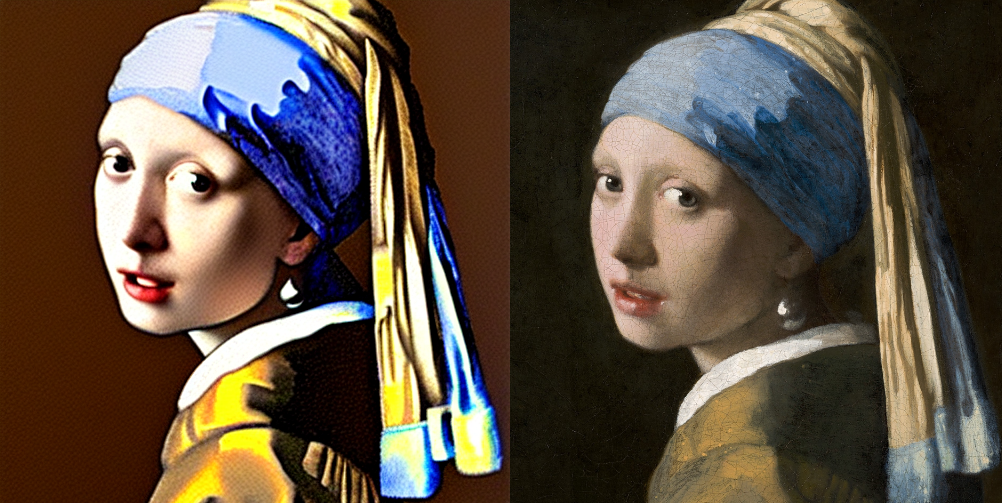
I haven't been following super closely but I don't know of any claims or examples where input images were recreated to a significant degree by stable diffusion.
Left: “Girl with a Pearl Earring, by Johannes Vermeer” by Stable Diffusion Right: Girl with a Pearl Earring by Johannes Vermeer
This specific one is not copyright violation as it is old enough for copyright to expire. But the same may happen with other images.
from https://alexanderwales.com/the-ai-art-apocalypse/ and https://alexanderwales.com/addendum-to-the-ai-art-apocalypse...
Even that if done by a person as far as I understand it would not constitute a copyright infringement. It's a separate work mimicking Vermeer's original. The closest real world equivalent I can think of is probably the Obama Hope case by AP vs Shepard Fairy but that settled out of court so we don't really know what the status of that kind of reproduction is legally. On top of that though the SD image isn't just a recoloring with some additions like Fairy's was so it's not quite as close to the original as that case is.
It is current at the SCOTUS so we should see a ruling for the USA sometime in the next year or so.
https://en.m.wikipedia.org/wiki/Andy_Warhol_Foundation_for_t...