You put it as a remix, but remixes are credited and expressed as such.
I don’t see Midjourney (et al) as remixes, myself. More like “inspired by.”
Its all the same they just dont realize this.
https://twitter.com/ebkim00/status/1579485164442648577
Not sure if this was fed the original image as an input or not.
Also seen a couple cases where people explicitly trained a network to imitate an artist's work, like the deceased Kim Jung Gi.
I think over time we are going to see the following:
- If you take say a star wars poster, and inpaint in a trained face over luke's, and sell that to people as a service, you will probably be approached for copyright and trademark infringement.
- If you are doing the above with a satirical take, you might be able to claim fair use.
- If you are using AI as a "collage generator" to smash together a ton of prompts into a "unique" piece, you may be safe from infringement but you are taking a risk as you don't know what % of source material your new work contains. I'd like to imagine if you inpaint in say 20 details with various sub-prompts that you are getting "safer".
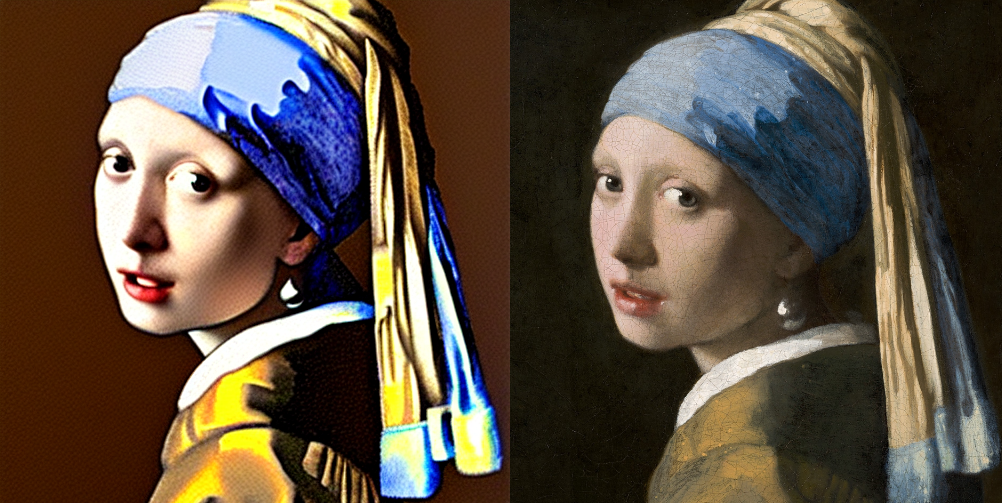
Left: “Girl with a Pearl Earring, by Johannes Vermeer” by Stable Diffusion Right: Girl with a Pearl Earring by Johannes Vermeer
This specific one is not copyright violation as it is old enough for copyright to expire. But the same may happen with other images.
from https://alexanderwales.com/the-ai-art-apocalypse/ and https://alexanderwales.com/addendum-to-the-ai-art-apocalypse...
I can imagine Mona Lisa in my head, but it doesn't really "exist" verbatim in my head. It's only an approximation.
I believe copilot works the same way (?)
So much for “generation” - it seems as if these models are just overfitting on extremely small subset of input data that it did not utterly failed to train on, almost that there could be geniuses who would be able to directly generate weight data from said images without all the gradient descent thing.
Sometimes the original information is there in the model, encoded/compressed/however you want to look at it, and can be reproduced.
The scenes à faire doctrine would certainly let you paint your own picture of a pretty girl with a large earring, even a pearl one. That, however, is definitely the same person, in the same pose/composition, in the same outfit. The colors are slightly off, but the difference feels like a technical error rather than an expressive choice.
It's similar to saying that any digital representation of an image isn't an image just a dataset that represent it.
If what you said was any sort of defense every image copyright would never apply to any digital image, because the images can be saved in different resolutions, different file formats, or encoded down. e.g. if a jpeg 'image' was only an image at an exact set of digital bits i could save it again with a different quality setting and end up with a different set of digital bits.
But everyone still recognises when an image looks the same, and courts will uphold copyright claims regardless of the digital encoding of an image. So goodluck with that spurious argument that it's not copyright because 'its on the internet (oh its with AI etc).
But anyway, how I see stable diffusion being different is that it's a tool to generate all sorts of images, including copyrighted images.
It's more like a database of *how to* generate images rather than a database *of* images. Maybe there isn't that much of a difference when it comes to copyright law. If you ask an artist to draw a copyrighted image for you, who should be in trouble? I'd say the person asking most of the time, but in this case we argue it's the people behind the pencil or whatever. Why? Because it's too easy? Where does a service like fiver stand here?
So if a tool is able to generate something that looks indistinguishable from some copyrighted artwork, is it infringing on copyright? I can get on board with yes if it was trained on that copyrighted artwork, but otherwise I'm not so sure.
To make it concrete, imagine the latest Disney movie poster. You redraw it 95% close to the original, just changing the actual title. Then you sell your poster on Amazon at half the price of the actual poster. Would you get a copyright strike ?
Warhol’s estate seems likely to lose and their strongest argument is that Warhol took a documentary photo and transformed it into a commentary on celebrity culture. Here, I don’t even see that applying: it just looks like a bad copy.
https://www.scotusblog.com/2022/10/justices-debate-whether-w...
It looks like it wouldn't in the UK, probably wouldn't in the US but would in Germany. The cases seem to hinge on the level of intellectual creativity of the photograph involved. The UK said that trying to create an exact copy was not an original endeavour whereas Germany said the task of exact replication requires intellectual/technical effort of it's own merit.
https://www.theipmatters.com/post/are-photographs-of-public-...
The issue is in how it creates the output. Both Dalle and Copilot can work only by taking work of people in past, sucking up their earned know how and creations and remixing it. All that while not crediting (or paying) anyone. The software itself might be great but it only works because it was fed with loads of quality material.
It's smart copy&paste with obfuscation. If thats ok legally. You can imagine soon it could be used to rewrite whole codebases while avoiding any copyright. All the code will technically be different, but also the same.
This is the problem of applying the idea of ownership to ideas and expression like art. Art in particular is a very remix and recombination driven field.
This specific one would not be a problem, but doing it with a still copyrighted work would be.