This is what you get when you build with AI, an electron app with an input field.
This is just bad product management.
I guess you get an Electron app if you don't prompt it otherwise. Probably because it's learned from what all the humans are putting out there these days.
That said.. unless you know better, it's going to keep happening. Even moreso when folks aren't learning the fundamentals anymore.
- UE5 has its own custom UI framework, which definitely does not feel "native" on any platform. Not really any better than Electron.
- You can easily call native APIs from Electron.
I agree that Electron apps that feel "web-y" or hog resources unnecessarily are distasteful, but most people don't know or care whether the apps they're running use native UI frameworks, and being able to reassign web developers to work on desktop apps is a significant selling point that will keep companies coming back to Electron instead of native.
LLM output is called slop for a reason.
A full fledged app, that does everything I want, is ~ 10MB. I know Tauri+Rust can get it to probably 1 MB. But it is a far cry from these Electron based apps shipping 140MB+ . My app at 10MB does a lot more, has tons of screens.
Yes, it can be vibe coded and it is especially not an excuse these days.
Microsoft Teams, Outlook, Slack, Spotify? Cursor? VsCode? I have like 10 copies of Chrome in my machine!
All I see is hype blog posts and pre-IPO marketing by AI companies, not much being shipped though.
On MacOS is much better. But most of the team either ended up with locked in Mac-only or go cross platform with Electron.
One of Electron's main selling points is that you control the browser version. Anything that relies on the system web view (like Tauri and Wails) will either force you to aggressively drop support for out-of-date OS versions, or constantly check caniuse.com and ship polyfills like you're writing a normal web app. It also forces you to test CSS that touches form controls or window chrome on every supported major version of every browser, which is just a huge pain. And you'll inevitably run into bugs with the native -> web glue that you wouldn't hit with Electron.
It is absolutely wasteful to ship a copy of Chrome with every desktop app, but Tauri/Wails don't seem like viable alternatives at the moment. As far as I can tell, there aren't really any popular commercial apps using them, so I imagine others have come to the same conclusion.
May be an app that is as complex as Outlook needs the pixel-perfect tweaking of every little button that they need to ship their own browser for exact version match. But everything else can use *system native browser*. Use Tauri or Wails or many other solutions like these
That said, I do agree on the other comments about TUIs etc. Yes, nobody cares about the right abstractions, not even the companies that literally depend on automating these applications
Edit: I'm not going to keep addressing your comment if you keep editing it. You asked for an example & I found two very easily. I am certain there are many others so at this point the onus is on you to figure out what exactly it is you are actually arguing.
I've got a medical doctor handwriting decipherer, a board game simulator that takes a PDF of the rulebooks as input and an accounting/budgeting software that can interface with my bank via email because my bank doesn't have an API.
None of that is of any use to you. If you happen to need a similar software, it will be easier for you to ask your own AI to make a custom one for you rather than adapt the ones I had my AI make for me.
Under the circumstances, I would feel bad shipping anything. My users would be legitimately better off just vibe coding their own versions.
You don't need to use microsoft's or apple's or google's shit UI frameworks. E.g. see https://filepilot.tech/
You can just write all the rendering yourself using metal/gl/dx. if you didn't want to write the rendering yourself there are plenty of libraries like skia, flutter's renderer, nanovg, etc
But sure, you could have some specific need, but I find it hard to believe for these simple apps.
E.g. just say "write a c++ gui widget library using dx11 and win32 and copy flutters layout philosophy, use harfbuzz for shaping, etc etc"
I insist on good UI as well, and, as a web developer, have spent many hours hand rolling web components that use <canvas>. The most complicated one is a spreadsheet/data grid component that can handle millions of rows, basically a reproduction of Google Sheets tailored to my app's needs. I insist on not bloating the front-end package with a whole graph of dependencies. I enjoy my NIH syndrome. So I know quality when I see it (File Pilot). But I also know how tedious reinventing the wheel is, and there are certain corners that I regularly cut. For example there's no way a blind user could use my spreadsheet-based web app (https://github.com/glideapps/glide-data-grid is better than me in this aspect, but there's no way I'm bringing in a million dependencies just to use someone else's attempt to reinvent the wheel and get stuck with all of their compromises).
The answer to your original question about why these billion dollar companies don't create artisanal software is pretty straightforward and bleak, I imagine. But there are a few actually good reasons not to take the artisanal path.
c Do this programming task for me.
You will be outcompeted if you waste your time reinventing the wheel and optimizing for stuff that doesn't matter. There is some market for highly optimized apps like e.g. Sublime Text, but you can clearly see that the companies behind them are struggling.
For example, I tried opening a 200MB log file in Apple's Console.app and it hung. Opened right up in VS Code.
It would be nice if someone made a way to write desktop apps in JavaScript with a consistent, cross-platform modern UI (i.e. swipe to refresh, tabs, beautiful toggle switches, not microscopic check boxes) but without resorting to rendering everything inside a bloated WebKit browser.
Would genuinely love your thoughts if you try it. Early users have been surprised by how native it feels!
The second example is twitter post of a crypto bro asking people to build something using his crypto API. Nothing shipped.
Literally nothing shipped, just twitter posts of people selling a coding bootcamp and crypto.
That's only for Windows though, it seems? Maybe the whole "just write all the rendering yourself using metal/gl/dx" is slightly harder than you think.
Use native for osx Use .Net framework for windows Use whatever on Linux.
Its just being lazy and ineffective. I also do not care about whatever "business" justification anyone can come up with for half assing it.
No-one outside of a small sliver of the tech community cares if an app is built with web tech
Electron also opens up easier porting to Linux which almost certainly wouldn't happen if companies insist on native only
Even a full-featured TUI like Claude Code is highly limited compared to a visual UI. Conversation branching, selectively applying edits, flipping between files, all are things visual UI does fine that are extremely tedious in TUI.
Overall it comes down to the fact that people have to use TUI and that’s more important than it being easy to train, and there’s a reason we use websites and not terminals for rich applications these days.
I use web-tech apps because I have to, and because they're adequate, not because it's an optimal user experience.
When was the last time complaining about this did anything?
They do, but they don't know what's causing it. 8GB of RAM usage for Codex App is clown-level ridiculous.
Even though OpenAI has a lot of cash to burn, they're not in a good position now and getting butchered by Anthropic and possibly Gemini later.
If any major player in this AI field has the power to do it's probably Google. But again, they've done the Flutter part, and the result is somewhat mixed.
At the end of the day, it's only HN people and a fraction of Redditors who care. Electron is tolerated by the silent majority. Nice native or local-first alternatives are often separate, niche value propositions when developers can squeeze themselves in over-saturated markets. There's a long way before the AI stuff loses novelty and becomes saturated.
I see complains about RAM and slugginess against Slack and countless others Electron apps every fucking day, same as with Adobe forcing web rendered UI parts in Photoshop, and other such cases. Forums are full of them, colleagues always complain about it.
> You will be outcompeted if you waste your time reinventing the wheel and optimizing for stuff that doesn't matter. There is some market for safe, environmentally-friendly products, but you can clearly see that the companies that make them are struggling.
ok.
That is not correct. One of the major selling points of Electron is precisely that you can call native APIs.
(I was a swing developer for several years)
Shock horror, the waste adds up, and it adds up extremely quickly.
Atlassian products are a great example of this. Everyone knows Atlassian has garbage performance. Everyone complains about it. Never gets fixed though. Everyone I know could write customer complaints about its performance in every feedback box for a year, and the only thing that would happen is that we’d have wasted our own time.
Users _care_ about this stuff. They just aren’t empowered to feedback about it, or are trained to just sigh and put up with it.
getting it out now suggests there are structural problems about how decisions get made and code gets shipped—and the "iterate faster" line feels misplaced
- Good cross platform support (missing in filepilot)
- Want applications to feel native everywhere. For example, all the obscure keyboard shortcuts for moving around a text input box on mac and windows should work. iOS and Android should use their native keyboards. IME needs to work. Etc
- Accessibility support for people who are blind and low vision. (Screen readers, font scaling, etc)
- Ergonomic language bindings
Hitting these features is more or less a requirement if you want to unseat electron.
I think this would be a wonderful project for a person or a small, dedicated team to take on. Its easier than it ever used to be thanks to improvements in font rendering, cross platform graphics libraries (like webgpu, vulcan, etc) and improvements in layout engines (Clay). And how much users have dropped their standards for UI consistency ever since electron got popular and microsoft gave up having a consistent UI toolkit in windows.
There are a few examples of teams doing this in house (eg Zed). But we need a good opensource project.
I think most people start off overusing these tools, then they find the few small things that genuinely improve their workflows which tend to be isolated and small tasks.
Moltbot et al, to me, seems like a psyop by these companies to get token consumption back to levels that justify the investments they need. The clock is ticking, they need more money.
I'd put my money on token prices doubling to tripling over the next 12-24 months.
There should be no excuses! Figure it out!
Thanks for contributing to the obsolescence cycle.
do you think i as a software engineer like using Jira? Outlook? etc? Heck even the trendy stuff is broken. Anthropic took took 6 months to fix a flickering claude code. -_-
Chinese open weights models make this completely infeasible.
They're only doing well because of their illegal monopolistic practices not being cracked down on.
Obsidian is an Electron app which is pretty much universally loved. We can both give single examples
Anthropic and OpenAI could open source their models and it wouldn't make it any cheaper to run those models.. You still need $500k in GPUs and a boatload of electricity to serve like 3 concurrent sessions at a decent tok/ps.
There are no open source models, Chinese or otherwise that are going to be able to be run profitably and give you productivity gains comparable to a foundation model. No matter what, running LLMs is expensive and the capex required per tok/ps is only increasing, and the models are only getting more compute intensive.
The hardware market literally has to crash for this to make any sense from a profitability standpoint, and I don't see that happening, therefor prices have to go up. You can't just lose billions year after year forever. None of this makes sense to me. This is simple math but everyone is literally delusional atm.
https://openrouter.ai/moonshotai/kimi-k2.5
It's a fantasy to believe that every single one of these 8 providers is serving at incredibly subsidized dumping prices 50% below cost and once that runs out suddenly you'll pay double for 1M of tokens for this model. It's incredibly competitive with Sonnet 4.5 for coding at 20% of the token price.
I encourage you to become more familiar with the market and stop overextrapolating purely based on rumored OpenAI numbers.
How far from grace we have fallen :sob:
That's an incredibly bold claim that would need quite a bit of evidence, and just waving "$500k in gpus" isn't it. Especially when individuals are reporting more than enough tps at native int4 with <$80k setups, without any of the scaling benefits that commercial inference providers have.
The product people are building things, but OpenAI has literally been throwing stuff at the wall and it hasn't been sticking. They seem to be behind in terms of everything user interface. Canvas came after Anthropic had artifacts. Codex came after Anthropic had Claude Code.
Some of their researchers (okay one) have (has) stated they believe in interface work. That's because GUIs help engage the person beyond thought, and help the person work with more complexity (perception, physics, form, 3D). But they're playing catchup, or they're trying to incubate wins in science / math.
I haven't touched desktop application programming in a very long time and I have no desire to ever do so again after trying to learn raw GTK a million years ago, so I'm admittedly kind of speaking out of my ass here.
This is a new era where “if it works more or less well, ux/dx is fine, let’s ship it” has more moat than ever. Everything else is really secondary.
There's plenty of competition for VSCode too.
Don't forget that these Electron apps outcompeted native apps. Figma and VSCode were underdogs to native apps at one point. This is why your supply side argument doesn't make any sense.
Who told you that? You can write entire C libraries and call them from Electron just fine. Browser is a native application after all. All this "native applications" debate boils down to the UI implementation strategy. Maintaining three separate UI stacks (WinUI, SwiftUI, GTK/Qt) is dramatically more expensive and slower to iterate on than a single web-based UI with shared logic
We already have three major OSes, all doing things differently. The browsers, on the other hand, use the same language, same rendering model, same layout system, and same accessibility layer everywhere, which is a massive abstraction win.
You don't casually give up massive abstraction wins just to say "it's native". If "just build it natively" were actually easier, faster, or cheaper at scale, everyone would do just that.
But there isn't, not if you include all the extensions and remember the price
What a weird comparison, one is free, another one is a premium app, of course a lot of people prefer some suffering over paying money
> reinventing the wheel
what exactly are you inventing by using a framework "invented" decades ago and used by countless apps in all those years?
You reduce development effort by a third, it is ok to debate whether a company so big should invest into a better product anyway but it is pretty clear why they are doing this
If it was a hindrance, why did it win?
Seems clear to me that Electron's higher RAM usage did not affect adoption. Instead, Electron's ability to write once and ship in any platform is what allowed VSCode to win.
No, differently
> If it was a hindrance, why did it win?
Because reality is not as primitive as you portray it to be, you can have hindrances and boosts with the overall positive even winning effect? That shouldn't be that hard!
> Seems clear to me that Electron's higher RAM usage did not affect adoption.
Again, it only seems clear because you ignore all the dirt, including basic things (like here, it's not just ram, is disk use, startup speed, but also like before with competition) and strangely don't consider many factors.
> Instead, Electron's ability to write once and ship in any platform is what allowed VSCode to win.
So nothing to do with it using the most popular web stack, meaning the largest pool of potential contributors to the editor or extensions??? What about other cross platform frameworks that also allowed that??? (and of course it's not any platform, just 3 desktop ones where VSc runs)
I don't quite understand the obsession with shipping fancy enterprise b2b saas solutions. That was the correct paradigm for back when developing custom code was expensive. Now it is cheap.
Why pay for Salesforce when you only use 1% of Salesforce's features? Just vibe code the 1% of features that you actually need, plus some custom parts to handle some cursed bespoke business logic that would be a pain in the ass to do in Salesforce anyway.
Done by the company which sells software which is supposed to reduce it tenfold?
Qt is also pretty memory-hungry; maybe rich declarative (QML) skinnable adaptable UIs with full a11y support, etc just require some RAM no matter what. And it also looks a wee bit "non-native" to purists, except on Windows, where the art of uniform native look is lost.
Also, if you ever plan extensions / plugin support, you already basically have it built-in.
Yes, a Qt-based program may be wonderfully responsive. But an Electron-based app can be wonderfully responsive, too. And both can feel sluggish, even on great hardware. It all depends on a right architecture, on not doing any (not even "guaranteed fast") I/O in the GUI thread, mostly. This takes a bit of skill and, most importantly, consideration; both are in short supply, as usual.
The biggest problem with Electron apps is their size. Tauri, which relies on the system-provided web view component, is the reasonable way.
That’s actually why we're working on Slint (https://slint.dev): It's a cross-platform native UI toolkit where the UI layer is decoupled from the application language, so you can use Rust, JavaScript, Python, etc. for the logic depending on what fits the project better.
So nothing to do with it using the most popular web stack, meaning the largest pool of potential contributors to the editor or extensions??? What about other cross platform frameworks that also allowed that??? (and of course it's not any platform, just 3 desktop ones where VSc runs)
Are you arguing that Electron helped VSCode win or what? Because Electron being able to use a popular web stack is also a benefit.
What is your point?
Value is value, and levers are levers, regardless of the resources you have or the difficulty of the problem you're solving.
If they can save effort with Electron and put that effort into things their research says users care about more, everyone wins.
The fact that we did this as a 1-man team for the GUI and that I can still compile it today (if I had the code) against wxWidgets, to then run on macOS and Windows simply shows the lazy nature of (most/all?) desktop apps by big companies these days.
I utterly detest using them, but it seems customers think an app that takes 5 seconds to launch with a spinning whirly wheel and horizontal gradient animation over list views for 5+ seconds before content is loaded is perfectly acceptable. Quality with a capital K!
It's weird that we don't have a unified "React Native Desktop" that would build upon the react-native-windows package and add similar backends for MacOS and Linux. That way we could be building native apps while keeping the stuff developers like from React.
Nothing is worse than reading something like this. A good software developer cares. It’s wrong to assume customers don't care simply because they don't know what's going on under the hood. Considering the downsides and the resulting side effects (latency, more CPU and RAM consumption, fans spinning etc.), they definitely do care. For example, Microsoft has been using React components in their UI, thinking customers wouldn’t care, but as we have been seeing lately, they do care.
I'm not saying this is a huge problem for me even if it bothers me personally. But if you're here on HN advocating native over Electron, then it seems logical to me that you would care about being truly native instead of merely "using native controls while feeling off".
This is even before getting to the point that Qt isn't truly native. They just draw controls in a style that looks native, they don't actually use native controls. wxWidgets uses native controls but they don't behave better despite that.
It's not about money. It's not a tradeoff in cost vs quality - it's a tradeoff in development speed. Shipping N separate native versions requires more development time for any given change: you must implement everything (at least every UI) N times, which drastically increases the design & planning & coordination required vs just building and shipping one implementation.
Do you want to move slower to get "native feel", or do you want to ship fast and get N times as much feature dev done? In a competitive race while the new features are flowing, development speed always wins.
Once feature development settles down, polish starts to matter more and the slowdown becomes less important, and then you can refocus.
For teams comfortable with C++ or with existing C++ libraries to integrate, it can of course still be a strong choice, just not the preferred one for most current teams.
Value prop of product quality aside, isn't the AI claim that it helps you be more productive? I would expect that OpenAI would run multiple frontends and that they'd use Codex to do it.
Ie are they using their own AI (I would assume it's semi-vibe-coded) to just get out a new product or using AI to create a new product using the productivity gains to let them produce higher quality?
Our IDE does this: common code / logic, then a native macOS layer and a WPF layer. Yes, it takes a little more work (less than you'd think!) but we think it is the right way to do it.
And what I hope is that AI will let people do the same -- lower the cost and effort to do things like this. If Electron was used because it was a cheap way to get cross-platform apps out, AI should now be the same layer, the same intermediate 'get stuff done' layer, but done better. And I don't think this prevents doing things faster because AI can work in parallel. Instead of one agent to update the frontend, you have two to update both frontends, you know?
We're building an AI agent, btw. Initially targeting Delphi, which is a third party's product we try to support and provide modern solutions for. We'll be adding support for our own toolchains too.
What I fear is that people will apply AI at the wrong level. That they'll produce the same things, but faster: not the same things, but better (and faster.)
It seems odd to me that the software world has gone in the direction of "quick to write - slow to run". It should be the other way around. Things of quality (eg. paintings by Renaissance masters) took time to create, despite being quick to observe.
It also seems proven that releasing software quickly ("fast iteration") doesn't lead to quality - see how many releases of the YouTube app or Netflix there are on iOS or Android; if speedy releases are important, it is valuing rush to production over quality, much like a processed food version of edible content.
In a world that is also facing energy issues, sluggish and inefficient performance should be shunned, not welcomed?
I suppose this mentality is endemic, and why we see a raft of cruddy slow software these days, where upcoming developers ("current teams") no longer value performance over ease of their job. It can only get worse if the "it's good enough" mentality persists. It's quite sad.
Doesn't this get thrown out the window now that everyone claims you can be 10x, 50x, 100x more productive with AI? Hell people were claiming you can ask a bunch of AI agents to build a browser from scratch, so surely the dev speed argument no longer applies.
So if you want a multiplatform desktop app also supporting Linux, React Native isn't going to cut it.
I'm not saying native is better or worse, but this will be why.
Part of this (especially the CPU) is teams under-optimizing their Electron apps. See the multi-X speedup examples when they look into it and move hot code to C et al.
The browser is compiled to native code. It wasn't that long ago that we had three seperate web browsers who couldn't agree on the same set of standards either.
Try porting your browser to Java or C# and see how much faster it is then. The OS the browser and the server run on are compiled to native code. Sun gave up on HotJava web browser in the 1990's, because it couldn't do %10 or %20 of what Netscape or IE could do, and was 10 x slower.
Not everybody is running a website selling internet widgets. Some of us actually have more on the line if our systems fail or are not performant than "oooh our shareholders are gonna be pissed".
People running critical emergency response systems day in, day out.
The very system you typed this bullshit on is running native code. But oh no, thats "too hard" for the webdev crowd. Everyone should bend to accomodate them. The OS should be ported to run inside the browser, because the browser is "so good".
Good one. It's hilarious to see this Silicon Valley/Bay Area, chia-seed eating bullshit in cheap spandex riding their bikes while the trucks shipping shit from coast to coast passing them by.
Sorry to nitpick, but this should be "by three" or "by two thirds", right?
[1] https://www.qt.io/blog/speed-up-qt-development-with-qml-hot-...
Exactly. Years go by and HN keeps crying about this despite it being extremely easy to understand for anyone. For such a smart community, it's baffling how some debates are so dumb.
The only metric really worth reviewing is resource usage (and perhaps appearance). These factors aren't relevant to the general population as otherwise, most people wouldn't use these apps (which clearly isn't the case).
I suspect that final(*) UI is much more similar to TUI: being kind of conversational (human <> AI). Current GUIs provided by your bank/etc are much less effective/useful for us, comparing to conversation way: 'show/do me sth which I just need'. Not to mention (lack of) walled garden effect, and attention grabbing not in the user interest (popups, self-promo, nagging). Also if taking into account age factor. Also that we do not have to learn, yet another GUI (teach a new bank to your mom ;). So at least 4 distinct and important advantages for TUI.
My bet: TUI/conversation win (*).
*) there will be some UI where graphical information density is important (air controller?) especially in time critical environments. yet even there I suspect it's more like conversation with dynamic image/report/graph generated on the go. Not the UI per se.
For coding, interacting with the agent is best done via chat, especially if you’re trying to run teams of agents, then you’re not going to be looking at code all the time. The agent will summarize the changes, you will click on the diffs, approve them and move on. So it’s a very different experience from being the only one coding.
Edit:
Here’s a hot take -
A quick note on SwiftUI, it’s a piece of garbage that’s so hard to use that native devs despise it. So far no AI has been able to one shot it for me.
Blender most likely uses immediate mode - which is more resource intensive and less efficient than a stateful object oriented interface. But Zed uses a similar approach with (I think) success.
Then think about this, pre-AI, Google with all its billions, used web interfaces in all its desktop product GUIs :)
Apple, with all of its billions, created XCode which is inferior to every other IDE I have ever used. They still haven’t learned from Visual Studio. Microsoft is bad at a lot of things but developer tooling isn’t one of them.
All that to say, even if you knew what you wanted, taking that vision to reality is a difficult challenge. At least with AI, they could create a 100 different prototypes cheaply and pick the best direction based on that. That they should do, and they probably aren’t.
Yes that would take much disk space, but it takes 50Mb or 500Mb isn't noticeable for most users. Same goes for memory, there is a gain for sure but unless you open your system monitor you wouldn't know.
So even if it's something the company could afford, is it even worth it?
Also it's not just about cost but opportunity cost. If a feature takes longer to implement natively compared to Electron, that can cause costly delays.
It comes back to fundamental programming guidelines like DRY (Don't Repeat Yourself) - if you have three separate implementations in different languages for everything, changes will be come harder and you will move slower. These golden guidelines still stand in a vibe-code world.
They are not.
A good iOS app is not 1:1 equivalent to what a good Android app would be for the same goal. Treating them as such just gives users a lowest common denominator product.
I have a MacBook with 16GB of RAM and I routinely run out of memory from just having Slack, Discord, Cursor, Figma, Spotify and a couple of Firefox tabs open. I went back to listening to mp3s with a native app to have enough memory to run Docker containers for my dev server.
Come on, I could listen to music, program, chat on IRC or Skype, do graphic design, etc. with 512MB of DDR2 back in 2006, and now you couldn’t run a single one of those Electron apps with that amount of memory. How can a billion dollar corporation doing music streaming not have the resources to make a native app, but the Songbird team could do it for free back in 2006?
I’ve shipped cross platform native UIs by myself. It’s not that hard, and with skyrocketing RAM prices, users might be coming back to 8GB laptops. There’s no justification for a big corporation not to have a native app other than developer negligence.
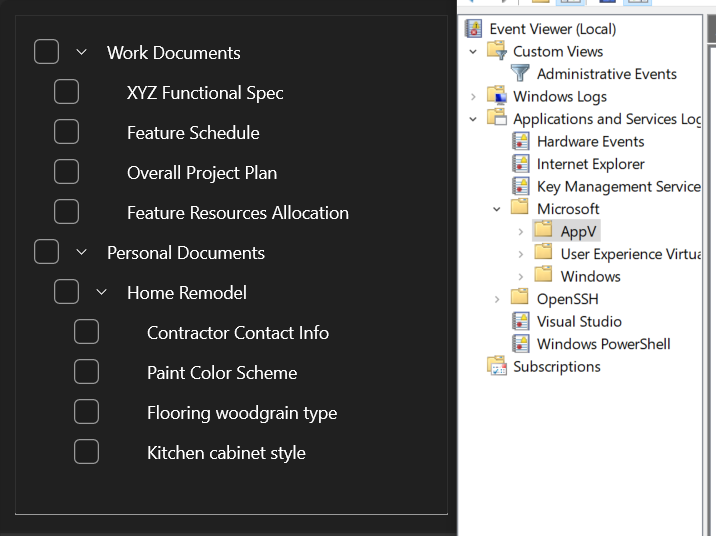
Just look at this TreeView in WinUI2 (w/ fluent design) vs a TreeView in the good old event viewer. It just wastes SO MUCH space!
https://f003.backblazeb2.com/file/sharexxx/ShareX/2026/02/mm...
And imo it's just so much easier to write a webapp, than fiddle with WinUI. Of course you can still build on MFC or Win32, but meh.
So, there seems to be light.
Microsoft makes a new UI framework every couple of years, liquid glass from apple and gnome has a new gtk version every so often.
These strategies are fine for toy apps but you cannot ship a production app to millions or even thousands of people without these basics.
The productivity comparison must be made between how long it takes to ship a certain amount of stuff.
I know you need to cope because your competency is 1:1 correlated to the quality and quantity of tokens you can afford, so have fun with your Think for me SaaS while you can afford it. You have no clue the amount of engineering that goes into provide inference at scale. I wasn't even including the cost of labor.
React Native Skia allegedly runs on Linux too
Argument feels more like FUD than something rooted in factual reality.
1. Turing test UX's, where a chat app is the product and the feature (Electron is fine) 2. The class of things LLMs are good at that often do not need a UI, let alone a chat app, and need automation glue (Electron may cause friction)
Personally, I feel like we're jumping on capabilities and missing a much larger issue of permissioning and security.
In an API or MCP context, permissions may be scoped via tokens at the very least, but within an OS context, that boundary is not necessarily present. Once an agent can read and write files or executed commands as the logged in user, there's a level of trust and access that goes against most best practices.
This is probably a startup to be hatched, but it seems to me this space of getting agents to be scoped properly and stay in bounds, just like cursor has rules, would be a prereq before giving access to an OS at all.
- Native apps integrate well with the native OS look and feel and native OS features. I'd say it's nice to have, but not a must have, especially considering that the same app can run on multiple platforms.
- Native apps use much less RAM than Electron apps. I believe this one is a real issue for many users. Running Slack, Figma, Linear, Spotify, Discord, Obsidian, and others at the same time consumes a lot of memory for no good reason.
Which makes me wonder: Is there anything that could removed from Electron to make it lighter, similar to what Qt does?
Which parts in particular do you think electron misses from this list?
> You still need $500k in GPUs and a boatload of electricity to serve like 3 concurrent sessions at a decent tok/ps.
as being patent bullshit, after which the burden is squarely on you to back up the remainder of your claims.
There are valid use cases for Docker on those types of software, but most users just use Docker for convenience or because "everyone else" uses them. Maybe influenced by Linux users where Docker has lower overhead. It's convenient for sure, but it also has a cost on Mac/Windows
I think it is a daft thing to move to shipping a colossal web framework and entire browser simply because of 1px UI alignments (which have been a solved problem for decades in C++ anyway).
He who holds the purse strings, decides. The people who pay to have the apps made get to decide and they have decided that what geeks want doesn't matter.
And every time a geek tries to change that, he only wins for a short while and then we're back to the primordial soup.
Oh, and regular users obviously don't care enough.
I don't expect any LLM to empower people as much as Emacs can, but they will definitely empower more people in total, just because LLMs are easier to use than Emacs.