Who told you that? You can write entire C libraries and call them from Electron just fine. Browser is a native application after all. All this "native applications" debate boils down to the UI implementation strategy. Maintaining three separate UI stacks (WinUI, SwiftUI, GTK/Qt) is dramatically more expensive and slower to iterate on than a single web-based UI with shared logic
We already have three major OSes, all doing things differently. The browsers, on the other hand, use the same language, same rendering model, same layout system, and same accessibility layer everywhere, which is a massive abstraction win.
You don't casually give up massive abstraction wins just to say "it's native". If "just build it natively" were actually easier, faster, or cheaper at scale, everyone would do just that.
You reduce development effort by a third, it is ok to debate whether a company so big should invest into a better product anyway but it is pretty clear why they are doing this
Done by the company which sells software which is supposed to reduce it tenfold?
Value is value, and levers are levers, regardless of the resources you have or the difficulty of the problem you're solving.
If they can save effort with Electron and put that effort into things their research says users care about more, everyone wins.
It's weird that we don't have a unified "React Native Desktop" that would build upon the react-native-windows package and add similar backends for MacOS and Linux. That way we could be building native apps while keeping the stuff developers like from React.
It's not about money. It's not a tradeoff in cost vs quality - it's a tradeoff in development speed. Shipping N separate native versions requires more development time for any given change: you must implement everything (at least every UI) N times, which drastically increases the design & planning & coordination required vs just building and shipping one implementation.
Do you want to move slower to get "native feel", or do you want to ship fast and get N times as much feature dev done? In a competitive race while the new features are flowing, development speed always wins.
Once feature development settles down, polish starts to matter more and the slowdown becomes less important, and then you can refocus.
Value prop of product quality aside, isn't the AI claim that it helps you be more productive? I would expect that OpenAI would run multiple frontends and that they'd use Codex to do it.
Ie are they using their own AI (I would assume it's semi-vibe-coded) to just get out a new product or using AI to create a new product using the productivity gains to let them produce higher quality?
Our IDE does this: common code / logic, then a native macOS layer and a WPF layer. Yes, it takes a little more work (less than you'd think!) but we think it is the right way to do it.
And what I hope is that AI will let people do the same -- lower the cost and effort to do things like this. If Electron was used because it was a cheap way to get cross-platform apps out, AI should now be the same layer, the same intermediate 'get stuff done' layer, but done better. And I don't think this prevents doing things faster because AI can work in parallel. Instead of one agent to update the frontend, you have two to update both frontends, you know?
We're building an AI agent, btw. Initially targeting Delphi, which is a third party's product we try to support and provide modern solutions for. We'll be adding support for our own toolchains too.
What I fear is that people will apply AI at the wrong level. That they'll produce the same things, but faster: not the same things, but better (and faster.)
Doesn't this get thrown out the window now that everyone claims you can be 10x, 50x, 100x more productive with AI? Hell people were claiming you can ask a bunch of AI agents to build a browser from scratch, so surely the dev speed argument no longer applies.
So if you want a multiplatform desktop app also supporting Linux, React Native isn't going to cut it.
Part of this (especially the CPU) is teams under-optimizing their Electron apps. See the multi-X speedup examples when they look into it and move hot code to C et al.
The browser is compiled to native code. It wasn't that long ago that we had three seperate web browsers who couldn't agree on the same set of standards either.
Try porting your browser to Java or C# and see how much faster it is then. The OS the browser and the server run on are compiled to native code. Sun gave up on HotJava web browser in the 1990's, because it couldn't do %10 or %20 of what Netscape or IE could do, and was 10 x slower.
Not everybody is running a website selling internet widgets. Some of us actually have more on the line if our systems fail or are not performant than "oooh our shareholders are gonna be pissed".
People running critical emergency response systems day in, day out.
The very system you typed this bullshit on is running native code. But oh no, thats "too hard" for the webdev crowd. Everyone should bend to accomodate them. The OS should be ported to run inside the browser, because the browser is "so good".
Good one. It's hilarious to see this Silicon Valley/Bay Area, chia-seed eating bullshit in cheap spandex riding their bikes while the trucks shipping shit from coast to coast passing them by.
Sorry to nitpick, but this should be "by three" or "by two thirds", right?
Exactly. Years go by and HN keeps crying about this despite it being extremely easy to understand for anyone. For such a smart community, it's baffling how some debates are so dumb.
The only metric really worth reviewing is resource usage (and perhaps appearance). These factors aren't relevant to the general population as otherwise, most people wouldn't use these apps (which clearly isn't the case).
Yes that would take much disk space, but it takes 50Mb or 500Mb isn't noticeable for most users. Same goes for memory, there is a gain for sure but unless you open your system monitor you wouldn't know.
So even if it's something the company could afford, is it even worth it?
Also it's not just about cost but opportunity cost. If a feature takes longer to implement natively compared to Electron, that can cause costly delays.
It comes back to fundamental programming guidelines like DRY (Don't Repeat Yourself) - if you have three separate implementations in different languages for everything, changes will be come harder and you will move slower. These golden guidelines still stand in a vibe-code world.
They are not.
A good iOS app is not 1:1 equivalent to what a good Android app would be for the same goal. Treating them as such just gives users a lowest common denominator product.
I have a MacBook with 16GB of RAM and I routinely run out of memory from just having Slack, Discord, Cursor, Figma, Spotify and a couple of Firefox tabs open. I went back to listening to mp3s with a native app to have enough memory to run Docker containers for my dev server.
Come on, I could listen to music, program, chat on IRC or Skype, do graphic design, etc. with 512MB of DDR2 back in 2006, and now you couldn’t run a single one of those Electron apps with that amount of memory. How can a billion dollar corporation doing music streaming not have the resources to make a native app, but the Songbird team could do it for free back in 2006?
I’ve shipped cross platform native UIs by myself. It’s not that hard, and with skyrocketing RAM prices, users might be coming back to 8GB laptops. There’s no justification for a big corporation not to have a native app other than developer negligence.
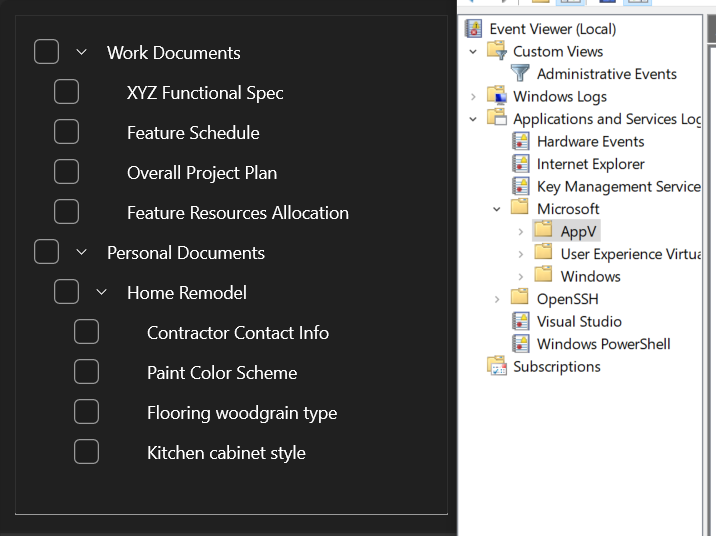
Just look at this TreeView in WinUI2 (w/ fluent design) vs a TreeView in the good old event viewer. It just wastes SO MUCH space!
https://f003.backblazeb2.com/file/sharexxx/ShareX/2026/02/mm...
And imo it's just so much easier to write a webapp, than fiddle with WinUI. Of course you can still build on MFC or Win32, but meh.
Microsoft makes a new UI framework every couple of years, liquid glass from apple and gnome has a new gtk version every so often.
The productivity comparison must be made between how long it takes to ship a certain amount of stuff.
React Native Skia allegedly runs on Linux too
Argument feels more like FUD than something rooted in factual reality.
- Native apps integrate well with the native OS look and feel and native OS features. I'd say it's nice to have, but not a must have, especially considering that the same app can run on multiple platforms.
- Native apps use much less RAM than Electron apps. I believe this one is a real issue for many users. Running Slack, Figma, Linear, Spotify, Discord, Obsidian, and others at the same time consumes a lot of memory for no good reason.
Which makes me wonder: Is there anything that could removed from Electron to make it lighter, similar to what Qt does?
There are valid use cases for Docker on those types of software, but most users just use Docker for convenience or because "everyone else" uses them. Maybe influenced by Linux users where Docker has lower overhead. It's convenient for sure, but it also has a cost on Mac/Windows