I will say I've found Clojure to be a success story for doing GUI work. Projects like Dave Ray's seesaw (https://github.com/clj-commons/seesaw) are an amazing demo of how one man can rearchitect an API like Swing into something that is deceptively fun to use. High hopes that this project goes somewhere that is similarly enjoyable.
Per the other comment, might do less dunking
Like, honest question, I do agree with most of their points and don’t think they’re presenting them in a too harsh way
http://groovy-lang.org/dsls.html#swingbuilder https://github.com/scala/scala-swing
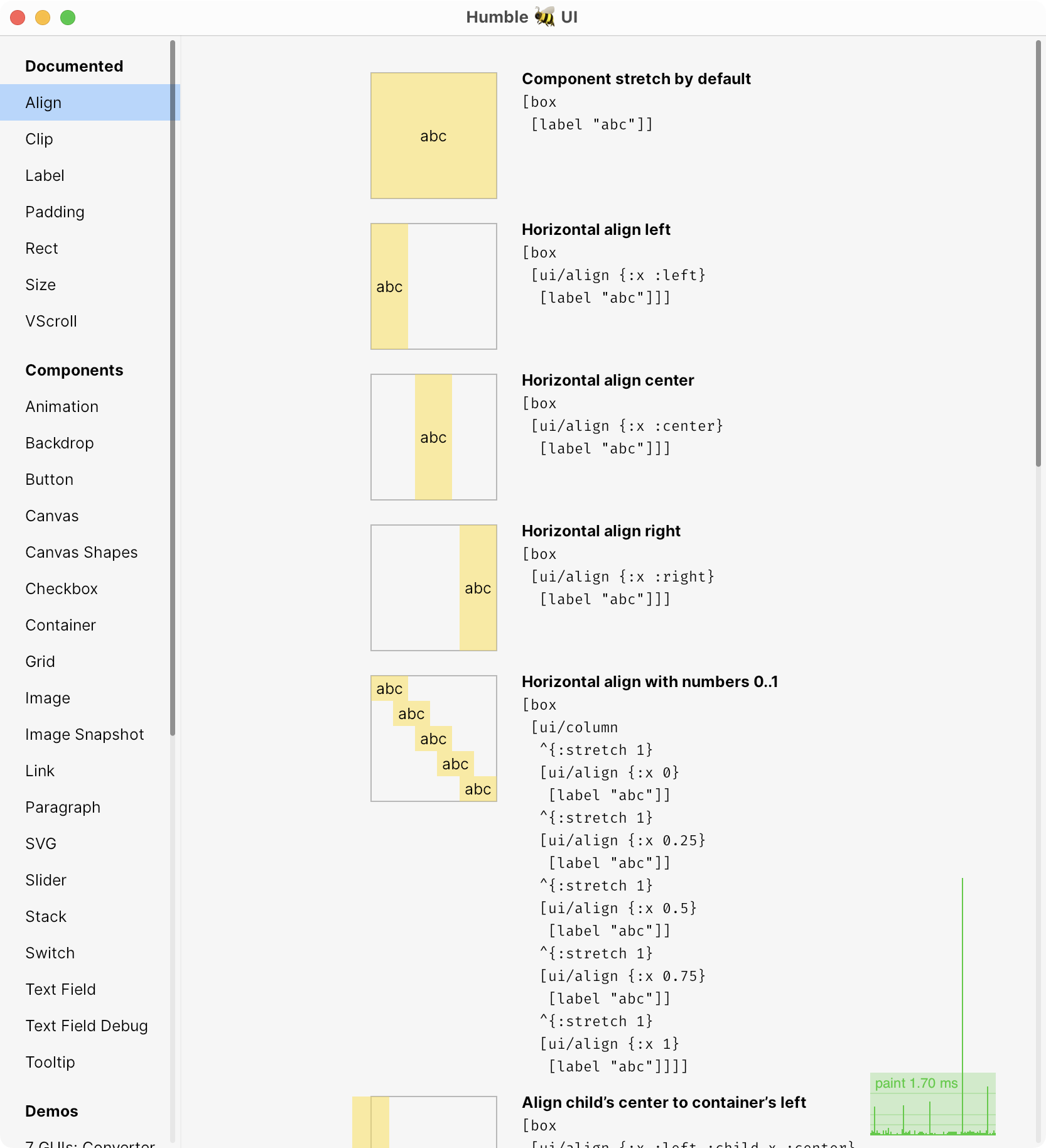
Work in progress. No docs, and everything changes every day.But, looking at the examples (picked the Wordle one since I know that game): https://github.com/HumbleUI/HumbleUI/blob/main/dev/examples/...
I find it extremely hard to read. Even small snippets, say line 56 to 74 which define this "color", "merge-colors" and "colors"... then the "field" one lines 76 to 117 is even harder.
is it more natural read for people familiar with writing functional programs? (am I permanently "broken" due to my familiarity with imperative programing?)
I wonder what the same Wordle example would look like in, say pure Flutter.
Also wonder how would that code look with external dependencies (say hitting a server to get the word of the day), and navigation (with maintaining state in between those pages)
As just one person who has written a great deal of functional code, it reads well to me. I think because I am used to reading it "inside out"? Reading lisp-likes is probably helpful.
Take 'color' for example. It opens with a 'cond', with three branches. First branch is if the idx-th position in word is the same as letter, return green. Second branch is if the word includes the latter at all, yellow. Otherwise we're grey.
That took me a few seconds to grok. Just one anecdote for you. Don't think you're broken but reading/writing this kind of code even a little bit will change the way you see code IMO.
Also,
(apply merge-with {} ...)
Examples include cond, let [{:keys ...}], for being a list comprehension rather than a loop, #(%) function literals, and @ deref.
* The cond macro which works similarly to C switch
* Hashmap functions like merge and merge-with
* Destructuring
* The for macro which is similar to the "for each in" statements
None of these are something unfamiliar to common programming languages so that code will not be hard understand once you go over the initial syntax and idiom hump. The syntax makes things much easier once you get to used to it, I think all Clojure programmers like it.
When reading lisp code, you navigate it like a tree. Indention matters and clean lisp code has the same indention level for all sibling nodes (with minor deviations for special constructs). Most code follows the pattern of defining "variable" bindings (e.g. via `let`) and then it has one final expression that uses all these bindings to calculate a value.
  (defn name-of-a-function-that-i-define [first-argument second-argument]
    (let [sum-of-some-numbers (+ 1 2 3)
          product-of-some-numbers (* 1 2 3)]
      (+ first-argument
         second-argument
         sum-of-some-numbers
product-of-some-numbers)))I think you make a great point, a point that once someone has gotten used to lisp, is harder to fully appreciate. I’m at the stage now in my lisp journey that i didn’t find those hard to read but it wasn’t that long ago that i felt almost nerd sniped by this weird language. I think it’s worth pointing out that in a more advanced example, I’d still have been comfortable because of the repl - I could navigate between each sub expression with a keystroke and I can send each to the repl with a keystroke and see what they do. Lisp really makes it easy to do this kind of bottom-up assembly - both when you’re writing and when you’re understanding someone else’s code.
A corollary to that, and which was key to me falling in love with lisps, is that the signal-to-noise ratio is off the charts. Whatever you want to implement, probably doesn’t require a lot of code. Wordle in 189 lines is pretty decent. There’s just less to fit in your head and what’s there tends to be solving the problem at hand, not boiler plate.
> People prefer native apps to web apps
> Java has “UI curse”: Looked bad
to be at odds with this aspect of the design:
> No goal to look native
> Leverage Skia
One thing to add to what others have said, when you're met with code like this in the wild and you need to modify/add/remove something but don't have a 100% understanding yet, the common workflow is that you explore this code with your "evaluator" (basically a REPL connected to your editor).
So if you come across snippets of code you don't understand very well, you place your cursor at the various forms and execute them. So you'll start at the inner forms, and slowly work your way outwards, and after that you've verified assumptions both about the function's internal workings and how you'll use it from the outside.
"Java has UI curse" is referring to how when Java tries to imitate native UI (note the difference to "native app", which is in contrast to a web app), it fails and hits the uncanny valley. No-one likes it.
Given that, it's not a contradiction to have a native app, that does not try to use the native GUI toolkit of the host platform, using Skia directly to draw UI elements.
    def color(word, letter, idx):
        if word[idx] == letter:
            return GREEN
        elif letter in word:
            return YELLOW
        else:
            return GREY
There are two types of apps: 1. the ones that professionals use and 2. the ones that consumers use.
for 1. they don't care if it looks native, as long as it works and is performant e.g. DAWs, Video Editing tools, Trading, etc.
2. likewise I don't think it matters that much.
my guess is the myth came from OS makers.
Moreover, web UIs tend to be less sophisticated and less power user friendly, due to HTML/CSS and browser API limitations. This unfortunately often carries over even to non-browser-based applications that however use a web-like UI.
I don’t care if things look native, however I am actively repulsed by modern web design trends.
Native is what doesn't run in an emulator, in this case everything non-Electron fits the definition.
At that time I'd just opt for sleep. Or sex. Or drink. Reading code doesn't belong to things one should do at 2AM.
The README also suggests that the reason why people prefer native apps isn’t just the UI’s aesthetics, but:
> Normal shortcuts, icon, its own window, file system access, notifications, OS integrations
That's just a myth spread by a few workaholic programmers. Luckily, there are enough 9-5 programmers to clean up the mess created by those 2AM committers.
Don't confuse familiarity with readability.
Try this with ChatGPT, Claude or Gemini. All LLM's are really good with this translation tasks
This is a tangent, but I've been thinking about how I feel when the conditions of an if-else ladder rely on the order they're listed in.
This is an example; if you swapped the order of those branches around, the coloration would become incorrect.
I'm a little happier when the conditions are described completely, such that swapping the order of the checks doesn't change which of them evaluate false or true, but it's also true that that can add quite a bit of complexity over an order-sensitive set of conditions.
Thoughts?
I don't use Clojure professionally, but I've spent years using the language personally. It might be hard to believe, but it really is beautiful once you learn it, and extremely powerful as well.
Imagine a language that has a built in parser and code generation library.
External dependencies you manage like in most other applications nowadays, you don't hit external services in the "guts" of your code unless you really need to, for performance, testability and to keep the less reliable parts of your code isolated, you keep the interactions with external services as close to the "main" of the application as you can.
When things break down is with more complex data models of the application, not even as much because of the language itself but because Clojure programmers actively reject using record types and interfaces, and just pass dictionaries around. You wind up with some code that, bafflingly, gives the impression of being very simple and neat, but you can't tell what it's actually doing.
I hate meaningless statements like this. This means nothing, other maybe that you know Python. 20 years ago people might have said that about Python - I even know many people today who would say that about Python.
Having a bit of Lisp experience (really not a lot), I find it very easy and elegant to read.
> is it more natural read for people familiar with writing functional programs? (am I permanently "broken" due to my familiarity with imperative programing?)
No, most people who say something like this are simply unwilling to invest an evening into a language they're not already familiar with.
I can tell you that this code is very easy to read if you are familiar with Clojure. In fact, this example is lovely! Seeing this code really makes me wanting to try this library! Clojure has this terse, yet readable aesthetic that I like a lot.
But I completely understand you because at some point Clojure code also looked alien to me. You are not broken for having familiarity with some style of code. Familiarity is something you can acquire at any time, and then this code will be easy to read.
True hard-to-read code is one that is hard to understand even if you master the language it is written in.
I had been programming in C for a while, learning from K&R, to build ray tracing input files and that sort of thing so I was kind of disappointed but whatever, I was a mature student who had rediscovered computers a couple of years before (had a C64 in the 80s) and was just happy to be there.
Anyway, this guy in the back yells out "I could do that in 2 lines of Q-BASIC" or something to that effect (Q-BASIC was definitely part of his pithy one-liner). Little did I know he was representing so many of the people I would encounter over the next decades.
If you know Clojure, the code presented in the example seems fairly straightforward. Parentheses demarcate the syntax tree; and the last expression in any tree is the result carried forward.
MacOS is a close second, with a few native apps that can't decide exactly what a checkbox or a button should look like.
And Win10 on my wife's machine is a salad, reminding me of Linux desktop experience from 1998.
I feel like it's mostly consumers who ask for native look, and particular users on macOS, as almost all other professional-oriented software doesn't offer that. But yet it comes up for every GUI toolkit that lands on the HN frontpage.
Unfortunately desktop environments on some proprietary operating systems are themselves comprised of apps written with different toolkits and bearing different looks and feels. But that's just a problem specific to them. KDE apps are all maybe to Plasma, GNOME apps are all native to GNOME.
- buttons are labeled and placed correctly, and respond to expected input (including secondary focus and secondary action on MacOS, for example)
- dropdowns/selects behave correctly, and respond to expected input (for example, you can type to select in MacOS dropdowns).
- windows have OS-defined areas for drag/resize, for titles, for toolbars etc. They also appear correctly in the OS's window management tools (app switchers etc.)
- text inputs use the OS-default shortcuts and have access to OS-provided tools (e.g. spell checker)
- controls and windows respond correctly to keyboard and mouse. E.g. for a while Apple's own Catalyst apps didn't have the standard Cmd+Q to close the app. Many custom modals do not dismiss the modal on Escape
- context menus are standard in the places where you expect standard context menus. Well, app menus, too.
And the list just goes on and on.
I don't even think native macOS UI is so great cross-plat programs should target it. It's full of its own weird conventions like a "New item" button being a tiny "+" at the bottom of the left sidebar, the last place I always look.
Safari is an example of UX that has stuck to hard macOS conventions and was always worse off for it. Not until recently did it begin relenting, and now it's bearable to use as a daily driver. Xcode is another classic example of hostile native macOS UX conventions. Finder.app is another.
I'd rather software ask "what's the UX that makes the most sense?" rather than "how can I make my UI look native?" On HN people seem to think by solving the latter, you solve the former. But that isn't the case.
This is pretty funny, because if you just use Gnome apps + desktop environment, you have a consistent experience. But if you only use Microsoft/Windows GUIs, panels and applications, it nowhere near as consistent.
So even the Gnome team can build better UI and UX than Windows themselves can, pretty telling.
https://s.tonsky.me/share/Screenshot%202024-08-27%20at%2017....
I think it’s just a familiarity thing. Clojure is different from most languages in that it’s a lisp and it’s immutable-first functional. That gives it a bit of a learning curve compared to other languages, but I find other simpler languages quite dificulte to read until I’m familiar with them, too.
The preference for native look was once about the impact of familiarity on usability. When 95% of people's interactions with computers was a single OS and native apps, they would expect controls to look a particular way. They could figure out other variants, sure, but from a UX design perspective, there's little reason to add that minor cognitive overhead needlessly.
Today, people's experiences are less likely to be monoculture like they once were, which dilutes one of the values of native controls. That's not to say designing with familiarity of controls in mind doesn't have value, just that it's less about, for example, buttons looking like buttons native to the OS, and more about visually reading as "this is a button" more generally.
    (defn color [word letter idx]
      (cond
        (= (nth word idx) letter) :green
        (str/includes? word letter) :yellow
        :else :gray))
(def s (seq ("test1"))
Python, meanwhile, fails on lazy input as it isn't indexable.
word = (c for c in "test1")
So you're ok with a mp3 player that takes 6 seconds to start up, is janky when it starts, takes 300MB of RAM, every row item is 100px high and every interaction with every UI element takes a noticeable delay on the order of 100x milliseconds?
And you're gonna tolerate the same story with the file explorer app, the archive/zip app, the WiFi SSID selection dialog, etc?
    def color(word, letter, idx):
        cond:
            word[idx] == letter: return GREEN
            letter in word: return YELLOW
True: return GREY (first (filter identity
[(and (condition-three) (action-three))
(and (condition-one) (action-one))
(and (condition-four) (action-four))
(and (condition-two) (action-two))]))
You probably wouldn't want to most of the time, but if the conditions are slow to test but otherwise inexpensive, it might be a useful optimization.
And unfortunately, you won't get much compiler assistance either with Clojure, beyond basic things. So it's easy to have bugs that will take a while to track down in a complex codebase.
I avoided Clojure for nearly 15 years because I thought so too.
Turned out I spoke English and couldn't read Russian. But that didn't mean Russian was unreadable—I just didn't know how. It had nothing to do with whether or not it was "readable" or not, it was easy to read (and understand) once I learned how.
After about two weeks, I found reading Clojure to be just as easy as any other code. I did that at 46, so I don't think age is a major barrier. (I've written read and written code my entire life.)
I'm now writing Clojure code every day and am much happier as a developer. (That's why I made the effort initially, and it definitely paid off.)
One thing that really helped was asking ChatGPT or Claude to explain a piece of Clojure code to me, when I had questions. Especially early on, that was invaluable.
Also, learning structured code editing made a big difference—I consider it to be essential. It was extremely frustrating until I spent an afternoon doing that.
Clojure code is "read" differently than, say, Python or JavaScript or C and that's reflected in how you navigate and edit the code.
YMMV
Either way, it’s bad experience for the end user
People like to hate on them, but their design is actually really good, innovative and the applications running on GTK are incredibly fast and stable.
Or possibly the code even uses non-symbols for some of the arguments. Suppose that letter is sometimes the integer 1.
I also hope that, unlike MS, they have no infighting between departments, and no stack ranking.
There are a lot of assumptions baked in that aren't holding up today.
For example, high density and multi monitor aren't well supported. There's a bunch of stuff hard-coded in the JDK that no longer makes sense and you have to hack around.
As an example, look at typical popular iOS apps: they’re often 100-500 Mb, even though they have absolutely no reason to be. LinkedIn is 400Mb, random airline app is 300Mb. Banking app? 350Mb.
Is it bad to bundle Chrome and NodeJS? Yes, undoubtedly (but that’s already changing). Is that the only way to deploy web-based apps to desktop? No. Is native UI gonna fix it? Temporarily at best, while the platform’s native ecosystem is simply too small to cause that level of bloat.
I sincerely want to know what I am missing, because the fact that Clojure is hosted on the JVM (mainly) seems like a plus to me.
I don't much like the build tools in the jvm environment such as maven or gradle, and the error messages could be better for sure. Is there more ugliness that I should look into?
I'm not complaining/hating, Gnome is my desktop environment of choice since some time ago.
Was more a nod to how awful Microsoft seems to (still) be at UI and UX.
Native app is just another set of layers of abstractions. As a comparison, SwiftUI doesn't render 500 items quickly enough (https://www.reddit.com/r/swift/comments/18dlgv0/improving_pe...), which is a tiny number for web.
JavaFX uses the same approach as Humble UI: they draw all the widgets themselves and have custom cross-platform look and feel.
We aim to be better quality version of JavaFX
    fun color(word: String, letter: Char, idx: Int) =
      when (letter) {
        word[idx] -> GREEN
        in word -> YELLOW
        else -> GRAY
}Perhaps you've done it wrong? To read any Lisp code one needs a REPL. And you don't typically type directly in it, you connect to it and eval things from source files. Once you get connected to a REPL, you can eval any expression and sub-expression, and with practice, you'd learn to grok the code without a REPL.
And for writing Lisp, you only need structural editing support in your editor. Once you find basic commands - moving structures around is far more enjoyable process than writing things in an unstructured language.
I am far more productive using Clojure instead of Java and Clojurescript instead of Javascript, Fennel instead of Lua, etc. - it's easier to read, easier to modify, easier to maintain. But, yeah, it does require some practice, just like any other skill.
- Clojure has strong type inference, catching many errors at compile-time.
- The REPL provides immediate feedback and testing capabilities.
- Clojure's immutability and functional paradigms reduce bug-prone code.
- Tools like core.spec offer runtime type checking and data validation.
- IDEs like Cursive provide advanced static analysis and refactoring support.
- Clojure's simplicity and consistency make bugs easier to spot and fix.
- You also completely ignoring Clojure's rich ecosystem of testing frameworks and tools.
Besides - Clojure is not JVM-only, Clojure is a hosted language, it can work a top of different platforms: JS engine - Clojurescript; Flutter - ClojureDart; Native Code scripting - Babashka; NodeJS - nbb; .Net - Clojure CLR; Fennel even though technically is not a Clojure, is a lovely little language very similar to it and it works on Lua. There's also jank-lang, currently in development that works on top of LLVM. There are a bunch of other Clojure dialects - for Rust, Go, Python, Erlang, etc.
Once you learn the basic structural editing commands, writing code becomes like composing poetry out of haiku pieces. Instead of thinking like: "how do I grab these vars used inside this function and refactor it to be them in their own unit?...", you'd just grab some expressions and move them around, like bricks or lego pieces. It is extremely satisfying way of writing programs. The only drawback of that approach is that later it becomes harder to work with "more traditional" PLs, you just can't easily manipulate code the same way in Python, JS/TS, Kotlin, Java, C++, etc. - you need a "structured", homoiconic, lispy language for that trick to work. Treesitter makes an effort to improve the process, but it still not on the same level of simplicity.
Can you give an example? Would these tools allow you to define a custom type with fields and ensure it is correct everywhere at compile time like a static language?
I'm not sure what you mean by structural editing support. I usually find things like autocomplete or automatic parenthesis to be more of a nuisance than a help.
- Dynamic predicates - Spec allows you to define types using arbitrary predicates, which can be more expressive than traditional static type systems;
- Runtime generative testing - Spec can automatically generate test data based on your specifications, which is powerful for property-based testing;
- Flexible validation - You can validate complex nested data structures and apply specs selectively, which is often more flexible than static type checking;
- Extensibility - Specs can be added to existing types without modifying their source, and data-driven nature of it - Specs are just data and can be manipulated programmatically.
No, REPLs in other languages are not equal to REPLs in Lisp dialects. I bet what you are describing is not the same workflow that an average Clojurian would use. In other languages you typically type directly into the REPL console. With Clojure, you typically connect your editor to a running REPL instance and then manipulate things directly from the source code - you basically write the program, while living inside it - your codebase becomes a living, breathing, maleable entity.
Structural editing has little to do with autocomplete, it's just a way to manipulate expressions - move them around, raise them, transpose them, wrap/unwrap, etc.
I suppose you tried to understand Clojure by looking at the code, and that could be challenging - without proper REPL and structural editing support, it may not be the same joyful experience that many Clojurians know.
- Power - you can do arbitrary checks on the data, static type systems are quite weak in what kind of properties they can verify (far from turing complete)
- Flexibility to do checking at where you want at runtime (eg check data at API boundaries)
- Ability to treat schemas as data, generate them, output them as data and share between systems (for example in databases), throug conversions possible to interop with other platforms (eg json schema)
- loose coupling to your programming language, are just libraries
Or you'd run a curl command once and continue exploring the data - parsing slicing, dicing, grouping, sorting any way you like, or even have it visualized in the Portal tool with charts and graphs.
Look, I'm currently writing tests for a thing, while my IDE is connected to a service running on a Kubernetes pod in the cloud - I can eval any function that affects the execution of the service, I can explore the db tables, change the routes and re-run the tests - all that without having to restart the pod, without having to deploy anything, without even having to save any files (if I don't have to).
Lisp REPL-driven development gives you immediate feedback, allows you to modify and debug running programs on-the-fly, allows you to experiment, it's great for understanding language features interactively, and it's a real, tangible productivity boost - it's superb for rapid prototyping.
> Interactivity is great, but it doesn't make up for the language itself.
The language is what allows that great interactivity and exploratory programming. I mean, I get it - while it may initially appear challenging to read, much like how sigma notation for loops in mathematics can be difficult to comprehend, with practice it becomes intuitive. One wouldn't go to math.stackexchange to complain about sigmas and other mathematical symbols being unintuitive, would they?