zlacker

[parent] [thread] 17 comments
1. reacto+(OP)[view] [source] 2024-01-27 21:35:05
By design, braking introduces drag onto the brake disc and in turn creates drag on the wheel. This drag is in opposition to forward momentum and so the rubber of the tyre flexes and gives to these forces a little at a time - resulting in slowing your forward momentum.

A rail car without rubber takes 10x-50x the distance to brake due to steel on steel friction.

Rubber is consumed from the tyre during acceleration, deceleration, and turning. Little rubber granules will roll off. The only time this isn’t happening is when the tyres aren’t in motion.

This is why you bring extra tyres to track day.

replies(2): >>raverb+G >>buran7+m2
2. raverb+G[view] [source] 2024-01-27 21:38:41
>>reacto+(OP)
Correct. I don't see why regenerative braking would be any different

Tire wear would be a factor of deceleration, regardless if it's from a traditional brake or electrical braking

replies(2): >>silver+Q2 >>reacto+j7
3. buran7+m2[view] [source] 2024-01-27 21:52:02
>>reacto+(OP)
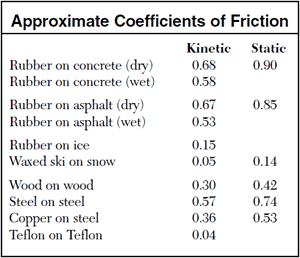
In motion the friction coefficient of rubber on asphalt (0.67) is not that far off from steel on steel (0.57) according to the internet [0]. That orders of magnitude difference in braking distance is more a result of train cars weighing 30-80t.

This comment does feel like talking to ChatGPT though, with the detailed clarifications the discussion didn't really require.

[0] https://www.aplusphysics.com/courses/honors/dynamics/images/...

replies(5): >>london+04 >>london+a4 >>bonzin+r6 >>reacto+a8 >>rightb+V8
◧◩
4. silver+Q2[view] [source] [discussion] 2024-01-27 21:54:27
>>raverb+G
One possibility - if you do regen braking as in one pedal driving, there is a lot less coasting to stop, and I imagine that is less stressful on the tires.
replies(1): >>jtc331+F3
◧◩◪
5. jtc331+F3[view] [source] [discussion] 2024-01-27 21:59:40
>>silver+Q2
It's an interesting idea, but in general you don't come most of the way to a stop coasting in an ICE car unless you're already at a low speed. Usually you coast some, and then you have to brake significantly still.
◧◩
6. london+04[view] [source] [discussion] 2024-01-27 22:01:46
>>buran7+m2
Trains take a really long time to stop because the tracks frequently aren't clean - even a tiny bit of leaves or grease can cut the coefficient of dynamic friction down 10x
◧◩
7. london+a4[view] [source] [discussion] 2024-01-27 22:02:45
>>buran7+m2
The mass of a vehicle does not determine the braking distance, assuming the braking is coefficient of friction limited.
replies(1): >>buran7+h6
◧◩◪
8. buran7+h6[view] [source] [discussion] 2024-01-27 22:20:55
>>london+a4
It does but not because it influences friction at the wheel contact point (the mass cancels out in that formula). If braking is done entirely in "wheels locked" fashion then all that matters is the friction coefficient between the wheel and the track. But most braking is not like that. A train will only lock the wheels in emergency braking as that will apply larger braking force than otherwise available.

In normal braking the friction between the pads and the wheel is the important one and in that case the stopping distance is determined by how much of the energy of the moving vehicle you can bleed through the force you apply with the braking pads. More mass/speed, more energy, more time needed to apply the xxxxN of force to the wheel and convert the energy to heat. The energy of the moving vehicle scales with its weight while the maximum force a friction braking system can apply doesn't.

The science of braking is even more complicated than that, materials heat up or melt, friction coefficients change, tires behave differently under different loads, ABS systems kick in, etc. These are deceptively complicated topics.

The formula for friction also doesn't contain surface area and yet we use wide tires and big brake pads. But the bottom line is that in a real life scenario (as in not in simplified formulas on paper) the weight of the vehicle very much influences the braking distance.

◧◩
9. bonzin+r6[view] [source] [discussion] 2024-01-27 22:21:28
>>buran7+m2
It doesn't change much, but note that unless you've blocked your wheels (and you have no ABS), you need to check the static coefficients. Wheels work so that from the point of view of the wheel the asphalt is still (i.e. there is no translation, only rotation).

This is why blocking the wheels increases braking distance: you suddenly have to deal with a much smaller friction coefficient.

replies(2): >>buran7+Z8 >>sokolo+ig
◧◩
10. reacto+j7[view] [source] [discussion] 2024-01-27 22:27:54
>>raverb+G
When the wheel is just coasting (no additional torque supplied) you have the least amount of friction (assuming you’re going in a straight line) against the rubber. The issue with fly-by-wire systems is there’s no coasting. An ECU is constantly supplying PWM like torque pulses to the wheels to keep the speed constant. My OneWheel burns through rubber because of this. My EV as well. Yet my ICE vehicles or vehicles with a CVT/Open Diff that let the wheels run free don’t suffer from having to change the tires every few months. I believe that’s in corroboration with what the article is claiming. The soft compound tires for ride comfort get absolutely chewed. There’s ripple like wear from the motors.
◧◩
11. reacto+a8[view] [source] [discussion] 2024-01-27 22:33:59
>>buran7+m2
Ouch, yeah - no GPT. I was saying that the rubber wear is a result of the above. Trains take a long time to stop because of their weight and lower friction on the rails. On trains it’s 0.35-0.5 not 0.57 [0]

[0] https://en.m.wikipedia.org/wiki/Adhesion_railway

◧◩
12. rightb+V8[view] [source] [discussion] 2024-01-27 22:39:05
>>buran7+m2
Tires deform way more than steel wheels. The cofficient of friction is just a part of the grip. You can brake with more than 0.67 g.
replies(1): >>buran7+ad
◧◩◪
13. buran7+Z8[view] [source] [discussion] 2024-01-27 22:39:42
>>bonzin+r6
Well that and the fact that rubber melts and that changes some coefficients. Nothing about braking is as simple as one formula.

P.S. Isn't the static coefficient calculated for a stationary object trying to move against a surface? In a wheels locked scenario the wheel is sliding so the dynamic coefficient is the one to look at, accounting for the changed material properties of the heated/melted material.

replies(1): >>bonzin+jd
◧◩◪
14. buran7+ad[view] [source] [discussion] 2024-01-27 23:22:29
>>rightb+V8
> You can brake with more than 0.67 g.

Of course you can but we're not talking about G-forces. That's a coefficient of friction [0], a dimensionless measure. It's determined empirically literally by rubbing things together and is then used to calculate the friction force between different materials.

[0] https://en.wikipedia.org/wiki/Friction#Coefficient_of_fricti...

replies(1): >>rightb+Q21
◧◩◪◨
15. bonzin+jd[view] [source] [discussion] 2024-01-27 23:23:24
>>buran7+Z8
Right, in the wheels locked scenario the dynamic coefficient is the one that matters, it's smaller than the static coefficient and that leads to a longer braking distance.

For a rolling wheel however, the stationary object is ideally just a point of the wheel, trying to move against the surface; but as soon as the wheel wins against the surface, the point rotates away and a new point tries to move against the surface. Even in the less ideal case a point of the tire always touches the same point of the asphalt from the moment it touches the ground to the moment it leaves it. So in that case you use the static coefficient.

For a more visual explanation see https://youtu.be/J0PVm4XTGeY?si=20TygSRdH3UxIx_4

replies(1): >>buran7+kf
◧◩◪◨⬒
16. buran7+kf[view] [source] [discussion] 2024-01-27 23:45:08
>>bonzin+jd
We'd probably be better off using the "sliding/rolling" terminology which is analogous but clearer and more intuitive when dealing with wheels.
◧◩◪
17. sokolo+ig[view] [source] [discussion] 2024-01-27 23:54:54
>>bonzin+r6
> Wheels work so that from the point of view of the wheel the asphalt is still

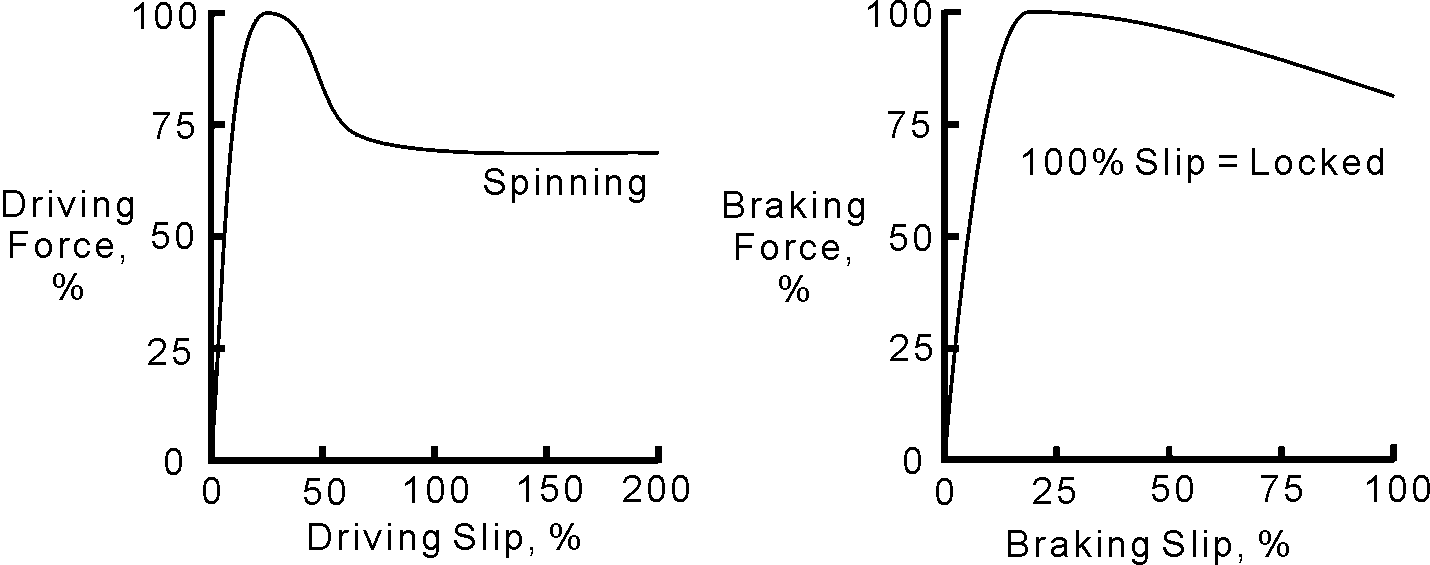
In order to create a longitudinal force, the tire must have non-zero slippage. It’s not large (for typical mild driving), but it’s not zero if you’re using the tire to accelerate or decelerate the car.

Max acceleration forces are found around 10% slip ratio.

http://www.insideracingtechnology.com/Resources/bhvrdrvbrksl...
◧◩◪◨
18. rightb+Q21[view] [source] [discussion] 2024-01-28 09:58:28
>>buran7+ad
I added g to give it a unit.

    mgμ = ma
    gμ = a
[go to top]