I definitely buy people with EVs hooning it around the place wrecking their tyres. It is really easy and fun to make use of all that torque. But it's not actually required.
Only 800 people in the state even own an EV. As one of the select few EV owners you can easily accelerate past the vast majority of the other cars on the road in Wyoming.
I'm not sure I follow what you mean when you say regenerative braking doesn't have to be put through the tires. The only reason you can do regenerative braking is because the vehicle inertia wants to keep going forward, so you allow that rotation to be used to drive the rotor and generate electricity. The ground resisting that rotation is required for the motor to have a generative load put on it. Either way it's still more you are asking the tire to withstand.
A rail car without rubber takes 10x-50x the distance to brake due to steel on steel friction.
Rubber is consumed from the tyre during acceleration, deceleration, and turning. Little rubber granules will roll off. The only time this isn’t happening is when the tyres aren’t in motion.
This is why you bring extra tyres to track day.
Tire wear would be a factor of deceleration, regardless if it's from a traditional brake or electrical braking
This comment does feel like talking to ChatGPT though, with the detailed clarifications the discussion didn't really require.
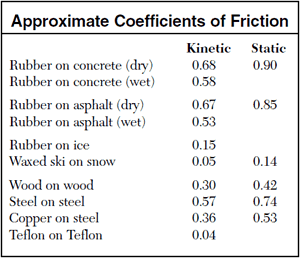
[0] https://www.aplusphysics.com/courses/honors/dynamics/images/...
In an ICE car, oscillating around the proper pedal position needed to maintain a particular speed leads to a cycle of coasting (not so hard on tires) and accelerating (harder on tires). With one pedal driving, at least with excessive oscillation, the cycle consists of regenerative breaking (harder on tires than coasting) and potentially more acceleration because the car slowed more rapidly. The more consistent you are at maintaining pedal position, the less the difference.
This might be best exhibited in downhill driving. An EV nudges the driver to be intentional about their downhill speed by applying regenerative braking, thereby requiring the driver to push the pedal down to reduce the braking. But on steep enough hills, there is still some braking. In an ICE vehicle, the driver might be more prone to just coast and let the car go a bit faster than they would have intentionally chosen.
In normal braking the friction between the pads and the wheel is the important one and in that case the stopping distance is determined by how much of the energy of the moving vehicle you can bleed through the force you apply with the braking pads. More mass/speed, more energy, more time needed to apply the xxxxN of force to the wheel and convert the energy to heat. The energy of the moving vehicle scales with its weight while the maximum force a friction braking system can apply doesn't.
The science of braking is even more complicated than that, materials heat up or melt, friction coefficients change, tires behave differently under different loads, ABS systems kick in, etc. These are deceptively complicated topics.
The formula for friction also doesn't contain surface area and yet we use wide tires and big brake pads. But the bottom line is that in a real life scenario (as in not in simplified formulas on paper) the weight of the vehicle very much influences the braking distance.
This is why blocking the wheels increases braking distance: you suddenly have to deal with a much smaller friction coefficient.
P.S. Isn't the static coefficient calculated for a stationary object trying to move against a surface? In a wheels locked scenario the wheel is sliding so the dynamic coefficient is the one to look at, accounting for the changed material properties of the heated/melted material.
Sure it’s lighter than a model Y or even a Leaf but it has decent acceleration if you know how to drive it.
Of course you can but we're not talking about G-forces. That's a coefficient of friction [0], a dimensionless measure. It's determined empirically literally by rubbing things together and is then used to calculate the friction force between different materials.
[0] https://en.wikipedia.org/wiki/Friction#Coefficient_of_fricti...
For a rolling wheel however, the stationary object is ideally just a point of the wheel, trying to move against the surface; but as soon as the wheel wins against the surface, the point rotates away and a new point tries to move against the surface. Even in the less ideal case a point of the tire always touches the same point of the asphalt from the moment it touches the ground to the moment it leaves it. So in that case you use the static coefficient.
For a more visual explanation see https://youtu.be/J0PVm4XTGeY?si=20TygSRdH3UxIx_4
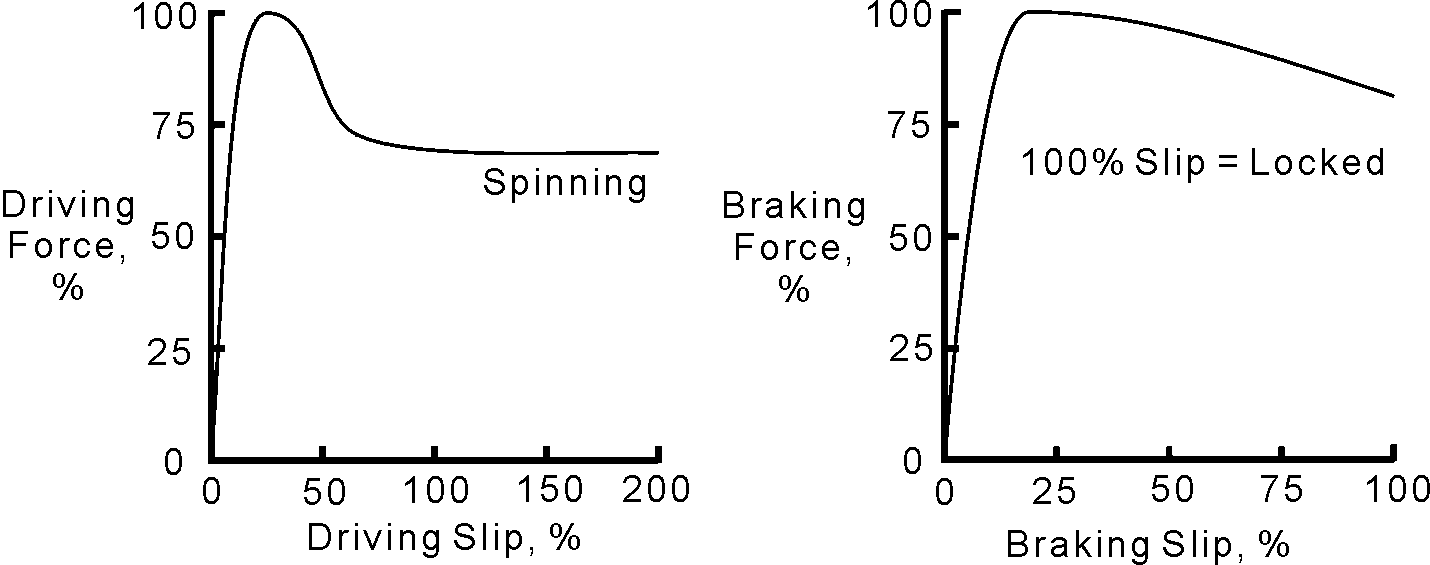
In order to create a longitudinal force, the tire must have non-zero slippage. It’s not large (for typical mild driving), but it’s not zero if you’re using the tire to accelerate or decelerate the car.
Max acceleration forces are found around 10% slip ratio.
http://www.insideracingtechnology.com/Resources/bhvrdrvbrksl...