I definitely buy people with EVs hooning it around the place wrecking their tyres. It is really easy and fun to make use of all that torque. But it's not actually required.
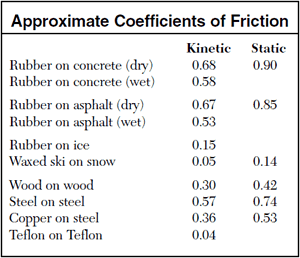
A rail car without rubber takes 10x-50x the distance to brake due to steel on steel friction.
Rubber is consumed from the tyre during acceleration, deceleration, and turning. Little rubber granules will roll off. The only time this isn’t happening is when the tyres aren’t in motion.
This is why you bring extra tyres to track day.
This comment does feel like talking to ChatGPT though, with the detailed clarifications the discussion didn't really require.
[0] https://www.aplusphysics.com/courses/honors/dynamics/images/...
In normal braking the friction between the pads and the wheel is the important one and in that case the stopping distance is determined by how much of the energy of the moving vehicle you can bleed through the force you apply with the braking pads. More mass/speed, more energy, more time needed to apply the xxxxN of force to the wheel and convert the energy to heat. The energy of the moving vehicle scales with its weight while the maximum force a friction braking system can apply doesn't.
The science of braking is even more complicated than that, materials heat up or melt, friction coefficients change, tires behave differently under different loads, ABS systems kick in, etc. These are deceptively complicated topics.
The formula for friction also doesn't contain surface area and yet we use wide tires and big brake pads. But the bottom line is that in a real life scenario (as in not in simplified formulas on paper) the weight of the vehicle very much influences the braking distance.