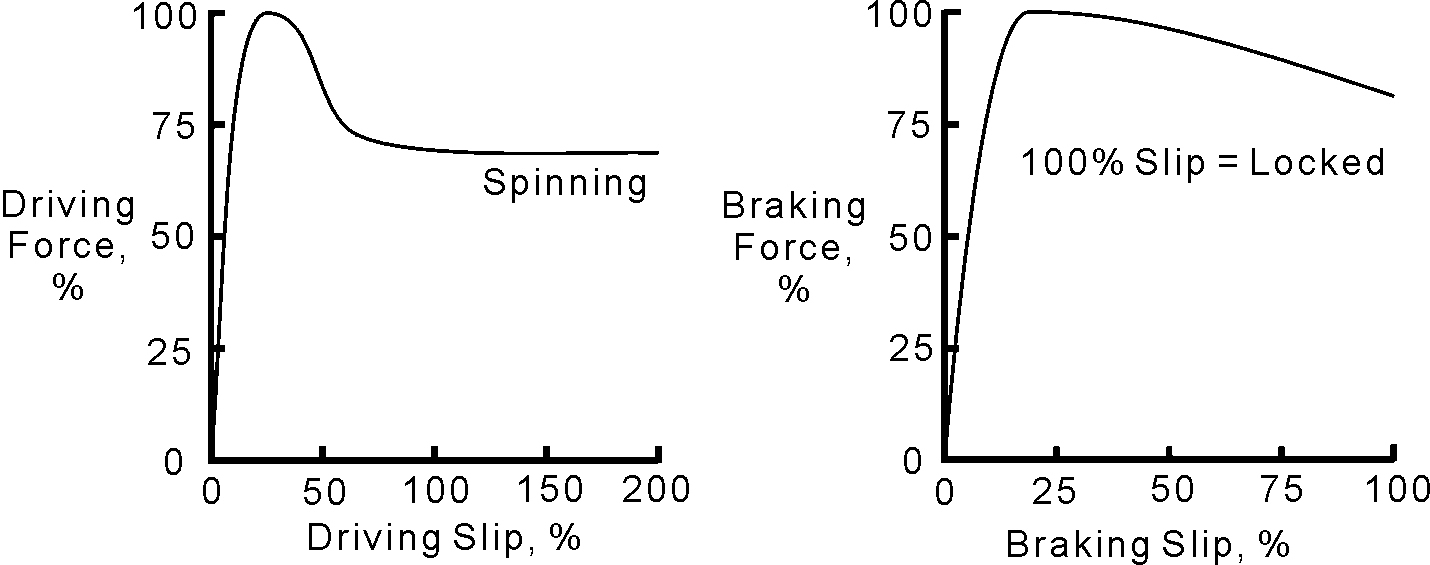
This is why blocking the wheels increases braking distance: you suddenly have to deal with a much smaller friction coefficient.
P.S. Isn't the static coefficient calculated for a stationary object trying to move against a surface? In a wheels locked scenario the wheel is sliding so the dynamic coefficient is the one to look at, accounting for the changed material properties of the heated/melted material.
For a rolling wheel however, the stationary object is ideally just a point of the wheel, trying to move against the surface; but as soon as the wheel wins against the surface, the point rotates away and a new point tries to move against the surface. Even in the less ideal case a point of the tire always touches the same point of the asphalt from the moment it touches the ground to the moment it leaves it. So in that case you use the static coefficient.
For a more visual explanation see https://youtu.be/J0PVm4XTGeY?si=20TygSRdH3UxIx_4
In order to create a longitudinal force, the tire must have non-zero slippage. It’s not large (for typical mild driving), but it’s not zero if you’re using the tire to accelerate or decelerate the car.
Max acceleration forces are found around 10% slip ratio.
http://www.insideracingtechnology.com/Resources/bhvrdrvbrksl...