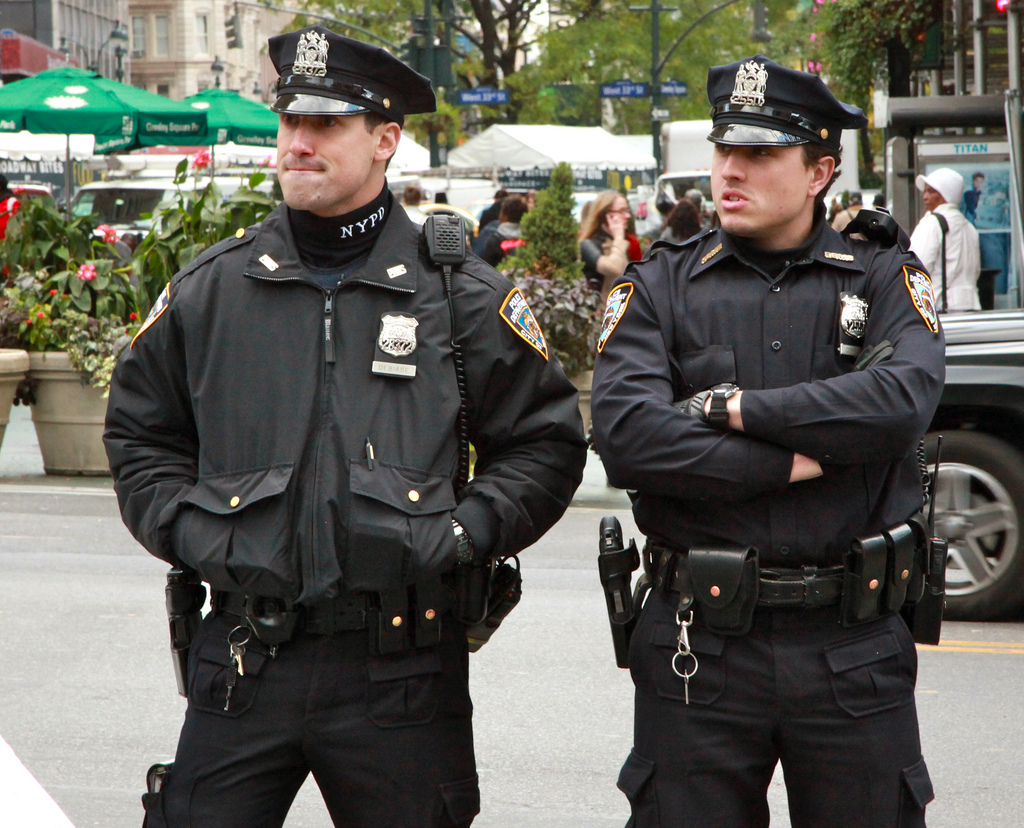
Dress for the job you want. If they all dress like storm troopers some of them will act like storm troopers.
NY state patrol uniform: Grey with purple ties. https://northcountrynow.com/sites/default/files/images/Zone2...
NYPD (new york city) police: Black on black with black ties. https://media.timeout.com/images/103899055/image.jpg
It seems meaningless, but having interacted with a few police agencies I have noticed a trend. They cops that show up for meetings in head-to-toe black tend to be more aggressive. They try to assert themselves in every meeting, which is entertaining as we are the military. They cannot win the "who has the bigger gun" thing. The cops that come in oldschool blue shirts and ties are much easier to work with.
(Fyi, if those two NYPD officers in the pic were in the military they would get a talking to about attitude. Hands in pockets. Chewing. Crossed arms. In public? Have some respect for your uniform.)
I'm also scared irreparable damage had been done to the police brand such that way fewer "good" people will want to sign up.
Totally agreed on the paint schemes.
[1] http://blogs.reuters.com/photo/files/2011/09/mdf489180.jpg
The police need to push cars to the side of the road on, I'd venture, a daily basis.
In what kind of weird and twisted world do police officers need to push cars to the side on a daily basis?
The leadership team for police that wants you dressing all paramilitary and in all black is going to have a focus on you acting a different way during training and in what your day to day is like than the other group.
There's also the brittle fact that I still remember the day long fire arms training where i was required to watch officers get shot for an hour and got it drilled into my head that it was better to shoot someone if I felt any risk or danger (and what to say if i had to do it), and that I needed to make sure i got to go home. It was all done in a very deniable way, but police officers are 100 percent indoctrinated during training to shoot if they feel like they are in any danger. I can speak more to what kind of training took place and the attitude of the instructors if people are curious.
Facetious commentary aside – and I do apologize for the tongue in cheekness – as a European I’ve always been struck by just how many wrecks and other debris are littered by the side of the roads in the US. Mileage varies I’m sure (no pun intended) but I covered 6660 miles on a road trip through in the US last year and it seemed almost universal to me that you’d see at least one car wreck (often partially or fully burned out) and loads of other debris like blown tires etc.
I think I’ve even got video from when I was leaving Kennedy Space Center and just a few miles from the bridges there was a car by the side of the road engulfed in flames.
On my latest road trip someone explained to me that the remnants of blown tires are from 18-wheelers that just keep on truckin’ once that happens, basically ignoring it till the next stop or even later. Given how many trucks you see on the road I wouldn’t be surprised if that’s true.
It's really not a strange concept and it's weird to me that you can't comprehend a first responder having a need to move a large, heavy, immobilized object.
Relevent: https://99percentinvisible.org/episode/the-blazer-experiment...
> For many years, the Menlo Park police had worn some variation of the traditional, pseudo-military, dark blue uniform. But Cizanckas thought that look was too intimidating and aggressive, so he traded it for slacks, dress shirts with ties, and a blazer. Guns and handcuffs remained hidden under the coat. Instead of a metal badge, the blazer sported an embroidered patch that looked a little like a coat of arms....
> That’s because uniforms not only shape how people see the police, but also how police see themselves. In challenging an image so entrenched in the style and psyche of police officers, Chief Cizanckas was bucking a tradition that would prove hard to change: a uniform whose history was interwoven with the profession it represented and that went back more than a hundred years.
Cops are also generally brutal on their vehicles. The biggest problem is probably a cop in a hurry getting out of a running vehicle without putting it into park. They get into lots of low-speed/rolling car collisions. These things happen if you are getting in/out of your car 50 times a day.
If not do a Google image search for 'american police officer' - almost every image has a different uniform colour, cut, insignia in it.
Dark blue, light blue, white, brown, black, grey, purple, yellow, green. It's every colour under the sun!
Two police officers:
https://static.trendscatchers.io/uploads/2019/01/bear34-uk.j...
https://writersforensicsblog.files.wordpress.com/2015/02/chi...
I think there's almost literally nothing consistent between these two uniforms (badge?)
> with a badge and utility belt
That's also what mall security guards wear in the US though.
There is a car accident every 3 seconds in America. Cops are almost always the first on the scene and clearing the highway of wrecked cars before a tow arrives is essential.
> An early study even suggested that altercations between citizens and police had declined because of the new uniform. The study’s findings were eventually challenged...
https://onlinelibrary.wiley.com/doi/abs/10.1111/j.1559-1816....
> Effects of such an alteration were examined in the laboratory and in the field. No positive effects of the uniform change were found.
That said I'm all for police not looking like an occupying military force armed to the teeth.
I’ll give you the green. That is unusual. It might be fair to add green to the list for some state trooper uniforms and park police uniforms.
I apologize if you’ve spent significant time in the US. I’m assuming you haven’t if significant variation in police uniform seems like it would commonly come up. The colors I mentioned are typical for city, county and state police. There are some variations, e.g., I said dark which could be black or a dark blue. To most people, the difference does not cause them to read the situation differently. When I review the uniforms of the 40-50 policing bodies with which I’m most familiar, I don’t see much deviation.
Security guards do try to mimic police uniforms as much as they can get away with, and I think that is dangerous. At minimum they should be forbidden from wearing a badge that looks like a police badge, and they should not be allowed to wear a hat that looks like a police hat. A security guard with a baseball hat, no badge, and their firm printed on their uniform is not easily mistaken for police.
In many cities (including mine, which has a lot of private security) the word POLICE is written in all caps and large letters on the back and front of their shirts. It's hard to make the distinction until you see them once, then it's pretty clear
Part of the training also drills in the fact that an untrained opponent with a sharp object like a knife is at a strategic advantage versus someone with a holstered firearm if they are closer than 21 feet away. Failure to maintain strategic dominance is a potentially fatal mistake.
Nobody is interested in empathizing with the mental state of the cop in these situations, and if you try to do so, you’ll be shouted down for not empathizing with the family and friends of the deceased. This is not only a false dichotomy, but it precludes you from arriving at possible solutions. The goal of this exercise is not to feel sorrow for the officer, but to discover the root cause of this pattern. Only after doing so can you expect to find solutions, and ultimately, save lives.
It is not acceptable to have a non-zero casualty rate, and what most people fail to understand is that the average human, even with training and experience (and often, experience is actually a liability, not an asset - people with PTSD are further compromised) cannot accurately assess and process a potential threat 100% of the time. This is the simple explanation for why these incidents seem to happen so frequently. Yet the general public thinks that police are somehow different from the average human, and that their brains do not work like their own. Or perhaps more accurately, they don’t understand how their own brain works, so in their mental re-enactment of the scenario, they make the correct decisions, and conclude that the only remaining explanation is hate, racism, or some other evil that only police seem to have.
If anyone wants to get a glimpse into what this environment does to a person, next time you go for dinner with a veteran, take note of where they sit at the table. More often than not, they will prefer to select a position that does not leave their back exposed to an entrance. Even in a harmless restaurant, their brain is instinctively on high alert for potential threats. That’s also why many of them cannot sleep.
IMHO, the way to prevent these errors is to prevent the number of opportunities to make a fatal mistake.
None of this is to suggest a complete lack of malice in all cases - but most of the time, people are people, and they will continue to do what people do, uniform or not.
A thousand people a year are killed by US cops. Canada, with 10% of the population, sees maybe 25 in a bad year.
"Fittingly, the most chilling scene in the movie doesn’t take place on a city street, or at a protest, or during a drug raid. It takes place in a conference room. It’s from a police training conference with Dave Grossman, one of the most prolific police trainers in the country. Grossman’s classes teach officers to be less hesitant to use lethal force, urge them to be willing to do it more quickly and teach them how to adopt the mentality of a warrior. ... In the class recorded for “Do Not Resist,” Grossman at one point tells his students that the sex they have after they kill another human being will be the best sex of their lives. The room chuckles. But he’s clearly serious. “Both partners are very invested in some very intense sex,” he says. “There’s not a whole lot of perks that come with this job. You find one, relax and enjoy it.”"
1. You do what you train to do.
2. What you look for in the world is what you will find.
3. Police work is risky, but not excessively so. https://www.bls.gov/iif/oshwc/cfar0020.pdf
Systems have both false positives and false negatives. A system with no false positives but many false negatives can be worse than a system with few false negatives and few false positives.
AL does not have an annual vehicle inspection, by the way.
There is no reason for them to be killing as many people as they do.
Yes, there is absolutely a reason. There is a reason for everything. If you want to fix it, you need to set your emotions aside and get to the root cause of that reason. If you continue to deny that there is a reason, you can expect the same tragic result.
Edit: I am not criticizing the statement or trying to put words in your mouth, I am just making sure I understood correctly. Because you may very well be suggesting a reality that most are unable to accept. I suspect if you say yes, you’ll be downvoted. But if I have that wrong, please do correct me.
The police in the U.S. seem to think like they are in the military , in their training and tactics. One big problem is the U.S. military is not exactly well regarded for is nuanced handling of conflict.
I once spoke to a marine who was involved in the invasion of Bagdad who describe their rules of engagement as "shoot any man woman or child holding a spade, a mobile phone, any kind of parcel or anything that might be a wire". These ROE are almost certainly a war crime, but the US is special so it gets away with it.
Now in the military you have a bunch of guys who actually have to deal with very dangerous, fluid situations that have a high likelihood of death. They mostly operate in areas where you have little room for anything other than binary control (obey or get shot). Whatever the details of the culture that was set down by the high ups before the Iraq invasion, I can somewhat get onboard. Casualties in a war zone are logistically hard, getting effective treatment often means at least some part of running them on a stretcher, potentially strapping them to the back of a vehicle and driving for an hour. If you aren't conservative in how you instruct people to respond, the effect can be highly non linear. One casualty take a 3 others out the fight, meaning casualties become more likely etc.
How police respond simply should not be modelled on the military. I entirely disagree with the idea that they are constantly primed to consider themselves one stop away from a body bag.
They almost certainly interact with more innocent members of the public than criminals. They are in largely stable situations. They may deal with bad people, but they do so in places that have good access to support, they will get timely care if something happens to them, and they almost certainly are well backed up if the situation gets out of hand.
My opinion is that the police basically suffer from a kind of dunning Kruger effect. Most would be woefully unprepared to handle an actual combat situation. You just have to compare the countless videos of about a dozen cops all unloading at the same car like the first to finish gets a prize.
Being a good solider is about maintaining discipline and composure under pressure. Most unit tactics involve some variant of your unit shooting over your head or off to your side whilst some of you push some kind of flanking manoeuvre. Our military even dropped the shoot from the hip on contact SOP because of the risk of friendly fire.
The police do not have anywhere near the same level of conditioning to operating under pressure from their training as any competent army gives it's soldiers. If they want to act like the military that's fine, but they should go through similar training before they do.
Here’s an Italian police car [0]. Here’s a Cobra HISS tank [1]. Here’s a local police department’s default cruiser [2].
When the police car looks more like a GI Joe tank than other nations, that’s an easy fix. Just like making kids were corny uniforms affects behavior, I think having police drive non-threatening cars will reduce violence.
[0] https://images.app.goo.gl/3uEds6hdzPwoiF6D7 [1] https://images.app.goo.gl/eJAaVdK5qNXEKah39 [2] https://www.ajc.com/rf/image_large/Pub/p8/AJC/2017/03/20/Ima...
Normally, getting to 0 false negatives requires a large number of false positives. E.g. if I wanted a 0 false negative pregnancy test, the only feasible way would be to tell some very large proportion (maybe all) test takers they are pregnant.
If it requires 20 innocent people to be killed in order to achieve say a goal of 1 police officer failing to identify a threat, who says that is the right balance?
You want to take emotions out of it, I say the life officer of a police officer is no more important than an innocent person, and given a police officer has a) control of which situations they enter and b) presumably accepts some level of risk from the job the choose and c) Killings by police are an externality that the police system is not incentivised to fix in a meaningful way , they should bear the burden of systemic risk from those interactions. Accepting no less than 1 innocent death for 1 police death seems like the rational baseline, and I think there are compelling points to suggest it should be less than one innocent death to police death.
People are right not to empathize.
Is the lack of interest in deescalating situations due to training or mentality or the wish to maintain authoritative appearances or some other factor I'm not thinking of?
I find point (a) interesting. You posit that they have control over which situations they enter. But one of the major criticisms I hear, after abuse of force, is that “the police didn’t do anything”. It would seem that these are incompatible. They can choose, but we expect them not to. We expect them to put themselves in harms way for us. As a society, we do value civilian lives the same as police lives. In fact, we value civilian lives far more. By and large, so do they. If they did not, they would not ever put themselves in a position where they might be killed. But, we expect them to do just that. If there is a heavily armed lunatic inside his house threatening to kill his wife and kids, we get out of dodge and tell the police to deal with it. I sure as hell am not going near that.
Just look at the outrage and protests every time an innocent man is killed. When is the last time anyone rioted, protested, or even remembered when an innocent police officer was killed? Never going to happen. By and large, we don’t give much of a shit about their lives. Most of us don’t even seem to consider them human. They know that, yet they do the job anyway.
Do you know how many police have been killed so far during the riots? One of them was just gunned down in cold blood in Oakland while guarding a federal building. He wasn’t doing any crowd control or engaged with protesters. A white van drove past, stopped, opened the sliding door, gunned him and his partner down, and drove off.
Another police chief was found dead outside of a looted pawn shop last night.
Nobody is ever going to protest this.
From the top down they simply dont care to follow. There is no punishment for them being violent against whomever they want.
I'm suggesting that optimizing for officer safety at all other costs may result in more overall death (/injury) than if more emphasis were put on civilian safety as well. I very much don't have any particular data to back that assertion up in this case, but often such things are true.
Hopefully that clarifies.
I can't parse what you're trying to say here, which prevented me from responding to the main body of your post, unfortunately.
> Nobody is ever going to protest this.
What would you suggest we protest? There are many dangerous professions. Law enforcement isn't even the most dangerous. They're not even in the top 10. Should we protest car accidents that lead to the death of professional truck drivers?
"Police" is an institution. It has norms and is governed by rules. Police officers are meant to protect and serve society. When they fail to do that, that should be protested. I don't see the value in protesting the fact that law enforcement careers carry risks. Yes, it's true that there are bad people in the world. That doesn't give law enforcement carte blanche to abuse their power, nor absolve individuals or institutions from protest of abuse of that power.
(There's also a relatively snarky response here: Yes, it's regrettable that these officers died in the line of duty. We should dismantle the US police institution in its entirety, which would solve both the concerns of BLM protestors and largely address your concern. While I don't share that view, I do know many people who do.)
2) Per [1] the surface area of your torso is about double that of one leg (that is, anterior torso is 18%, an individual leg anterior is 9%), so it's far more likely to hit if you aim for the torso. Even if you aim for a torso and miss, you might hit a limb or head - it's a lot less likely to miss a limb and hit something else.
3) The research behind the Tueller anti-knife self defence drill found an attacker with a knife could cover 21 ft / 6.4 metres in about 1.5 seconds. To stop the attack, you have to be able to shoot them before they can close to melee range - you must aim for the largest possible target to have any hope of success.
I am not commenting on US police practices generally, but specifically that the idea you can shoot to wound is neither responsible nor practical.
What is your proposed solution?
Your point is valid, but reading "there is no reason" literally misses the intended meaning, which is "this is unacceptable and cannot stand".
Part of the duty of a police officer is to put themselves in higher-danger situations than other citizens in order to protect and serve the public, up to and including taking physical harm or death (in fact half of police fatalities every year are in car accidents on duty).
If you train to be a hair trigger, protect-yourself-at-all-costs cop, that's how you will behave.
For what it’s worth, black men kill more cops than cops kill unarmed black men.
It’s tragic, but many orders of magnitude away from your claim.
It’s not the quantity that makes it horrible, tragic, and infuriating. It is all those things because it’s evidence of a larger systemic issue which includes lots of other awful things that fall short of homocide; and it’s largely unnecessary.
[0] https://www.cdc.gov/healthequity/lcod/men/2017/nonhispanic-b...
[1] https://www.statista.com/statistics/585152/people-shot-to-de...
Regarding your second claim, I can't find those numbers. The closest thing I can find is this newsweek piece [2] with data from 2013 and 2014. That suggests most people who kill police are white. But it also includes prison guards as police.
[1]: https://www.latimes.com/science/story/2019-08-15/police-shoo...
[2]: https://www.newsweek.com/who-kills-police-officers-315701
You're right the quantity isn't specifically important but it does illustrate that there is a problem. Even if it is not the #1 cause of death it is disproportionately higher.
I moved to Europe three years ago. Here, police outfits are designed to be seen in the dark, so they're day glo and neutral. In the US, police officers are terrifying creatures.
So why is the United States police unique amongst all other developed countries for its kill rate then?
> Part of the training also drills in the fact that an untrained opponent with a sharp object like a knife is at a strategic advantage versus someone with a holstered firearm if they are closer than 21 feet away.
And yet I've seen police officers here in Europe deal with people with knives without ever pulling a gun. Why can we do this and you can't?
The idea that a man with a knife 20 feet away from a man with a gun has the advantage! - it just seems like a justification for the incompetent policing that the US is notorious for all over the world.
When I lived in the United States, on the very rare occasion that a police officer was killed, our community would memorialize him.
But the fact is that police officers kill others at at least _twenty times_ the rate that police officers get killed by non-police officers.
More, if someone kills a police officer, they are almost always caught, and then gets decades in jail. When a police officer kills someone else, nothing happens to them, even when the police officer.
I lived for thirty years in the United States, and I saw the most terrible behavior from police officers - not just brutality, but gross incompetence and corruption (as in "bundles of cash being handed to cops").
Now I live in Europe, and police here are competent and friendly (and also very effective at dealing with violent drunks, I actually laughed to see someone just lifted up from behind by two cops struggling away in midair, hurting no one, not even himself). It's like night and day.
> Another police chief was found dead outside of a looted pawn shop last night.
I wasn't able to find even _one_ police chief who was found dead.
I did find a story about a retired police captain who was found dead, but no one else.
So at least some truck drivers will ignore a blowout, particularly if it's in the last couple of hours of a trip.
This is what it looks like even when the officer knows it is coming: https://youtu.be/2h0-q_IJbxE
> And yet I've seen police officers here in Europe deal with people with knives without ever pulling a gun. Why can we do this and you can't?
"Combat experts" must hate these European police, not abiding by their theories.
Yes. What is and what is not a war crime is determined by the ICC in the Hague. The US does not recognize the authority of the ICC.
Per definition, no US soldier can literally ever commit a war crime.
So in that respect, they are not a whole lot different from US police. They can commit atrocities and get away with it.
It's like as if Germany decided to just not show up at Nuremberg.