Now one fix that removing some of the equipment will do will reduce the amount of psychological impact it has on those wielding it, as in reduce the Rambo effect. The idea of attaching military style equipment to the current problems is only for political purposes, they needed to blame Trump for the violence.
However in the end, there are few alternatives to fixing the police and their application and misapplication of force
1) Restrict conditions that can be placed in union negotiated contracts regarding officer behavior, culpability, and indemnification.
2) If not 1) then make it illegal for the unions to exist with regards to any public servant who is armed
3) civilian oversight boards that are veto proof against the police they monitor. Not only would they review incidents which are questionable they would have to involved in any use of concentrated force to include no knock warrants; something which should be illegal except in the most incredible cases.
4) holding elected and appointed officials of the localities, city, county, or state, accountable for the harm caused by their police forces.
Dress for the job you want. If they all dress like storm troopers some of them will act like storm troopers.
NY state patrol uniform: Grey with purple ties. https://northcountrynow.com/sites/default/files/images/Zone2...
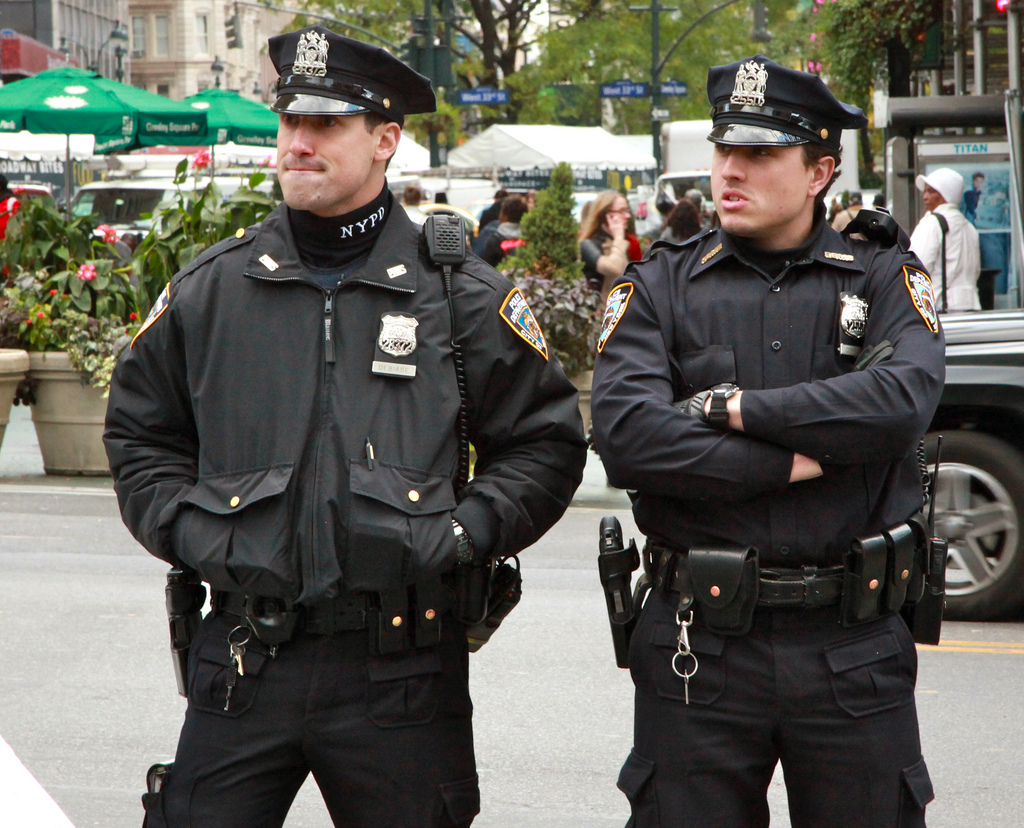
NYPD (new york city) police: Black on black with black ties. https://media.timeout.com/images/103899055/image.jpg
It seems meaningless, but having interacted with a few police agencies I have noticed a trend. They cops that show up for meetings in head-to-toe black tend to be more aggressive. They try to assert themselves in every meeting, which is entertaining as we are the military. They cannot win the "who has the bigger gun" thing. The cops that come in oldschool blue shirts and ties are much easier to work with.
(Fyi, if those two NYPD officers in the pic were in the military they would get a talking to about attitude. Hands in pockets. Chewing. Crossed arms. In public? Have some respect for your uniform.)
The leadership team for police that wants you dressing all paramilitary and in all black is going to have a focus on you acting a different way during training and in what your day to day is like than the other group.
There's also the brittle fact that I still remember the day long fire arms training where i was required to watch officers get shot for an hour and got it drilled into my head that it was better to shoot someone if I felt any risk or danger (and what to say if i had to do it), and that I needed to make sure i got to go home. It was all done in a very deniable way, but police officers are 100 percent indoctrinated during training to shoot if they feel like they are in any danger. I can speak more to what kind of training took place and the attitude of the instructors if people are curious.
Part of the training also drills in the fact that an untrained opponent with a sharp object like a knife is at a strategic advantage versus someone with a holstered firearm if they are closer than 21 feet away. Failure to maintain strategic dominance is a potentially fatal mistake.
Nobody is interested in empathizing with the mental state of the cop in these situations, and if you try to do so, you’ll be shouted down for not empathizing with the family and friends of the deceased. This is not only a false dichotomy, but it precludes you from arriving at possible solutions. The goal of this exercise is not to feel sorrow for the officer, but to discover the root cause of this pattern. Only after doing so can you expect to find solutions, and ultimately, save lives.
It is not acceptable to have a non-zero casualty rate, and what most people fail to understand is that the average human, even with training and experience (and often, experience is actually a liability, not an asset - people with PTSD are further compromised) cannot accurately assess and process a potential threat 100% of the time. This is the simple explanation for why these incidents seem to happen so frequently. Yet the general public thinks that police are somehow different from the average human, and that their brains do not work like their own. Or perhaps more accurately, they don’t understand how their own brain works, so in their mental re-enactment of the scenario, they make the correct decisions, and conclude that the only remaining explanation is hate, racism, or some other evil that only police seem to have.
If anyone wants to get a glimpse into what this environment does to a person, next time you go for dinner with a veteran, take note of where they sit at the table. More often than not, they will prefer to select a position that does not leave their back exposed to an entrance. Even in a harmless restaurant, their brain is instinctively on high alert for potential threats. That’s also why many of them cannot sleep.
IMHO, the way to prevent these errors is to prevent the number of opportunities to make a fatal mistake.
None of this is to suggest a complete lack of malice in all cases - but most of the time, people are people, and they will continue to do what people do, uniform or not.
Systems have both false positives and false negatives. A system with no false positives but many false negatives can be worse than a system with few false negatives and few false positives.
Edit: I am not criticizing the statement or trying to put words in your mouth, I am just making sure I understood correctly. Because you may very well be suggesting a reality that most are unable to accept. I suspect if you say yes, you’ll be downvoted. But if I have that wrong, please do correct me.
Normally, getting to 0 false negatives requires a large number of false positives. E.g. if I wanted a 0 false negative pregnancy test, the only feasible way would be to tell some very large proportion (maybe all) test takers they are pregnant.
If it requires 20 innocent people to be killed in order to achieve say a goal of 1 police officer failing to identify a threat, who says that is the right balance?
You want to take emotions out of it, I say the life officer of a police officer is no more important than an innocent person, and given a police officer has a) control of which situations they enter and b) presumably accepts some level of risk from the job the choose and c) Killings by police are an externality that the police system is not incentivised to fix in a meaningful way , they should bear the burden of systemic risk from those interactions. Accepting no less than 1 innocent death for 1 police death seems like the rational baseline, and I think there are compelling points to suggest it should be less than one innocent death to police death.
I find point (a) interesting. You posit that they have control over which situations they enter. But one of the major criticisms I hear, after abuse of force, is that “the police didn’t do anything”. It would seem that these are incompatible. They can choose, but we expect them not to. We expect them to put themselves in harms way for us. As a society, we do value civilian lives the same as police lives. In fact, we value civilian lives far more. By and large, so do they. If they did not, they would not ever put themselves in a position where they might be killed. But, we expect them to do just that. If there is a heavily armed lunatic inside his house threatening to kill his wife and kids, we get out of dodge and tell the police to deal with it. I sure as hell am not going near that.
Just look at the outrage and protests every time an innocent man is killed. When is the last time anyone rioted, protested, or even remembered when an innocent police officer was killed? Never going to happen. By and large, we don’t give much of a shit about their lives. Most of us don’t even seem to consider them human. They know that, yet they do the job anyway.
Do you know how many police have been killed so far during the riots? One of them was just gunned down in cold blood in Oakland while guarding a federal building. He wasn’t doing any crowd control or engaged with protesters. A white van drove past, stopped, opened the sliding door, gunned him and his partner down, and drove off.
Another police chief was found dead outside of a looted pawn shop last night.
Nobody is ever going to protest this.
When I lived in the United States, on the very rare occasion that a police officer was killed, our community would memorialize him.
But the fact is that police officers kill others at at least _twenty times_ the rate that police officers get killed by non-police officers.
More, if someone kills a police officer, they are almost always caught, and then gets decades in jail. When a police officer kills someone else, nothing happens to them, even when the police officer.
I lived for thirty years in the United States, and I saw the most terrible behavior from police officers - not just brutality, but gross incompetence and corruption (as in "bundles of cash being handed to cops").
Now I live in Europe, and police here are competent and friendly (and also very effective at dealing with violent drunks, I actually laughed to see someone just lifted up from behind by two cops struggling away in midair, hurting no one, not even himself). It's like night and day.
> Another police chief was found dead outside of a looted pawn shop last night.
I wasn't able to find even _one_ police chief who was found dead.
I did find a story about a retired police captain who was found dead, but no one else.