Now one fix that removing some of the equipment will do will reduce the amount of psychological impact it has on those wielding it, as in reduce the Rambo effect. The idea of attaching military style equipment to the current problems is only for political purposes, they needed to blame Trump for the violence.
However in the end, there are few alternatives to fixing the police and their application and misapplication of force
1) Restrict conditions that can be placed in union negotiated contracts regarding officer behavior, culpability, and indemnification.
2) If not 1) then make it illegal for the unions to exist with regards to any public servant who is armed
3) civilian oversight boards that are veto proof against the police they monitor. Not only would they review incidents which are questionable they would have to involved in any use of concentrated force to include no knock warrants; something which should be illegal except in the most incredible cases.
4) holding elected and appointed officials of the localities, city, county, or state, accountable for the harm caused by their police forces.
Dress for the job you want. If they all dress like storm troopers some of them will act like storm troopers.
NY state patrol uniform: Grey with purple ties. https://northcountrynow.com/sites/default/files/images/Zone2...
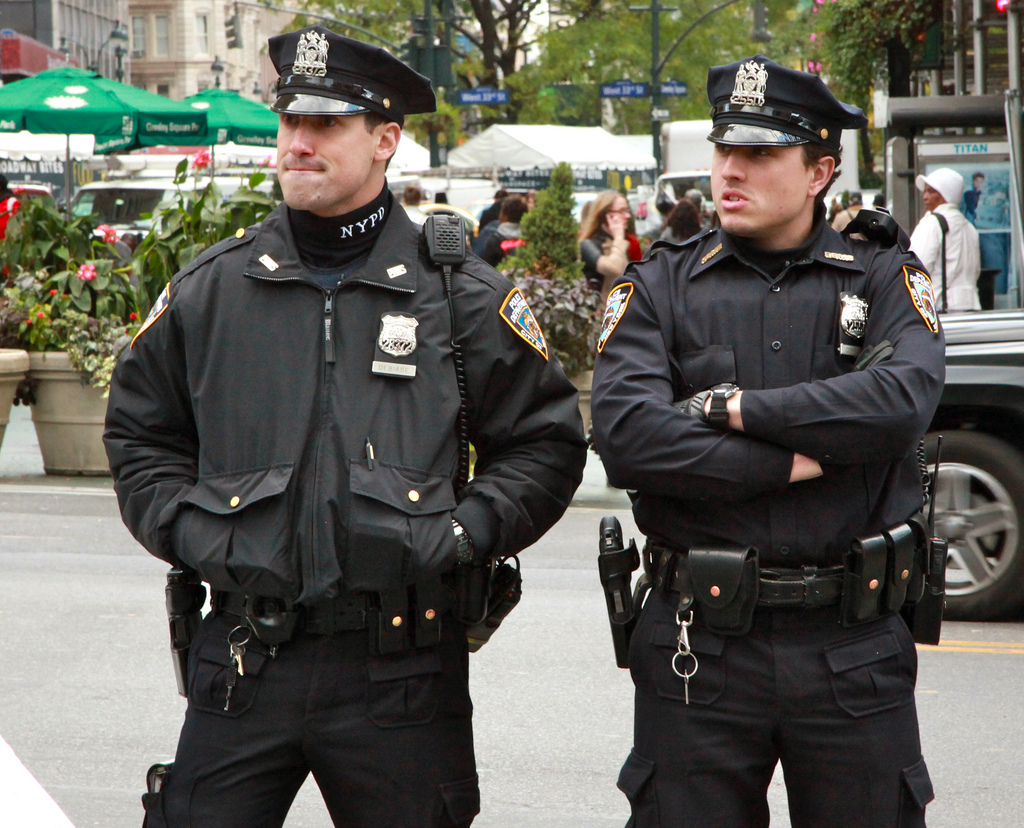
NYPD (new york city) police: Black on black with black ties. https://media.timeout.com/images/103899055/image.jpg
It seems meaningless, but having interacted with a few police agencies I have noticed a trend. They cops that show up for meetings in head-to-toe black tend to be more aggressive. They try to assert themselves in every meeting, which is entertaining as we are the military. They cannot win the "who has the bigger gun" thing. The cops that come in oldschool blue shirts and ties are much easier to work with.
(Fyi, if those two NYPD officers in the pic were in the military they would get a talking to about attitude. Hands in pockets. Chewing. Crossed arms. In public? Have some respect for your uniform.)
The leadership team for police that wants you dressing all paramilitary and in all black is going to have a focus on you acting a different way during training and in what your day to day is like than the other group.
There's also the brittle fact that I still remember the day long fire arms training where i was required to watch officers get shot for an hour and got it drilled into my head that it was better to shoot someone if I felt any risk or danger (and what to say if i had to do it), and that I needed to make sure i got to go home. It was all done in a very deniable way, but police officers are 100 percent indoctrinated during training to shoot if they feel like they are in any danger. I can speak more to what kind of training took place and the attitude of the instructors if people are curious.
Part of the training also drills in the fact that an untrained opponent with a sharp object like a knife is at a strategic advantage versus someone with a holstered firearm if they are closer than 21 feet away. Failure to maintain strategic dominance is a potentially fatal mistake.
Nobody is interested in empathizing with the mental state of the cop in these situations, and if you try to do so, you’ll be shouted down for not empathizing with the family and friends of the deceased. This is not only a false dichotomy, but it precludes you from arriving at possible solutions. The goal of this exercise is not to feel sorrow for the officer, but to discover the root cause of this pattern. Only after doing so can you expect to find solutions, and ultimately, save lives.
It is not acceptable to have a non-zero casualty rate, and what most people fail to understand is that the average human, even with training and experience (and often, experience is actually a liability, not an asset - people with PTSD are further compromised) cannot accurately assess and process a potential threat 100% of the time. This is the simple explanation for why these incidents seem to happen so frequently. Yet the general public thinks that police are somehow different from the average human, and that their brains do not work like their own. Or perhaps more accurately, they don’t understand how their own brain works, so in their mental re-enactment of the scenario, they make the correct decisions, and conclude that the only remaining explanation is hate, racism, or some other evil that only police seem to have.
If anyone wants to get a glimpse into what this environment does to a person, next time you go for dinner with a veteran, take note of where they sit at the table. More often than not, they will prefer to select a position that does not leave their back exposed to an entrance. Even in a harmless restaurant, their brain is instinctively on high alert for potential threats. That’s also why many of them cannot sleep.
IMHO, the way to prevent these errors is to prevent the number of opportunities to make a fatal mistake.
None of this is to suggest a complete lack of malice in all cases - but most of the time, people are people, and they will continue to do what people do, uniform or not.
The police in the U.S. seem to think like they are in the military , in their training and tactics. One big problem is the U.S. military is not exactly well regarded for is nuanced handling of conflict.
I once spoke to a marine who was involved in the invasion of Bagdad who describe their rules of engagement as "shoot any man woman or child holding a spade, a mobile phone, any kind of parcel or anything that might be a wire". These ROE are almost certainly a war crime, but the US is special so it gets away with it.
Now in the military you have a bunch of guys who actually have to deal with very dangerous, fluid situations that have a high likelihood of death. They mostly operate in areas where you have little room for anything other than binary control (obey or get shot). Whatever the details of the culture that was set down by the high ups before the Iraq invasion, I can somewhat get onboard. Casualties in a war zone are logistically hard, getting effective treatment often means at least some part of running them on a stretcher, potentially strapping them to the back of a vehicle and driving for an hour. If you aren't conservative in how you instruct people to respond, the effect can be highly non linear. One casualty take a 3 others out the fight, meaning casualties become more likely etc.
How police respond simply should not be modelled on the military. I entirely disagree with the idea that they are constantly primed to consider themselves one stop away from a body bag.
They almost certainly interact with more innocent members of the public than criminals. They are in largely stable situations. They may deal with bad people, but they do so in places that have good access to support, they will get timely care if something happens to them, and they almost certainly are well backed up if the situation gets out of hand.
My opinion is that the police basically suffer from a kind of dunning Kruger effect. Most would be woefully unprepared to handle an actual combat situation. You just have to compare the countless videos of about a dozen cops all unloading at the same car like the first to finish gets a prize.
Being a good solider is about maintaining discipline and composure under pressure. Most unit tactics involve some variant of your unit shooting over your head or off to your side whilst some of you push some kind of flanking manoeuvre. Our military even dropped the shoot from the hip on contact SOP because of the risk of friendly fire.
The police do not have anywhere near the same level of conditioning to operating under pressure from their training as any competent army gives it's soldiers. If they want to act like the military that's fine, but they should go through similar training before they do.