https://web.archive.org/web/20200127011511/https://www.spect...
Of course, the DSM is very controversial, and many people could fill in the argument, but this article doesn't do it.
It's still entirely possible that it happened as reported, but that the (properly) confidential records were destroyed/lost.
According to Wikipedia, "'[s]he writes that she cannot be completely certain that Rosenhan cheated', despite entitling her book as she did." [1]
Did you read the article? This isn't possible at all.
> the distinguished psychologist Eleanor Maccoby, who was in charge of assessing Rosenhan’s tenure file, reported that she and others were deeply suspicious of him, and that they found it ‘impossible to know what he had really done, or if he had done it’, granting him tenure only because of his popularity
True, this is just circumstantial.
> At various times, Rosenhan had proffered sometimes contradictory biographical fragments about pseudo-patients 2 through to 8, but even with the assistance of a private detective, these leads led nowhere.
Hmm, it'd be hard for everything to have happened as reported, given that what was reported contradicted itself.
> In a larger sense, it scarcely matters, because Cahalan uncovered so much other evidence of Rosenhan’s malfeasance and lies.
Hmmmmmmmm...
> He claimed, for example, to have carefully coached his volunteers before sending them forth. Bill Underwood and Harry Lando emphatically denied this.
OK, now we know it didn't happen as reported even in cases where there wasn't an internal contradiction in the reporting.
> Lando appears to have been dismissed from the study, not because he violated protocol, but because, as Rosenhan incredulously noted about his confinement, ‘HE LIKES IT!’
The "throw away any data you don't like" school of research.
> Most damning of all, though, are Rosenhan’s own medical records. When he was admitted to the hospital, it was not because he simply claimed to be hearing voices but was otherwise ‘normal’.
Note that this is what he reported he had claimed.
> On the contrary, he told his psychiatrist his auditory hallucinations included the interception of radio signals and listening in to other people’s thoughts. He had tried to keep these out by putting copper over his ears, and sought admission to the hospital because it was ‘better insulated there’. For months, he reported he had been unable to work or sleep, financial difficulties had mounted and he had contemplated suicide. His speech was retarded, he grimaced and twitched, and told several staff that the world would be better off without him.
A virtually infinite number of things can cause symptoms which have some overlap with schizophrenia, and that's why today (I'm not an expert, but I'm assuming what I know of is representative) on intake they classify someone as "schizophreniform" - apparently a fancy way to say "looks like/might be schizophrenia" without committing to anything.
For every person that has a chronic condition, there are going to be many that have one episode and it never recurs. Maybe it was a virus. Maybe they had some weird allergic reaction. Hospitals are never going to know for sure what's wrong with everyone, so the humane thing is not to insist they determine whether the remainder is "real" or not.
Being involuntarily admitted as a psych patient has permanent consequences, and it's uncomfortable to think about someone who doesn't "deserve" the stigma being caught up in it. I think an obsession with this scenario drives the people who crusade against psychiatry. But putting more pressure on medical professionals to always get it right is only liable to make things worse. You can't get better results by applying thumbscrews to people who genuinely try their best to deal with a fundamentally intractable problem.
This did jump out at me:
"then, as now, no scans, no blood tests, no laboratory findings allowed them to distinguish the mad from the sane"
In the 21st century, I believe hospitals in the US typically screen for likely drugs first, when someone appears to have psychotic symptoms. But they also (at least where I know about) do pretty comprehensive blood tests that show clear metabolic abnormalities and then just discard the results when they don't know what it means. So in a sense, sure, there's no blood test for mental symptoms, and yet if positive tests for various things are routinely met with a shrug and typical psychotropic drugs administered, then the statement is misleading.
The problem of false priors, deliberate misdirection, and motivated reasoning are insidious. Having to un-learn false models is difficult and expensive, personally, bit especially socially.
Even if Rosenhan's experiment was a fraud, the notion that psychiatric institutions or the field of psychology does not engage in the practice of arbitrary, thinly-supported, or entirely fictitious diagnosis, or failure to account for changes in condition, at least at times isn't disproved. And ... at least to my lay understanding ... this does seem to manifest elsewhere than in Rosenhan's accounts.
There are two competing sets of motivated reasoning to be considered here, which makes determination of ground truth that much more difficult.
On false priors, I've been familiar for a time with the notion of "Wittgenstein's Ladder", a/k/a "Lies told to children" (https://en.wikipedia.org/wiki/Wittgenstein%27s_ladder):
My propositions serve as elucidations in the following way: anyone who understands me eventually recognizes them as nonsensical, when he has used them—as steps—to climb beyond them. (He must, so to speak, throw away the ladder after he has climbed up it.)
He must transcend these propositions, and then he will see the world aright.
-- Tractatus Logico-Philosophicus 6.54
This leads to the challenge over time of finding oneself having climbed the ladder, but in discussions with others, constantly confronted with it, and having to explain around or over it. Wittgenstein's Ladder becomes, when erected horizontally across a passage of understanding rather than vertically to greater heights or across gulfs, Wittgenstein's Barricade.
It's this constant having-to-retread-fundamentals which seems to actively impede further development of knowledge and understanding, and which I've found increasingly intolerable in much popular media and discussion. Worse when it's not even the fundamentals which are being retread, but someone's self-serving current reformulation (often worse than the original). See Schopenhauer's "On Authorship".
Ultimately he claimed to have eight pseudo-patients, but investigation has turned up three, and none match what was described in the paper. (Eg, Rosenhan said it was easy to be admitted, even after showing limited symptoms, but he was actually only admitted after showing extreme symptoms. He said life while admitted was dreadful, but one of the subjects was dropped because he found it peaceful and helpful.)
Occam's razor suggests that there were only 3-4, he lied about their results, and made up the rest. But maybe there were some others, and maybe some of them actually had experiences similar to the paper? But even so, at best, he lied, filtered data, and reported very mixed results as being anything but. More likely....yes, complete horseshit.
There's no real defence of his work possible; at this point it's just speculating over whether it was all lies, or just a misleading mixture of lies and truth, and trying to estimate the damage it did.
Keep in mind, a major part of his paper was about how the pseudo-patients were admitted after describing extremely limited and mild symptoms. And a major part of the investigation was determining that, at least in one case, this is untrue; Rosenhan claimed to have extremely severe symptoms, including suicidal ideation.
In other words, it now sounds like the hospitals responded reasonably, but Rosenhan's paper claimed something quite different.
Re-reading the article, It seems to suggest that it undermined public trust in forced psychiatric treatment. I can only guess that the author believes this was for the worse and is the titular setback?
Because what else can be done except to say "ok, there are symptoms, now the symptoms went away, huh." If he was honest, it doesn't reflect that badly on the professionals because there's always going to be cases that fit the pattern.
His distortion seems exactly like every pop-sci article today that is written for outrage-clicks. It seems kind of quaint, even though granted it's an influential paper.
Did Roseanhan claim to have a dr-patient relationship with them. Do they just mean alleged-patients or alleged study subjects?
And they are basically defined by clustering of symptoms. This is driven by welfare/insurance reasons. You need a diagnosis to get benefits.
And while they often can't treat the underlying problem for schizophrenia and other diseases, they can definitely treat the symptoms. So if you have some of the same symptoms by some other unique variant of the disease, the treatment may still by useful.
Diagnosis is still left to the subjective assessment of the practitioner before prescribing powerful psychotropics that DO change brain chemistry in unpredictable ways, and cause a host of side effects often worse than the original symptoms.
So the argument today that psychiatry lacks any scientific basis and rigor for its practices is still very valid and legitimate.
Assuming Rosenhan's study was fictional, what was his intent? Was it a lie intentionally designed to discredit, destroy, or reform these institutions?
If I do a study showing that handwashing in surgeons measurably reduces risk of infection, does the fact that I don't know about microbes make lacking in scientific rigor and remove its scientific basis?
Maybe someday we'll have wide access to inexpensive monitoring techniques that could fill this need.
Or at least that's the version told in Adam Curtis' documentary The Trap (part 1)[1] which engages in Curtis's usual enthusiasm for fashioning a sweeping historical narrative out of somewhat sparse materials - in this case presenting the "Thud" experiment and its followup as a pivot point in the tale of how R. D. Laing's anti-psychiatry ironically led to the advent of the DSM IV era.
However that may be, if Curtis' account of the followup is correct it seems harder to argue the diagnostic prowess of the psychiatrists was not open to question, regardless of the status of the original experiment.
1: In the section beginning here: https://youtu.be/y97Ywl7RtUw?t=2204
No, there are not. A given drug may work consistently for some people, while having no effect, or detrimental effects on other people with the same diagnosis.
And while they often can't treat the underlying problem
for schizophrenia and other diseases, they can
definitely treat the symptoms.
Psychiatry is far, far from perfect. It is a discipline that is still taking its tiniest of baby steps into the realm of actual usefulness.
I think any psychiatrist would be willing to openly admit this; that the mind is still largely a mystery to us and we have probably centuries of learning to do, due to the extreme difficulty of studying a living mind, much less performing repeatable experiments upon them.
And yet criticism of psychiatry so often misses the point! The medicines are sometimes hugely beneficial. Sometimes not. But I know lives that have been transformed for the better thanks to them.
"Consistently and repeatedly" does not mean "this works 100.0% of the time."
Would you deny that exercise fails to consistently and repeatably help people lose weight? Would you say that existing treatments for heart attack victims fail to consistently and repeatably help victims? Would you say umbrellas fail to consistently and repeatably stop rain from falling on your head?
None of these things work 100% of the time, but they are frequently successful.
Psychiatry is a field still in its infancy due to the difficulty of studying the mind. We should hold it accountable for its failings and work to make sure it improves. But, it has successes as well.
It's not the only game in town when it comes to mental health, for sure, but it's also compatible with a lot of other things that can have great benefits for mental health. Meditation, lifestyle changes, exercise, therapy, environment... none are incompatible with psychiatry, which is not perfect but can be a valuable tool in the toolbox.
The distinction is that pop-sci articles are just journalism. Most academics take pop-sci journalism in their field with a grain of salt at most, and usually a hard eye-roll.
Real scientific journal/conference articles are held to real standards. Exaggerating or misreporting results in a scientific article is basically malpractice. It's by far the worst (scientific) thing that a scientist can do.
Mind: I'm not arguing that science doesn't make mistakes. Science is a mistake-making-and-correcting process. But there are certain fields of science, somewhat more so in the social than physical and biological sciences, in which a widely-adopted plausible theoretical understanding seems missing.
Science seems to move through stages, of observation and categorisation, to individual models of localised predictive (or descriptive) understanding, to a fundamental theoretical underpinning.
Geology and biology are interesting cases, each being effectively ancient, but for which the establishment of the underlying theory lies largely within human memory.
In the case of biology, taxonomic classification, Darwin's theory of evolution based on variation, inheritence, and selection, Mendelian genetics, and finally the discovery of the structure and reading of DNA and RNA by Watson, Crick, and others (1950s) cast the final links in the chain. We're strengthening those, but the underlying model seems largely complete.
(I'd count concepts of dissipative systems as largely conformant with this model, though important additions.)
For geology, similarly, there was the notion of stratigraphy, which established an ordering but not a specific timescale for geology. Understanding of that didn't occur until the work of Rutherford, Soddy, Holmes, and Boltwood, largely in the first decade of the 20th century.
At the time, the leading scientific value for the age of the Earth was 20 millions of years, by William Thomson, Lord Kelvin (reduced from an earlier estimate of 100 million years). Rutherford and Boltwood's initial measurements based on radioactive decay demonstrated a timescale of billions of years, subsequently refined to the present value of 4.6 billion +/- 1% in the 1950s.
That still didn't explain much geological activity, particularly vulcanology, earthquakes, uplifts, and subsidence (though sedimentation and erosion were well understood). That required the notion of plate tectonics and continental drift, formally adopted only in 1965-1967 (by various conferences / professional bodies).
Plate tectonics, driven by residual thermal heat of formation and radioactive decay in the Earth's core and mantle is now considered the theoretical underpinning of all of geology. It's formal adoption is 55 years old, for a study that's existed since the time of ancient Greece.
The social sciences -- sociology, psychology, political economy, and political science -- lack any such empirically demonstratable and falsifiable theoretcal underpinning. To a large extent they've resisted adopting one.
That last point isn't uncommon -- biology certainaly resisted evolution, and geology plate tectonic (see Naomi Oreske's works on this topic, themselves fascinating studies of the evolution of scientific theory: https://www.worldcat.org/search?qt=worldcat_org_all&q=au%3Ao...).
And as with pre-genetic biology, pre-tectonic geology, pre-Newtonian physics, and pre-Mendeleevian chemistry, there are useful concepts, models, methods, and mathematical relations in these fields. But not a true unifying theoretic basis.
If psychology wants the status and rewards of being considered a legitimate science, it needs to make dramatic changes. In the meantime any initial result psychological research produces must be considered not just preliminary, but suspect.
[1] https://en.m.wikipedia.org/wiki/Power_posing [2] https://science.sciencemag.org/content/348/6239/1100.2
It's to make the point that he didn't recruit actual patients for the study, but (in his telling) perfectly sane people to pretend to be ill.
Did the DSM-IV result in inaccurate diagnoses? Worse treatment? The review doesn't clearly state a single negative consequence. For that matter, reading the review, I can't even be sure if the book argues that the DSM-IV was bad, or if that's merely the review authors' opinion. I expect that kind of clarity from a review, and it's missing here.
Or again, on the point about the DSM-IV being a response to Rosenthal, what I'd like to read is something along the lines of "Cahalan's book presents detailed evidence that the DSM-IV was [influenced/prompted by/etc] the reaction to Rosenthal's experiment".
In defense of the reviewer: the worst issue might be a case where the title simply promises more than the article delivers. And the reviewer typically doesn't write their title, so it may be the editor who is to blame.
Milgram, Zimbardo all these experiments from the 50's onwards are junk. Doesn't mean it set back psychiatry.
How psychiatry works is you get something that you intuitively think is true, make up a experiment to prove it (so it's ok for others to agree without getting in trouble)
Then consensuses decides.
It's blockchain.
If you mean all psychotherapy is bullshit, you're wrong. There are bad therapists just like with everything else, but good psychotherapists have saved a lot of lives over the years.
And if, on the off chance, you think all therapy is bullshit despite never having had therapy yourself... well, nobody is that stupid, right?
At the very least, Rosenhan convinced a lot of people that the Church of Scientology might be right about something.
I'm more worried about a diagnosis -- even a correct one -- that marks you forever and limits your freedom in overt and subtle ways.
I'm sure that prevents a lot of people from seeking treatment, unfortunately.
So what social-psychological experiments are bogus?
The most famous problem experiment I can think of is Zimbardo's fake prison, and IIRC the primary objection was that the effect was too strong. He let it go on too long and everyone was disgusted.
Rosenhan's experiment is bogus, yes, but I have to wonder... psychiatrists were condoning lobotomies just 15 years earlier. Is it likely that an entire discipline could turn itself around in that time? (Which doesn't excuse Rosenhan, of course)
I am 100% open to your thesis but would like more data.
Other than encouraging employment of gay individuals by political campaigns/canvassers or maybe a general superiority complex, by stating that only gay people are capable of changing people's minds on the subject.
I have noticed a general pattern on Twitter, from people who push this sort of social science stuff, that they believe only people who are in the in-group (ie, race, gender, class, etc) are allowed to have opinions or engage in research about the group itself. Which always seemed anti-intellectual and borderline dangerous, as it actively discourages the wider population not only from doing useful research but also helping overcome ignorance in their day-to-day conversations, writing books, political projects, etc and generally engaging in issues.
It just makes everyone even more scared, careful, and closed off to the subject(s). Which is the opposite incentive structure for 'producing a cascade of opinion change' (as the study claims).
This just seems to be a punitive approach to change/progress, where oppressed groups, or people representing the groups, are just in it to collect an endless amount of things to shame other people for "not getting it", which ties back into the superiority thing. Assuming the actual goal is ending oppression, this is taking a totally backwards approach by providing ever more ways to minimize and degrade the opinions and personhood of other groups. And when this (self-)destructive strategy is challenged it's met with a bunch of hand-wavy stuff about privilege to justify everything.
Meanwhile the average person on the outside is just trying to live there life and aren't heavily invested. This punitive approach, particularly via social media, would seem to me to make them more likely to just avoid, ignore, or even resent such talk of change.
How do you know if it's pretty rare? I'm unaware of anyway for people to collect data on it. I'm doubtful anyone can get justice when it happens, unless insanely rich and or large media following while being wrongly forcibly incarnated.
I'm not aware of many limitations besides some people getting their driver's license taken away. I think most people don't seek treatment because they don't really believe in the psych illnesses. Also the baggage that comes with relying on medication with the short or long term side effects.
The reason is simple. This article is pure propaganda along the lines of the book "The great pretender" by Susannah Cahalan.
The experiment might have flaws, but this second part is conclusive and no critics ever address it.
This is just another brick on the long propaganda road to a destination that is very worrisome.
This article is nothing but propaganda.
These experts never explained why homosexuality was considered a mental illness and later that decision was reverted. Neither of those changes was ever justified.
It's almost like those decisions are made with no objective criteria.
Quite on the contrary. For a recent example of misapplication on the thousands see [1]. The idea that the deliberate misapplication of these "laws" doesn't exist or is minimal in the current year is completely false.
[1] https://www.tampabay.com/news/education/2019/12/10/floridas-...
Forget ever legally owning a gun. Or get a security clearance. And if you ever end up in court it'll almost immediately disqualify your testimony.
The idea that a 'normal person' might become a nazi if ordered by an authority figure was provocative, since it suggested the potential to be a nazi existed in many if not all of us. The disturbing and provocative result of Milgram's experiment seemed to suggest that 'regular people' could indeed become nazis if given orders from an authority figure.
The deceit occurred when the results to publish were cherrypicked from a larger set of experiments performed by Milgram and his team, in which various variables were tweaked. The people from New Haven (home to Yale University) were most likely to comply when given orders from a man dressed like a scientist and were less likely to comply when the orders were given by people in other sorts of costumes. Why? Because people in New Haven had pride in their community, in the university located in their community, and had a belief in the necessity of science. They complied when they were told that compliance would further scientific progress, which they considered to be virtuous. These people were in fact motivated by ideology, just as Adolf Eichmann was. Just as Adolf Eichmann believed in the necessity of the nazi ideology, these people believed in the necessity of scientific progress.
So what did the experiments actually show? It showed that many people are willing to commit atrocities if they believe the ends justify the means. That's not really a provocative result.
https://invidio.us/watch?v=BAjN6bG7XzM
(There's a paper, I'm not sure if it's published, I received it directly from Keen, will research.)
There's Thorstein Veblen's provocative question as to why economics is not an evolutionary science: https://archive.org/details/jstor-1882952
There's the difficulty economics has, generally, in even settling on basic questions: what is wealth (is it a stock or a flow? how is it measured?)? What is money? What is value?
W. Brian Arthur notes in one of his books that virtually all economics is aimed at policy, and that as a consequence there's very little purely theoretical foundation. (His own contribution has been on complexity economics, with several interesting contributions and two notable seminars.)
Of the set of sciences here, political science is the one I can comment the least on, though if it should also happen to revolve and evolve largely around policy rather than theoretic discussion, it may be afflicted by similar dynamics as economics, and a casual observation suggests it is.
My reading is that the social sciences generally should probably be formulated as systems sciences, and there've been some attempts, mostly solidly rejected, at doing so. Norbert Weiner's exceedingly cringily-named On the Humane Use of Human Beings (the book is vastly better than its title suggests) was an attempt at this. There's another by Alfred Kuhn (no relation to Thomas), of the University of Cincinnati, The study of society : a unified approach (https://www.worldcat.org/title/study-of-society-a-unified-ap...)
The systems dynamics approach of Jay Forrester and others would be another.
The organisation of M.I.T.'s study of psychology, "Brain and Cognitive Sciences" (formed through departmental mergers in 1986) reflects one approach.
My view of pscyhology and sociology is that they are studies of behaviour, of individuals and groups, on the basis of perceptions, information processing, and interactions, subject to evolutionary and other influences, as well as various pathologies.
Many psychological disorders seem to me more akin to cancer in physical medicine, as opposed to infectious diseases: they concern symptom clusters which may have multiple and diverse underlying etiologies, rather than of specific cause-centered disorders.
The distinction is that if you can identify a specific underlying causal agent (say: bacterium or virus, or some environmental insult), you can focus treatment on eliminating or attacking that specific cause.
If you have a symptom cluster with multiple possible etiologies, you risk falling into the One True Way trap, thinking that one identified cause is all causes.
Robert Sapolsky's lecture on depression and the various ways in which various types of behaviour-regulating neurotransmitters can malfunction is an example of the underlying messaging complexity within psychology:
https://invidio.us/watch?v=NOAgplgTxfc
I'm less versed again on sociology, and would speak less to its specific failures and more what I've noted looking through survey texts: that there doesn't seem to be any single underlying organisational premise. Again I'd suggest that this be as a systems science, here looking at groups of people (from couples/teams to all of humanity), and various behaviours. "Evolution" here would include both biological and cultural transmission of information.
The increasing specialisation both between and within academic domains, grants-making processes, various forms of gatekeeping and academic jealousies, all contribute to this.
The capitalist-communist antipathy throughout much of the 20th century also created major impediments, on both sides. Each camp was highly ideologically motivated, each used a consolidation of political power to drive academic policy and practice, and each side tended to both cultivate groupthink around certain concepts and mark others as taboo.
The Soviet Bloc notably preempted explorations in biology. The Western states greatly suppressed anything remotely touching on Marxist concepts (of which there is both bad and good). There were some shared areas of neglect (notably environmental concerns) and of focus (nuclear energy, weapons, jet propulsion, and space flight).
The interactions of power, ideology, and academic interests is ... pretty fascinating of itself.
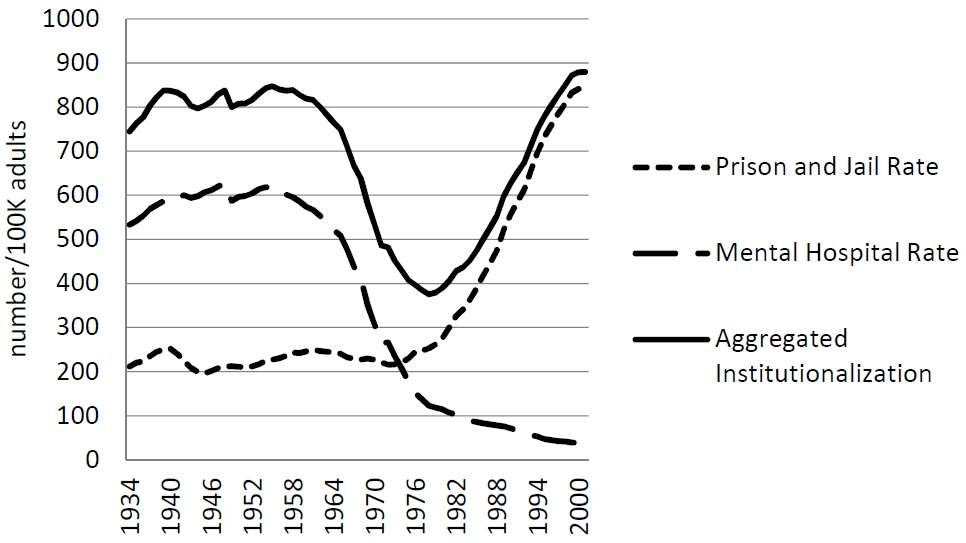
The graph is from a blog post on Volokh Conspiracy[2] about a paper from American Criminal Law Review [3] entitled "Is Mass Incarceration Inevitable"
[1]https://d2eehagpk5cl65.cloudfront.net/img/q60/uploads/2019/1...
[2] https://reason.com/2019/10/08/in-mass-incarceration-inevitab...
[3] https://papers.ssrn.com/sol3/papers.cfm?abstract_id=3436933
It's been said that psychiatry is the new religion and psychiatrists the new priests for a reason. Any good actor with enough information can pretend he has a mental illness and fool psychiatrists. Not only that, you can have psychiatrists come up with different diagnoses for the same individual - even to the point of contradicting each other. And there is no scientific way to show one psychiatrist is correct or not.
Just like religion was the best we could do with level of knowledge we had in the past. Psychiatry is sadly the best we can do with the current level of knowledge. It's pretty much voodoo, but it's better than the voodoo that came before it. If neuroscience ( an actual science ) lives up to its potential, then we'll finally be able to toss psychology into the same waste bin we put astrology in and perhaps psychiatry can have a scientific foundation.
https://scholar.google.com/scholar?hl=en&as_sdt=0%2C5&q=Comb...
'a hospital' - which hospital?
Makes sense to carefully re-examine the other claims of the paper.
But in the sciences he’s been debunked. Any Psych 101 book will tell you his methods are no longer used. Their most direct descendant, psychodynamics, is very different from its ancestor.
Within the sciences, check out Karl Popper’s work on falsifiability. Freud is his example of pseudoscience: it sounds smart, and it can explain lots of things in retrospect, but if you write down it’s predictions in advance they often don’t match outcomes. Practitioners don’t acknowledge this or try to correct it.
If I recall from discussion at the time, the reason the false finding was so welcome (and therefore so rewarding to the con man who wrote it up) was that it purported to show that making a large change to public opinion was cheap and easy to do.
Theranos anyone?
Every field should be looked at with caution until the perverse incentives that currently exist in academics are addressed.
What I see instead is a bias in certain physical sciences to think that somehow experiential phenomena are less rigorous because they don't fit the mold of those sciences as much. The systems are more complex and different metaphysically, so their legitimacy is questioned. This is somehow still happening even as developments in fields like quantum physics and AI are leading many very competent scholars to question basic assumptions about the nature of experience and consciousness vis-a-vis physically observable phenomena.
The irony of the Rosenhan study is that Rosenhan was putting forth exactly the same arguments as you, that psychiatry lacks rigor because it's too subject to the whims of subjectivity. So when this paper is shown to have been a fraud (even though it was dismissed in the field for many other reasons, but overall because it was unscientific) it is evidence that psychology is unrigorous? When it is not widely known to be a fraud per se, it is cited as evidence that psychology is unrigorous as well? It seems there's no way to win: the critics of the field cite this work as evidence of lack of rigor, and then when it's shown to be fraudulent, it's also shown as lack of rigor.
The even greater irony is that many of these fraudulent studies are being identified by... you guessed it, psychologists. I would go so far as to say no field has done more for the scientific study of science than psychology. Meta-analysis has its birthplace in psychology, and all these discussions of replicability ultimately flow from psychology as a field. If anything, psychology is among the only ones to be open about these issues and to take them seriously. In many other fields, they're swept under the rug, and questioners are attacked with arrogant hostility and accusations of incompetence.
Can you find me any psychiatrist that's pushing the chemical imbalance theory? Every single doctor I know thinks chemical imbalance is bunk.
Psychology is different in the sense that it doesn't seem to matter to the field very much whether they are correct. I say this because they keep doing experiments which lack a robust design, and then proceed to use complex statistical models to infer many unsupported claims which never seem to replicate. Then they meta-analyse these results to conclude that if there is an effect it is small or only applies to certain people. The 'power pose' study I linked is a case in point. All this is done in a very rigorous way by rigorous people using advanced equipment and statistics, who spend much time spinning careful narratives about their work in long Discussion sections. But you don't get a medal for trying in science.
It is hardly a compliment to psychology that they gave birth to the meta-analysis [1]. Note that getting some result in an experiment, then having the result overturned in a meta-analysis is the functional equivalent of not having done the experiment at all. In fact, it is inferior to doing nothing, because you have just wasted everyone's time.
[1] https://www.sciencemag.org/news/2018/09/meta-analyses-were-s...
Even without the anecdotal information that things were not presented as they were told, the study is still, and always has been, useless. If someone presents at an asylum begging to be admitted, and describing strange symptoms that they say are causing them distress, it is reasonable to admit them for observation.