https://web.archive.org/web/20200127011511/https://www.spect...
It's still entirely possible that it happened as reported, but that the (properly) confidential records were destroyed/lost.
According to Wikipedia, "'[s]he writes that she cannot be completely certain that Rosenhan cheated', despite entitling her book as she did." [1]
The problem of false priors, deliberate misdirection, and motivated reasoning are insidious. Having to un-learn false models is difficult and expensive, personally, bit especially socially.
Even if Rosenhan's experiment was a fraud, the notion that psychiatric institutions or the field of psychology does not engage in the practice of arbitrary, thinly-supported, or entirely fictitious diagnosis, or failure to account for changes in condition, at least at times isn't disproved. And ... at least to my lay understanding ... this does seem to manifest elsewhere than in Rosenhan's accounts.
There are two competing sets of motivated reasoning to be considered here, which makes determination of ground truth that much more difficult.
On false priors, I've been familiar for a time with the notion of "Wittgenstein's Ladder", a/k/a "Lies told to children" (https://en.wikipedia.org/wiki/Wittgenstein%27s_ladder):
My propositions serve as elucidations in the following way: anyone who understands me eventually recognizes them as nonsensical, when he has used them—as steps—to climb beyond them. (He must, so to speak, throw away the ladder after he has climbed up it.)
He must transcend these propositions, and then he will see the world aright.
-- Tractatus Logico-Philosophicus 6.54
This leads to the challenge over time of finding oneself having climbed the ladder, but in discussions with others, constantly confronted with it, and having to explain around or over it. Wittgenstein's Ladder becomes, when erected horizontally across a passage of understanding rather than vertically to greater heights or across gulfs, Wittgenstein's Barricade.
It's this constant having-to-retread-fundamentals which seems to actively impede further development of knowledge and understanding, and which I've found increasingly intolerable in much popular media and discussion. Worse when it's not even the fundamentals which are being retread, but someone's self-serving current reformulation (often worse than the original). See Schopenhauer's "On Authorship".
Or at least that's the version told in Adam Curtis' documentary The Trap (part 1)[1] which engages in Curtis's usual enthusiasm for fashioning a sweeping historical narrative out of somewhat sparse materials - in this case presenting the "Thud" experiment and its followup as a pivot point in the tale of how R. D. Laing's anti-psychiatry ironically led to the advent of the DSM IV era.
However that may be, if Curtis' account of the followup is correct it seems harder to argue the diagnostic prowess of the psychiatrists was not open to question, regardless of the status of the original experiment.
1: In the section beginning here: https://youtu.be/y97Ywl7RtUw?t=2204
Mind: I'm not arguing that science doesn't make mistakes. Science is a mistake-making-and-correcting process. But there are certain fields of science, somewhat more so in the social than physical and biological sciences, in which a widely-adopted plausible theoretical understanding seems missing.
Science seems to move through stages, of observation and categorisation, to individual models of localised predictive (or descriptive) understanding, to a fundamental theoretical underpinning.
Geology and biology are interesting cases, each being effectively ancient, but for which the establishment of the underlying theory lies largely within human memory.
In the case of biology, taxonomic classification, Darwin's theory of evolution based on variation, inheritence, and selection, Mendelian genetics, and finally the discovery of the structure and reading of DNA and RNA by Watson, Crick, and others (1950s) cast the final links in the chain. We're strengthening those, but the underlying model seems largely complete.
(I'd count concepts of dissipative systems as largely conformant with this model, though important additions.)
For geology, similarly, there was the notion of stratigraphy, which established an ordering but not a specific timescale for geology. Understanding of that didn't occur until the work of Rutherford, Soddy, Holmes, and Boltwood, largely in the first decade of the 20th century.
At the time, the leading scientific value for the age of the Earth was 20 millions of years, by William Thomson, Lord Kelvin (reduced from an earlier estimate of 100 million years). Rutherford and Boltwood's initial measurements based on radioactive decay demonstrated a timescale of billions of years, subsequently refined to the present value of 4.6 billion +/- 1% in the 1950s.
That still didn't explain much geological activity, particularly vulcanology, earthquakes, uplifts, and subsidence (though sedimentation and erosion were well understood). That required the notion of plate tectonics and continental drift, formally adopted only in 1965-1967 (by various conferences / professional bodies).
Plate tectonics, driven by residual thermal heat of formation and radioactive decay in the Earth's core and mantle is now considered the theoretical underpinning of all of geology. It's formal adoption is 55 years old, for a study that's existed since the time of ancient Greece.
The social sciences -- sociology, psychology, political economy, and political science -- lack any such empirically demonstratable and falsifiable theoretcal underpinning. To a large extent they've resisted adopting one.
That last point isn't uncommon -- biology certainaly resisted evolution, and geology plate tectonic (see Naomi Oreske's works on this topic, themselves fascinating studies of the evolution of scientific theory: https://www.worldcat.org/search?qt=worldcat_org_all&q=au%3Ao...).
And as with pre-genetic biology, pre-tectonic geology, pre-Newtonian physics, and pre-Mendeleevian chemistry, there are useful concepts, models, methods, and mathematical relations in these fields. But not a true unifying theoretic basis.
If psychology wants the status and rewards of being considered a legitimate science, it needs to make dramatic changes. In the meantime any initial result psychological research produces must be considered not just preliminary, but suspect.
[1] https://en.m.wikipedia.org/wiki/Power_posing [2] https://science.sciencemag.org/content/348/6239/1100.2
At the very least, Rosenhan convinced a lot of people that the Church of Scientology might be right about something.
Quite on the contrary. For a recent example of misapplication on the thousands see [1]. The idea that the deliberate misapplication of these "laws" doesn't exist or is minimal in the current year is completely false.
[1] https://www.tampabay.com/news/education/2019/12/10/floridas-...
https://invidio.us/watch?v=BAjN6bG7XzM
(There's a paper, I'm not sure if it's published, I received it directly from Keen, will research.)
There's Thorstein Veblen's provocative question as to why economics is not an evolutionary science: https://archive.org/details/jstor-1882952
There's the difficulty economics has, generally, in even settling on basic questions: what is wealth (is it a stock or a flow? how is it measured?)? What is money? What is value?
W. Brian Arthur notes in one of his books that virtually all economics is aimed at policy, and that as a consequence there's very little purely theoretical foundation. (His own contribution has been on complexity economics, with several interesting contributions and two notable seminars.)
Of the set of sciences here, political science is the one I can comment the least on, though if it should also happen to revolve and evolve largely around policy rather than theoretic discussion, it may be afflicted by similar dynamics as economics, and a casual observation suggests it is.
My reading is that the social sciences generally should probably be formulated as systems sciences, and there've been some attempts, mostly solidly rejected, at doing so. Norbert Weiner's exceedingly cringily-named On the Humane Use of Human Beings (the book is vastly better than its title suggests) was an attempt at this. There's another by Alfred Kuhn (no relation to Thomas), of the University of Cincinnati, The study of society : a unified approach (https://www.worldcat.org/title/study-of-society-a-unified-ap...)
The systems dynamics approach of Jay Forrester and others would be another.
The organisation of M.I.T.'s study of psychology, "Brain and Cognitive Sciences" (formed through departmental mergers in 1986) reflects one approach.
My view of pscyhology and sociology is that they are studies of behaviour, of individuals and groups, on the basis of perceptions, information processing, and interactions, subject to evolutionary and other influences, as well as various pathologies.
Many psychological disorders seem to me more akin to cancer in physical medicine, as opposed to infectious diseases: they concern symptom clusters which may have multiple and diverse underlying etiologies, rather than of specific cause-centered disorders.
The distinction is that if you can identify a specific underlying causal agent (say: bacterium or virus, or some environmental insult), you can focus treatment on eliminating or attacking that specific cause.
If you have a symptom cluster with multiple possible etiologies, you risk falling into the One True Way trap, thinking that one identified cause is all causes.
Robert Sapolsky's lecture on depression and the various ways in which various types of behaviour-regulating neurotransmitters can malfunction is an example of the underlying messaging complexity within psychology:
https://invidio.us/watch?v=NOAgplgTxfc
I'm less versed again on sociology, and would speak less to its specific failures and more what I've noted looking through survey texts: that there doesn't seem to be any single underlying organisational premise. Again I'd suggest that this be as a systems science, here looking at groups of people (from couples/teams to all of humanity), and various behaviours. "Evolution" here would include both biological and cultural transmission of information.
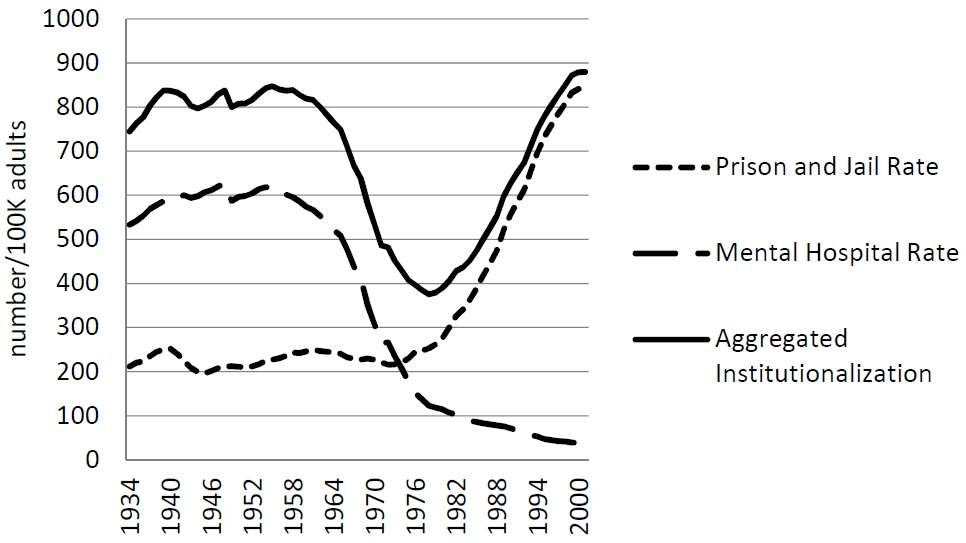
The graph is from a blog post on Volokh Conspiracy[2] about a paper from American Criminal Law Review [3] entitled "Is Mass Incarceration Inevitable"
[1]https://d2eehagpk5cl65.cloudfront.net/img/q60/uploads/2019/1...
[2] https://reason.com/2019/10/08/in-mass-incarceration-inevitab...
[3] https://papers.ssrn.com/sol3/papers.cfm?abstract_id=3436933
https://scholar.google.com/scholar?hl=en&as_sdt=0%2C5&q=Comb...
Psychology is different in the sense that it doesn't seem to matter to the field very much whether they are correct. I say this because they keep doing experiments which lack a robust design, and then proceed to use complex statistical models to infer many unsupported claims which never seem to replicate. Then they meta-analyse these results to conclude that if there is an effect it is small or only applies to certain people. The 'power pose' study I linked is a case in point. All this is done in a very rigorous way by rigorous people using advanced equipment and statistics, who spend much time spinning careful narratives about their work in long Discussion sections. But you don't get a medal for trying in science.
It is hardly a compliment to psychology that they gave birth to the meta-analysis [1]. Note that getting some result in an experiment, then having the result overturned in a meta-analysis is the functional equivalent of not having done the experiment at all. In fact, it is inferior to doing nothing, because you have just wasted everyone's time.
[1] https://www.sciencemag.org/news/2018/09/meta-analyses-were-s...