zlacker

[return to "David Rosenhan’s fraudulent Thud experiment set back psychiatry for decades"]
1. hyperp+I3[view] [source] 2020-01-26 23:56:39
>>lcaff+(OP)
While this is fascinating and I'm glad to have read it, it doesn't substantiate that this experiment set back psychiatry. The fact that the DSM-IV was prompted or encouraged by the experiment is suggested, but there's no argument for it. Even beyond that, the article doesn't even hint at an argument that the DSM-IV set back psychiatry (except offering the bare assertion that reductionism is false).

Of course, the DSM is very controversial, and many people could fill in the argument, but this article doesn't do it.

◧◩
2. Merril+uf[view] [source] 2020-01-27 02:41:27
>>hyperp+I3
It no doubt aided the movement to deinstitutionalize patients with mental illness. Between 1955 and 1994, most state hospitals for the mentally ill were closed. This was done with the best of intentions, but the implementation led to the current mess where many severely mentally ill people are without adequate treatment and are homeless or imprisoned.
◧◩◪
3. aksss+rt[view] [source] 2020-01-27 06:59:39
>>Merril+uf
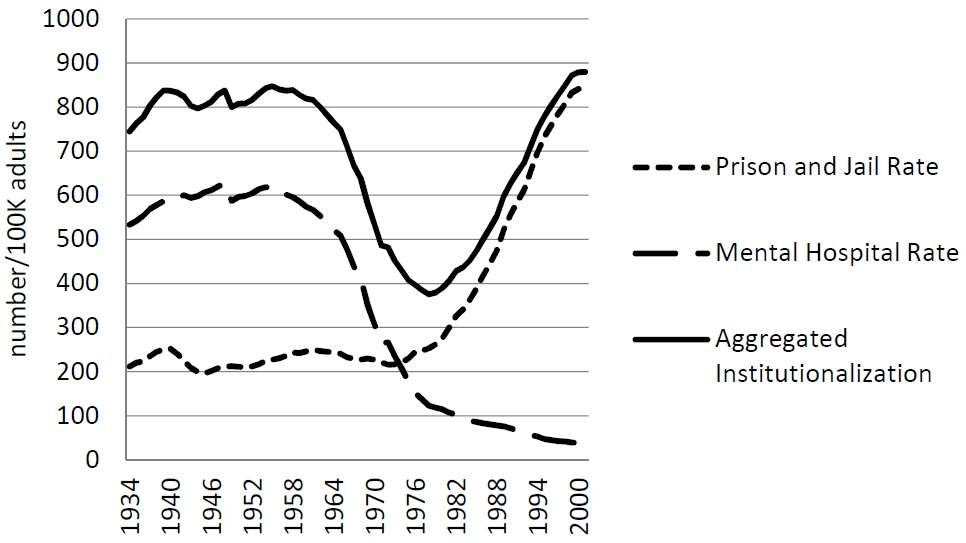
There's a great graph[1] showing per capita US institutionalization rates from 1934-2000, differentiating between prison, mental institutions and the combined total. The aggregate rate of US institutionalization is about the same as it was in 1954ish, the holding pen has just changed.

The graph is from a blog post on Volokh Conspiracy[2] about a paper from American Criminal Law Review [3] entitled "Is Mass Incarceration Inevitable"

[1]https://d2eehagpk5cl65.cloudfront.net/img/q60/uploads/2019/1...

[2] https://reason.com/2019/10/08/in-mass-incarceration-inevitab...

[3] https://papers.ssrn.com/sol3/papers.cfm?abstract_id=3436933
[go to top]