Of course, the DSM is very controversial, and many people could fill in the argument, but this article doesn't do it.
Re-reading the article, It seems to suggest that it undermined public trust in forced psychiatric treatment. I can only guess that the author believes this was for the worse and is the titular setback?
Or at least that's the version told in Adam Curtis' documentary The Trap (part 1)[1] which engages in Curtis's usual enthusiasm for fashioning a sweeping historical narrative out of somewhat sparse materials - in this case presenting the "Thud" experiment and its followup as a pivot point in the tale of how R. D. Laing's anti-psychiatry ironically led to the advent of the DSM IV era.
However that may be, if Curtis' account of the followup is correct it seems harder to argue the diagnostic prowess of the psychiatrists was not open to question, regardless of the status of the original experiment.
1: In the section beginning here: https://youtu.be/y97Ywl7RtUw?t=2204
Did the DSM-IV result in inaccurate diagnoses? Worse treatment? The review doesn't clearly state a single negative consequence. For that matter, reading the review, I can't even be sure if the book argues that the DSM-IV was bad, or if that's merely the review authors' opinion. I expect that kind of clarity from a review, and it's missing here.
Or again, on the point about the DSM-IV being a response to Rosenthal, what I'd like to read is something along the lines of "Cahalan's book presents detailed evidence that the DSM-IV was [influenced/prompted by/etc] the reaction to Rosenthal's experiment".
In defense of the reviewer: the worst issue might be a case where the title simply promises more than the article delivers. And the reviewer typically doesn't write their title, so it may be the editor who is to blame.
If you mean all psychotherapy is bullshit, you're wrong. There are bad therapists just like with everything else, but good psychotherapists have saved a lot of lives over the years.
And if, on the off chance, you think all therapy is bullshit despite never having had therapy yourself... well, nobody is that stupid, right?
At the very least, Rosenhan convinced a lot of people that the Church of Scientology might be right about something.
The reason is simple. This article is pure propaganda along the lines of the book "The great pretender" by Susannah Cahalan.
The experiment might have flaws, but this second part is conclusive and no critics ever address it.
This is just another brick on the long propaganda road to a destination that is very worrisome.
This article is nothing but propaganda.
These experts never explained why homosexuality was considered a mental illness and later that decision was reverted. Neither of those changes was ever justified.
It's almost like those decisions are made with no objective criteria.
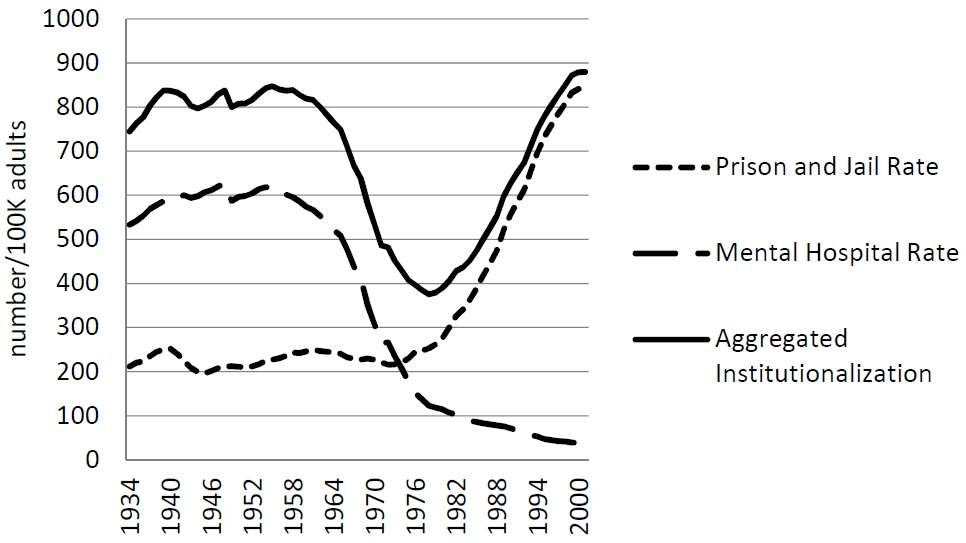
The graph is from a blog post on Volokh Conspiracy[2] about a paper from American Criminal Law Review [3] entitled "Is Mass Incarceration Inevitable"
[1]https://d2eehagpk5cl65.cloudfront.net/img/q60/uploads/2019/1...
[2] https://reason.com/2019/10/08/in-mass-incarceration-inevitab...
[3] https://papers.ssrn.com/sol3/papers.cfm?abstract_id=3436933
https://scholar.google.com/scholar?hl=en&as_sdt=0%2C5&q=Comb...
'a hospital' - which hospital?
Makes sense to carefully re-examine the other claims of the paper.
But in the sciences he’s been debunked. Any Psych 101 book will tell you his methods are no longer used. Their most direct descendant, psychodynamics, is very different from its ancestor.
Within the sciences, check out Karl Popper’s work on falsifiability. Freud is his example of pseudoscience: it sounds smart, and it can explain lots of things in retrospect, but if you write down it’s predictions in advance they often don’t match outcomes. Practitioners don’t acknowledge this or try to correct it.