https://climatereanalyzer.org/clim/sst_daily/
You'll notice something special about the time plot thus far for 2023 ...
I hear 1.5 C, 2 C all the time, but not much is happening [1] so I am looking for a best estimate to what should I expect in 2030, 2040 and 2050; not that 1.5 is "technicaly possible" cause it's practically impossible.
[1] https://www.nationalobserver.com/2018/12/12/analysis/co2-vs-...
From the linked paper describing the radiative balance calculations (note we are currently still in the highest emission scenario used in these models):
https://gmd.copernicus.org/articles/13/3571/2020/
> "Here, we include a representation of permafrost feedbacks based on the MAGICC permafrost (Schneider von Deimling et al., 2012), leading to additional cumulative CO2 emissions of 25 to 88 GtC by 2100, 42 to 378 GtC by 2200, and 51 to 542 GtC by 2300 for the lowest (SSP1-1.9) and highest (SSP5-8.5) scenario, respectively (Table 2). Thus, our permafrost module is in line with the IPCC Special Report on 1.5 ∘C warming assumptions for the lowest scenarios (25 GtC versus 27 GtC). While we do not entertain the probabilistic version in this study, our default settings are comparable to the median values reported in Schneider von Deimling (2012). In the highest scenarios (SSP5-8.5), these permafrost-related Earth system feedbacks cause CO2 concentrations that are up to 200 ppm higher by 2200 (Fig. 3a)."
The study also suggests that the solar activity estimates considered in the most recent reports by the UN’s Intergovernmental Panel on Climate Change (IPCC) likely underestimated the role of the Sun in global warming since the 19th century.”
https://www.ceres-science.com/post/new-study-suggests-global...
"The paper was strongly criticized by numerous scientists for its methodology and for its misuse of data from previously published studies, which prompted concerns about the peer review process of the paper. The controversy resulted in the resignation of half of the editors of the journal and in the admission by its publisher, Otto Kinne, that the paper should not have been published as it was."
https://en.wikipedia.org/wiki/Soon_and_Baliunas_controversy
Did it not occur to you to check this?
I get the worries, Lithium mining causes ecological damage, but every sort of resource extraction causes ecological damage. Every kilogram of pollution generated from lithium mining prevents many times more pollution generated from oil extraction and emissions. Lithium, cobalt, and the rest aren't exotic materials, the battery industry is huge and has many decades of experience building batteries.
Synthesizing hydrocarbons is an important technology. But that process is incredibly energy intensive, and it's much more efficient to use electricity to just charge a battery. The scale of production of synthetic hydrocarbons isn't anywhere close to where it would need to be to make a dent in climate change. I think that electrofuels will be very important in aviation - they're the only apparent pathway to run jet engines without emissions. But it will be a long time, if ever, before that technology is mature enough to fuel passenger vehicles at a meaningful scale.
[1] https://www.iea.org/data-and-statistics/charts/comparative-l...
[2] https://afdc.energy.gov/vehicles/electric_emissions.html
[3] https://www.sciencedirect.com/science/article/pii/S136403212...
And In reality all of SOHO(Greenwich village, Chelsea, Fidi etc) the interior excluding the west side and east side high way could be 90% car free with high speed mass transit to bus/electric street cars you anywhere there could work much better. Cars move at not more than 20 MPH on most streets there any way now and are inefficient at transporting people.
People will realize they can just park outside manhattan in Brooklyn or Jersey City and just take a train in and just use car as a luxury instead of a necessity of transit to work the economics of the auto based economy will change. Cities and areas around them are high density once car use changes there it will change everywhere(LA I am looking at you).
[1] https://www.nyc.gov/html/brt/html/routes/14th-street.shtml
> Often asserted, rarely backed up. A LR Model 3 weighs 4000 lbs. A Chevy Bolt weighs 3600 lbs. An AWD Camry weighs 3600, an Audi S3 weighs 3500. It's ~15% more for sedans.
Because it's approaching "common knowledge", at least for people paying vague attention to the switch. Here's three articles just from this year - took me 10 seconds to find on Google:
https://www.axios.com/2023/04/28/evs-weight-safety-problems
https://globalnews.ca/news/9587791/electric-vehicle-weight-s...
https://www.npr.org/2023/01/11/1148483758/ntsb-heavy-electri...
I think we agree then about "alternative growth" or "eco-growth" where GDP and resource consumption are decoupled, where GDP continues to increase while environmental impact simultaneously falls. Most wealthy countries are already actually at that point already - CO2 emissions are falling while they still grow (adjusted for offshore emissions). It's an important point to me because the degrowth people I've encountered are kinda defeatist and I don't think will be able to grow a coalition, but decoupling the environment from growth is eminently doable.
Noah Smith is my main influence on this topic: https://www.noahpinion.blog/p/people-are-realizing-that-degr... https://www.noahpinion.blog/p/degrowth-we-cant-let-it-happen...
Whoa, could you point me to the source?
I found only this statement so far:
> If the pH gets too low, shells and skeletons can even begin to dissolve.
src: https://www.noaa.gov/education/resource-collections/ocean-co...
Just from 2020 to 2023, more than $24 Billion in interest-free loans were distributed. https://www.imf.org/en/Blogs/Articles/2023/03/31/the-time-is...
There is no such thing as "enough help", but each country should do its own part, and birth control is for sure important for countries with birth rate > 3 and cannot provide to its people. I came myself from a poor country and I can guarantee that there is no way to develop a long term plan, if the population increases in a high pace. There is no way to allocate money accordingly and create infrastructure in such a pace to support it.
You can live in Mackinak and try out the no car lifestyle. Watch out for the crap and piss in the gutters. https://www.michigan.org/city/mackinac-island
What explains the remaining percent points then?
Atmospheric CO2 at the first measurement in ~1958 was ~318, latest in 2022 was ~419 (reading a plot on wikipedia[1]). Note that in 1958, the industrial revolution was already in history books, idk what pre-fossil-fuel values were. Going from 318 in 1958 to 419 in 2022 is +32%, you said 3%, so there's a few missing there
[1] https://en.wikipedia.org/wiki/Carbon_dioxide_in_Earth%27s_at...
Edit: just noticed the article lede says +50% since mid-18th century, I don't need to be interpreting graphs here lol. Either way, you missed an order of magnitude somewhere. But it also doesn't matter, because if 3% would have changed our habitat then it still would have been too much right?
3% per year would be dangerous: in the 60s it used to be 320 out of a million molecules of air, 320*(1.03^(2023-1960)) = 2060 per million. A cognitive decline is observable as of 1000 per million. https://en.wikipedia.org/wiki/Carbon_dioxide#Below_1%
Don't underestimate compound interest across multiple generations!
I presently find that appearing ... once only ... via Algolia:
<https://hn.algolia.com/?dateRange=all&page=0&prefix=false&qu...>
Here you go: https://en.wikipedia.org/wiki/Climate_change#/media/File:Gre...
Searched for a Wikipedia article called global warming -> automatic redirect to climate change article -> scroll through different graphs et voila, found this one
Granted, cars and air travel, but I think it is more than minor. But anything that is unnecessary, is important. The point is, travel less, that's the best way to admire the places you admire. Something to consider the next time you plan a vacation.
How about a nice bike ride near where you live and marvel at the beauty that is near you? It's still beautiful. And you did our planet a favor.
I'm not sure how helpful it is to compare different cars.
Here's a more apples-to-apples comparison: a 2023 Kia Niro (which is itself a conventional hybrid, with a gasoline engine and a small battery and electric motor) compared to a 2023 Kia Niro EV. Almost everything is the same except the drivetrain. The EV[0] is ~500-800lbs heavier than the hybrid[1] depending on trim level and options, which is basically the difference between an empty car and one loaded with four adults and some luggage.
[0]: https://www.kiamedia.com/us/en/models/niro-ev/2023/specifica...
[1]: https://www.kiamedia.com/us/en/models/niro/2023/specificatio...
I also echo the sentiment that we should both create a culture of questioning excesses, enjoying a simplified lifestyle of essentials: good health (address pollution, agriculture filled with toxic compounds, etc.), peace, arts and culture, instead of often self-destructive excesses; and that we should look at effective interventions: feeling good about it is not enough, we need actual effective change!
Some of the most effective changes you can do individually[1] is (1) reducing meat consumption significantly;[2] (2) Less air travel (3) Use alternative forms of transportation (bike, walk, public transit, live near work?).
(Of course, if you have a huge house with tons of appliances... I'm sure that's highly significant!)
I'm doing all those things personally. And as honest as I can: I think my health and wellbeing genuinely improved (I've lost weight due to better mostly-plant diet, am much more fit due to walking and public transit; I guess there's a psychological factor from knowing I'm helping too!). Public transit is the most inconvenient sometimes (other times it's far more convenient), but then I'm not absolute and take a ride faring app every now and then. Living this way isn't only possible, it's genuinely good.
Discovering places nearby to travel and connecting with local history and culture is something I also think we could do a lot more.
And by all means, be politically active on this issue! (I can't change things like energy matrix with individual habits, but I can vote well)
I'm with you dude :) Hack the planet!
[1] This seems to be a pretty good source: https://theconversation.com/here-are-the-most-effective-thin... I'm sure there are others similar as well
[2] That's good for animals too :)
Everyone says they would love to live in a walkable city, but for some reason, at least in the US, the biggest gainers in population over the recent decades have been all automobile-centric cities (which are probably more accurately described as a large patchwork of suburbs). NYC would have shrunk due to out-migration to other places if it wasn't for foreign in-migration[0]. Chicago lost people 15 out of the last 20 years[1].
[0]: https://www.nyc.gov/assets/planning/download/pdf/about/dcp-p...
[1]: https://www.chicagotribune.com/news/ct-met-census-chicago-me...
Looking into this now, though, the linked website has a emissions page[1] which shows only an absolute number rather than a year-on-year increase. Where did you find the YoY value of ~3%?
[1] https://climatechangetracker.org/co2/human-induced-yearly-co...
> It is not unreasonable to assume that governments will follow through with at least some of their promises and pledges
FWIW, it actually looks like we're on a path to 2.5-2.9 °C of warming with current policies, and nearly another 1°C reduction with current pledges which are indeed much less likely to fully materialise. Via https://en.wikipedia.org/wiki/Climate_change#/media/File:Gre... which appears to use 2021 data. The "no climate policies" scenario is shown as having the lower error margin actually above +4°C
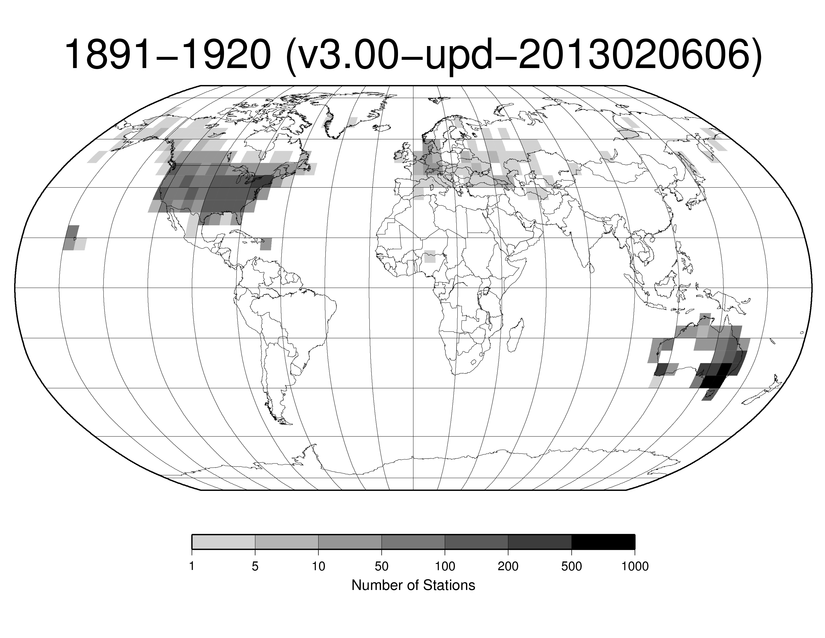
https://www.ncei.noaa.gov/sites/default/files/2021-03/statio...
Notice how the data comes almost entirely from the USA and Australia. In Australia it's only the populated coastal regions with data, with the central deserts having none. Density in Europe is virtually non-existent by comparison, with Spain/Portugal having no data, most of Russia having no data, large parts of Europe having only a single station, there's nothing in China, India, Japan, there's a single station for the whole of Africa, etc. And of course the sea is missing.
By 1950 things have improved in the northern hemisphere somewhat:
https://www.ncei.noaa.gov/sites/default/files/2021-03/statio...
Russia and Europe now has coverage throughout, albeit with way lower station density than the USA (probably it doesn't matter much). The southern hemisphere outside of Australia is still almost completely missing, just a handful of stations outside of South Africa.
Even today most parts of the Earth's surface are missing direct land measurements (there are satellites):
https://climatedataguide.ucar.edu/sites/default/files/2022-0...
None of this is surprising. Only rich stable parts of the world can afford to spend time reliably reading thermometers every day. Europe spent a lot of the time before 1950 either at war or rebuilding.
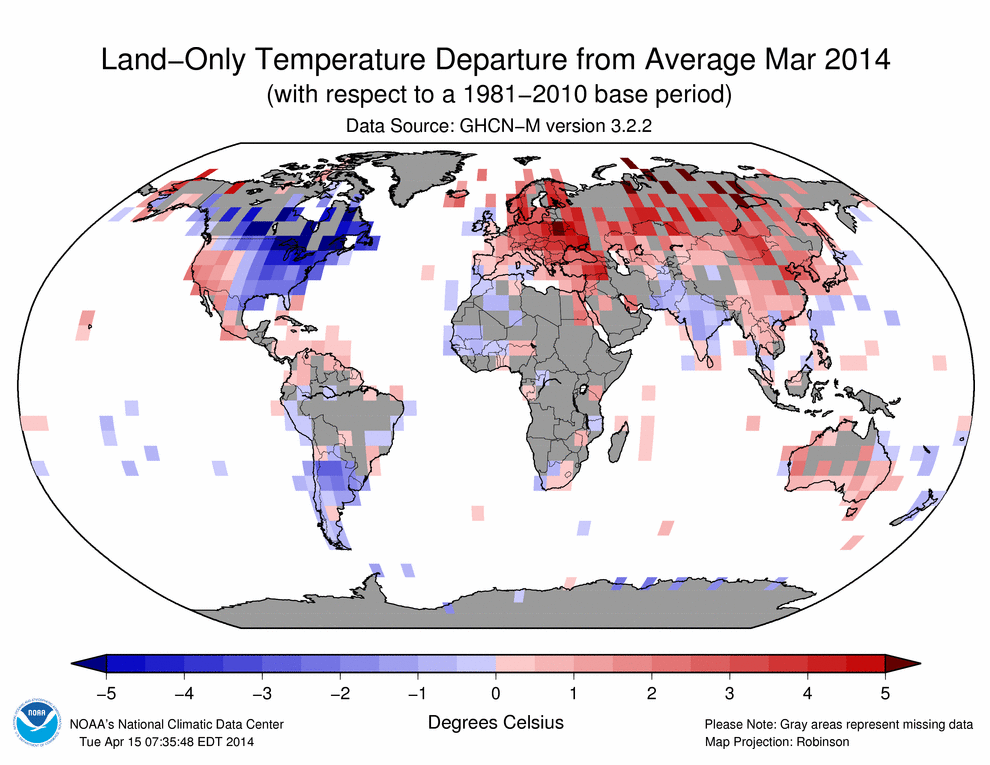
Note that missing data doesn't stop them colouring in those parts of the map with temperature readings and claiming they come from ground stations. They don't make it clear but for most of the world temperature readings are made up (interpolated over vast distances), example:
http://www.columbia.edu/~mhs119/Temperature/T_moreFigs/2015-...
They don't know what the mean was in 1950 for most of the world because they don't have any data, but that doesn't stop them drawing maps showing the change from that non-existent mean.
[1] https://climatetippingpoints.info/2022/09/09/climate-tipping...
https://www.europarl.europa.eu/doceo/document/P-9-2022-00127...
But they lobby against anything that could practically reduce dependence on fossil fuels, not just nuclear. If you want to do anything about it you have to overcome that.
The archaeological record says the opposite. I don't know what Latin or Greek texts you're reading because they are full of references to things that can't be done today.
The Vikings were practicing agriculture in Greenland. [1] That's impossible now, it's too cold.
The Greenland climate was a bit warmer than it is today, and the southernmost tip of the great island was luscious and green and no doubt tempted Eric the Red and his followers. This encouraged them to cultivate some of the seed corn they brought with them from Iceland.
Bison skeletons have been found in mountain caves at altitudes that imply it was drastically warmer in the past [2].
From this it can be concluded that the beech limit but also the forest line during the »wisent time« (6,000 to 1,200 years before today) was much higher and the average summer temperature had to be at least 3 to 6 °C higher than today. Oaks (Quercus) at an altitude of 1,450 metres around 2,000 years ago also indicate a climate approximately 4 to 7 °C warmer than today.
This is well beyond the level that climatologists assure us means global destruction.
The fact that it was warmer in the past was not actually considered controversial up until Michael Mann started drawing his incorrect hockey-stick graphs. Go back just 20 years and you'll find the warmth of the Roman period being discussed quite openly, like this map [3] of suspected Roman England vineyard locations in which one is as far north as Lincolnshire, impossible in today's climate. This 2001 archaeological paper doesn't comment on the fact that it was warmer back then because everyone knew it and the fact was considered unremarkable.
Climatologists have done a great job of not only erasing this history but making it verboten to point out. Yet the problematic facts remain. Climatology doesn't have reliable methods for reconstructing past temperatures, has sparse data even for the modern era and routinely makes claims directly at odds with very well understood historical evidence.
[1] https://sciencenordic.com/agriculture-archaeology-denmark/vi...
[2] http://www.museumgolling.at/wp-content/uploads/2022/09/9_Sch...
[3] https://core.ac.uk/download/pdf/27661.pdf (figure 6)
At 2 C a cascade of tipping points might start:
https://climatetippingpoints.info/2022/09/09/climate-tipping...
"Batteries are heavy. That’s why, generally, electric cars weigh considerably more than otherwise similar gasoline-powered vehicles"[0]
"Electric vehicles can be anywhere from hundreds to thousands of pounds heavier than similarly sized gas vehicles because EV batteries are so much heavier than engines."[1]
EDIT: I just looked up the weight of my little car's engine, it's just 69 kg (152 lbs). The weight of the battery in a Renault Zoe is 326 kg (719 lbs).
[0] https://edition.cnn.com/2021/06/07/business/electric-vehicle... [1] https://www.axios.com/2023/04/28/evs-weight-safety-problems
I am precisely saying that we need to prioritize. I would rather survive the summer and not fly far away on holiday than die in the summer.
> Is the plan that everybody becomes a peasant?
Well big cities are a problem, and people working in services definitely rely on a society built on abundant energy.
I don't know exactly what the solution is. What I know is that our society is built on fossil fuel, and not only those are limited, but they are killing us. So we need to remove fossil fuels. Then looking at the numbers, it appears that we can't reasonably hope to replace fossil fuels entirely. Hence we have to use less energy, hence we have to degrow.
I hardly advise reading https://www.amazon.com/World-Without-End-Blain-Christophe-eb..., that's from a well-known french engineer.
One is Aurelien Barrau, astrophysicist and philosopher, who made me realize that CO2 is not the problem. If we changed fossil fuels with fusion, we would still be living a mass extinction. We are destroying biodiversity because of our way of life.
The other one is Jean-Marc Jancovici, who explains that the root cause is fossil fuels. Climate is just a consequence (a very bad one, hence we need to solve the energy problem even faster).
I strongly recommend his book, which explains his ideas really well. Probably works better if you know Europe a bit, but I think that the English edition is modified a bit for US citizen: https://www.amazon.com/World-Without-End-Blain-Christophe-eb...
One problem with electrified aircraft is that longer ranges probably translate to much lower speeds. Total mass is absolutely critical, so two of the biggest areas of research are likely to be materials (lightweighting the entire airframe) and automation (removing pilots and flight attendants). Given that electrified aircraft are already likely to be small (I'm assuming anywhere from two to perhaps 20 or 40 passengers), eliminating anywhere from 50% to 10% of the total payload mass will be a major consideration.
But you're still looking at a slow flight in a small plane at lower altitudes (and bumpier air), with minimum cargo or carry-on allowances. If there's no alternative ground route, or schedule flexibility is of the essence, that might be an option, but not especially fast or comfortable.
Looking through proposed aircraft, I'm seeing models designed for anywhere from one to 186 passengers (the last is considerably more than I'd thought viable, Wright Electric with a 335 mi (540 km) range). More likely to me are the Zunum Aero (12 passengers, 700 mi / 1125 km range) and Eviation (9 passengers, 100--600 miles). From: <https://www.cnn.com/travel/article/electric-aircraft/index.h...>
Zunum's ceased operations.
Eviation appears to be ongoing. From Wikipedia:
With 260 Wh/kg cells, the 900 kWh battery capacity (3,460 kg, 7,630 lb) is initially estimated to give the design a range of 540–650 nmi (1,000–1,200 km) at 240 knots and 10,000 ft (3,048 m).[6] This is anticipated to increase as battery technology improves.
<https://en.wikipedia.org/wiki/Eviation_Alice>
(Again, somewhat better than my expectations.)
A prototype has flown, and there are orders for at least 167 aircraft. Colour me surprised.
Eviation Alice is the only electric aircraft listed by Wikipedia to give passenger numbers:
They are well funded and have customers lined up
Noting that the ES-30 claims 30 passengers and an all-electric range of 200 km, 20k ft. service ceiling. No top/cruise speed mentioned.
I'm researching this to have some concrete data, but I doubt I'll have it together soon enough to share in this thread. Will definitely share on HN when this topic comes back around with what I find.
> Look around: all the ideas to replace them right now are wishful thinking.
I don't think this is true at all. Solar is improving at a rapid pace and is already cheaper. We need a large scale rollout, but that's a will issue, not a tech issue. Nuclear is always an option as well. You can see this in many places, here's a graph of solar production in the US, that rise looks amazing!
https://www.eia.gov/totalenergy/data/browser/index.php?tbl=T...
> Now, you can choose to be a techno-pessimist about all this if you want. You can assume, if you like, [... adds an incomplete list of stuff that could prevent technology from solving the problem ...]. Yes, with enough mental effort, you can ignore a technological revolution in progress. > > But ignoring a technological revolution in progress will accomplish nothing.
Let's be real: this article does not prove that solar can replace fossil fuels. It has faith that it can, and believes that "anyway if that doesn't work, we're screwed, so we have to believe in it".
It merely extrapolates from the growth of solar in the last few years. That is not enough.
My turn to suggest a different view: https://www.amazon.com/World-Without-End-Blain-Christophe-eb...