Would you mind if AI starts creating art like yours?
What if your clients tell you they bought the AI generated art instead of yours?
Yeah, sure you'd mind. However, we have decided as a society that "style" is not protected.
Your line of reasoning sounds like “ah, we already won so your protest doesn’t matter anyway”, but did you already win actually? Do you really not need all their development to draw on the same level? Just show that.
And then someone comes along and competes with you?
—
No one is bothered by competition in markets.
Why do we have more or less empathy of this type for some professions?
I think attempting to prevent this is a losing battle.
Given most of the heavy lifting is already done, this seems like a pretty easy thing for anyone to do.
There is a secondary issue on that there is other people being able to craft high quality images with strong compositions without spending the "effort/training" that artists had to use over years to produce them, so they are bitter about that too, but that's generally a minor cross-section of the publicvoutcry tho they are quite vitriolic
Photobashing, tracing, etc there have always been a layer of purists whom look down on anyone that doesn't "put the effort in" yet get great results in a timely manner, these purists will always exist, just like how it was when digital painting was starting, people were looked down by oil painters for not putting the effort in, even when oil painters themselves used tricks like projectors to the empty blank canvas to get perspective perfect images, but that's just human nature to a degree, trying to put down other people while yourself doing tricks to speed up processes
Simply hiding in an obsolete technicality is sure a wrong way to handle it.
edit: the examples are all about objects, but my understanding is that it is capable of style transfers as well.
The law isn't there to protect my feelings, so whether I mind or not is irrelevant. Artists have had to deal with shifting art markets for as long as art has been a profession.
> What if your clients tell you they bought the AI generated art instead of yours?
I'd be sad and out of a source of income. Much the same way I would be if my clients hired another similar but cheaper artist. The law doesn't guarantee me a livelihood.
I think this isn't just a simple discussion on competition and copyright, I think it's a much larger question on humanity. It just seems like potentially a bleak future if enjoyable and creative pursuits are buried and even surpassed by automation.
Could you please elaborate, why its "short-sighted"?
> As an artist, would you be much happier if, rather than the AI copying your style, the AI generated infinitudes of pictures in a style that the overwhelming majority of humans prefers to yours, so that you couldn't hope to ever create anything that people outside of a handful of hipsters and personal friends will value?
You mean that any artist should be just happy that his work is used by other people / rich corporation / AI without consent? Cool, cool.
I really doubt that AI will somehow be our successors. Machines and AI need microprocessors so complex that it took us 70 years of exponential growth and multiple trillion-dollar tech companies to train even these frankly quite unimpressive models. These AI are entirely dependent on our globalized value chains with capital costs so high that there are multiple points of failure.
A human needs just food, clean water, a warm environment and some books to carry civilization forward.
People keep saying this without defining what exactly they mean. This is a technical topic, and it requires technical explanations. What do you think "mostly copying" means when you say it?
Because there isn't a shred of original pixel data reproduced from training data through to output data by any of the diffusion models. In fact there isn't enough data in the model weights to reproduce any images at all, without adding a random noise field.
> The benefits of allowing this will be had by a very small group of corporations and individuals
You are also grossly mistaken here. The benefits of heavily restricting this, will be had by a very small group of corporations and individuals. See, everyone currently comes around to "you should be able to copyright a style" as the solution to the "problem".
Okay - let's game this out. US Copyright lasts for the life of author plus 70 years. No copyright work today will enter public domain until I am dead, my children are dead, and probably my grandchildren as well. But copyright can be traded and sold. And unlike individuals, who do die, corporations as legal entities do not. And corporations can own copyright.
What is the probability that any particular artistic "style" - however you might define that (whole other topic really) - is truly unique? I mean, people don't generally invent a style on their own - they build it up from studying other sources, and come up with a mix. Whatever originality is in there is more a function of mutation of their ability to imitate styles then anything else - art students, for example, regularly will do studies of famous artists and intentionally try to copy their style as best they can. A huge amount of content tagged "Van Gough" in Stable Diffusion is actually Van Gough look-alikes, or content literally labelled "X in the style of Van Gough". It had nothing to do with them original man at all.
I mean, zero - by example - it's zero. There are no truly original art styles. Which means in a world with copyrightable art styles, all art styles eventually end up as a part of corporate owned styles. Or the opposite is also possible - maybe they all end up as public domain. But in both cases the answer is the same: if "style" becomes a copyrightable term, and AIs can reproduce it in some way which you can prove, then literal "prior art" of any particular style will invariably be an existing part of an AI dataset. Any new artist with a unique style will invariably be found to simply be 95% a blend of other known styles from an AI which has existed for centuries and been producing output constantly.
In the public domain world, we wind up approximately where we are now: every few decades old styles get new words keyed into them as people want to keep up with the times of some new rising artist who's captured a unique blend in the zeitgeist. In the corporate world though, the more likely one, Disney turns up with it's lawyers and says "we're taking 70% or we're taking it all".
Which is what most humans do, and what most humans need.
Imagine you are a painter and you have developed your expertise in photorealistic painting over your entire lifetime.
Would you mind if someone snaps a photograph of the same subject you just painted?
What if your commissioners tell you they decided to buy a photograph instead of your painting because it looked more realistic?
Every argument I've seen against AI art is an appeal to (human) ego or an appeal to humanity. I don't find either argument compelling. Take this video [0] for example and half of the counterarguments are an appeal to ego - and one argument tries to paint the "capped profit" as a shady dealing of circumventing laws without realizing (1) it's been done before, OpenAI just tried slapping a label on it and (2) nonprofits owning for-profit subdivisions is commonplace. Mozilla is both a nonprofit organization (the Foundation) and a for-profit company (the Corporation).
E:
I'm going to start a series of photographs that are intentionally bad and poorly taken. Poor framing, poor lighting, poor composition. Boring to look at, poor white balance, and undersaturated photos like the kind taken on overcast days. With no discernable subjects or points of interest. I will call the photos art - things captured solely with the press of a button by pointing my camera in a direction seemingly at random. I'm afraid many won't understand the point I am making but if I am making a point it does make the photographs art - does it not? I'm pretty sure that is how modern art works. I will call the collection "Hypocrisy".
E2:
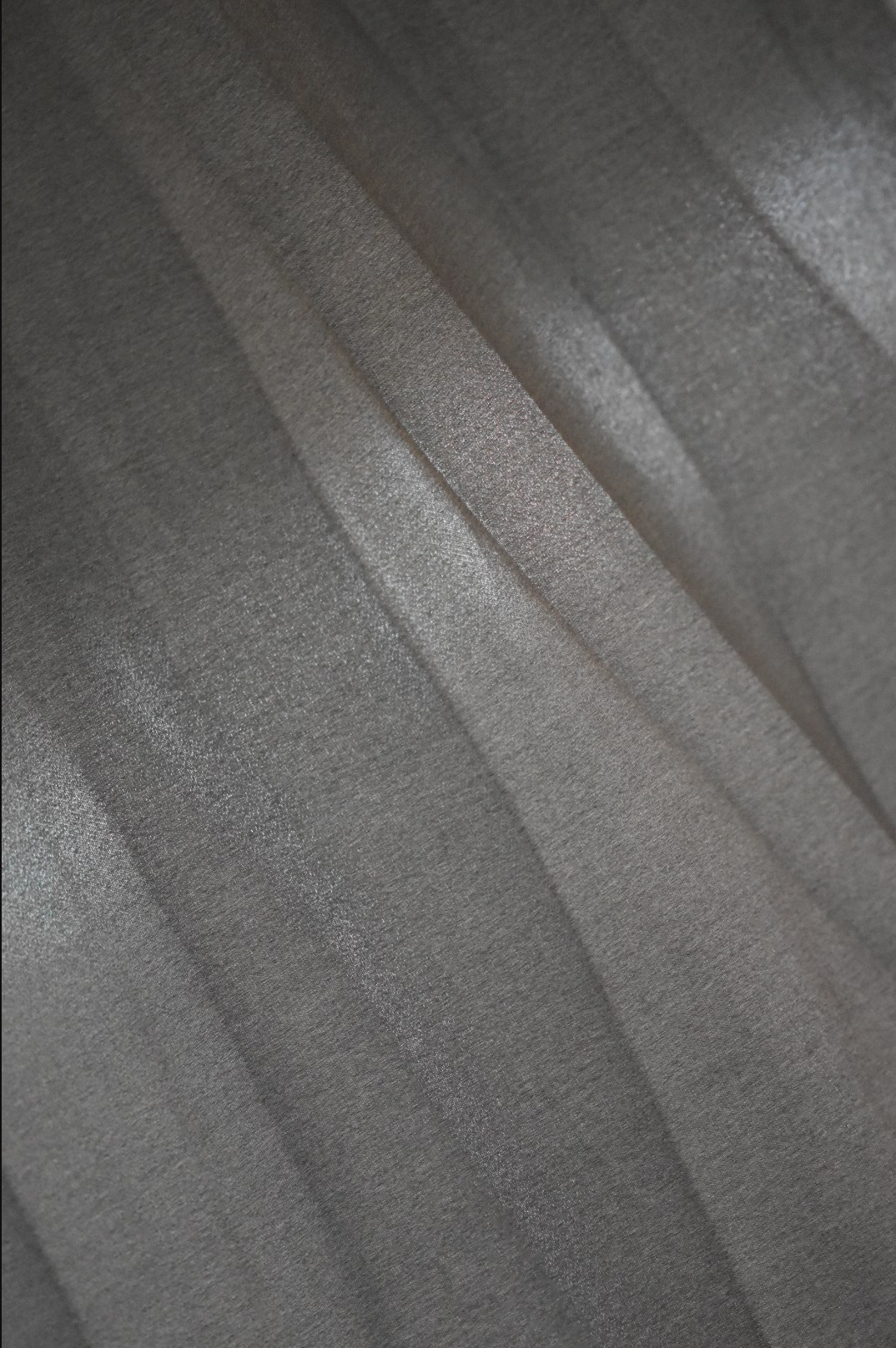
The first photo of the collection to set the mood - a picture of the curtain in my office: https://kimiwo.aishitei.ru/i/mUjQ5jTdeqrY3Vn0.jpg
Chosen because it is grey and boring. The light is not captured by the fabric in any sort of interesting manner - the fabric itself is quite boring. There is no pattern or design - just a bland color. There is nothing to frame - a section of the curtain was taken at random. The photo isn't even aligned with the curtain - being tilted some 40 odd degrees. Nor is the curtain ever properly in focus. A perfect start for a collection of boring, bland photos.
[0] https://www.youtube.com/watch?v=tjSxFAGP9Ss&feature=youtu.be
I disagree that there is no originality in art styles, human creativity amounts to more than just copying other people. There is no way a current gen AI model would be able to create truly original mathematics or physics, it is just able to reproduce facsimile and convincing bullshit that looks like it. Before long the models will probably able to do formal reasoning in a system like Lean 4, but that is a long way of from truly inventive mathematics or physics.
Art is more subtle, but what these models produce is mostly "kitsch". It is telling that their idea of "aesthetics" involves anime fan art and other commercial work. Anyways, I don't like the commercial aspects of copyright all that much, but what I like is humans over machines. I believe in freely reusing and building on the work of others, but not on machines doing the same. Our interests are simply not aligned at this point.
Which is pretty close to the actual issue here, that artists did not give their permission to use their own work to generate their competition.
Here is an example for keras (a popular ML framework). https://keras.io/guides/transfer_learning/
Ever wondered why artists have to show up at gallery parties to sell their stuff?
Because it's barely been a year since we've gone from people confidently asserting that AI won't be able to produce visual art on the level of human professionals at all to the current situation. Predictions on ways in which AI performance will not catch up to or overtake human performance have a bad track record at the moment, and it has not been long enough to even suspect that the current increase in performance might be plateauing. Cutting-edge image generation AI appears to often imitate human artists in obvious ways now, but it seems quite plausible that the gap between this and being "original"/as non-obvious in your imitation of other humans as those high-performing human artists that are considered to be original is merely quantitative and will be closed soon enough.
> You mean that any artist should be just happy that his work is used by other people / rich corporation / AI without consent? Cool, cool.
I don't know how you get that out of what I said. Rather, I'm claiming that artists will have enough to be unhappy about being obsoleted, and the current direction of their ire at being "copied" by AI may be a misdirection of effort, much as if makers of horse-drawn carriages had tried to forestall the demise of their profession by complaining that the design of the Ford Model T was ripped off of theirs (instead of, I don't know, lobbying to ban combustion engines altogether, or sponsoring Amish proselytism).
Several open source licenses do not agree with this (they enforce restrictions on how it is to be shared).
To some. To others, the artistic object is all that all that matters.
Meanwhile, where is my levy of custom artists willing to do free commission work for me? It’s enjoyable, right?
I see a lot of discussion about money and copyright, and little to no discussion about the individual whose life is enriched by access to these tools and technologies.
As for your bleak future… will that even come to pass? I don’t know. Maybe it depends on your notion of “surpass”, and what that looks like.
It’s a stupid concept. It would never work. Even the visualizations we see that are explicitly attempting to copy another artist’s style are often still clearly not exactly the same.
Photos will periodically be added to the collection - not that I expect anyone whatsoever to ever be interested in following a collection of photos that is meant to be boring and uninspired. However - feel free to use this collection of photos as a counterargument to the argument that "art requires some effort". I promise that I will put far less thought and effort into the photos of this collection than I have in any writing of prompts for AI generated art that I've done.
Art is little more than a statement and sometimes a small statement can carry a large message.
Tomorrow I will work on setting up a domain and gallery for the images - to facilitate easier discussion and sharing. Is the real artistic statement the story behind the collection and not the collection itself? How can the two be separated? Can one exist without the other?
Another place to look is the financially independent. What are they doing with their time?
When Alpha Go adds one of its own self-vs-self games to its training database, it is adding a genuine game. The rules are followed. One side wins. The winning side did something right.
Perhaps the standard of play is low. One side makes some bad moves, the other side makes a fatal blunder, the first side pounces and wins. I was surprised that they got training through self play to work; in the earlier stages the player who wins is only playing a little better than the player who loses and it is hard to work out what to learn. But the truth of Go is present in the games and not diluted beyond recovery.
But a LLM is playing a post-modern game of intertextuality. It doesn't know that there is a world beyond language to which language sometimes refers. Is what a LLM writes true or false? It is unaware of either possibility. If its own output is added to the training data, that creates a fascinating dynamic. But where does it go? Without Alpha Go's crutch of the "truth" of which player won the game according to the hard coded rules, I think the dynamics have no anchorage in reality and would drift, first into surrealism and then psychosis.
One sees that AlphaGo is copying the moves that it was trained on and a LLM is also copying the moves that is was trained on and that these two things are not the same.
I think for most people the enjoyable and fulfilling part of life is feeling useful or having some expression and connection through their work. There's definitely some people who can create in a vacuum with no witness and be fulfilled, but I think there's a deep need for human appreciation for most people.
> As for your bleak future… will that even come to pass? I don’t know. Maybe it depends on your notion of “surpass”, and what that looks like.
I don't know either, maybe it will be fine. Maybe this will pass like the transition from traditional to digital. But something about this feels different...like it's actually stealing the creative process rather than just a paradigm shift.
It seems inevitable and I don't think we can stop it, but I just am kind of worried about the collective mental health of humanity. What does a world look like where people have no jobs and even creative outlets are dominated by AI? Are people really just happy only consuming? What even is the point of humanity existing at that point?
I was the first photographer I knew of that combined astrophotography with wedding portraiture. That was new. Now lots of people do it - far better than me (I rarely get the chance)!
I’m a small fry so they almost assuredly didn’t get the idea from me, before anyone says I claim otherwise. There were probably a few photographers who thought to do it and now everybody has seen it and emulates it. The true artists put just a little spin on it, from which others will learn. So it goes.
My argument is just, and has always been, that this is a novel right that is not covered by existing legislation.