zlacker

[parent] [thread] 6 comments
1. angst_+(OP)[view] [source] 2026-02-03 18:08:06
It was earlier than the 90s, and came with popular 8-bit CPUs in the 80s. The Z-80 microprocessor could address 64kb (which was 65,536 bytes) on its 16-bit address bus.

Similarly, the 4104 chip was a "4kb x 1 bit" RAM chip and stored 4096 bits. You'd see this in the whole 41xx series, and beyond.

replies(2): >>pdw+B5 >>magica+49
2. pdw+B5[view] [source] 2026-02-03 18:29:03
>>angst_+(OP)
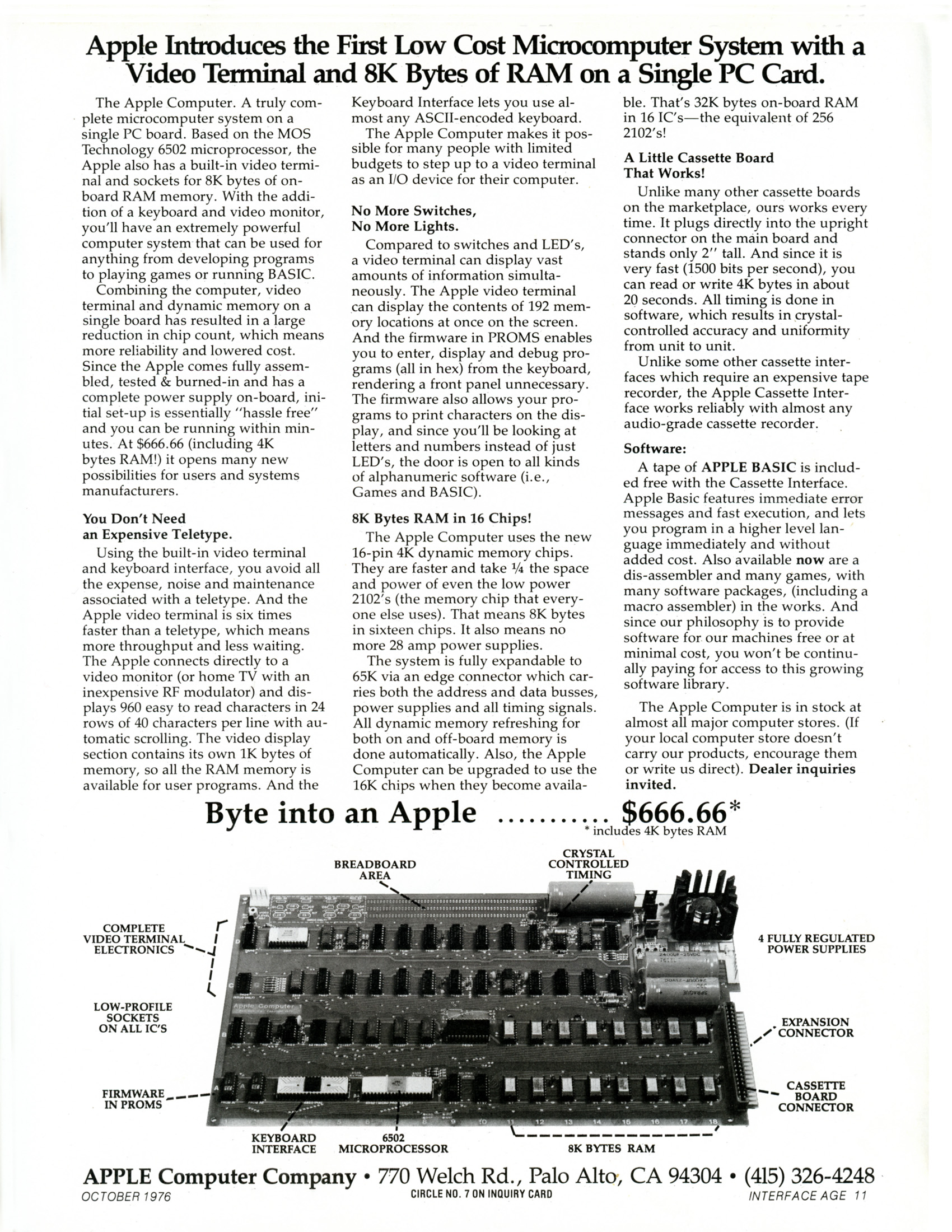
Even then it was not universal. For example, that Apple I ad that got posted a few days ago mentioned that "the system is expandable to 65K". https://upload.wikimedia.org/wikipedia/commons/4/48/Apple_1_...
replies(2): >>wvenab+cf >>kstrau+zA
3. magica+49[view] [source] 2026-02-03 18:41:32
>>angst_+(OP)
> The Z-80 microprocessor could address 64kb (which was 65,536 bytes) on its 16-bit address bus.

I was going to say that what it could address and what they called what it could address is an important distinction, but found this fun ad from 1976[1].

"16K Bytes of RAM Memory, expandable to 60K Bytes", "4K Bytes of ROM/RAM Monitor software", seems pretty unambiguous that you're correct.

Interestingly wikipedia at least implies the IBM System 360 popularized the base-2 prefixes[2], citing their 1964 documentation, but I can't find any use of it in there for the main core storage docs they cite[3]. Amusingly the only use of "kb" I can find in the pdf is for data rate off magnetic tape, which is explicitly defined as "kb = thousands of bytes per second", and the only reference to "kilo-" is for "kilobaud", which would have again been base-10. If we give them the benefit of the doubt on this, presumably it was from later System 360 publications where they would have had enough storage to need prefixes to describe it.

[1] https://commons.wikimedia.org/wiki/File:Zilog_Z-80_Microproc...

[2] https://en.wikipedia.org/wiki/Byte#Units_based_on_powers_of_...

[3] http://www.bitsavers.org/pdf/ibm/360/systemSummary/A22-6810-...

◧◩
4. wvenab+cf[view] [source] [discussion] 2026-02-03 19:04:54
>>pdw+B5
Seems like a typo given that the ad contains many mentions of K (8K, 32K) and they're all of the 1024 variety.
replies(1): >>duskwu+Dg
◧◩◪
5. duskwu+Dg[view] [source] [discussion] 2026-02-03 19:11:03
>>wvenab+cf
If you're using base 10, you can get "8K" and "32K" by dividing by 10 and rounding down. The 1024/1000 distinction only becomes significant at 65536.
replies(1): >>wvenab+Rh
◧◩◪◨
6. wvenab+Rh[view] [source] [discussion] 2026-02-03 19:16:10
>>duskwu+Dg
Still the advertisement is filled with details like the number of chips, the number of pins, etc. If you're dealing with chips and pins, it's always going to base-2.
◧◩
7. kstrau+zA[view] [source] [discussion] 2026-02-03 20:39:59
>>pdw+B5
Someone here the other day said that it could accept 64KB of RAM plus 1KB of ROM, for 65KB total memory.

I don't know if that's correct, but at least it'd explain the mismatch.
[go to top]