Stability AI knew they would be sued to the ground if they trained their AI generating music equivalent called 'Dance Diffusion' model on thousands of musicians without their permission and used public domain music instead.
So of course they think it is fine to do it to artists copyrighted images without their permission or attribution, as many AI grifters continue to drive everything digital to zero. That also includes Copilot being trained on AGPL code.
On the other hand, nobody owns a copyright on a specific style. If I go study how to make art in the style of my favorite artist, that artist has no standing to sue me for making art in their style. So why would they have standing to sue for art generated by an AI which is capable of making art in their style?
[1] https://fishstewip.com/mickey-mouse-copyright-expires-at-the...
edit: the examples are all about objects, but my understanding is that it is capable of style transfers as well.
In 2018[0], didn't Getty force Google to change how Google Images presented results, following a lawsuit in 2016[1]?
[0] https://arstechnica.com/gadgets/2018/02/internet-rages-after... [1] https://arstechnica.com/tech-policy/2016/04/google-eu-antitr...
Absolutely. Google previously had a direct link to the full-size image, but it has removed this due to potential legal issues. See [0].
> Is that a violation if the bakery didn't advertise it?
According to Disney, it is. See [1].
> Any privately commissioned art?
Not any art, no. Only that which uses IP/material they do not have a license to.
[0]: https://www.ghacks.net/2018/02/12/say-goodbye-to-the-view-im...
[1]: https://en.wikipedia.org/wiki/Cake_copyright#Copyright_of_ar...
This has always been the case. Most entertainment regardless of form (music, art, tv, games...) is mediocre or below mediocre, with the occasional good or even rarer exceptional that we all buzz about.
AI image gen is only allowing a wider range of people to express their creativity. Just like every other tools that came before it lowered the bar of entry for new people to get in on the medium (computer graphics for example allowed those who had no talent for pen and paper to flourish).
Yes, there will be a lot of bad content, but that's nothing out of the ordinary.
The matters of the baker and the privately comissioned art are more complicated. The artist and baker hold copyrigh for their creation, but their products are also derived from copyrighted work, so Disney also has rights here [1]. This is just usually not enforced by copyright holders because who in their right mind would punish free marketing.
A latent space that contains every image contains every copyrighted image. But the concept of sRGB is not copyrighted by Disney just yet.
If you have views on whether they'll win, the prediction market is currently at 49%: https://manifold.markets/JeffKaufman/will-the-github-copilot...
you can still copyright characters separatedly. he's feigning ignorance of how copyright work to make a sensationalistic point, which pretty much invalidate and poison what is otherwise an interesting argument at the boundary between derivative work and generative art.
Intellectual property concepts in their current form started to appear as soon as prints, so about the 15th century.
https://en.wikipedia.org/wiki/History_of_copyright#Early_dev...
> Who can't contribute to Wine?
> Some people cannot contribute to Wine because of potential copyright violation. This would be anyone who has seen Microsoft Windows source code (stolen, under an NDA, disassembled, or otherwise). There are some exceptions for the source code of add-on components (ATL, MFC, msvcrt); see the next question.
I've seen a few MIT/BSD projects that ask people not to contribute if they have seen the equivalent GPL project. It's a problem because Copilot has seen "all" GPL projects.
<https://waxy.org/2019/12/how-artists-on-twitter-tricked-spam...>
If art streams are tree-spiked with copyrighted or trademarked works, then AI generators might be a bit more gun-shy about training with abandon on such threads.
It's a form of monkeywrenching.
<https://en.wikipedia.org/wiki/Tree_spiking>
<https://en.wikipedia.org/wiki/Sabotage#As_environmental_acti...>
https://waxy.org/2019/12/how-artists-on-twitter-tricked-spam...
-> here is the actual judgement though: https://juris.bundesgerichtshof.de/cgi-bin/rechtsprechung/do...
Imagine you are a painter and you have developed your expertise in photorealistic painting over your entire lifetime.
Would you mind if someone snaps a photograph of the same subject you just painted?
What if your commissioners tell you they decided to buy a photograph instead of your painting because it looked more realistic?
Every argument I've seen against AI art is an appeal to (human) ego or an appeal to humanity. I don't find either argument compelling. Take this video [0] for example and half of the counterarguments are an appeal to ego - and one argument tries to paint the "capped profit" as a shady dealing of circumventing laws without realizing (1) it's been done before, OpenAI just tried slapping a label on it and (2) nonprofits owning for-profit subdivisions is commonplace. Mozilla is both a nonprofit organization (the Foundation) and a for-profit company (the Corporation).
E:
I'm going to start a series of photographs that are intentionally bad and poorly taken. Poor framing, poor lighting, poor composition. Boring to look at, poor white balance, and undersaturated photos like the kind taken on overcast days. With no discernable subjects or points of interest. I will call the photos art - things captured solely with the press of a button by pointing my camera in a direction seemingly at random. I'm afraid many won't understand the point I am making but if I am making a point it does make the photographs art - does it not? I'm pretty sure that is how modern art works. I will call the collection "Hypocrisy".
E2:
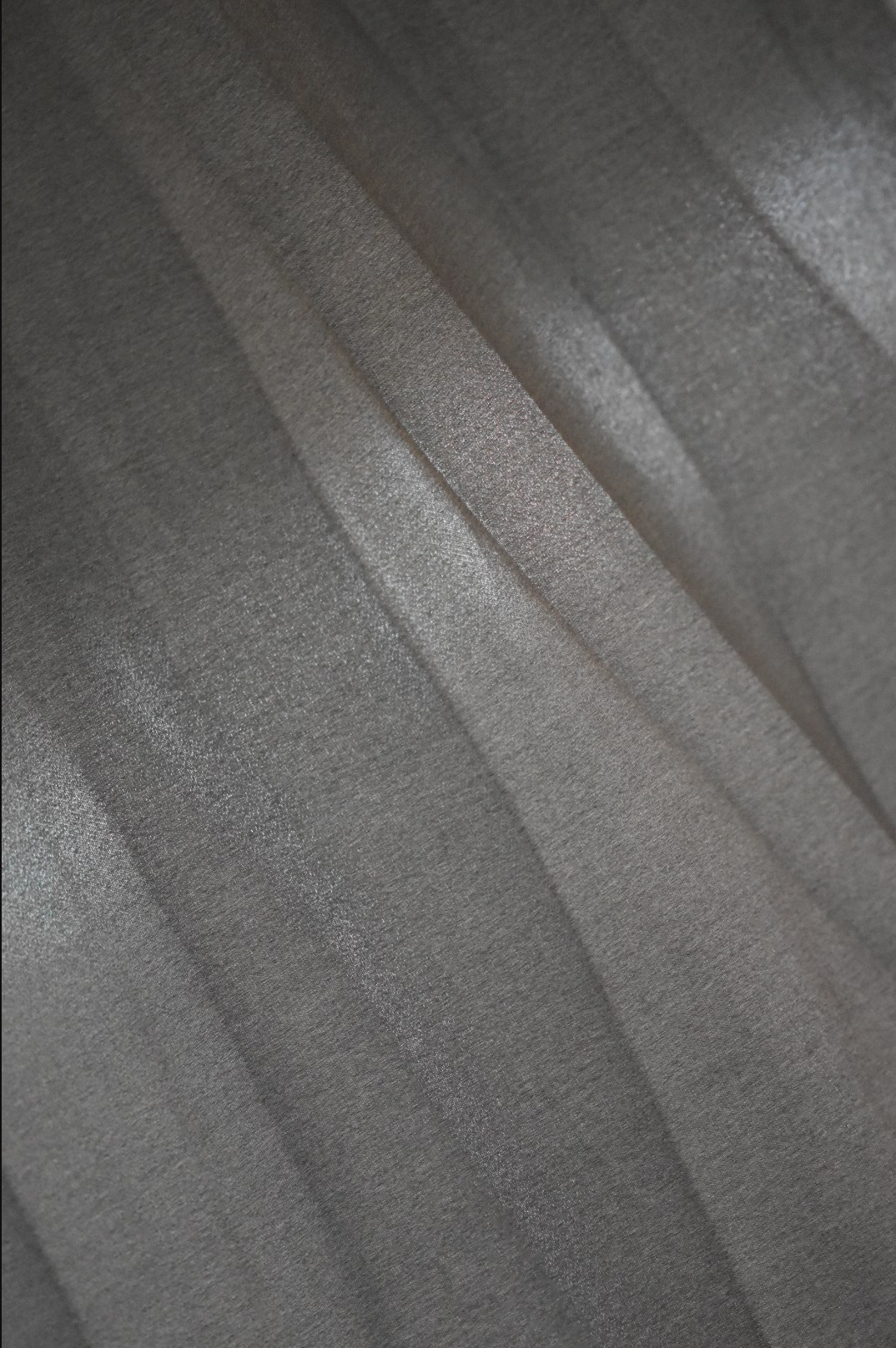
The first photo of the collection to set the mood - a picture of the curtain in my office: https://kimiwo.aishitei.ru/i/mUjQ5jTdeqrY3Vn0.jpg
Chosen because it is grey and boring. The light is not captured by the fabric in any sort of interesting manner - the fabric itself is quite boring. There is no pattern or design - just a bland color. There is nothing to frame - a section of the curtain was taken at random. The photo isn't even aligned with the curtain - being tilted some 40 odd degrees. Nor is the curtain ever properly in focus. A perfect start for a collection of boring, bland photos.
[0] https://www.youtube.com/watch?v=tjSxFAGP9Ss&feature=youtu.be
But that is giving AI too much credit. As advanced as modern AI models are, they are not AGIs comparable to human cognition. I don't get the impulse to elevate/equate the output of trained AI models to that of human beings.
This is the main reason I haven't actually incorporated any AI tools into my daily programming yet - I'm mindful that I might end up spending more time tracking down issues in the auto-generated code than I saved using it in the first place.
[0] You can see the results here https://twitter.com/NickFisherAU/status/1601838829882986496
https://en.m.wikipedia.org/wiki/Scientific_American_Frontier...
Edit: confused SAF with Nova!
This feels like the natural outcome of Moravec's paradox[1]. I can imagine a grim future where most intellectually stimulating activities are done by machines and most of the work that's left for humans is building, cleaning, and maintaining the physical infrastructure that keeps these machines running. Basically all the physical grunt work that has proven hard to find a general technological solution for.
Here is an example for keras (a popular ML framework). https://keras.io/guides/transfer_learning/
That said, I don't think AIs ability to generate art is a major milestone in the progress of things, I think it's more of the same, automating low value-add processes.
I agree that AI is/will-be an incredibly disruptive technology. And that automation in general is putting more and more people out of jobs, and extrapolated forward you end up in a world where most humans don't have any practical work to do other than breed and consume resources at ever increasing rates.
As much as I'm impressed by AI art (it's gorgeous), at the end of the day it's mainly just copying/pasting/smoothing out objects it's seen before (training set). We don't think of it as clipart, but that's essentially what it is underneath it all, just a new form of clipart. Amazing in it's ability to reposition, adjust, smooth images, have some sense of artistic placement, etc. It's lightyears beyond where clipart started (small vector and bitmap libraries). But at the end of the day it's just automating the creation of images using clipart. Re-arranging images you've seen before so is not going to make anyone big $$$. End of the day the quality of the output is entirely subjective, just about anything reasonable will do.
This reminds me a lot of GPT-3... looks like it has substance but not really. GPT-3 is great at making low value clickbait articles of cut-and-paste information on your favorite band or celebrity. GPT-3 will never be able to do the job of a real journalist, pulling pieces together to identify and expose deeper truths, to say, uncover the Theranos fraud. It's just Eliza [1] on steroids.
The AI parlor tricks started with Eliza, and have gotten quite elaborate as of late. But they're still just parlor tricks.
Comparing it to the challenges of programming, well yes I agree AI will automate portions of it, but with major caveats.
A lot of what people call "programming" today is really just plumbing. I'm a career embedded real-time firmware engineer, and it continues to astonish me that there's an entire generation of young "programmers" who don't understand basic computing principles, stacks, interrupts, I/O operations.. at the end of the day their knowledge base seems comprised of knowing which tool to use where in orchestration, and how to plumb it together. And if they don't know the answer they simply google and stack overflow will tell them. Low code, no code, etc. (python is perfect for quickly plumbing two systems together). This skill set is very limited and wouldn't even get you a junior dev position when I started out. I'm not suprised it's easy to automate, as it will generally have the same quality code (and make the same mistakes) as a human dev that simply copies/pastes Stack Overflow solutions.
This is in stark contrast to the types of problems that most programmers used to solve in the old days (and a smaller number still do). Stuff that needed an engineering degree and complex problem solving skills. But when I started out 30 years ago, "programmers" and "software engineers" were essentially the same thing. They aren't now, there is a world of difference between your average programmer and a true software engineer today.
Not saying plumbers aren't valuable.. they absolutely are as more and more of the modern world is built on plumbing things together. Highly skilled software engineers are needed less and less, and that's a net-good thing for humanity. No one needs to write operating systems anymore, lets add value building on top of them. Those are the people making the big $$$, their skillset is quite valuable. We're in the middle of a bi-furcation of software engineering careers. More and more positions will only require limited skills, and fewer and fewer (as a percentage) will continue to be highly skilled.
So is AI going to come in and help automate the plumbing? Heck yes, and rightly so... They've automated call centers, warehouse logistics, click-bait article writing, carry-out order taking, the list goes on and on. I'd love to have an AI plumber I could trust to do most of the low-level work right (and in CI/CD world you can just push out a fix if you missed something).
I don't believe for a second that today's latest and greatest "cutting edge" AI will ever be able to solve the hard problems that keep highly skilled people employed. New breakthroughs are needed, but I'm extremely skeptical. Like fusion promises, general purpose AI always seems just a decade or two away. Skilled labor is safe, for now.. maybe for a while yet.
The real problem as I see it, is that AI automation is on course to eliminate most low skilled jobs in the next century, which puts it on a collision course with the fact that most humans aren't capable of performing highly skilled work (half are below average by definition). Single parent workig the GM line in the 50's was enough afford an average family a decent life. Not so much where technology is going. At the end of the day the average human will have little to contribute to civilization, but still expects to eat and breed.
Universal basic income has been touted as a solution to the coming crisis, but all that does is kick the can down the road. It leads to a world of too much idle time (and the devil will find work for idle hands) and ever growing resource consumption. A perfect storm.... at the end of the day what's the point of existing when all you do is consume everything around you and don't add any value? Maybe that's someone's idea of utopia, but not mine.
This has been coming for a long time, AI art is just a small step on the current journey, not a big breakthrough but a new application in automation.
/rant
You're comparing apples to oranges. Digging a trench by hand is also vastly more difficult than art or programming.
There's just as much AI hype around code generation, and some programmers are also complaining (https://www.theverge.com/2022/11/8/23446821/microsoft-openai...).
Overall though the sentiment is that AI tools are useful and are a sign of progress. The fact that they are stirring so much contention and controversy is just a sign of how revolutionary they are.
Obviously a lot of money will be lost for artists in a variety of commercial fields, but the ultimate "success of art" will be unapproachable by AI given its subjective nature.
Developers though will be struggling to compete from both a speed and technical point of view, and those hurdles can't be simply overcome with a shift in how someone feels. And you're right about the arms race, it just won't be happening with humans. It'll be computing power, AIs and the people capable of programming those AIs.
Photos will periodically be added to the collection - not that I expect anyone whatsoever to ever be interested in following a collection of photos that is meant to be boring and uninspired. However - feel free to use this collection of photos as a counterargument to the argument that "art requires some effort". I promise that I will put far less thought and effort into the photos of this collection than I have in any writing of prompts for AI generated art that I've done.
Art is little more than a statement and sometimes a small statement can carry a large message.
Tomorrow I will work on setting up a domain and gallery for the images - to facilitate easier discussion and sharing. Is the real artistic statement the story behind the collection and not the collection itself? How can the two be separated? Can one exist without the other?
Marx makes the case in Grundisse https://thenewobjectivity.com/pdf/marx.pdf that the automation of work could improve the lives of workers -- to "free everyone’s time for their own development". Ruth Gilmore Wilson observes that capital's answer is to build complexes of mass incarceration & policing to deal with the workers rendered jobless by automation https://inquest.org/ruth-wilson-gilmore-the-problem-with-inn... -- that is, those who have too much "free" time. In such a world, Marx speculates that "Wealth is not command over surplus labour time’ (real wealth), ‘but rather, disposable time outside that needed in direct production", but Wilson reminds us that capital's apparent answer to date has been fascism.
Artists are poets, and they're railing against Trurl's electronic bard.
[https://electricliterature.com/wp-content/uploads/2017/11/Tr...]
We don‘t know. We just don‘t.
It‘s too difficult to predict what, say, software developers will do in a few years and how demand or salary or competition will be.
Look at this final video of the 2012 Deep Learning course by Hinton that I still remember from a long time ago: https://m.youtube.com/watch?v=FOqMeBM3EIE
What I do know however is this:
- Short term nothing special will happen.
- In the actually interesting projects that I worked on I always ran out of time. So much more could be imagined that could have been done but there was no time or budget to do it. Looking forward to AI making a dent in this a bit.
I can't copy your GPL code. I might be able to write my own code that does the same thing.
I'm going to defend this statement in advance. A lot of software developers white knight more than they strictly have to; they claim that learning from GPL code unavoidably results in infringing reproduction of that code.
Courts, however, apply a test [1], in an attempt to determine the degree to which the idea is separable from the expression of that idea. Copyright protects particular expression, not idea, and in the case that the idea cannot be separated from the expression, the expression cannot be copyrighted. So either I'm able to produce a non-infringing expression of the idea, or the expression cannot be copyrighted, and the GPL license is redundant.
[1] https://en.wikipedia.org/wiki/Abstraction-Filtration-Compari...
Current SOTA: https://openai.com/blog/vpt/
> A small amount of actual artists
It's extremely funny that you say this, because taking a look at the Trending on Artstation page tells a different story.
1. This is theft and that's bad.
2. People who do this are getting gains without putting the work and that's bad. (And, per quite a few commenters I've seen, are talentless hacks.)
I have a lot of empathy for the first, and think it has merit, and have a much smaller amount of empathy for the second.
I ended up reading a lot of the quote tweets on this guy the other day: https://twitter.com/ammaar/status/1601284293363261441/retwee...
Here's just a few of thousands in the vein of number 2:
> No talent or passion whatsoever
> He thinks he created something
> Why don't you subscribe to writing and art classes?
> This so ugly and shows real disrespect for people who have made stuff by themselves for years.
> Men will literally sell AI trash and call it "art" instead of go to therapy
> Can’t write or draw but wants to do both
> This is nothing but a HUGE disrespect to all the writers and artists around the world, and all it does is belittle their REAL work and effort. > > This is not art. > Nothing to be proud of.
> I just spent 8 months illustrating a children’s book by hand—working, not “playing”—after a lifetime of training. > > FUCK OFF!
There are also plenty people are complaining about "theft", but it honestly, re-reading through it now, it feels like a minority. If this were done using fully public-domain content, does it sound like any of the people I quoted above been okay with it?
There's a clear disdain for "non-artists" creating art in a new way. I very much feel for the people who see their careers going away, and I can also empathize people who spent a long time acquiring a creative skill that's now "unnecessary". Programming has this too—those darn kids programming in Python rather than Assembly, or doing bootcamps that don't teach big-O notation. This is a normal, human way to feel, and I feel that too from time to time. BUT, I also resist that feeling. I choose not to express disdain for newcomers using new technology, or skipping the old ways.
A large (or at least loud) part of the art community seen here is expressing absolute disdain for those of us who are "cheating" not because "copyright infringement" but because we're using new technology that bypasses years of learning and that's very much eating into my empathy for the community in general. I find it toxic in the programming community and I find it toxic in the art community. Right now, it's exploding in the art community in a way far beyond what I've witnessed in programming.
I have no idea how well it holds up to modern reading, but I found it interesting at the time.
He posits two outcomes - in the fictionalised US the ownership class owns more and more of everything, because automation and intelligence remove the need for workers and even most technicians over time. Everyone else is basically a prisoner given the minimum needed to maintain life.
Or we can become “socialist” in a sort of techno-utopian way, realising that the economy and our laws should work for us and that a post-labor society should be one in which humans are free from dependence on work rather than defined by it.
Does this latter one imply a total lack of freedom? It certainly implies dependence on the state, but for most people (more or less by definition) an equal share would be a better share than they can get now, and they would be free to pursue art or learning or just leisure.
Indeed, you should not read it as an imperative. The other commentator was also put on the wrong foot by this.
Maybe I should not have assumed people would know Genesis, https://en.wikipedia.org/wiki/Book_of_Genesis. I should be more explicit: we are not some holy creatures. Don't assume that the few who are gonna reap the rewards will spontaneously share them with others. We are able to let others suffer to gain a personal advantage.
This was my reply: https://news.ycombinator.com/item?id=34005604
I also agree that artist employment isn't sacred, but after extensive use of the generation tools I don't see them replacing anything but the lowest end of the industry, where they just need something to fill a space. The tools can give you something that matches a prompt, but they're only really good if you don't have strong opinions about details, which most middle tier customers will.
Case in point: https://stackoverflow.com/help/gpt-policy
> This trust is broken when users copy and paste information into answers without validating that the answer provided by GPT is correct, ensuring that the sources used in the answer are properly cited (a service GPT does not provide), and verifying that the answer provided by GPT clearly and concisely answers the question asked.
- If I draw an animation and post it to YouTube, and one of the characters happens to be Mickey Mouse, that will be legal. But I still can't name my channel "Mickey Mouse Official" or put the character's face in my channel profile, since that's source-identifying material.
- If I just flat-out reupload Steamboat Willie to YouTube, with the (possibly incorrect) title "Walt Disney's FIRST EVER CARTOON", that also will be legal - because the title is purely nominative and does not imply that I'm licensed by Disney.
- If I release STL or STEP files on Thingiverse for printing Mickey Mouse christmas ornaments, that will be legal - but I have to make sure that nobody thinks this is actually made by Disney.
- Mass-produced merchandise sold in stores will be very difficult to sell legally, since generally speaking the whole object is considered source-identifying when you put it on a store shelf. About the only thing you could do is sell figurine blind-bags with no indication that there's public-domain Disney stuff in there.
That last one is probably why Disney isn't trying to, say, push Mexican life+100 terms[1] on everyone. Mickey Mouse is more valuable as a branding and merchandising tool than as a creative work.
Copyright law itself also has a preemption clause[2] which prohibits making copyright-shaped claims under other laws. This is usually mentioned in the context of state right-of-publicity laws[3], but the text of the clause would also apply to trying to "trademark a copyright" to keep the mouse in his cage.
[0] This is part of "trademark fair use", which is an entirely different concept to the copyright fair use one.
[1] Oh, yeah, I forgot - in all those YouTube examples you need to convince YouTube to block your upload in Mexico, which they are unwilling to do. The stated reason is that pirates could be harder to catch if they geoblocked their uploads. However, this already causes problems for, say, people reviewing anime - which is actually illegal in Japan! So I suspect that YouTube might have to change their policies on this at some point as more large publishers' work hits the public domain in certain countries but not others.
[2] 18 USC 301
[3] https://www.sheppardmullin.com/media/article/753_CL%2025-4%2...