He talks about General Magic, which shipped basically an early smartphone in 1994:
I co-founded a company called General Magic, we wanted to make personal communicators that would be intimate devices, with you all the time... we wanted to do something smaller that would be in your pocket and with you all the time, and we failed. We really couldn’t - the components were too expensive, there wasn’t a good capacitive touch sensing that you could do gentle swipe...
And the meteoric rise of the Internet drew the attention away from it and all our partners kinda went to work on the Internet. And yeah, they were right to do so.
We were just ahead of our time. I’m pleased to see some of the ideas that we had bore fruit in the long run, and that’s really what I saw, and the first iPhone was hey - somebody’s finally done the personal communicator.
The lecture also has one of my favorite lines from any lecture I've attended: You know, I’m not like advocating that every software designer should go out and take LSD, but it worked for me.
[1] https://scs.hosted.panopto.com/Panopto/Pages/Viewer.aspx?id=...
I think that if hypercard had been the engine of the web instead of html/css, we would have had the current state of the web (ie. with client-side dynamic applications) a lot sooner.
Wether Hypertalk would have been a better choice than javascript to program the web, this is another story :)
For the curious, the Hypertalk entry in wikipedia contains a lot of code examples: https://en.wikipedia.org/wiki/HyperTalk
https://github.com/PierreLorenzi/HyperCardPreview See HyperCard stacks in Mac OS X
https://news.ycombinator.com/item?id=19253435 HyperCard Users Guide (1987) [pdf]
https://news.ycombinator.com/item?id=14985604 HyperCard On The Archive
https://news.ycombinator.com/item?id=19237052 HyperCard Adventures
https://en.wikipedia.org/wiki/ResEdit
macintosh font manager
https://news.ycombinator.com/item?id=16550308 Is there an open-source hypercard equivalent?
https://www.luna-lang.org/#Features
https://scratch.mit.edu/studios/198036/ https://scratchx.org/ https://medium.com/@hiroyuki.osaki/how-to-develop-your-own-b...
http://www.cs.cmu.edu/~bam/uicourse/05440inter2019/Bill_Atki...
And here are some more links to the original interview with Leo Laporte, the Mondo 2000 article, and some other stuff about his talk, that I posted to a previous HN discussion:
https://news.ycombinator.com/item?id=21779399
Bobbie: Was Brad really serious when he said "no hands" were raised in response to Bill's question??! Kids these days, sheez! ;)
>Then at 1:03:15 a student asked him the million dollar question: what was the impetus and motivation behind HyperCard? He chuckled, reached for the transcript he had off-camera, and then out of the blue he asked the entire class "How many of you guys have done ... a psychedelic?" (Brad reported "No hands", but I think some may have been embarrassed to admit it in front of their professor). So then Bill launched into reading the transcript of the LSD HyperCard story, and blew all the students' minds.
>See video of Bill's talk:
https://scs.hosted.panopto.com/Panopto/Pages/Viewer.aspx?id=...
>The next week I gave a talk to the same class that Bill had just traumatized by asking if they'd done illegal drugs, and (at 37:11) I trolled them by conspiratorially asking: "One thing I wanted to ask the class: Have any of you ever used ... (pregnant pause) ... HyperCard? Basically, because in 1987 I saw HyperCard, and it fucking blew my mind." Then I launched into my description of how important and amazing HyperCard was.
>See video of Don's talk:
https://scs.hosted.panopto.com/Panopto/Pages/Viewer.aspx?id=...
>Here is an index of all of the videos from Brad Myers' interaction techniques class, including Rob Haitani (Palm Pilot), Shumin Zhai (text input and swipe method), Dan Bricklin (spreadsheets, Demo prototyping tool), Don Hopkins (pie menus), and Bill Atkinson (Mac, HyperCard):
https://scs.hosted.panopto.com/Panopto/Pages/Sessions/List.a...
https://medium.com/@donhopkins/hyperlook-nee-hypernews-nee-g...
>SimCity, Cellular Automata, and Happy Tool for HyperLook (nee HyperNeWS (nee GoodNeWS))
>HyperLook was like HyperCard for NeWS, with PostScript graphics and scripting plus networking. Here are three unique and wacky examples that plug together to show what HyperNeWS was all about, and where we could go in the future!
[...]
>The Axis of Eval: Code, Graphics, and Data
>We will return to these three important dimensions of Code, Graphics and Data as a recurring theme throughout this article. But which way to go from here?
>Alan Kay on NeWS:
>“I thought NeWS was ‘the right way to go’ (except it missed the live system underneath). It was also very early in commercial personal computing to be able to do a UI using Postscript, so it was impressive that the implementation worked at all.” -Alan Kay
It was indeed deeply inspired by and indebted to HyperCard, but of course had networking built in thanks to NeWS, and used PostScript as the data format and networking protocol (like XML and JSON are now used), and as the scripting language (which is more like Lisp than HyperTalk), and as the imaging model instead of pixels (including a nice built-in structured graphics editor component that supported EPS and raster images too, which you could use to build your own apps, property sheets, and editors, like the editable Clock component the article shows).
Another significant difference between HyperCard and HyperLook is that HyperLook used its own "stacks" to implement its own user interface for property sheets, etc. HyperCard just used the traditional Mac Toolbox for its user interface, instead of property sheets and dialogs being stacks. So you could edit and customize HyperLook property sheets and dialogs, and define new classes of HyperLook widgets, and then build your own seamlessly integrated property sheets for them (or just customize the property sheets of existing components). For example, I defined some NeWS Toolkit OPEN LOOK components like sliders and buttons and menus to support SimCity, all configurable with their own property sheets. The property sheets could use as many PostScript graphics editor components as they needed: for example, the editable clock component's property sheet let you edit its clock face, minute hand, and hour hand, which it rotated and drew around the clock. ...But it was just too slow to practically redraw a second hand once per second, so I left that out! Then you could copy and paste your custom clocks into any HyperLook stack, in case you cared what time it was.
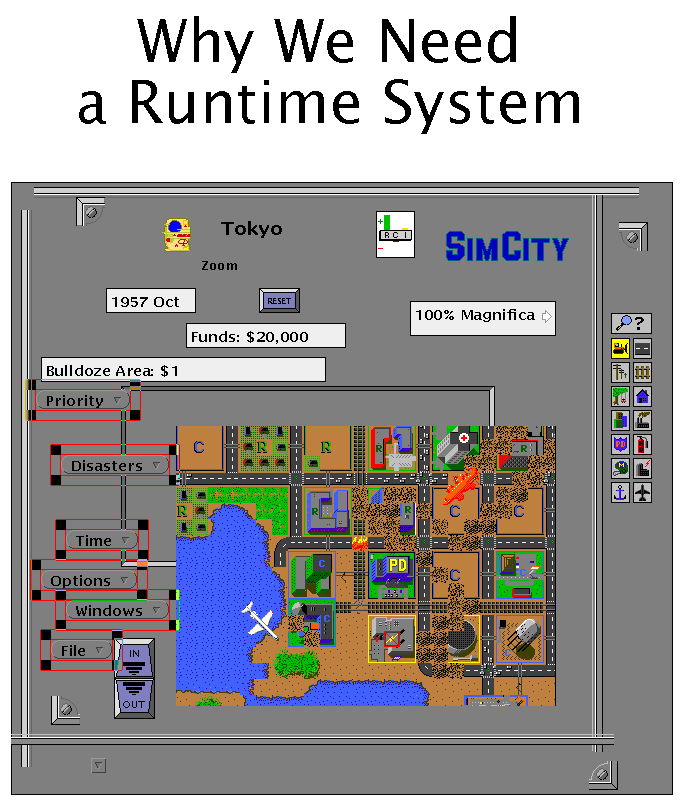
However, this feature did enable "user interface vandalism", so HyperLook has a non-editable runtime system with the editors stripped out, that you could ship with apps:
http://www.art.net/~hopkins/Don/hyperlook/TalkRunTime.gif
In case you don't like PostScript as much as I do, Arthur van Hoff also wrote "PdB", an object oriented C to PostScript compiler that you could use to write classes and scripts. Later, after working on Java at Sun and leaving to found Marimba, Arthur wrote Bongo in Java, which was inspired by HyperCard (and called the Java compiler he wrote at Sun to dynamically compile scripts), and Danny Goodman wrote the book on Bongo! (He also wrote the book on HyperCard.) Arthur's working at Apple, now.
https://en.wikipedia.org/wiki/Arthur_van_Hoff
https://www.amazon.com/Official-Marimba-Guide-Bongo-Goodman/...
https://books.google.nl/books?id=NToEAAAAMBAJ&pg=PA47&lpg=PA...
I've included links to a bunch of brochures, articles, product info, documentation, and SimCity README and manual at the end of the article. Here's the link to the HyperLook product info, which summarizes it pretty well, and the HyperLook SimCity manual, which has a lot of screen snapshots and shows what it can do.
HyperLook Product Info:
http://donhopkins.com/home/HyperLook-Product-Info.pdf
HyperLook SimCity Manual:
https://donhopkins.com/home/HyperLook-SimCity-Manual.pdf
Also here's an illustrated transcript of a HyperLook SimCity demo (that shows all kinds of other HyperLook and NeWS stuff too, and includes a link to the original video):
https://medium.com/@donhopkins/hyperlook-simcity-demo-transc...
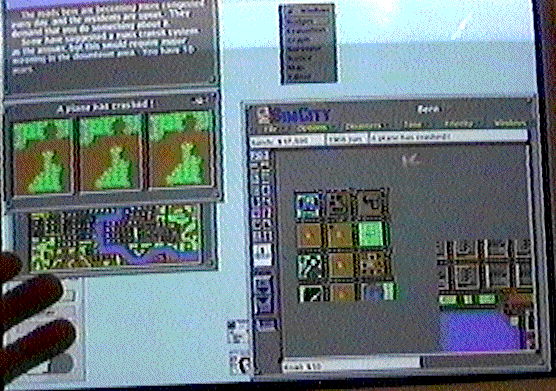
Imagine a window manager built on top of something like HyperLook, where users can not only edit the "chrome" in the window frames to make them look and behave any way they prefer, but also compose custom task-oriented interfaces by copying and pasting components from different parts of the same app, or even different apps, and integrating them by scripting, so you don't have to flip between different windows and navigate to different parts of multiple apps, and you just have all the controls you need together in one place, without any unnecessary junk. For example, SimCity came with an audio mixing server that other apps could use by sending messages to it, which would be mixed with SimCity's sounds, so you could make a button that went "PING" whenever you pressed it, then copy and paste it into any other HyperLook stack, and it would work! Or you could make a custom "SimCity Surveillance" window by copying three different map views into the same window:
https://miro.medium.com/max/556/0*XknyNX0FMotAR7y_.gif
>The neat thing is that this view here itself is just another user interface component, and I can copy and paste that, and have multiple views. Each one of these animated scrolling SimCity editors, once I’ve made one, I can put them anywhere. This window, you can click here to get three of them.
https://en.wikipedia.org/wiki/Cyberdog
>Cyberdog was an OpenDoc-based Internet suite of applications, developed by Apple Computer for the Mac OS line of operating systems. It was introduced as a beta in February 1996 and abandoned in March 1997. The last version, Cyberdog 2.0, was released on April 28, 1997. It worked with later versions of System 7 as well as the Mac OS 8 and Mac OS 9 operating systems.
>Cyberdog derived its name from a cartoon in The New Yorker captioned "On the Internet, nobody knows you're a dog."
https://medium.com/@donhopkins/focusing-is-about-saying-no-s...
>“Focusing is about saying no.” -Steve Jobs, WWDC ‘97. As sad as it was, Steve Jobs was right to “put a bullet in OpenDoc’s head”.
As was Sun's original "HotJava" browser, implemented in Java of course, which was less formally component based than OpenDoc (since Java didn't have a comparable user interface component system like OpenDoc at the time, but it was at least very object oriented, modular, and extensible). HotJava served the purpose of opening a lot of people's eyes to the possibilities of Java and the web, but, like CyberDog, it was ahead of its time, and wasn't fully developed into a viable product, and served more as a technology demonstration and source of inspiration.
https://en.wikipedia.org/wiki/HotJava
>HotJava (later called HotJava Browser to distinguish it from HotJava Views) was a modular, extensible web browser from Sun Microsystems implemented in Java. It was the first browser to support Java applets, and was Sun's demonstration platform for the then-new technology. It has since been discontinued and is no longer supported. Furthermore, the Sun Download Center was taken down on July 31, 2011, and the download link on the official site points to a placeholder page saying so.
Unfortunately, neither CyberDog nor HotJava (nor Netscape, until JavaScript finally arrived on the scene) had scripting languages built in, which I believe is an essential ingredient to the success of web browsers and component systems (and text editors like Emacs, and user interface editors like HyperCard or HyperLook or Bongo, or content management systems and blogging tools like Frontier and Radio Userland, etc). Even something as terrible as Microsoft OLE, which evolved from Visual Basic VBXs, was successful because it was built around a scripting language (Visual Basic for VBX, but OLE opened it up to any language via COM/IDispatch/ActiveX/IScriptingEngine/etc).
https://news.ycombinator.com/item?id=21783227
>In fact, one of the earliest tools that enabled anyone, even children, to author and publish their own interactive dynamic web applications with graphics, text, and even forms and persistent databases, was actually based on HyperCard and the MacHTTP/WebStar web server on the Mac:
https://news.ycombinator.com/item?id=16226209
>One of the coolest early applications of server side scripting was integrating HyperCard with MacHTTP/WebStar, such that you could publish live interactive HyperCard stacks on the web! Since it was based on good old HyperCard, it was one of the first scriptable web authoring tools that normal people and even children could actually use!
MacHTTP / WebStar from StarNine by Chuck Shotton, and LiveCard HyperCard stack publisher:
CGI and AppleScript:
http://www.drdobbs.com/web-development/cgi-and-applescript/1...
>Cal discusses the Macintosh as an Internet platform, then describes how you can use the AppleScript language for writing CGI applications that run on Macintosh servers.
https://news.ycombinator.com/item?id=7865263
MacHTTP / WebStar from StarNine by Chuck Shotton! He was also VP of Engineering at Quarterdeck, another pioneering company.
https://web.archive.org/web/20110705053055/http://www.astron...
http://infomotions.com/musings/tricks/manuscript/0800-machtt...
http://tidbits.com/article/6292
>It had an AppleScript / OSA API that let you write handlers for responding to web hits in other languages that supported AppleScript.
I used it to integrate ScriptX with the web:
http://www.art.net/~hopkins/Don/lang/scriptx/scriptx-www.htm...
https://medium.com/@donhopkins/1995-apple-world-wide-develop...
The coolest thing somebody did with WebStar was to integrate it with HyperCard so you could actually publish live INTERACTIVE HyperCard stacks on the web, that you could see as images you could click on to follow links, and followed by html form elements corresponding to the text fields, radio buttons, checkboxes, drop down menus, scrolling lists, etc in the HyperCard stack that you could use in the browser to interactive with live HyperCard pages!
That was the earliest easiest way that non-programmers and even kids could both not just create graphical web pages, but publish live interactive apps on the web!
Using HyperCard as a CGI application
http://aaa-proteins.uni-graz.at/HyperCGI.html
https://web.archive.org/web/20021013161709/http://pfhyper.co...
http://www.drdobbs.com/web-development/cgi-and-applescript/1...
https://web.archive.org/web/19990208235151/http://www.royals...
What was it actually ever used for? Saving kid's lives, for one thing:
>Livecard has exceeded all expectations and allows me to serve a stack 8 years in the making and previously confined to individual hospitals running Apples. A whole Childrens Hospital and University Department of Child Health should now swing in behind me and this product will become core curriculum for our medical course. Your product will save lives starting early 1997. Well done.
- Director, Emergency Medicine, Mater Childrens Hospital
We're always looking for more stacks, and have an upload form[2] for stacks to be added to the collection. If you've got some old stacks lying around, they'd be a great addition to the collection.
Extracting stacks off old Macs, floppy disks and SCSI hard drives from the 80s / 90s isn't always the easiest, but I'm always happy to help people with this - my email is hypercardonline@gmail.com .
https://news.ycombinator.com/item?id=15327767
>Morgan Dixon's and James Fogarty's work is truly breathtaking and eye opening, and I would love for that to be a core part of a scriptable hybrid Screen Scraping / Accessibility API approach.
>Screen scraping techniques are very powerful, but have limitations. Accessibility APIs are very powerful, but have different limitations. But using both approaches together, screencasting and re-composing visual elements, and tightly integrating it with JavaScript, enables a much wider and interesting range of possibilities.
>Think of it like augmented reality for virtualizing desktop user interfaces. The beauty of Morgan's Prefab is how it works across different platforms and web browsers, over virtual desktops, and how it can control, sample, measure, modify, augment and recompose guis of existing unmodified applications, even dynamic language translation, so they're much more accessible and easier to use!
https://news.ycombinator.com/item?id=11520967
Web Site: Morgan Dixon's Home Page. http://morgandixon.net/
Web Site: Prefab: The Pixel-Based Reverse Engineering Toolkit.
https://web.archive.org/web/20130104165553/http://homes.cs.w...
Video: Prefab: What if We Could Modify Any Interface? Target aware pointing techniques, bubble cursor, sticky icons, adding advanced behaviors to existing interfaces, independent of the tools used to implement those interfaces, platform agnostic enhancements, same Prefab code works on Windows and Mac, and across remote desktops, widget state awareness, widget transition tracking, side views, parameter preview spectrums for multi-parameter space exploration, prefab implements parameter spectrum preview interfaces for both unmodified Gimp and Photoshop:
http://www.youtube.com/watch?v=lju6IIteg9Q
PDF: A General-Purpose Target-Aware Pointing Enhancement Using Pixel-Level Analysis of Graphical Interfaces. Morgan Dixon, James Fogarty, and Jacob O. Wobbrock. (2012). Proceedings of the SIGCHI Conference on Human Factors in Computing Systems. CHI '12. ACM, New York, NY, 3167-3176. 23%.
https://web.archive.org/web/20150714010941/http://homes.cs.w...
Video: Content and Hierarchy in Prefab: What if anybody could modify any interface? Reverse engineering guis from their pixels, addresses hierarchy and content, identifying hierarchical tree structure, recognizing text, stencil based tutorials, adaptive gui visualization, ephemeral adaptation technique for arbitrary desktop interfaces, dynamic interface language translation, UI customization, re-rendering widgets, Skype favorite widgets tab:
http://www.youtube.com/watch?v=w4S5ZtnaUKE
PDF: Content and Hierarchy in Pixel-Based Methods for Reverse-Engineering Interface Structure. Morgan Dixon, Daniel Leventhal, and James Fogarty. (2011). Proceedings of the SIGCHI Conference on Human Factors in Computing Systems. CHI '11. ACM, New York, NY, 969-978. 26%.
https://web.archive.org/web/20150714010931/http://homes.cs.w...
Video: Sliding Widgets, States, and Styles in Prefab. Adapting desktop interfaces for touch screen use, with sliding widgets, slow fine tuned pointing with magnification, simulating rollover to reveal tooltips:
https://www.youtube.com/watch?v=8LMSYI4i7wk
Video: A General-Purpose Bubble Cursor. A general purpose target aware pointing enhancement, target editor:
http://www.youtube.com/watch?v=46EopD_2K_4
PDF: Prefab: Implementing Advanced Behaviors Using Pixel-Based Reverse Engineering of Interface Structure. Morgan Dixon and James Fogarty. (2010). Proceedings of the SIGCHI Conference on Human Factors in Computing Systems. CHI '10. ACM, New York, NY, 1525-1534. 22%
https://web.archive.org/web/20150714010936/http://homes.cs.w...
PDF: Prefab: What if Every GUI Were Open-Source? Morgan Dixon and James Fogarty. (2010). Proceedings of the SIGCHI Conference on Human Factors in Computing Systems. CHI '10. ACM, New York, NY, 851-854.
https://web.archive.org/web/20141024012013/http://homes.cs.w...
Morgan Dixon's Research Statement:
http://morgandixon.net/morgan-dixon-research-statement.pdf
Community-Driven Interface Tools
Today, most interfaces are designed by teams of people who are collocated and highly skilled. Moreover, any changes to an interface are implemented by the original developers and designers who own the source code. In contrast, I envision a future where distributed online communities rapidly construct and improve interfaces. Similar to the Wikipedia editing process, I hope to explore new interface design tools that fully democratize the design of interfaces. Wikipedia provides static content, and so people can collectively author articles using a very basic Wiki editor. However, community-driven interface tools will require a combination of sophisticated programming-by-demonstration techniques, crowdsourcing and social systems, interaction design, software engineering strategies, and interactive machine learning.
SmutStack was the first commercial HyperCard product available at rollout, released two weeks before HyperCard went public at a MacWorld Expo, cost $15, and made a lot of money (according to Chuck). SmutStack 2, the Carnal Knowledge Navigator, had every type of sexual adventure you could imagine in it, including information about gays, lesbians, transgendered, HIV, safer sex, etc. Chuck was also the marketing guy for Mac Playmate, which got him on Geraldo, and sued by Playboy.
https://www.zdnet.com/article/could-the-ios-app-be-the-21st-...
>Smut Stack. One of the first commercial stacks available at the launch of HyperCard was Smut Stack, a hilarious collection (if you were in sixth grade) of somewhat naughty images that would make joke, present a popup image, or a fart sound when the viewer clicked on them. The author was Chuck Farnham of Chuck's Weird World fame.
>How did he do it? After all, HyperCard was a major secret down at Cupertino, even at that time before the wall of silence went up around Apple.
>It seems that Farnham was walking around the San Jose flea market in the spring of 1987 and spotted a couple of used Macs for sale. He was told that they were broken. Carting them home, he got them running and discovered several early builds of HyperCard as well as its programming environment. Fooling around with the program, he was able to build the Smut Stack, which sold out at the Boston Macworld Expo, being one of the only commercial stacks available at the show.
https://archive.org/stream/MacWorld_9008_August_1990/MacWorl...
Page 69 of https://archive.org/stream/MacWorld_9008_August_1990
>Famham's Choice
>This staunch defender was none other than Chuck Farnham, whom readers of this column will remember as the self-appointed gadfly known for rooting around in Apple’s trash cans. One of Farnham ’s myriad enterprises is Digital Deviations, whose products include the infamous SmutStack, the Carnal Knowledge Navigator, and the multiple-disk set Sounds of Susan. The last comes in two versions: a $15 disk of generic sex noises and, for $10 more, a personalized version in which the talented Susan moans and groans using your name. I am not making this up.
>Farnham is frank about his participation in the Macintosh smut trade. “The problem with porno is generic,” he says, sounding for the briefest moment like Oliver Wendell Holmes. “When you do it, you have to make a commitment ... say you did it and say it’s yours. Most people would not stand up in front of God and country and say, ‘It’s mine.’ I don’t mind being called Mr. Scum Bag.”
>On the other hand, he admits cheerily, “There’s a huge market for sex stuff.” This despite the lack of true eroticism. “It’s a novelty,” says Farnham. Sort of the software equivalent of those ballpoint pens with the picture of a woman with a disappearing bikini.
https://archive.org/stream/NewComputerExpress110/NewComputer...
Page 18 of https://archive.org/stream/NewComputerExpress110
>“Chuck developed the first commercial stack, the Smutstack, which was released two weeks before HyperCard went public at a MacWorld Expo. He’s embarrassed how much money a silly collection of sounds, cartoons, and scans of naked women brought in. His later version, the Carnal Knowledge Navigator, was also a hit.
An introduction to Apple's Hypercard. Guests include Apple Fellow and Hypercard creator Bill Atkinson, Hypercard senior engineer Dan Winkler, author of "The Complete Hypercard Handbook" Danny Goodman, and Robert Stein, Publisher of Voyager Company. Demonstrations include Hypercard 1.0, Complete Car Cost Guide, Focal Point, Laserstacks, and National Galllery of Art. Originally broadcast in 1987. Copyright 1987 Stewart Cheifet Productions.
https://en.wikipedia.org/wiki/The_Manhole
>The Manhole is a notable computer game because like Cosmic Osmo and Spelunx it has no goal and no end; as a software toy the object is simply to explore and have fun.
>Reception
>Describing The Manhole as "the first children's software to require a hard disk", Macworld in March 1989 stated that its "realistic sounds, the fantasy-filled graphics, and the stack construction are truly impressive". The magazine "highly recommended [the game] for young children[, and] it's hard to imagine a playful soul of any age who wouldn't enjoy exploring the mind-tickling world inside The Manhole".
>The Manhole won a Software Publishers Association Excellence in Software Award in 1989 for Best New Use of a Computer.
https://en.wikipedia.org/wiki/Cosmic_Osmo_and_the_Worlds_Bey...
>Cosmic Osmo was created by brothers Rand and Robyn Miller, who went on to form the company Cyan and develop the best-selling adventure game Myst.
>It was created, and runs, using HyperCard. Animated portions were made using MacroMind VideoWorks, a linear animation program that later became Macromedia Director. A XCMD plug-in enabled VideoWorks animated sprites to be displayed with an alpha mask on top or behind HyperCard's graphic layer.
Cosmic Osmo (Apple Macintosh):
https://www.youtube.com/watch?v=K30UmVsqTn8
I will never forget the fun of watching a friend's little kid delightedly playing around with Cosmic Osmo, excitedly explaining and demonstrating everything to all the bewildered adults!
Navigable games like Myst, Cosmic Osmo, and Manhole are so memorable, thanks to the Method of Loci:
https://en.wikipedia.org/wiki/Method_of_loci
"What did you expect from a blind mouse playing a piano made of Swiss cheese?"
https://www.youtube.com/watch?v=K30UmVsqTn8&t=14m00s
(Then at 14:25: Yo dawg, Cosmic Osmo in Cosmic Osmo!)
He paid me $1500 to port it. That was my first paid software job. It led to an internship somewhere else and the rest is history.
Funny enough, while trying to find information about it, I found a Usenet post in Google Groups where the professor mentioned my name in 1993 about the stack. I never knew he posted about me before today.
What's the reference you've found on Usenet?
It’s referenced here:
http://mirrorservice.org/sites/ftp.cdrom.com/pub/cdrom/cdrom...
search for “Professor X”. I first used a MacinTalk HyperCard plug in and later used a PlainTalk plug in.
That was actually my second version. My first version was written in AppleSoft Basic for the Apple //e and used Software Automated Mouth (https://en.wikipedia.org/wiki/Software_Automatic_Mouth)
Here is the Usenet reference. The professor still works for the same University.
https://groups.google.com/forum/m/#!search/HyperCard$20gcedu...