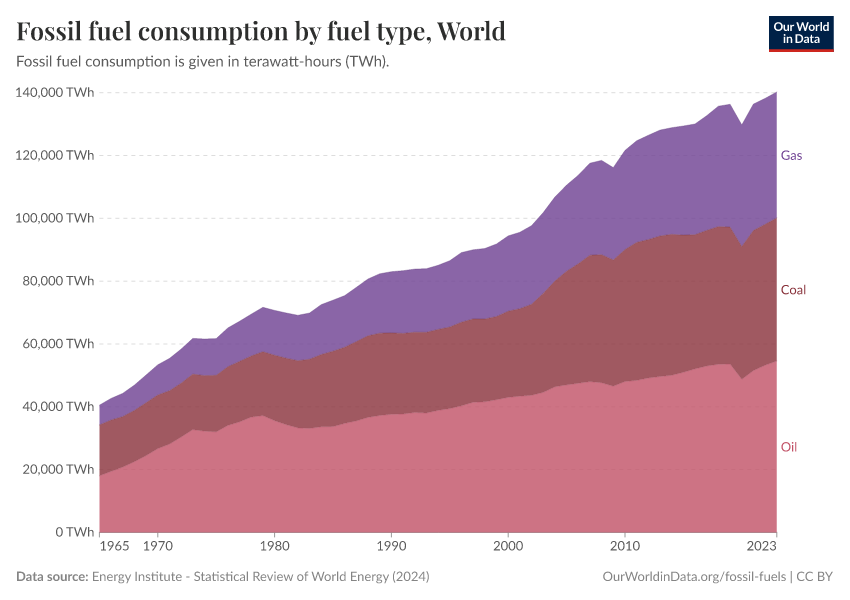
That is an incredibly large understatement. They have gotten it shamefully and fundamentally wrong year after year.
The only recent time fossil decreased was during covid, and even then it barely was a dent. To meet our climate goals we'd need something in the same vein as covid... constantly
https://ourworldindata.org/grapher/energy-consumption-by-sou...
https://ourworldindata.org/grapher/share-electricity-solar?t...
We talk more about it but in the facts nothing changes, if anything it's accelerating
It's wild how big companies, certain countries and billionaires are still holding on to nuclear fission (not fusion).
Nuclear reactors:
- take decades to build
- go massively over budget, at least 2x if not more [0]
- are inherently uneconomically: energy companies would never invest/build them on their own, only by lobbying governments for HUGE subsides (in various forms) do they get build
- inherently uninsurable: no private insurance company would insure a plant, again if private companies would need to build/run them on their own, every insurance company would deny them
- deconstructing them takes again billions and decades
- there's still no real-world solution (or even long-term secure storage) for nuclear waste in the world
---
Solar / Wind / Storage
Compare the 60 Billions for 1 single nuclear plant (UK) to what you would get from the same investment in solar (plus battery tech getting cheaper and better for storage). We are talking about differences in the magnitudes.
About the only value nuclear fission has is that's a central power source which gives the entities owning it huge power over the consumers.
[0] https://apnews.com/article/uk-nuclear-plant-hinkley-point-co...
https://ourworldindata.org/grapher/imported-or-exported-co-e...
https://commons.wikimedia.org/wiki/File:Itanium_Sales_Foreca...
So it's not the emissions that are stagnant, it's the per capita imports of emissions which are roughly flat.
They have a separate graph which reflects "consumption" based emissions:
https://ourworldindata.org/grapher/consumption-co2-per-capit...
https://climateanalytics.org/comment/will-2024-be-the-year-e...
The countries most talking about net-zero are indeed reducing their emissions. China is meanwhile trying to catch up to the standard of living of their Western counterparts, driving up emissions massively (while still having great per-capita values, there are just a lot of Chinese that previously lived on basically nothing)
> To keep global warming to no more than 1.5°C – as called for in the Paris Agreement – emissions need to be reduced by 45% by 2030 and reach net zero by 2050.
Even if we stopped right now we'd need to be back to ~2000 co2 emissions by 2030, that's in 5 years. Even if we had 5 years of covid with the same restrictions as we had in peak 2020 we wouldn't reach that point...
This model posits 97% carbon free generation in Australia with 5 hours of storage using actual real world weather data:
https://reneweconomy.com.au/a-near-100-per-cent-renewables-g...
>You can have many days or weeks
Maybe cite actual data.
>alternatives like gas peakers or perhaps nuclear.
Nuclear isnt a peaker. Or rather, it can theoretically be used as a peaker but burning literal $100 notes may be more cost effective in the long run than using it as a peaker.
Batteries and pumped storage are cost effective peakers. I find it's better when modeling renewable energy generation scenarios to try not to pretend they dont exist.
Land use is a large contributing factor to climate change but this particular image seems to be the best case scenario for large solar installation the ecosystem (marshland?) appears to be relatively undisturbed (also considering it is centrally located in a city of 4 million people solar panels or not it seems pretty lush). And I'll parrot an often cited statistic: "the entire U.S. could be powered by utility-scale solar occupying just 0.6% of the nation’s land mass" this (imo) makes a good case for solar PV as a relatively large chunk of installed grid capacity it just seems like a better compromise than the alternatives.
If utility scale battery storage ever pans out (that or UHV transmission or both) then we could see renewable sources like solar+wind actually work as base-load capacity.
Others also comment on this thread that converted agricultural land (i.e. field to pasture) meshes well with solar PV installation the plants typically do not need full sun. I would guess that a small percentage of installed solar required any kind of land shaping or clearing although it does happen [2].
[1] https://www.scientificamerican.com/article/china-invests-546...
[2] https://www.cmigroupinc.ca/solar-farm-environmental-impact-b...
I have another question then, does the planet care about "per capita" or about "total" emissions ?
Every few years they come up with the same fucking graph were the solid line goes straight up until "now" and the dotted line magically decreases in the close future and reach 0 in 50+ years, when none of us will be alive and accountable. meanwhile: https://climatanthropocene.com/wp-content/uploads/2022/12/co...
Thats the question this guy asked, using actual weather data to power his models instead of carbon industry fluff.
Unfortunately the instinctive skeptical reaction to this is not "here's an alternative model and alternative data" but "here's even more FUD".
If you look at which is growing faster you see that renewables appear to be growing faster relative to fossil fuels.
https://www.utilitydive.com/news/ustr-biden-tariff-increase-...
Solar is about to get hit with tariffs, but stockpiles give buyers opportunities - https://electrek.co/2025/04/08/solar-hit-tariffs-but-stockpi... - April 8th, 2025
Domestic supply chain looks like >>42790553 (courtesy u/jax)
> According to [1], the USA in January 2025 has almost 50GW/yr module manufacturing capacity. But to make modules you need polysilicon (25GW/yr manufacturing capacity in the US), ingots (0GW/yr), wafers (0GW/yr), and cells (0GW/yr). Hence the USA is seemingly entirely dependent on imports, probably from China which has 95%+ of the global wafer manufacturing capacity.
> Even when accounting for announced capacity expansion, the USA is currently on target to remain a very small player in the global market with announced capacity of 33GW/yr polysilicon, 13GW/yr ingots, 24GW/yr wafers, 49GW/yr cells and 83GW/yr modules (13GW/yr sovereign supply chain limitation).
> In 2024, China completed sovereign manufacturing of ~540GW of modules[2] including all precursor polysilicon, ingots, wafers and cells. China also produced and exported polysilicon, ingots, wagers and cells that were surplus to domestic demand. Many factories in China's production chain are operating at half their maximum production capacity due to global demand being less than half of global manufacturing capacity.[3]
(citations in their comment)
Global BESS deployments soared 53% in 2024 - https://www.energy-storage.news/global-bess-deployments-soar... - January 14, 2025 ("Storage installations in 2024 beat expectations with 205GWh installed globally, a staggering y-o-y increase of 53%. The grid market has once again been the driver of growth, with more than 160GWh deployed globally, of which 98% was lithium-ion.")
China’s Batteries Are Now Cheap Enough to Power Huge Shifts - https://www.bloomberg.com/news/newsletters/2024-07-09/china-... | https://archive.today/DklaA - July 9, 2024
China Already Makes as Many Batteries as the Entire World Wants - https://www.bloomberg.com/news/newsletters/2024-04-12/china-... | https://archive.today/8Dy4D - April 12, 2024
Global BESS deployments to exceed 400GWh annually by 2030, says Rystad Energy - https://www.energy-storage.news/global-bess-deployments-to-e... - June 15, 2023
Citations:
https://blog.gridstatus.io/caiso-beats-the-heat/#batteries-e...
https://english.elpais.com/economy-and-business/2024-08-25/b...
https://www.energy.ca.gov/data-reports/energy-almanac/califo...
Not that, but a "first adopter curse" AKA path dependence: https://en.m.wikipedia.org/wiki/Path_dependence
They are in operation on a number of large trucks.
[1]: https://www.carsguide.com.au/oversteer/phantograph-scania-tr...
Tom Scott video on the subject: https://www.youtube.com/watch?v=_3P_S7pL7Yg
Kurzweil 2010 https://www.youtube.com/watch?v=OYpoKYY1uy4
researchgate 2018 https://www.researchgate.net/figure/Exponential-growth-in-so...
some 2024 data https://www.linkedin.com/posts/paulfbrowning_exponential-pv-...
and on it goes at about 25% per year. That would have it covering all our needs in about 15 years.
For comparison with Hinkley C the UKs new nuclear reactor the site was selected in 2010 and the latest is "£41.6–47.9 billion in 2024 prices, with Unit 1 planned to become operational in 2029 to 2031."
Probably not, if your definition of "much further" is an increase from 30% or something.
As a data point, one Australia State uses 70% renewables, average, over a year: https://www.energymining.sa.gov.au/industry/hydrogen-and-ren... It's a mixture of wind and solar. Unlike other places that have a high percentage of renewable generation they do not have hydro of any sort.
The renewables have replaced coal and gas generation. They are at 70% because renewables were cheaper than fossil 20 years ago, because they have no coal or gas - it's all imported. The transition was purely driven by cost. The costs were higher than any other state in Australia, so they started earlier.
The most costly part right now is the remaining 30%, which is supplied by gas peakers. You can guess what might happen in the future from this: https://reneweconomy.com.au/i-could-never-find-a-business-ca... Some quotes to save you reading that link:
- “The reality is that you can’t buy a gas turbine for the next four to five years,” David Scaysbrook, the founder and co-head of Quinbrook Infrastructure Investors, one of the world’s biggest energy investors ... “They’re all sold out,” he says. And the price has also soared. “They are nearly four times the cost of what it was two years ago.”
- the rising cost of gas – it is about three times higher than it was a decade ago – has made the business case even more complicated (FYI: Australia is the worlds largest gas exporter - the problem isn't availability).
>In the first decade of the 2000s, plants were running around 70% of the time. They’re now running around 50% (https://www.sustainabilitybynumbers.com/p/china-coal-plants)
It shows solar PV as 6.91% of global electricity generation last year:
https://www.whitehouse.gov/fact-sheets/2025/04/fact-sheet-pr...
Yes, there are going to be places like Nuorgam in Finland where a population of 200 may turn out to be non-economical to put on the same suitably upgraded HVDC grid as everyone else, but they're also not getting e.g. a dedicated nuclear reactor any time soon.
Yes, that does still leave oil and gas in such places. Or would, if the oil and gas remained economical to supply internationally when the majority of users worldwide stop using it. Biofuels (e.g. wood in a fireplace) is still a thing, even if not fantastic for either health or environment. I have no idea if we're going to see other long-term chemistry-based solutions, people keep talking about ammonia but it's too far out of my knowledge to argue for or against.
[0] I'm 52° north and for the last 6 months was wearing T-shirts indoors for an average of 17 kWh per day (for everything: heating, hot water, appliances, tech) even though there were a few times I accidentally left a huge window open for hours. It's very well insulated and has a heat pump.
[1] Longer days closer to the equator. North tip of Lapland has 52 days without sunrise in winter[2], but it's just a question of "how much money and what's the cheaper alternative" for a grid connection that ultimately ends up in the Sahara where the winter solstice day length is 10 hours[3].
[2] https://www.finavia.fi/en/newsroom/2023/what-polar-night-exp...
[3] https://www.wolframalpha.com/input?i=Tataouine+sunrise+21+De...
Transmission losses are subject to engineering, and can be as low as you're willing to spend money to get them — as in, if the world all suddenly (magically and unrealistically) decided to be friends, you could put a girdle around the world with only 1 Ω resistance using existing manufacturing capacity[2].
[0] https://www.wolframalpha.com/input?i=Tarifa+Spain+sunrise+21...
[1] https://www.finavia.fi/en/newsroom/2023/what-polar-night-exp...
[2] ~ 12 months global aluminium production, but you could do it
US freight railroads used to carry a larger variety of goods and serve a larger variety of customers than they do today. They were never in the business of delivering finished goods directly to retail stores, but they did transport a large amount of single-carload and less-than-carload deliveries between factories and warehouses. This is why if you visit older industrial areas you will see train tracks everywhere, including in the middle of the street and sometimes directly into buildings.
When the trucking industry was deregulated in 1980, trucking companies undercut railroads on low-volume high-profit routes, leaving the railroads to focus on low-value bulk goods like coal. The total volume of freight actually went up, but both revenue per unit and gross revenue fell. The railroads struggled to justify the cost of maintenance on now less busy lines, so they abandoned many of them and neglected the maintenance on others. That made it impossible to win back the lost business from the trucking industry even as the cost of trucking skyrocketed. Everyone is now worse off except for the owners of the trucking companies.
As for Switzerland, they invented a special kind of shipping container and that can be loaded/unloaded from a train or truck with no need for a crane. This allows them to make carload and intermodal deliveries without building any new infrastructure.