zlacker

Only 7k Miles? EV Owners Not Happy About Tires Not Lasting Long

submitted by LinuxB+(OP) on 2024-01-27 21:00:27 | 23 points 59 comments
[view article] [source] [go to bottom]

NOTE: showing posts with links only show all posts
◧◩◪
20. mschus+Y6[view] [source] [discussion] 2024-01-27 21:51:47
>>TheCha+A4
I wouldn't be surprised if they drive something like a Honda Goldwing - the undisputed Big Chungus of the motorcycle world, clocking in at up to 800 pounds [1].

[1] https://de.wikipedia.org/wiki/Honda_Gold_Wing

◧◩◪
21. buran7+27[view] [source] [discussion] 2024-01-27 21:52:02
>>reacto+G4
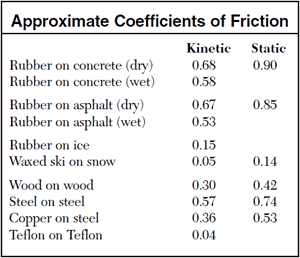
In motion the friction coefficient of rubber on asphalt (0.67) is not that far off from steel on steel (0.57) according to the internet [0]. That orders of magnitude difference in braking distance is more a result of train cars weighing 30-80t.

This comment does feel like talking to ChatGPT though, with the detailed clarifications the discussion didn't really require.

[0] https://www.aplusphysics.com/courses/honors/dynamics/images/...

◧◩◪◨
36. reacto+Qc[view] [source] [discussion] 2024-01-27 22:33:59
>>buran7+27
Ouch, yeah - no GPT. I was saying that the rubber wear is a result of the above. Trains take a long time to stop because of their weight and lower friction on the rails. On trains it’s 0.35-0.5 not 0.57 [0]

[0] https://en.m.wikipedia.org/wiki/Adhesion_railway

◧◩◪◨⬒
41. buran7+Qh[view] [source] [discussion] 2024-01-27 23:22:29
>>rightb+Bd
> You can brake with more than 0.67 g.

Of course you can but we're not talking about G-forces. That's a coefficient of friction [0], a dimensionless measure. It's determined empirically literally by rubbing things together and is then used to calculate the friction force between different materials.

[0] https://en.wikipedia.org/wiki/Friction#Coefficient_of_fricti...

◧◩◪◨⬒⬓
42. bonzin+Zh[view] [source] [discussion] 2024-01-27 23:23:24
>>buran7+Fd
Right, in the wheels locked scenario the dynamic coefficient is the one that matters, it's smaller than the static coefficient and that leads to a longer braking distance.

For a rolling wheel however, the stationary object is ideally just a point of the wheel, trying to move against the surface; but as soon as the wheel wins against the surface, the point rotates away and a new point tries to move against the surface. Even in the less ideal case a point of the tire always touches the same point of the asphalt from the moment it touches the ground to the moment it leaves it. So in that case you use the static coefficient.

For a more visual explanation see https://youtu.be/J0PVm4XTGeY?si=20TygSRdH3UxIx_4

◧◩◪◨⬒
44. sokolo+Yk[view] [source] [discussion] 2024-01-27 23:54:54
>>bonzin+7b
> Wheels work so that from the point of view of the wheel the asphalt is still

In order to create a longitudinal force, the tire must have non-zero slippage. It’s not large (for typical mild driving), but it’s not zero if you’re using the tire to accelerate or decelerate the car.

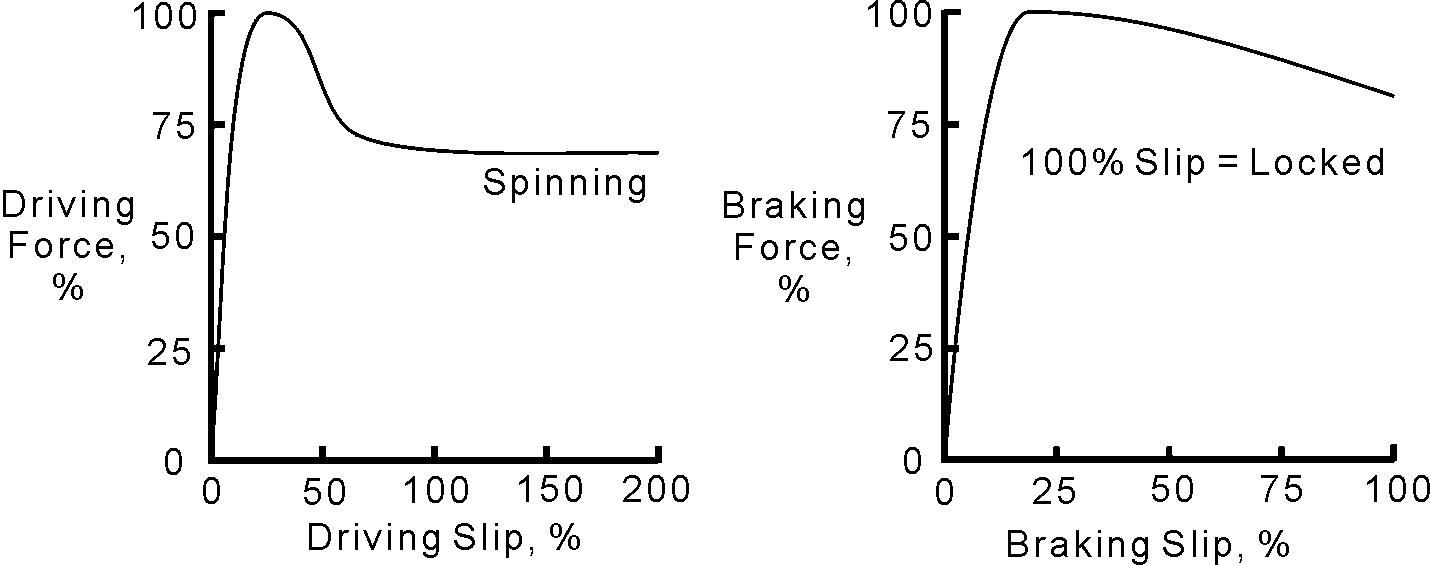
Max acceleration forces are found around 10% slip ratio.

http://www.insideracingtechnology.com/Resources/bhvrdrvbrksl...

◧◩◪◨⬒
56. defros+lb1[view] [source] [discussion] 2024-01-28 10:39:52
>>vr46+ya1
Here's a fun bit of local touring for you: https://www.youtube.com/watch?v=uL44EAyz8Qc

re: tyres and lifespan- https://youtu.be/XRATedP6SGw?t=571
[go to top]