I don't see any reason why thing must be different this time. Human demands are still infinite, while productivity is still limited (and btw meeting limited productivity with infinite demans is what economic is about). So no increase in productivity will make humans stop wanting more and close opportunities for new markets.
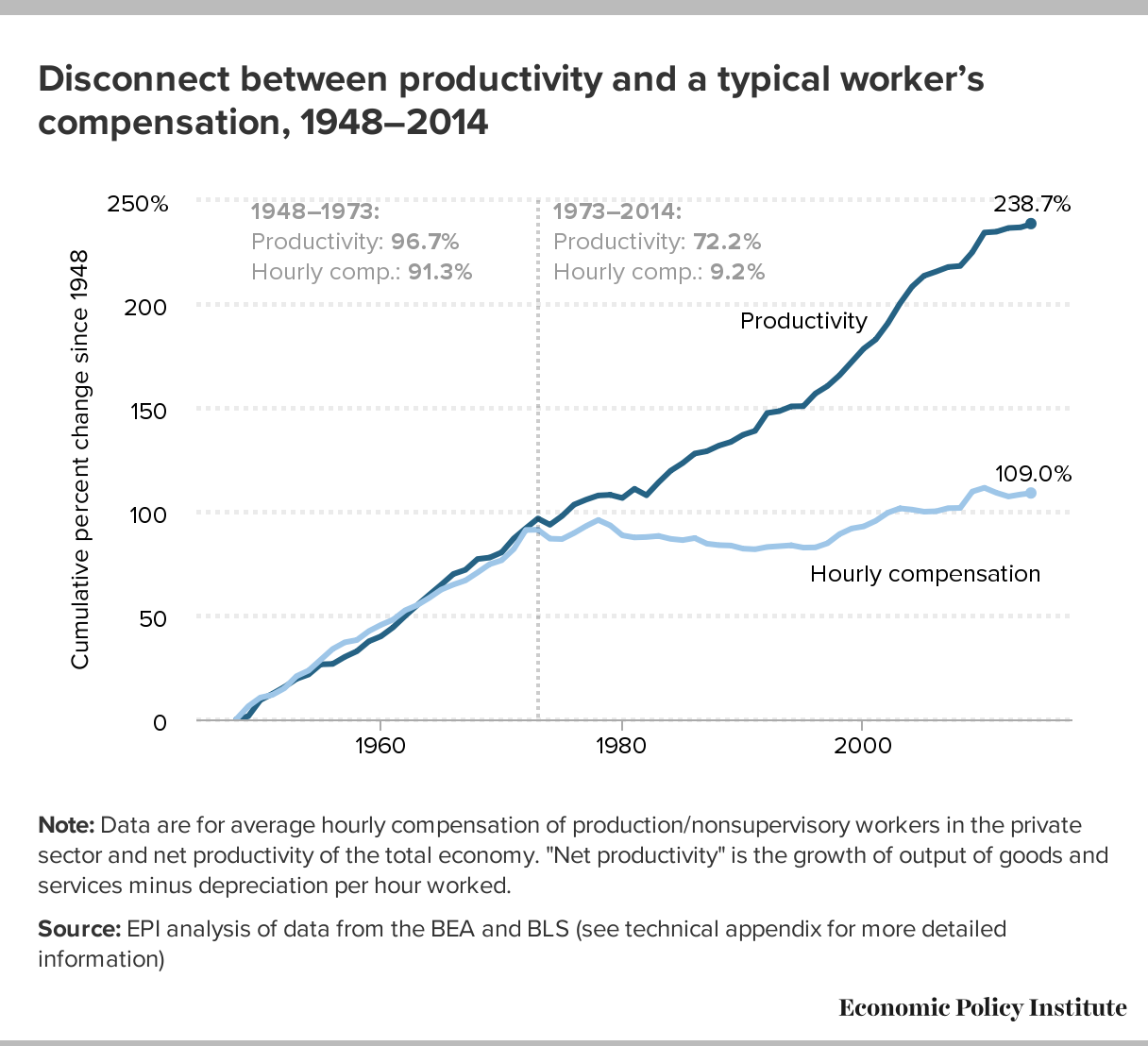
> Modern automation has seen productivity and wages begin to decouple.
Could you provide any sources on this topic? This is a new information for me here.
The difference is that AGI isn't a static tool. If some constraint is a limiting factor to economic activity, inventing a tool to eliminate the constraint uncorks new kinds of economic potential and the real economy expands to exploit new opportunities. But such tools historically were narrowly focused and so the new space of economic opportunity is left for human labor to engage with. AGI breaks this trend. Any knowledge work can in principle be captured by AGI. There is nothing "beyond" the function of AGI for human labor en mass to engage productively with.
To be clear, my point in the parent was from extrapolating current trends to a near-term (10-20 years) proto AGI. LLMs as they currently stand certainly won't put 90% of people out of work. But it is severely short-sighted to refuse to consider the trends and where the increasing sophistication of generalist AIs (not necessarily AGI) are taking society.
>Could you provide any sources on this topic? This is a new information for me here.
Graph: https://files.epi.org/charts/img/91494-9265.png
Source: https://www.epi.org/publication/understanding-the-historic-d...