That being said, the app is stuck at the launch screen, with "Loading projects..." taking forever...
Edit: A lot of links to documentation aren't working yet. E.g.: https://developers.openai.com/codex/guides/environments. My current setup involves having a bunch of different environments in their own VMs using Tart and using VS Code Remote for each of them. I'm not married to that setup, but I'm curious how it handles multiple environments.
Edit 2: Link is working now. Looks like I might have to tweak my setup to have port offsets instead of running VMs.
Begs the question if Anthropic will follow up with a first-class Claude Code "multi agent" (git worktree) app themselves.
Is it in the main Codex build? There doesn’t seem to be an experiment for it.
I ended up building a terminal[0] with Tauri and xterm that works exactly how I want.
0 - screenshot: https://x.com/thisritchie/status/2016861571897606504?s=20
[0]: http://theoryofconstraints.blogspot.com/2007/06/toc-stories-...
[1] https://firebase.google.com/docs/ai-assistance/mcp-server
I keep coming back to my basic terminal with tmux running multiple sessions. I recently though forked this https://github.com/tiann/hapi and been loving using tailscale to expose my setup on my mobile device for convenience (plus the voice input there)
A full fledged app, that does everything I want, is ~ 10MB. I know Tauri+Rust can get it to probably 1 MB. But it is a far cry from these Electron based apps shipping 140MB+ . My app at 10MB does a lot more, has tons of screens.
Yes, it can be vibe coded and it is especially not an excuse these days.
Microsoft Teams, Outlook, Slack, Spotify? Cursor? VsCode? I have like 10 copies of Chrome in my machine!
https://hyperengineering.bottlenecklabs.com/p/the-infinite-m...
Edit: I'm not going to keep addressing your comment if you keep editing it. You asked for an example & I found two very easily. I am certain there are many others so at this point the onus is on you to figure out what exactly it is you are actually arguing.
You don't need to use microsoft's or apple's or google's shit UI frameworks. E.g. see https://filepilot.tech/
You can just write all the rendering yourself using metal/gl/dx. if you didn't want to write the rendering yourself there are plenty of libraries like skia, flutter's renderer, nanovg, etc
I insist on good UI as well, and, as a web developer, have spent many hours hand rolling web components that use <canvas>. The most complicated one is a spreadsheet/data grid component that can handle millions of rows, basically a reproduction of Google Sheets tailored to my app's needs. I insist on not bloating the front-end package with a whole graph of dependencies. I enjoy my NIH syndrome. So I know quality when I see it (File Pilot). But I also know how tedious reinventing the wheel is, and there are certain corners that I regularly cut. For example there's no way a blind user could use my spreadsheet-based web app (https://github.com/glideapps/glide-data-grid is better than me in this aspect, but there's no way I'm bringing in a million dependencies just to use someone else's attempt to reinvent the wheel and get stuck with all of their compromises).
The answer to your original question about why these billion dollar companies don't create artisanal software is pretty straightforward and bleak, I imagine. But there are a few actually good reasons not to take the artisanal path.
That's only for Windows though, it seems? Maybe the whole "just write all the rendering yourself using metal/gl/dx" is slightly harder than you think.
[1] https://survey.stackoverflow.co/2025/technology/#1-computer-...
https://github.com/jgbrwn/vibebin
Although I would need it to listen on 0.0.0.0 instead of localhost because I use LXC containers so caddy on the host proxies to the container 10.x address. Hopefully yep has a startup flag for that. I saw that you can specify the port but didn't see listening address mentioned.
00: Iterate on requirements with ChatGPT outside of the IDE. Save as a markdown requirements doc in the repo
01: Inside the IDE; Analysis of current codebase based on the scope of the requirements
02: Based on 00 and 01, write the implementation plan. Implement the plan
03: Verification of implementation coverage and testing
04: Implementation summary
05: Manual QA based on generated doc
06: Update global STATE.md and DECISIONS.md that documents the app, and the what and why of every requirement
Every stage has a single .md as output and after the stage is finished the doc is locked. Every stage takes the previous stages' docs as input.
I have a half-finished draft with more details and a benchmark (need to re-run it since a missing dependency interrupted the runs)
https://dilemmaworks.com/implementing-recursive-language-mod...
https://openrouter.ai/moonshotai/kimi-k2.5
It's a fantasy to believe that every single one of these 8 providers is serving at incredibly subsidized dumping prices 50% below cost and once that runs out suddenly you'll pay double for 1M of tokens for this model. It's incredibly competitive with Sonnet 4.5 for coding at 20% of the token price.
I encourage you to become more familiar with the market and stop overextrapolating purely based on rumored OpenAI numbers.
Saying gpt-3.5-turbo is better than gpt-5.2 makes me think something you got some of them hidden motives.
https://code.claude.com/docs/en/common-workflows#use-extende...
That’s actually why we're working on Slint (https://slint.dev): It's a cross-platform native UI toolkit where the UI layer is decoupled from the application language, so you can use Rust, JavaScript, Python, etc. for the logic depending on what fits the project better.
It's weird that we don't have a unified "React Native Desktop" that would build upon the react-native-windows package and add similar backends for MacOS and Linux. That way we could be building native apps while keeping the stuff developers like from React.
What I didn't realize though, is that the limit doesn't reset each 5 hours as is the case for claude. I hit the limit of the free tier about 2 hours in, and while I was expecting to be able to continue later today, it alerts me that I can continue in a week.
So my hype for the amount of tokens one gets compared to claude was a bit too eager. Hitting the limit and having to wait a week probably means that we get a comparable token amount vs the $20 claude plan. I wonder how much more I'd get when buying the $20 plus package. The pricing page doesn't make that clear (since there was no free plan before yesterday I guess): https://developers.openai.com/codex/pricing/
https://openai.com/index/unrolling-the-codex-agent-loop/ https://platform.openai.com/docs/guides/conversation-state#c...
Context management is the new frontier for these labs.
[1] https://www.qt.io/blog/speed-up-qt-development-with-qml-hot-...
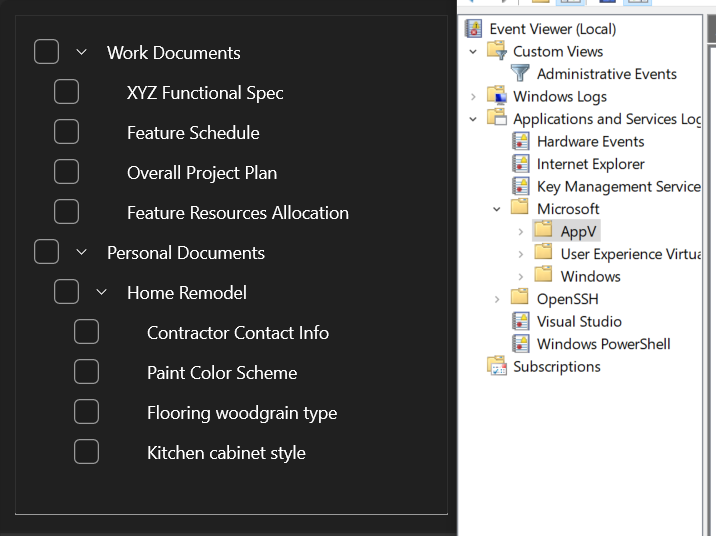
Just look at this TreeView in WinUI2 (w/ fluent design) vs a TreeView in the good old event viewer. It just wastes SO MUCH space!
https://f003.backblazeb2.com/file/sharexxx/ShareX/2026/02/mm...
And imo it's just so much easier to write a webapp, than fiddle with WinUI. Of course you can still build on MFC or Win32, but meh.
React Native Skia allegedly runs on Linux too