https://www.toonamiaftermath.com/schedule
You can also get it running in Plex (requires Plex pass) with these two projects:
http://users.wfu.edu/matthews/misc/dipole.html https://www.w9dup.org/technet_files/folded_dipoles_vhf_uhf_y...
Recording ~5 hours of television a night would have been a trivial cost for a network like NBC. Particularly compared to the licensing fees those hours would have had.
- Married with Children
- The Simpsons
- Fresh Prince of Bel Air
- SNL
- Airwolf
- Knight Rider
- The A-Team
It doesn't recreate standing and pointing in just right pose adjusting rabbit ears. They were impossible to tune them because touching them changes their parameters greatly. Some people put aluminum foil balls on the ends.
Many older TVs supported NTSC UHF (OTA) channels up to 83 and beyond, but the maximum channel was 69 because 70–83 were reallocated in 1983.
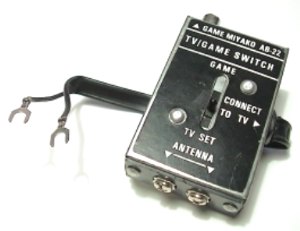
To hookup a Nintendo or Atari (NTSC) to an older TV, a box like this would be needed to switch between the console and the OTA antenna.[0] Some of them included an additional switch to select either channels 2 or 3. In the transition to coax, sometimes they would have or need a push on matching transformer to work with newer TVs. Nintendo released (included?) a coax-only auto switch.
0. https://www.vintagecomputing.com/wp-content/tvswitch_2_large...
https://upload.wikimedia.org/wikipedia/commons/c/cc/VHF_Usag...
I used to watch regularly -- funny how I remembered the names of Colin Quinn and Kari Wuhrer, but couldn't remember the host's name without looking it up.
It doesn't quite show static the way the website does, but it's also not exactly what I'd call "near instantaneous."
https://my10stv better known as Youtube.com
https://my20stv better known as TikTok.com
There is no https://my40stv but there should be.
I think that effect might be exaggerated because he's tuning across several channels in one turn (e.g. https://youtu.be/ahtRI-_A1j8?t=88) and those channels would be full of static. The device he's showing apparently spaces out its transmissions 4 channels apart.
What I meant by "near instantaneous" was that the delays were short enough that I don't recall registering them as "I'm waiting for this," and when started I using digital TVs I registered the channel-switch speed as a noticeable and annoying regression.
I guess my point is the simulation has a digitally-slow pause with static, which seems like anachronism with a coat of retro-colored paint. I may have overstated things, because I mainly watched TV after the dial era (and the 90s were definitely after the dial era).
The "schedule" is JSON, so it was easy enough to write a web page that parses today's schedule and presents it TV-Guide style: https://engineersneedart.com/UHF/
(Gaps in airtime are filled with shorts of various kinds.)
It spans the vhs era, curated by hand to flip through different oddities and ephemera.
No tracking, no algorithms, just a stream of fun wierdness. It even has a TV guide type thing so you can pick when to tune in.
Loving this project btw, so much nostalgia
https://en.m.wikipedia.org/wiki/Video_recorder_scheduling_co...
If you message me privately I'd be happy to share the data. The git repos are:
https://github.com/patsmad/nyt-listings https://github.com/patsmad/nyt-listings-app
I use them for curation at the moment so the READMEs leave ... something to be desired. I hope by the end of August to have a read-only version up and running, although without a wikipedia-like effort I don't see how I would curate it fully so it'll probably always be a little touch and go as to what data is available.
The stats I have from curating are: 369345 individual movie "listing boxes" (I would guess around 98% accuracy, although if I were to field a guess the actual number there should be is probably 400K) of which 321308 are matched to a movie, and 296941 of those are for sure unique. And overall 202203 have channel + time + duration matched up using the VCR listings (which the New York Times conveniently published from around November 20th 1990, and the internet archive very nicely has the program the VCRs used to encode/decode those codes). There are 21530 unique movies at the moment.
If I understand the New York Times correctly, then none of this can be commercialized since I scraped the core data (the pages themselves) from the TimesMachine, so this really is a personal project, which I'm happy to share. I've made a few Letterboxd lists from the corresponding data, for example a series of lists with all of the movies (and play times) for films playing on September 1 in particular e.g. https://letterboxd.com/patsmad/list/television-films-septemb... It is rather consistent, around 100 films a day, for 1990-1999 it was 106, 118, 74, 74, 89, 99, 98, 110, 97, 93. As is obvious I can talk about this for days.
I'm not sure the best way to do private messages, my email is associated with this account, but I have no idea if you can see that. I usually just lurk on HN.
https://www.encyclopedia.com/history/culture-magazines/1940s... https://duckduckgo.com/?t=ffab&q=broadcast+television+in+the...
There is at least 100 different films from every year from 1931 to 1999 it looks like (obviously many more from the 80s and 90s). But even just considering that, that's 7K as an absolute minimum. With straight-to-video and TV films the 90s peaked with ~850 unique films from 1995 alone playing on television. And to just give an idea of the level of obscurity, the median IMDb vote count for 1995 is 500, so half are on the level of something like https://www.imdb.com/title/tt0122968/ (which yes, played 7 times, mostly on TMC in March of 1996). Also once you get very obscure things get all muddled. Like with https://www.imdb.com/title/tt0112363/ which is marked as 1995 but certainly appears to have played once on television in 1991 so IMDb is wrong in this case. And of course there are a number of mistakes due to titles matching which I'm slowly correcting.
There are some caveats. This guy: https://www.imdb.com/title/tt0222755/, played 6 times, but on channel 41 (which at the time was Spanish language maybe?), so it has 0 votes on IMDb, but played 6 times on television, which is odd but not unheard of. But you do have to consider that this is using a slightly larger range of channels (some specific to the New York region, like CUNY and MSG) than one might expect. I would guess though that maybe 40% of films play on TCM, SHO, MAX, or HBO ultimately though. Most channels didn't play movies ever outside of primetime.