https://www.youtube.com/watch?v=fHsa9DqmId8 for his theory.
Can you explain with more details?
I use Youtube as a crowdsourced "MOOC"[0] and the algorithms usually recommended excellent followup videos for most topics.
(On the other hand, their attempt at matching "relevant" advertising to the video is often terrible. (E.g. Sephora makeup videos for women shown to male-dominated audience of audiophile gear.) Leaving aside the weird ads, the algorithm works very well for educational vids that interests me.)
[0] https://en.wikipedia.org/wiki/Massive_open_online_course
Yes, I was aware of Elsagate.[0] I don't play games so didn't realize every gaming video ends up with unwanted far-right and Ben Shapiro videos.
I guess I should have clarified my question. I thought gp's "unhealthy" meant Youtube's algorithm was bad for somebody like me that views mainstream non-controversial videos. (Analogy might be gp (rspeer) warning me that abestos and lead paint is actually cancerous but public doesn't know it.)
[1] https://www.quora.com/How-many-videos-are-uploaded-on-YouTub...
https://news.ycombinator.com/newsguidelines.html
There's a vast history about this for anyone who wants more explanation: https://hn.algolia.com/?sort=byDate&dateRange=all&type=comme...
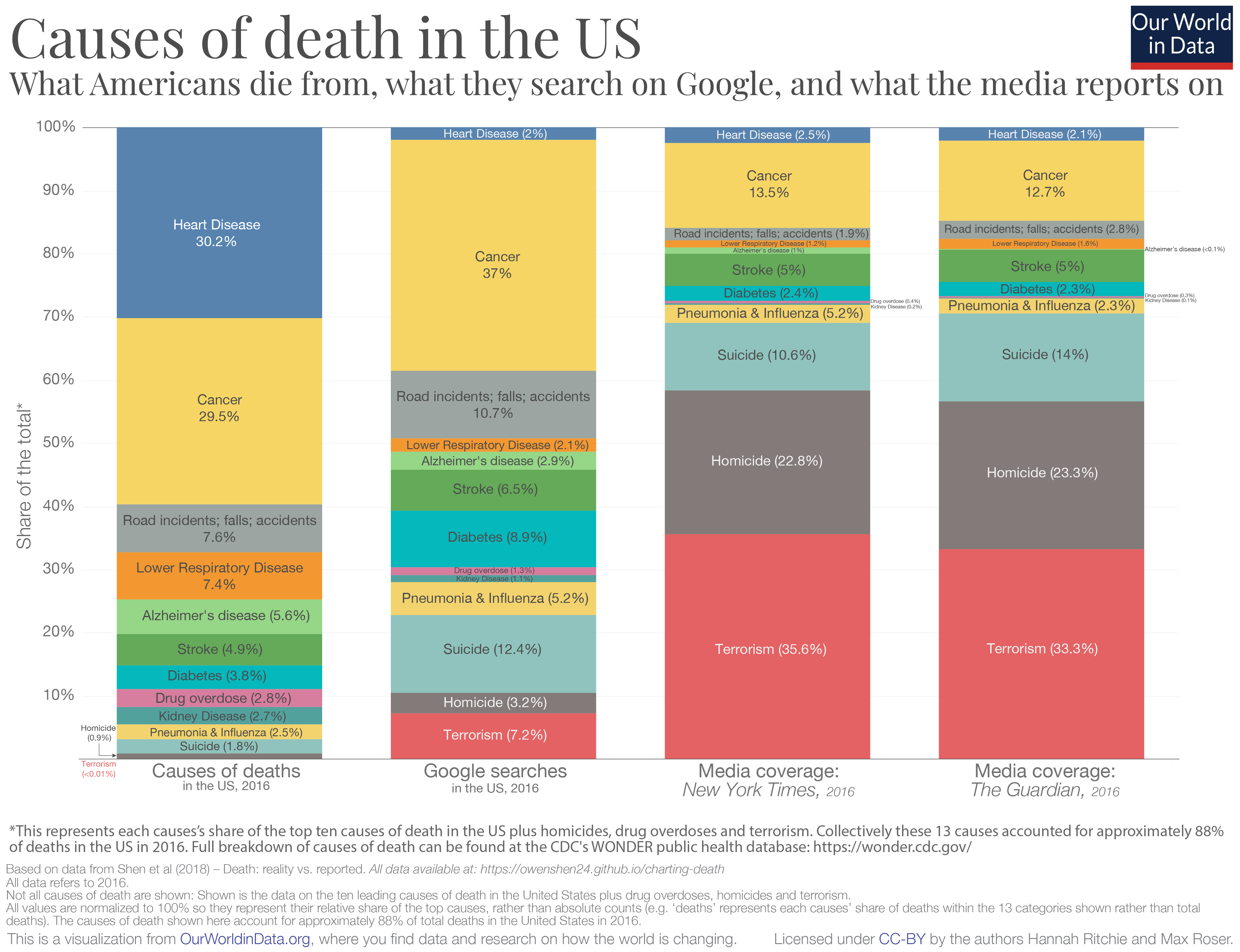
Data: https://ourworldindata.org/uploads/2019/05/Causes-of-death-i...
This isn't a knock against the NYTimes so much as it is of humanity, we're all fascinated by the lurid and sensational (note that the Google searches are similarly off) and this permeates all levels of life.
Just start banning certain creators from showing up in recommendations if their content crosses the line. Not that hard if you are willing to do it.
Subject to the laws of the jurisdiction in which it operates, of course. We could - if we so wanted - pass laws to regulate this behavior. That is perhaps the best option, in my own opinion.
> It's a product from a publicly traded company, therefore it "must" return value for stockholders.
The dogma that it "must" return value for shareholders is not an absolute rule[1]; rather it's a set of market expectations and some decisions from Delaware (which have an outsize impact on business law) that encourage it. But it's not required. In fact, many states allow a type of corporation that specifically and directly allows directors to pursue non-shareholder-value goals - the benefit corporation[2].
> The author is out of touch with reality.
Please re-read the HN guidelines[3].
> Stop feeding your kids youtube if you don't want them exposed to youtube. It's a private service(youtube), not a public park.
This is the doctrine of "caveat emptor," essentially - that a consumer is ultimately responsible for all behavior. However, a wealth of regulation exists because that's unworkable in practice. The FDA and the EPA come to mind, but we also regulate concepts like "false advertising." Your stance here ignores the realities of life in service of ideological purism.
[1] http://web.archive.org/web/20190327123200/https://www.washin...
We already have them, yet FB, IG, Twitter, YT are the social media behemoths.
Are you making a plea for the average internet person to care about the values of the platforms they use over the platform content? You are likely preaching to the choir here on HN, but I would guess that the audience here is only 1% of 1% of the audience you need to message.
Corps make good use of psychological experiments to optimize their utility function. "Evil is efficient." The problem is that companies optimize for money without taking into account any other factor in any significant way.
> In 1970, Nobel Prize–winning economist Milton Friedman published an essay in The New York Times Magazine titled “The Social Responsibility of Business Is to Increase Its Profits.” [1]
Arguably this quote incentivized the destruction of "good corporate citizenship" (although I admit it's possible that concept never existed in a broad sense).
[1] https://www.newsweek.com/2017/04/14/harvard-business-school-...
I'm glad you have a sense of the culture HN is trying to cultivate. Even getting just that across is astonishingly hard. By far the likeliest default is that nobody has any sense of it.
Does it fall short? Sure. The question is how much is possible on the internet—specifically on a large, public, optionally-anonymous internet forum, the bucket HN falls in. We're happy to do our utmost, but only along the axis of the possible. We can't come close to delivering everything people imagine and demand. Your comment doesn't allow for the constraints we're up against, how few degrees of freedom we have, or how close we come to getting crushed between the gears.
HN is a large enough population sample (5M readers a month) that it is divided wherever society is divided. That means you're inevitably going to see posts which represent the worst of society relative to your own views. Societies, actually, because whether you doubt it or not, HN is a highly international site. People post here relative to their respective local norms, but mostly in mutual ignorance of that fact. This accentuates how bad the worst posts seem.
So yes you see awful posts, but it doesn't follow that they're representative either of the community or the culture. Jumping to that conclusion is an error nearly everyone makes, because painful impressions (such as nasty comments) are vastly more memorable than pleasurable ones (such as sensible comments). This has been studied and there's a name for it: https://en.wikipedia.org/wiki/Hostile_media_effect. The phenomenon was established about news coverage (https://www.oxfordhandbooks.com/view/10.1093/oxfordhb/978019...), but internet comments are no different.
What are these "other sites and circles" you mention that do so much better culturally than HN does? Are they public forums where anybody can create an account? Are they optionally anonymous? How large are they? In other words, do they face the same problems that we do? If so, and they're better than we are at solving them, please point us there so we can learn from them. Nothing would make me happier. Usually, though, when people make this claim, they're talking about much smaller communities and/or ones that are not fully open.
https://www.newstatesman.com/science-tech/social-media/2019/...
Telephone service providers were monopolies, sometimes government monopolies. There was only one type of telephone you could use, and that was supplied by that same monopoly. It was illegal to attach anything else to the line either directly or indirectly. There were even (outside the US) laws on what you could say when talking on the phone.
Here's an article from 1994 about a modem maker who had products that were not officially licensed to connect to the network. https://www.newscientist.com/article/mg14219263-000-technolo...
https://www.theverge.com/2019/2/11/18220032/youtube-copystri...
https://redwoodbark.org/46876/culture/redwood-students-view-...
2019:
In response, the principal of the high school sent a note to students and parents Thursday night regarding the "hate-based video and text posts attributed to one of our students":
https://www.kron4.com/news/bay-area/bay-area-girl-says-she-l...
https://idioms.thefreedictionary.com/fast+talker
https://www.logicallyfallacious.com/tools/lp/Bo/LogicalFalla...
Cf: fast and loose:
https://idioms.thefreedictionary.com/play+fast+and+loose+wit...
The idea that large public internet forums inevitably degrade has been the default understanding of internet forums since before PG started HN—in fact he started HN as an experiment in escaping that fate (https://news.ycombinator.com/newswelcome.html). So another way of putting this is that you think HN's experiment has failed. That's fine, but I cling to a different view for the time being; out of cognitive dissonance if nothing else, since I spend days and nights working on it.
The guideline about flagging egregious comments is there to prevent obviously awful comments from generating off-topic, repetitive flamewars. If a comment like that is flagged and downvoted, that is challenging it. It means the community has rejected it. Better still, it minimizes its influence by stopping it at the root. Responding by pouring fuel on the flames is what causes it to expand and grow. Since you refer to not feeding trolls, you obviously know this. Beyond that, I'd have to see specific examples.
Since I don't know what semi-private controlled forums you're referring to and can't look at the criticisms of HN people are making there, it's impossible for me to evaluate them. That's a pity, because we might be missing opportunities for improvement. But the fact that they're starkly negative doesn't say much by itself. Smaller communities always have a negative view of larger communities—that's how community identity gets created. And cohesive communities always have a negative view of non-cohesive communities, because divisive topics inevitably produce responses that fall outside their acceptable spectrum. Sharing an acceptable spectrum is part of what makes a community cohesive. We don't have that on HN, certainly as a function of size, and probably also for other reasons.
And to call back to my original examples: The Katie Bouman thread(s) [1] [2] and the Women: Learn To Program [3] threads should give you quite a lot of pause. The fact that such benign incidents resulted in large flamewars is specifically an issue because it indicates a greater rot growing inside HN's culture.
There's obviously more examples (such as anything politically related almost immediately devolving into flamewars or whataboutism) which indicates that the mission statement simply isn't working. And the greater problem of flagging only works if the community as a whole agrees in a positive direction; if suddenly tomorrow HN was filled with people who held highly negative beliefs, then the flagging system fails.
When I look at other forums such as SomethingAwful, Penny Arcade etc I see them as surviving because they have much stronger moderation while maintaining a sustainable community size. And right now I don't see HN outlasting either of those communities. Without some sort of cohesion guiding the community, the end result is that the site will eventually be pulled away from its original purpose.
To sum up what I think would be necessary:
1. Long time contributors would need to be emphasized more. Especially the high quality contributors, because they serve as a way of keeping a community united.
2. The mission statement of HN needs to be less vague and more to the point. Keep a focus solely on things that happen with the tech community and issuing harsher but smaller punishments to people that cause issues. You issued a warning to me a while ago because I was being an ass, and on other sites a warning like that would've resulted in a harsher punishment like a temporary probation.
3. Politics is inescapable as was found out during the 'political detox' week. But other forums can help moderate and control political debates and inflammation by keeping them solely inline with the site's mission statement (ie: a gaming site focuses on politics as it relates to games).
That said, implementing a lot of this might be almost impossible at this point because people would decry censorship almost immediately, resulting in a large reactionary wave. Which unfortunately I think also says a lot about the overall lassiez-faire moderation style HN employs for everything but the most egregious and repeat of offenses.
[1] https://news.ycombinator.com/item?id=19632086