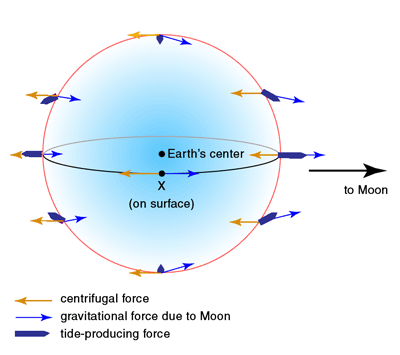
Intuitively you would think that the tide is being formed because the Moon is "lifting up" the water at the point closest to the Moon. But this contribution is actually very miniscule to the tidal effect. Instead the bulk of the tides are produced about 45 degrees away where the tidal force is parallel to the Earth's surface. This has the effect of dragging the water closer to the tidal bulge.
In particular, I could understand how two satellites connected by a cable would result in the cable being stretched. But I still find it hard to wrap my mind around the fact that we get a high tide where the Earth's gravity and the Moon's add (the far side of the Earth from the Moon), but we also get a high tide on the opposite side, where the Moon's gravitational pull is subtracted from the Earth's. The centrifugal force is (I think) a much better explanation. (I realize physicists don't consider that a force, but...)
So yes, tides really are weirder than I think.
(The other facts in the article were actually familiar, e.g. the fact that the tides in Hawaii are quite small, because it's not far from an amphidromic point.)
The near part of Earth experiences more gravity from the Moon, the far part less. The Earth moves in the center so the water bulges on the ends. Important part is that the Earth pulls things out their natural orbits.
With circular orbits, gravity and centrifugal force are balanced so could be considered difference on centrifugal force. But that isn't true for all orbits.
Water -- Ground -- Water
Now let's add a Moon with gravitational pull. The pull stretches the system, because gravity is stronger the closer you are to the Moon.
Water ---- Ground ---- Water -//- Moon
The water is farther away from the ground on both sides now, since both sides stretched.